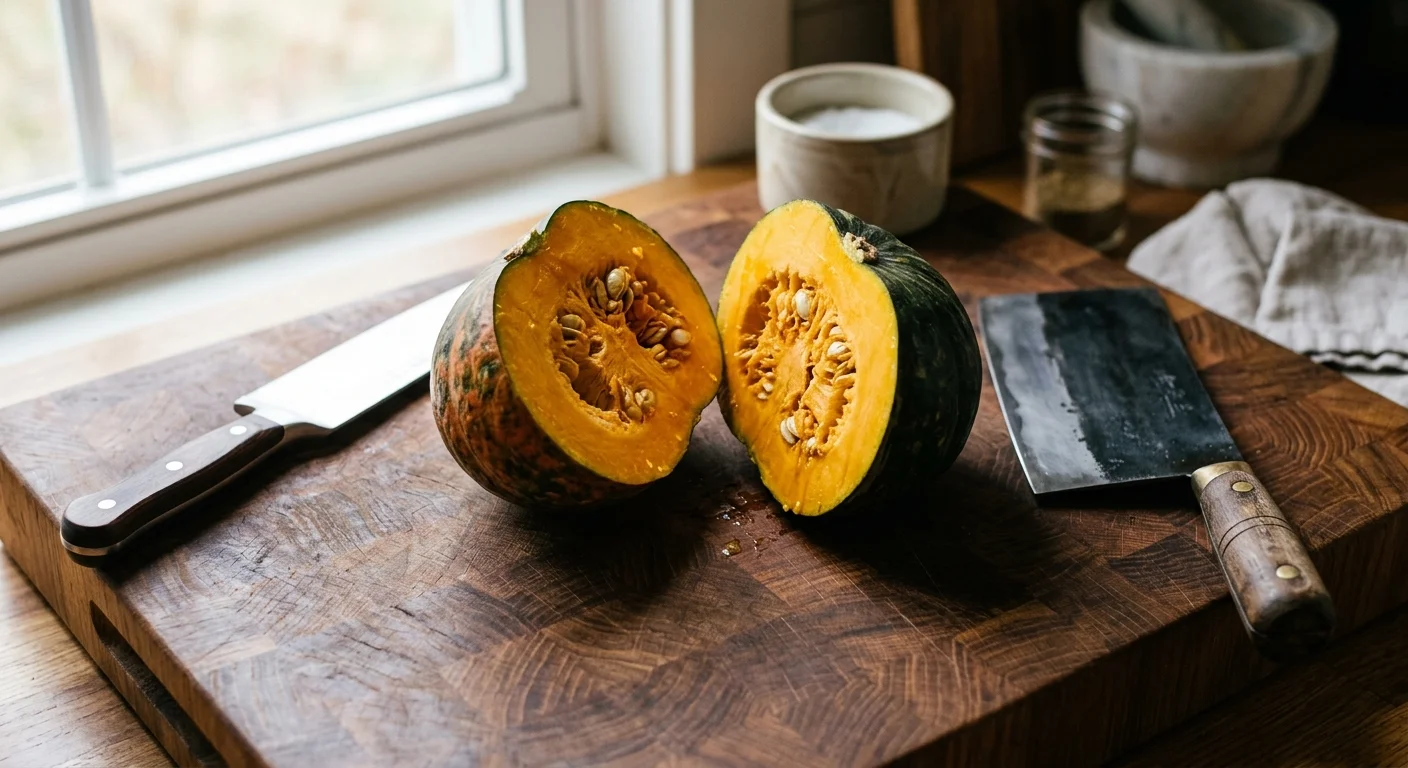
Splitting raw butternut or kabocha squash often traps your blade halfway down, leaving you wrestling with an immobilized edge and risking a severe slip injury. You can conquer these dense vegetables smoothly once you understand blade geometry.
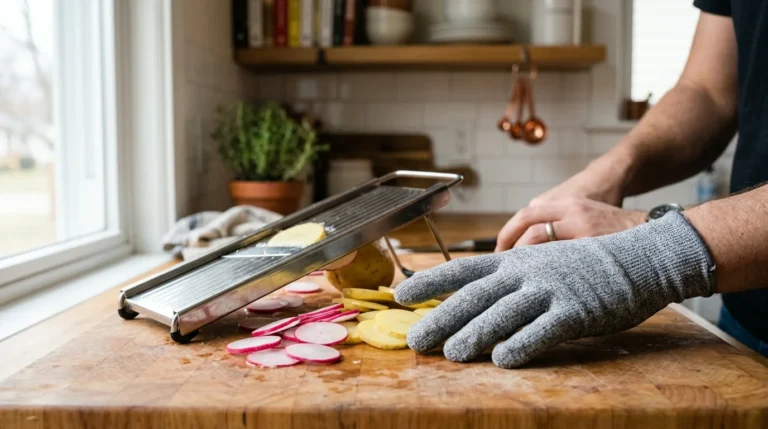
Wearing Kevlar cut gloves offers reliable hand defense in case a blade slips off a tough, rounded rind.
Dangerous kitchen slips do not stem from dull steel, but from lateral blade binding when thin knife profiles compress inside dense, low-moisture squash flesh. Most home cooks mistakenly blame their edge sharpness rather than physical blade taper.
Choosing between an eight-inch chef’s knife and a heavy Chinese vegetable cleaver requires analyzing spine thickness, bevel taper, and rotational torque to ensure total blade control throughout the downward cut.
The Physics of Blade Binding in Dense Squash
Winter squashes like butternut, acorn, and kabocha feature a structural matrix of tightly packed cellulose fibers. Because their water content is remarkably low, the dense flesh does not yield easily to an incoming blade.
Although some cooks reach for serrated bread knives to saw into stubborn exteriors, the tooth profile quickly binds once embedded in dense pulp.
Shaving off tough outer rinds beforehand with the right vegetable peeler can noticeably decrease entry resistance for your blade.
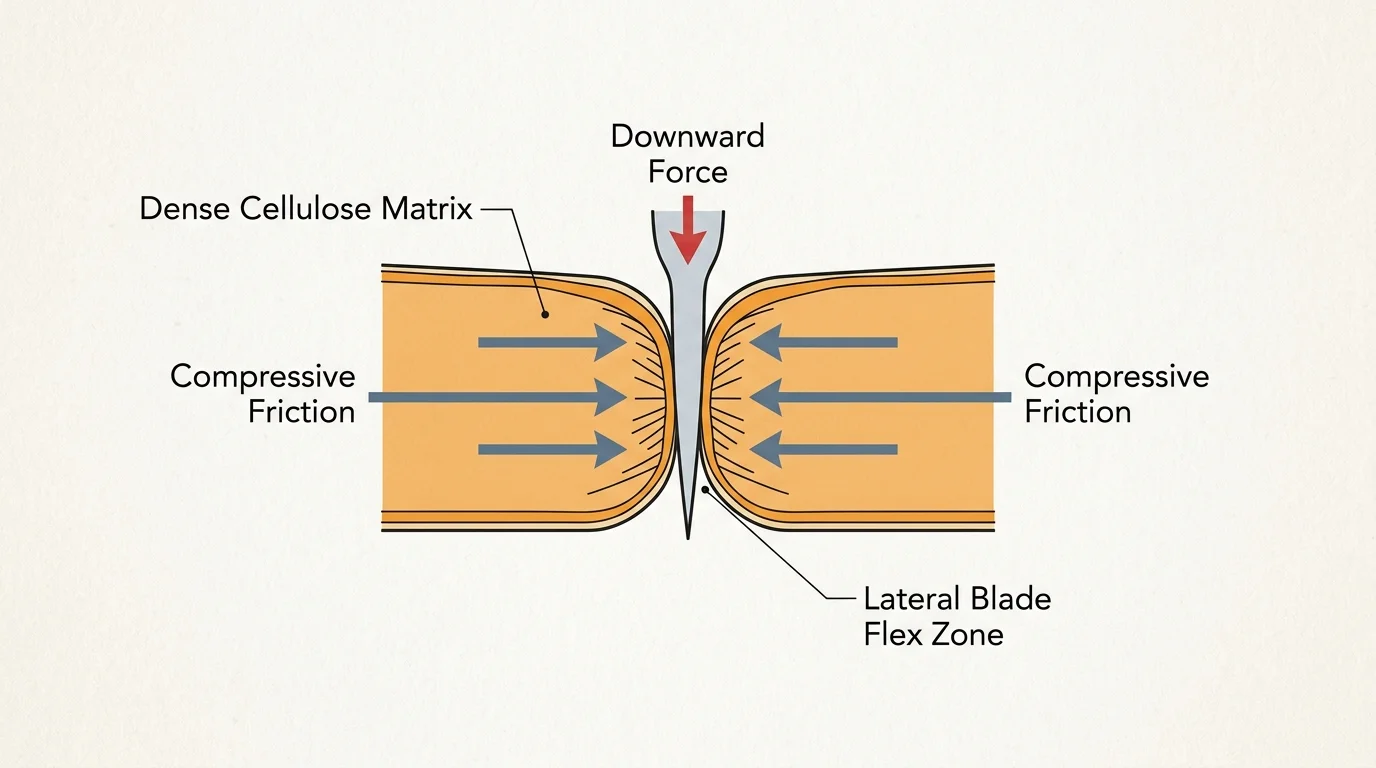
When an edge enters the squash, the displaced tissue presses inward against both sides of the blade. This compressive friction creates a mechanical vise effect known as blade binding.
As you apply downward force on a trapped knife, the resistance increases exponentially with cut depth. If the blade lacks sufficient rigidity, it flexes laterally inside the cut path.
Lateral blade flex directs your downward force off-center. When that happens, the knife can suddenly pop free of the squash, causing uncontrollable slippage toward your stabilizing hand.
Standard home kitchen injuries occur during this exact moment of blade release. Understanding how blade dimensions counteract compressive friction is the key to preventing meal prep accidents.
Spine Thickness and Wedge Mechanics: Cleaver vs. Chef’s Knife
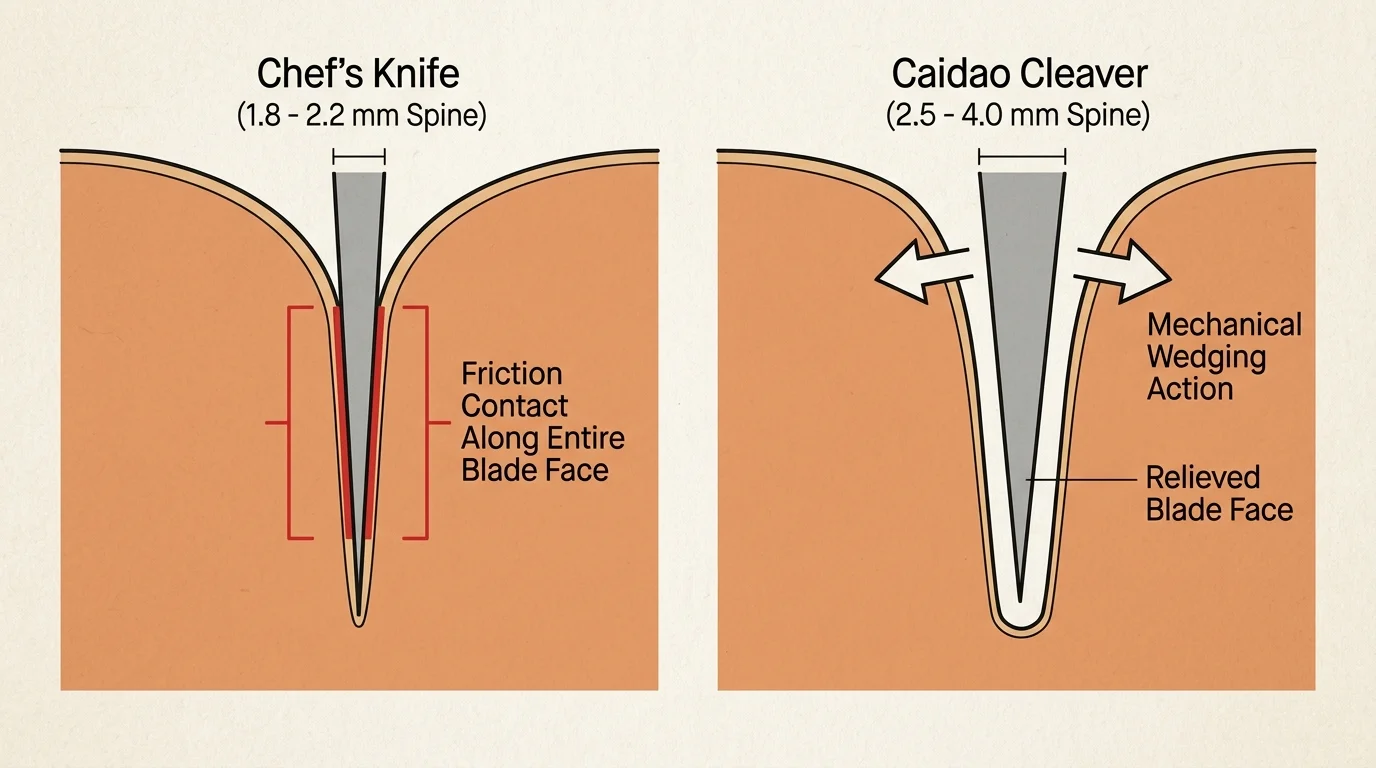
The primary mechanical difference between a standard chef’s knife and a vegetable cleaver lies in spine thickness. Most eight-inch chef’s knives feature a spine measuring 1.8 to 2.2 millimeters at the heel.
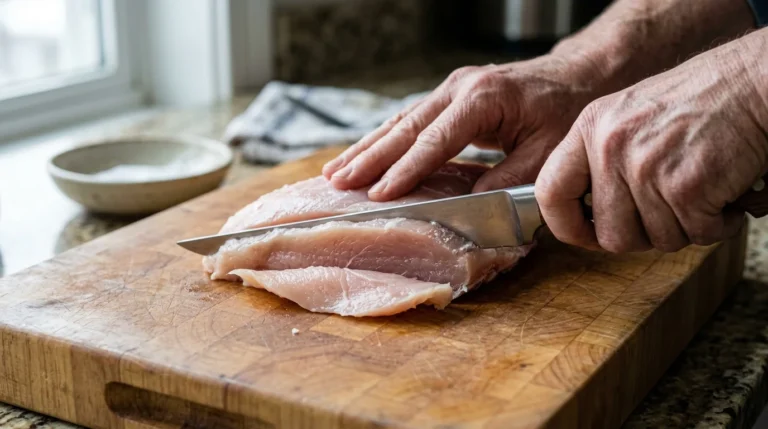
You encounter similar surface drag when slicing semi-frozen proteins, where flat knife profiles become immobilized by friction.
Chef’s knives utilize a full flat grind or gradual taper designed for slicing delicate proteins and soft vegetables. While excellent for low-friction tasks, this thin geometry provides minimal mechanical wedging action.
In contrast, a dedicated Chinese vegetable cleaver—often termed a caidao—frequently features a spine measuring 2.5 to 4.0 millimeters near the handle. This thicker spine acts as a functional wedge.
As the cutting edge penetrates the squash skin, the rapidly widening spine forces the two halves apart. The knife mechanically splits the squash open before the entire blade face can become pinched.
“A knife splitting dense winter squash acts as an inclined plane; blade thickness dictates whether the squash cracks open or traps the steel.”
By forcing the fibrous flesh outward, the wedge eliminates cheek friction along the blade body. A thick spine turns raw downward muscular force into efficient lateral displacement.
A thin chef’s knife forces you to cut through every single millimeter of dense fiber manually. A vegetable cleaver cuts the first half-inch and allows wedge pressure to fracture the rest.
Balance Points and Rotational Torque
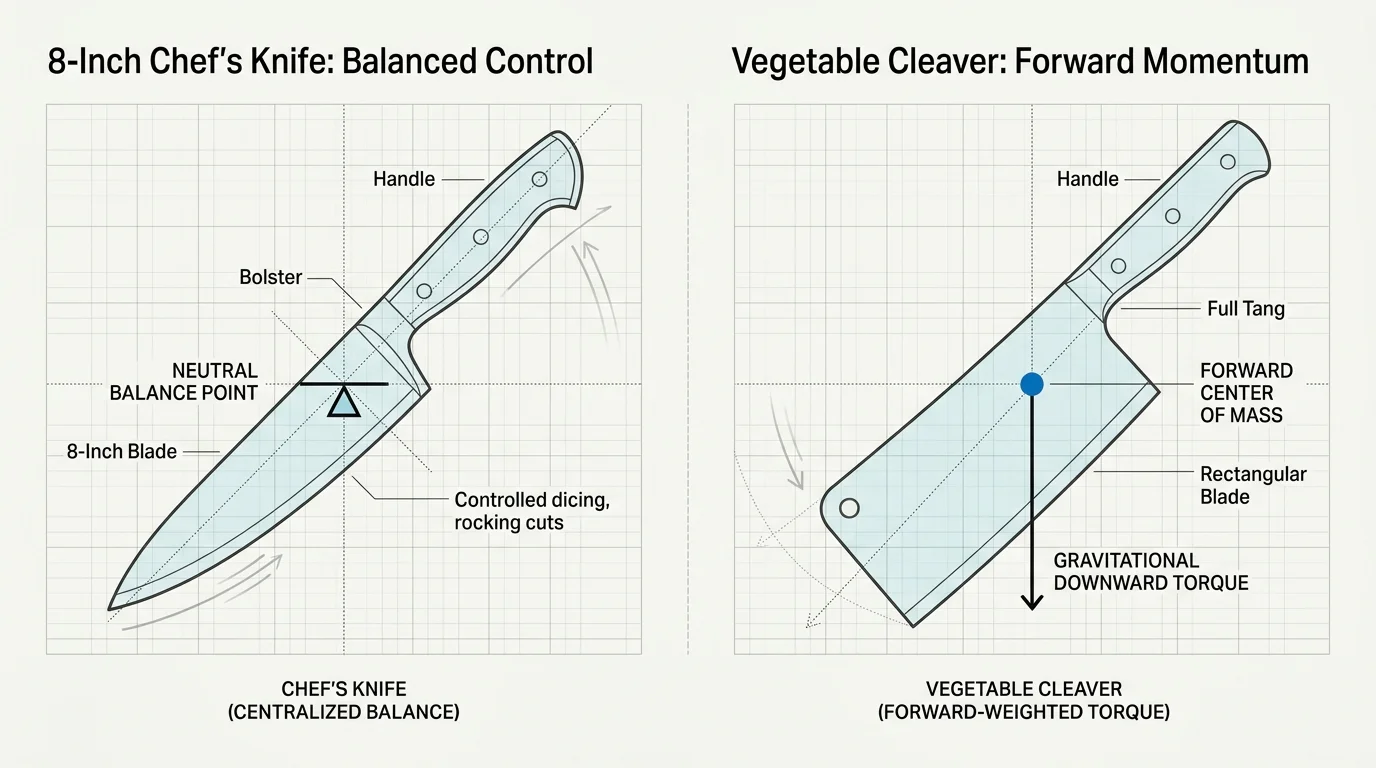
Balance points dictate how much leverage you exert when driving an edge through rigid produce. A standard chef’s knife typically balances directly at the bolster.
While compact paring knives excel at notching out woody stems, their diminutive blades cannot provide the vertical heft needed to split large vegetables.
The bolster is the thick part where the blade meets the handle, provides balance and finger protection. This neutral balance point optimizes agile tip work and rocking cuts.
Neutral balance works against you when splitting dense squash. Because the mass sits near your hand, your forearm muscles must supply nearly all the downward pressure.
Vegetable cleavers shift the center of gravity two to three inches forward of your pinch grip. This forward weight distribution harnesses gravity to generate downward cutting momentum.
A full tang—meaning the knife blade extends all the way through the handle for better balance—prevents mechanical handle failure under load. Cleavers with solid construction channel downward energy straight through the spine.
Blade height also controls rotational torque during heavy downward cuts. An eight-inch chef’s knife offers roughly 1.75 to 2 inches of blade height at the heel.
A Chinese vegetable cleaver provides 3.5 to 4.5 inches of vertical blade height. This wide surface area resists twisting motions, ensuring the knife tracks down in a strictly vertical plane.
When a blade stays vertical, lateral torque drops to zero. That stability eliminates the twisting that causes blades to slip off tough squash rinds.
Steel Metallurgy and Edge Durability
Blade material determines how well an edge survives contact with tough squash rinds and woody stems. Common kitchen knives rely on German stainless steel, Japanese carbon steel, or ceramic compounds.
For cooks wanting a fast way to refresh dulled bevels on tough German steel, electric knife sharpeners quickly reset edges after demanding vegetable prep.
Ceramic knives must never be used to split winter squash. Ceramic possesses high hardness but virtually zero lateral tensile strength, causing it to shatter when subjected to wedging pressure.
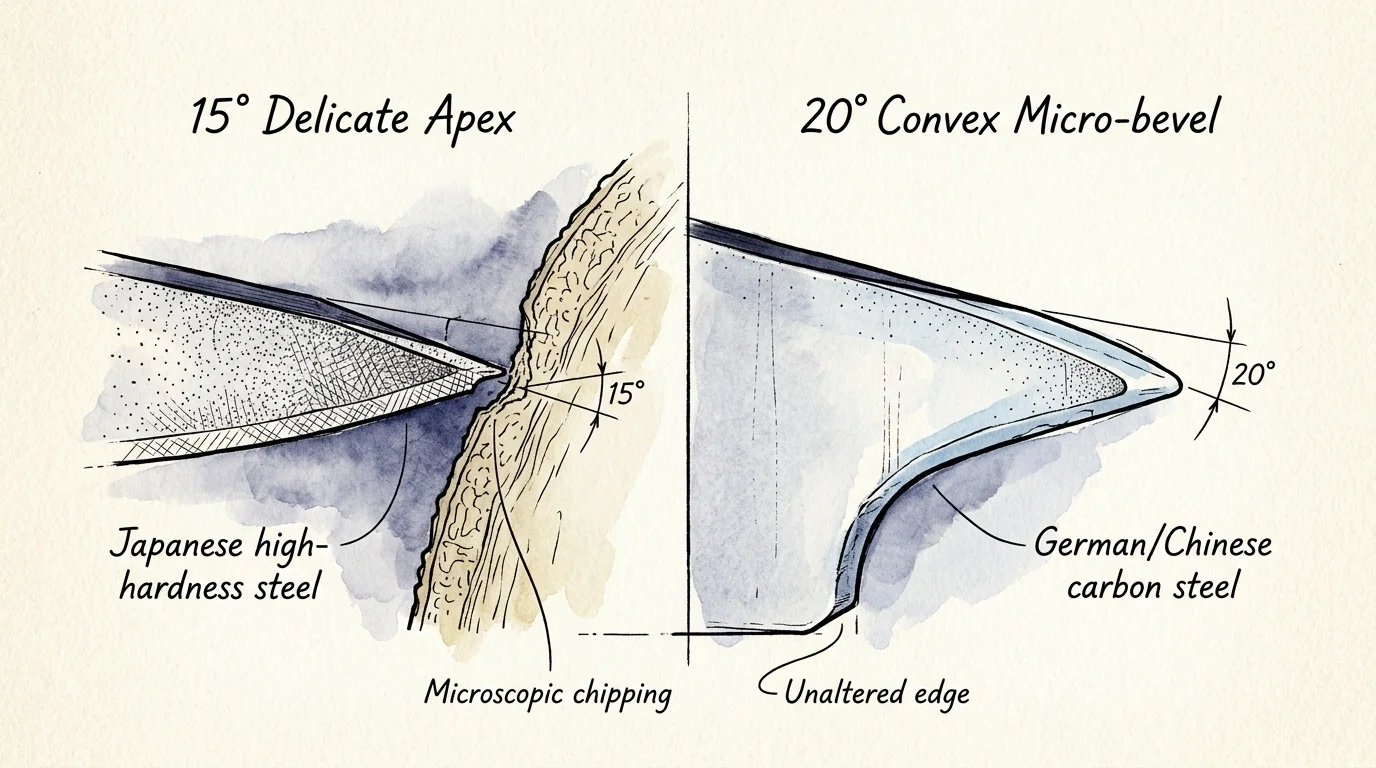
Japanese high-carbon steels, hardened to 60 or 62 on the Rockwell Hardness Scale (HRC), take a razor-sharp edge. However, their high hardness makes them brittle under heavy downward torque.
If you twist a brittle Japanese blade inside a dense kabocha squash, the delicate cutting edge will chip or micro-fracture along the board.
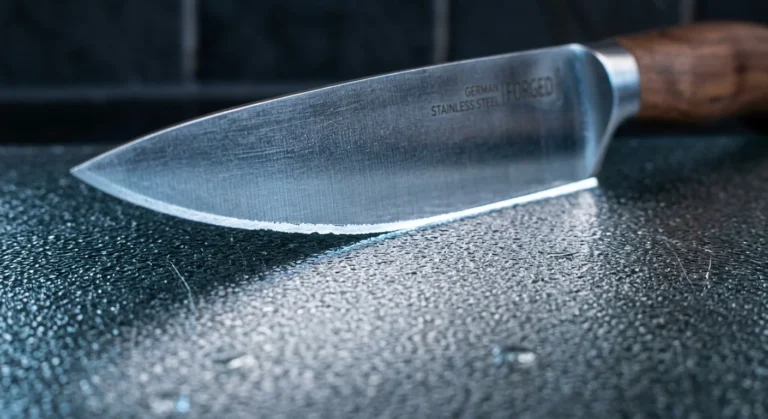
German-style stainless steels, such as X50CrMoV15, feature a softer rating between 55 and 58 HRC. This alloy exhibits superior ductility and toughness under extreme downward compression.
As testing from Serious Eats demonstrates, softer German steels resist edge chipping far better than brittle alloys when striking woody vegetable matter.
A tough steel rolls rather than chips when encountering hard seeds or thick rinds. You can quickly repair rolled steel with basic kitchen maintenance tools.
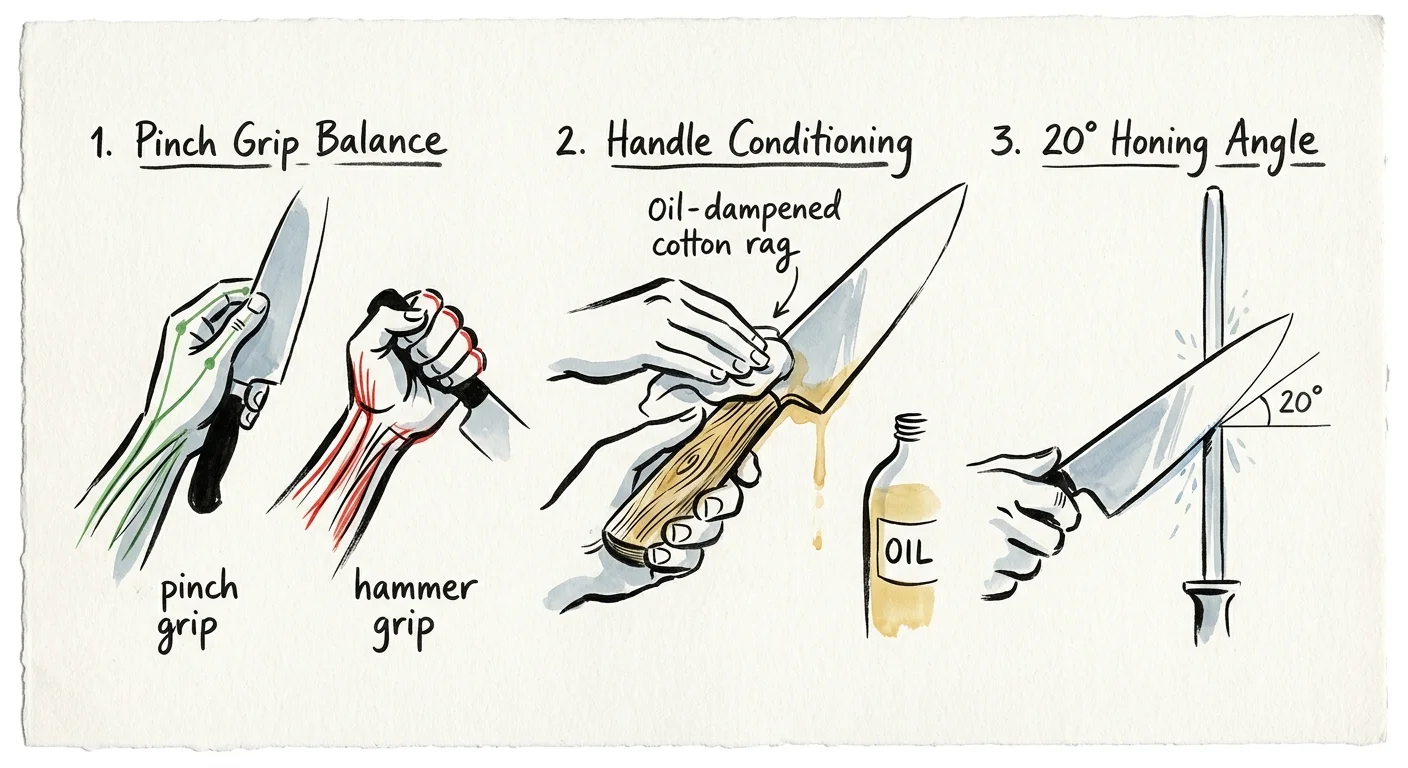
Regular honing, which means realigning the blade edge (doesn’t remove metal, just straightens it), keeps your edge true between squash sessions. Honing prevents microscopic deflections from worsening into dangerous cutting snags.
Periodic sharpening, which involves actually removing metal to create a new edge, restores true bevel geometry after heavy cutting. Maintaining a keen 18- to 20-degree bevel ensures smooth penetration.
Worked Example: Splitting a 3.5-Pound Kabocha Squash
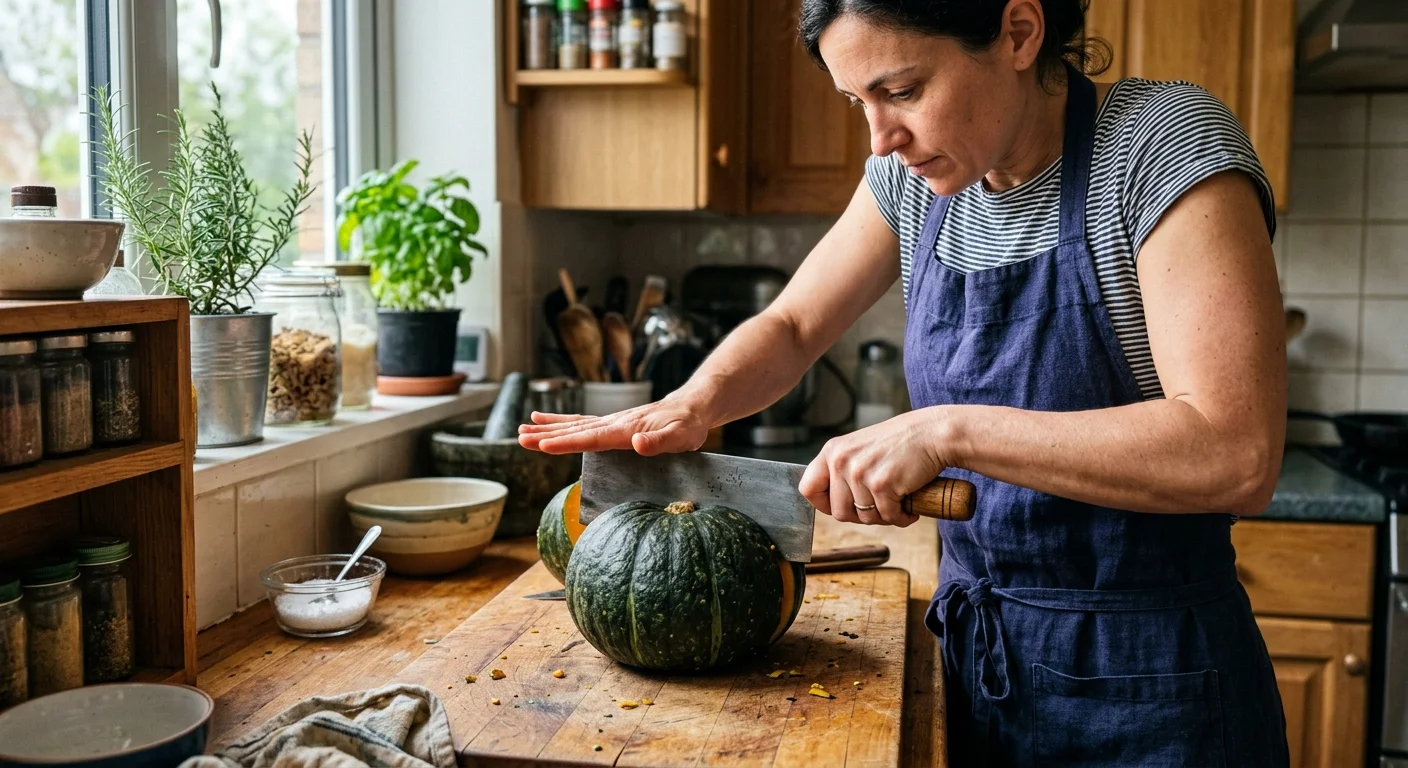
To examine blade physics under realistic conditions, consider a scenario where you split a 3.5-pound (1,587-gram) raw kabocha squash. Kabocha features an exterior rind thickness of 2.5 millimeters and an interior density of 0.92 grams per cubic centimeter.
Once your squash halves are roasted soft, using small-capacity immersion blender attachments allows you to whip the cooked flesh into silky soups right in the pot.
In Scenario A, you employ an eight-inch chef’s knife featuring a 2.0-millimeter spine at the heel and a 1.2-millimeter thickness mid-blade. The knife weighs 210 grams and carries a 15-degree edge bevel.
As you press into the squash, the thin blade penetrates 1.75 inches before the compressed starch clamps the flat sides of the steel. You must exert 28 pounds of continuous vertical downforce to keep moving.
Because the blade lacks wedge width, the squash does not crack open. The blade binds completely, creating 4.2 Newton-meters of lateral torque as your wrists fatigue and tilt off-axis.
Total time spent cutting through the center equator reaches four minutes and fifteen seconds. The user experiences severe palm strain and risks a slip if the blade wrenches free.
In Scenario B, you split the same squash using a heavy vegetable cleaver with a 3.8-millimeter spine and a total weight of 385 grams. The blade features a 20-degree primary grind angle.
You apply 16 pounds of downward pressure to break the top rind. At just 0.8 inches of penetration, the 3.8-millimeter spine pushes the squash halves apart with lateral mechanical force.
A loud crack sounds as the squash fractures along its natural fiber lines ahead of the cutting edge. Total splitting time takes just 45 seconds, requiring zero handle twisting and minimal arm exertion.
Comparative Blade Geometry and Tool Specifications
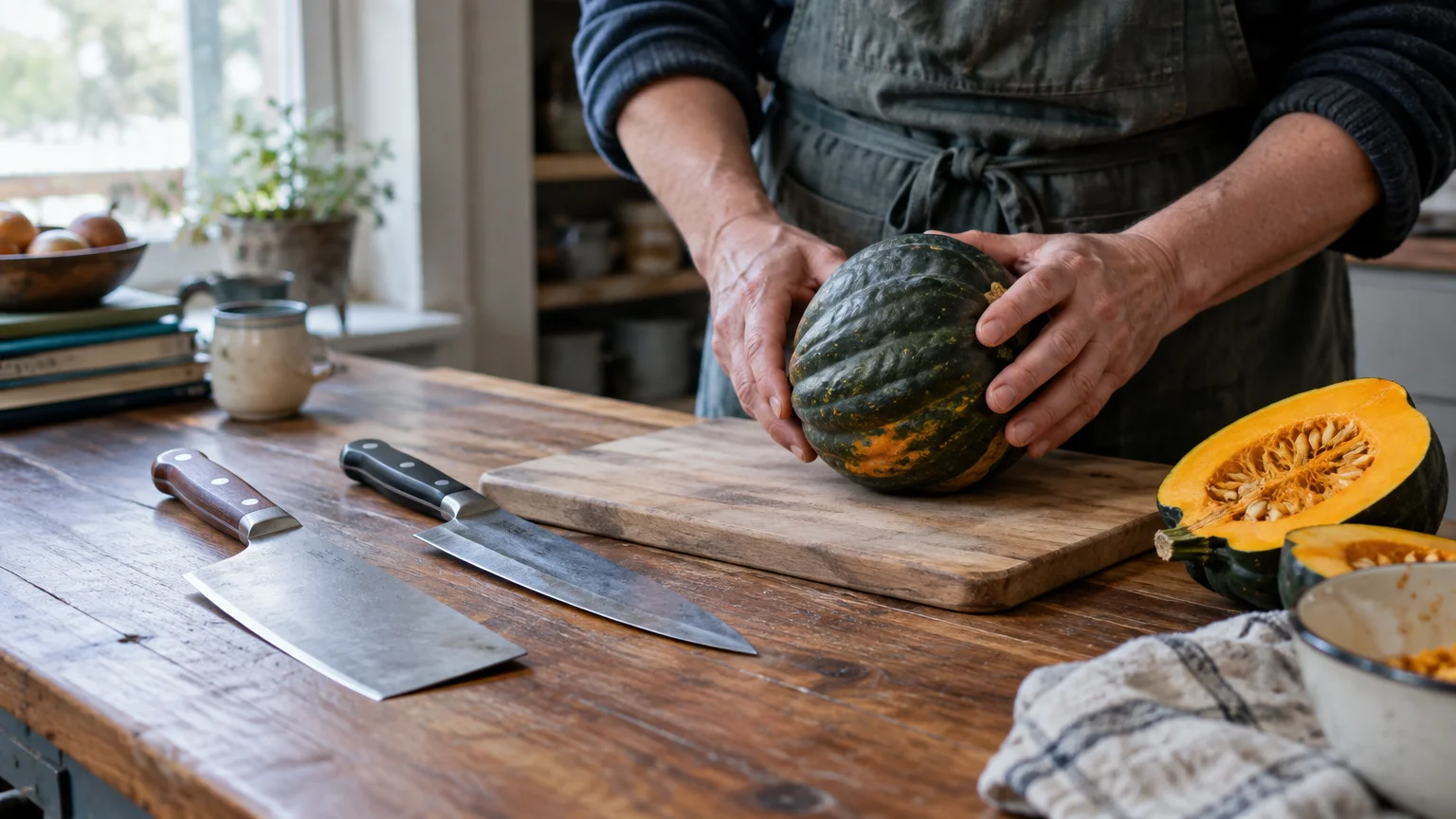
Selecting the right knife to cut butternut squash safely requires matching blade specifications to vegetable density. The following comparison highlights measurable attributes across leading kitchen knives used for heavy prep.
Investing in a versatile cleaver or robust chef’s knife is often smarter than buying bulky sets, as seen in our breakdown of the $150 prep-tool kit.
According to equipment evaluations by America’s Test Kitchen, taller blade profiles keep cuts plumb and prevent binding in dense squash.
| Knife Model | Spine Thickness (Heel) | Blade Height | Total Weight | Edge Grind Angle | Primary Steel Alloy |
|---|---|---|---|---|---|
| Victorinox Fibrox Pro 8-Inch Chef’s | 2.1 mm | 46 mm | 185 g | 15 degrees | High-Carbon Stainless |
| Mercer Culinary Genesis 8-Inch Short Bolster | 2.8 mm | 50 mm | 250 g | 15 degrees | German X50CrMoV15 |
| Shibazi F208-2 Vegetable Cleaver | 3.8 mm | 90 mm | 390 g | 20 degrees | 80Cr13 Clad Stainless |
| CCK Small Slicer Cleaver (KF1303) | 2.2 mm | 85 mm | 270 g | 18 degrees | Carbon Steel |
| Dexter-Russell Heavy Duty Cleaver 7-Inch | 4.5 mm | 100 mm | 710 g | 25 degrees | Proprietary DEXSTEEL |
Reviewing these specifications reveals why standard chef’s knives struggle with thick-skin squashes. The Victorinox Fibrox Pro excels at precision slicing, yet its 2.1-millimeter spine lacks wedging power.
The Shibazi F208-2 provides a 3.8-millimeter spine combined with a 90-millimeter blade height. This geometry delivers exceptional wedge force without the excessive 710-gram weight of a traditional meat-splitting cleaver.
Dexter-Russell’s heavy-duty model offers extreme splitting leverage, but its 25-degree edge angle makes fine dicing cumbersome after the squash is halved. A balanced vegetable cleaver splits and dices effectively.
Hand Fatigue, Ergonomics, and Maintenance Guidelines
Prepping large batches of autumn squash for freezer storage quickly causes forearm and wrist fatigue. Handle design and grip mechanics directly affect your cutting stability.
As reported by Consumer Reports, knife ergonomics and handle grip texture directly lower user slippage during high-resistance food preparation.
Avoid using a hammer grip where all four fingers wrap beneath the handle behind the bolster. Instead, choke up on the blade with a firm pinch grip, holding the base of the blade with your thumb and index finger.
A pinch grip on a tall cleaver brings your hand directly over the cutting plane. This posture eliminates the wrist flexion that causes repetitive strain during extended meal prep sessions.
Proper maintenance protects your edge geometry and prevents dangerous binding. Never place high-carbon or premium stainless prep knives in a residential dishwasher.
Dishwasher cycles expose blades to caustic detergents, extreme heat, and violent water jets that knock cutting edges against hard racks. Wash your tools by hand immediately using warm water and mild soap.
Dry the blade thoroughly with a lint-free towel to prevent rust spots on carbon steel cores. Store knives in a wooden block or on an encased magnetic strip rather than inside a crowded utensil drawer.
Once you split and peel your squash into manageable slabs, switch tools based on the desired shape. A mandoline—a flat cutting tool with adjustable blades for uniform slicing—should only process pre-split, softened squash slabs.
Never attempt to force a whole, raw, unpeeled winter squash across a mandoline surface. You risk catastrophic slip injuries if the rind snags against the stationary blade.
You can julienne—meaning cutting vegetables into thin matchstick strips—the pre-quartered squash flesh for roasting. A sharp chef’s knife or fine-toothed mandoline creates clean matchsticks effortlessly.
After roasting, you can use the pulse function—meaning short bursts of power on a food processor for better control—to puree cooked squash evenly without gumminess.
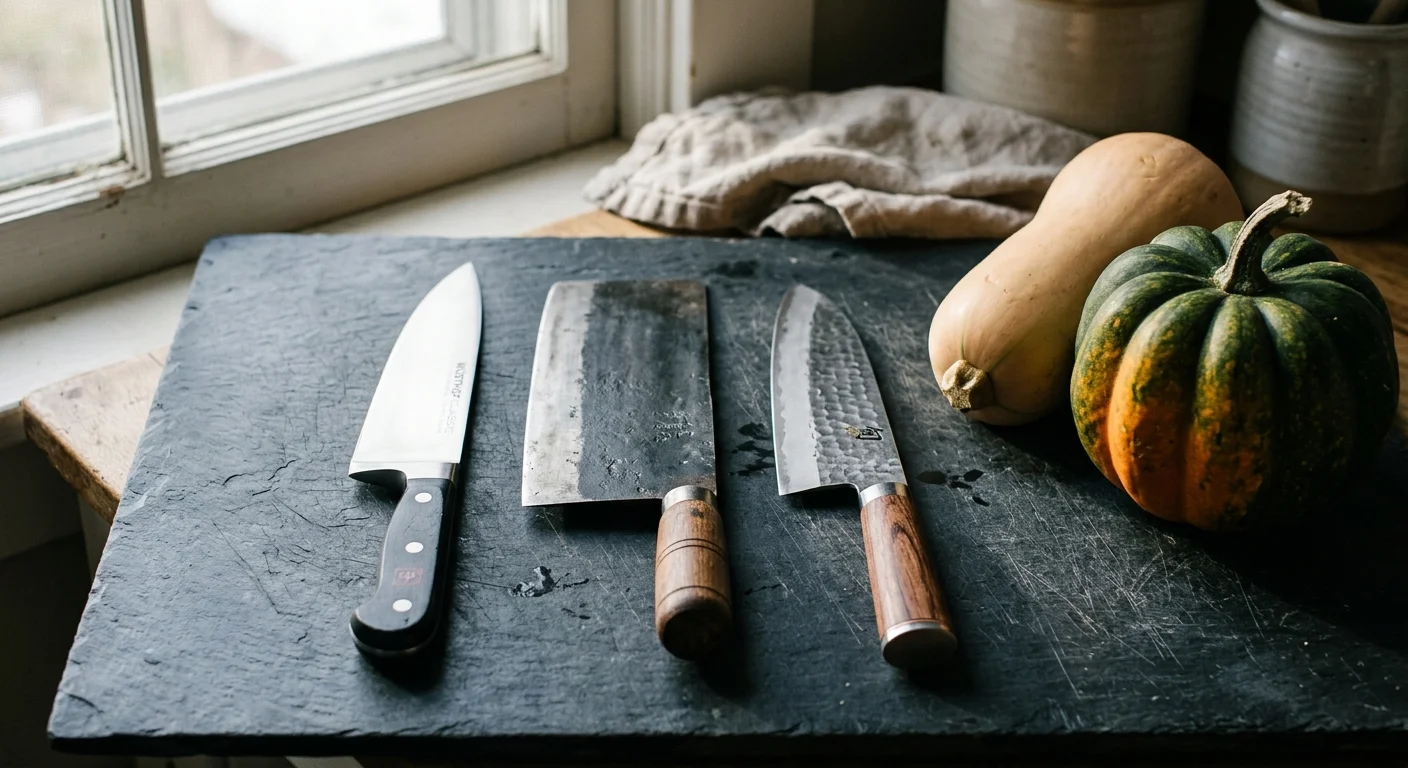
Top Knife Picks for Winter Squash Meal Prep
Choosing the correct blade for your kitchen depends on your prep volume, hand strength, and comfort with broad blades. Here are specific models tailored to different meal-prep needs.
Best for Beginners: Mercer Culinary Genesis 8-Inch Short Bolster Chef’s Knife. This model bridges the gap between traditional chef’s knives and heavy splitters.
The Genesis features a 2.8-millimeter spine thickness at the heel, which is significantly thicker than standard lightweight chef’s knives. Its German X50CrMoV15 alloy handles downward force without chipping.
The shortened bolster allows you to sharpen the entire length of the cutting edge back to the heel. Its textured Santoprene handle provides non-slip security even when handling moist squash.
Best for Serious Cooks: Shibazi F208-2 Professional Vegetable Cleaver. This eight-inch Chinese cleaver is an exceptional split kabocha squash knife.
With a 3.8-millimeter spine tapering toward the tip, it functions as a powerful wedge while maintaining a sharp cutting edge. The 90-millimeter blade height keeps downward strokes perfectly vertical.
Its three-layer clad steel features a durable core surrounded by softer stainless steel for structural resilience. The rounded wooden barrel handle fits securely into a standard pinch grip.
Best Value: Winco 8-Inch Chinese Cleaver (Blade Model KC-101). This commercial kitchen workhorse costs under twenty dollars while offering robust utility.
It provides an expansive blade face and a 2.5-millimeter spine that handles butternut squash easily. While the wooden handle requires occasional mineral oil conditioning, the stainless blade resists staining.
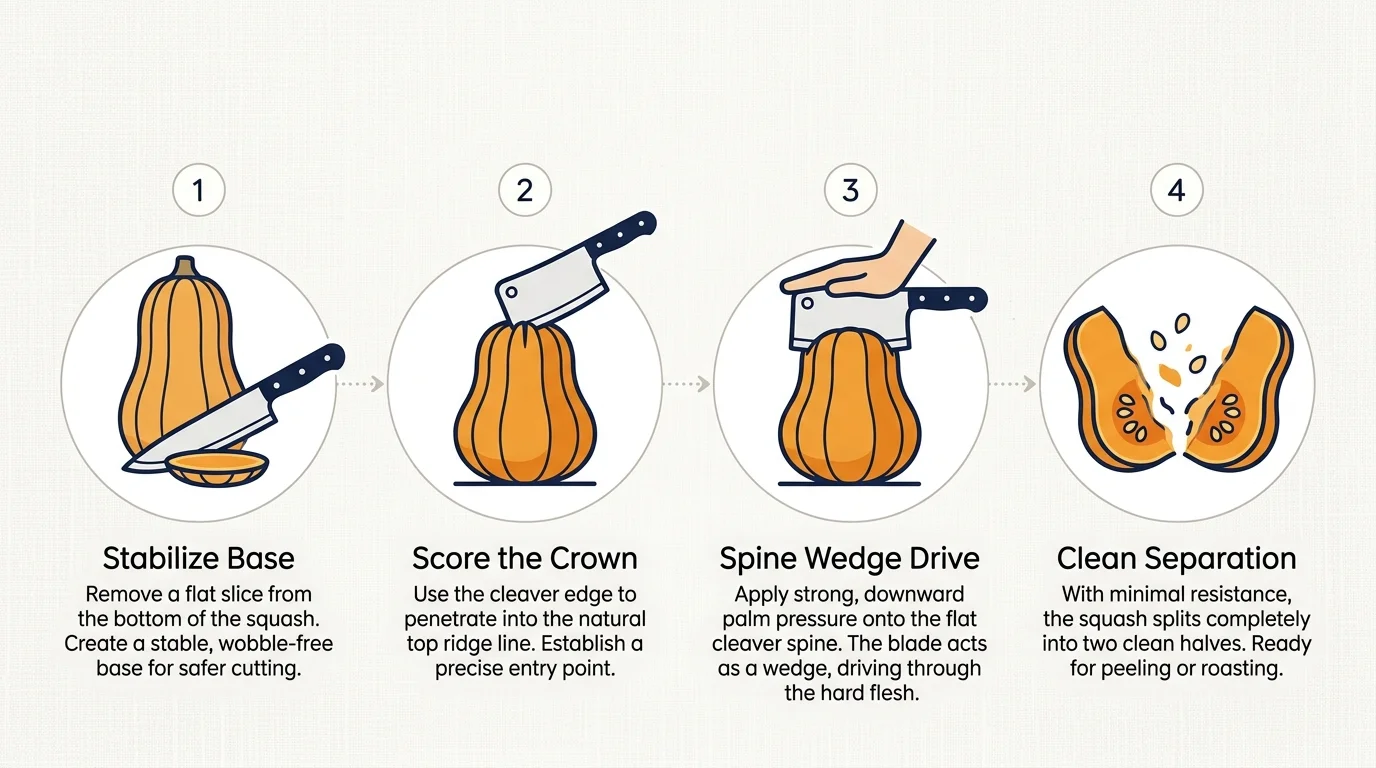
Safe Splitting Techniques and Meal Prep Workflow
Using the proper tool is only half the battle; technique ensures complete control during difficult cuts. Executing proper mise en place, which involves having all ingredients prepped and ready before cooking, ensures your cutting area remains uncluttered.
Begin by securing your cutting board. Place a damp kitchen towel or non-slip silicone mat directly beneath a heavy wooden board to prevent shifting under downward pressure.
Always create a stable, flat base on the squash before attempting to halve it lengthwise. Slice a quarter-inch slab off the stem end and root base to prevent the squash from rolling.
Stand the squash upright on its widest flat cut surface. Never attempt to halve a rolling cylinder on a slick board.
Insert the heel of your heavy blade for tough vegetables into the top center of the upright squash. Keep your stabilizing hand completely away from the path of the blade.
Rest your palm flat against the top corner of the cleaver’s spine if additional downward force is needed. Never strike the blade spine with a hammer or heavy object, which can snap the steel.
Press down smoothly through the centerline of the vegetable. The wedge action will pop the squash halves apart before the blade reaches the cutting board.
If you face an exceptionally fibrous squash, use microwave softening to reduce internal resistance. Microwaving a whole squash for two minutes at 1,000 watts relaxes cellulose bonding, reducing cutting resistance by roughly 30 percent.
Frequently Asked Questions
Can I use a traditional meat cleaver instead of a vegetable cleaver for squash?
You can use a meat cleaver, but its blunt 25-degree edge angle crushes produce rather than slicing cleanly. A vegetable cleaver features a thinner cutting edge that splits dense flesh with superior control.
Why does my chef’s knife get stuck halfway through butternut squash?
Your knife gets stuck because its thin spine creates insufficient wedge force to separate the squash halves. Low moisture in the squash causes the dense cellulose walls to clamp down on the sides of the blade.
Is it safe to microwave a winter squash before cutting it?
Yes, piercing the skin with a fork and microwaving the squash for two minutes softens the tough outer rind. This brief heating relieves internal tension and allows your knife edge to penetrate without excessive force.
What edge angle works best on a knife to cut butternut squash safely?
A primary edge angle of 18 to 20 degrees per side provides the ideal balance between durability and cutting efficiency. Narrower 15-degree edges chip easily, while wider 25-degree edges require excessive downward muscle power.
Disclaimer: Product prices and availability change frequently. Prices shown were accurate at time of writing but may have changed. We may earn a small commission from purchases made through links on this site, at no extra cost to you. Always use cutting tools carefully and follow manufacturer safety guidelines.