
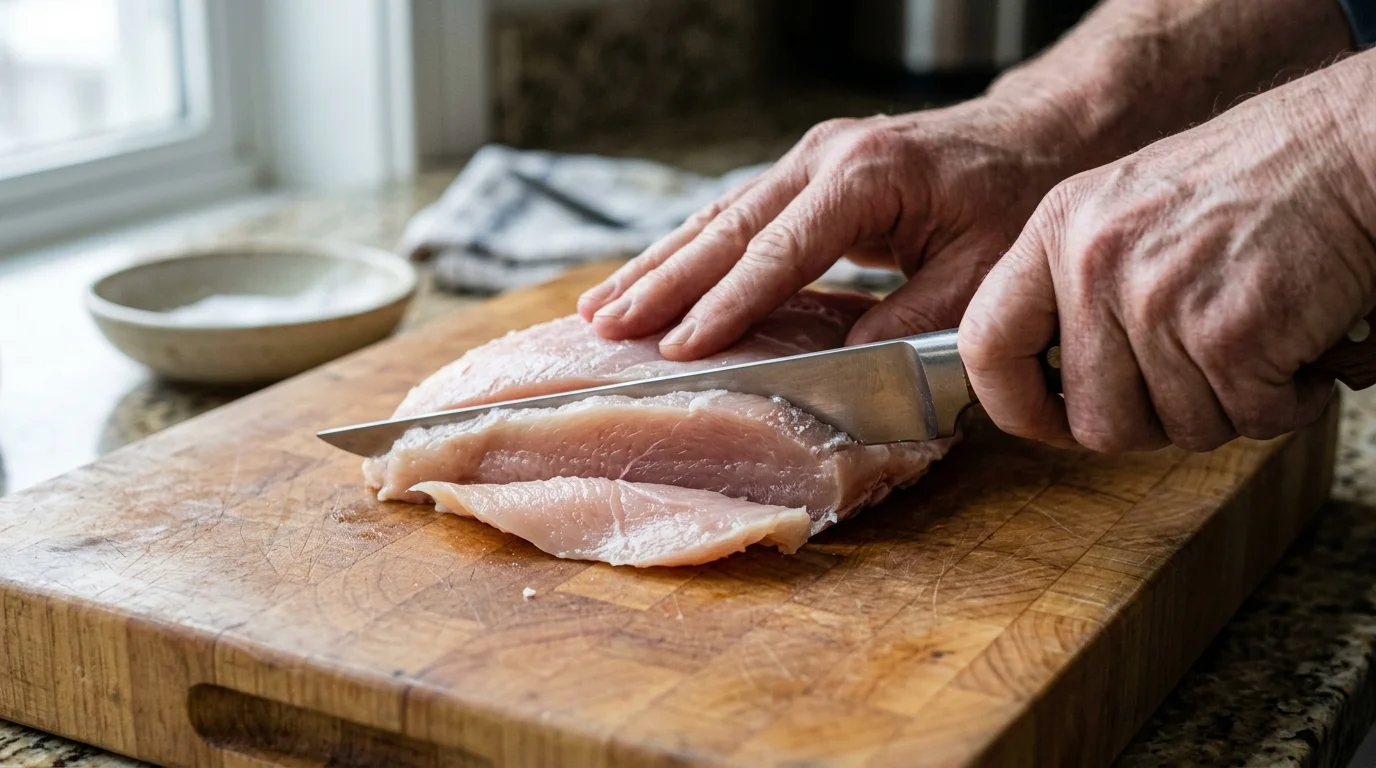
Slicing ten pounds of dense, semi-frozen chicken breast every Sunday destroys your wrists when you use a standard eight-inch chef’s knife. Switching to a narrow, stiff boning knife cuts prep time in half and eliminates joint strain.
Selecting purpose-built blades rather than defaulting to general-purpose cutlery reflects the core philosophy of buying kitchen knives that you actually need.
While culinary tradition favors the broad chef’s knife, its tall blade profile creates massive surface friction against chilled muscle fibers. A stiff boning knife minimizes surface contact, letting you glide cleanly through cold protein blocks with minimal downward pressure.
This mechanical advantage transforms weekly macro meal prep from an exhausting chore into an effortless routine. Here is why knife geometry matters and how to upgrade your bulk poultry workflow.
The Physics of Cutting Semi-Frozen Poultry: Surface Area and Friction
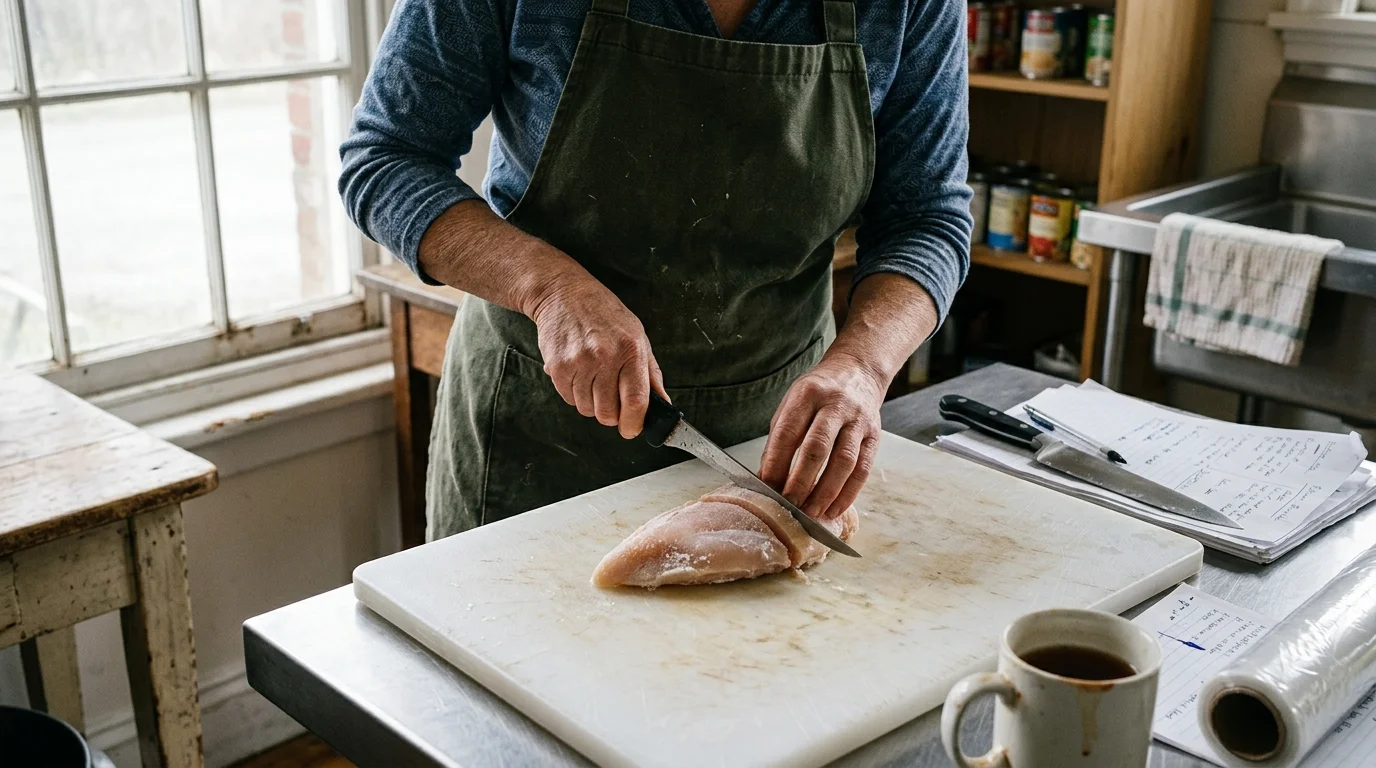
Chilling raw poultry in your freezer before slicing solidifies soft water content without freezing the core solid. This firming technique creates clean, paper-thin cutlets without meat tearing or shredding across your board.
While some cooks mistakenly reach for serrated bread knives to saw through cold meat, the coarse teeth tear chilled protein fibers rather than separating them cleanly.
Similar principles of blade geometry and wedging resistance dictate how easily different knife profiles separate dense, resistant foods.
According to equipment testing by Serious Eats, blade profile and wedging force dictate how cleanly a knife glides through dense proteins.
Semi-frozen chicken breast behaves like dense ballistic gel. As your knife enters the cold muscle, the split protein presses against both sides of the blade face.
This contact generates severe lateral friction. An eight-inch chef’s knife features a blade face measuring between 1.8 and 2.2 inches in vertical height.
That tall profile forces nearly twelve square inches of polished steel against freezing meat tissue during mid-stroke. The resulting vacuum suction and mechanical drag anchor the blade inside the breast.
To overcome this wedging resistance, your wrist and forearm muscles must exert forceful downward and forward thrust. Repeating that high-load stroke dozens of times causes acute forearm fatigue and tendon strain.
In contrast, a narrow boning knife measures just 0.75 to 1.0 inches from cutting edge to spine. That slim geometry slashes total surface contact by more than sixty percent.
Because less steel touches the chilly protein walls, lateral drag drops instantly. The blade glides through dense, near-frozen breast meat using simple arm momentum rather than aggressive downward force.
“Blade friction increases exponentially with surface area when processing cold, dense proteins. A narrower blade profile eliminates the suction effect that exhausts your cutting hand.”
You achieve razor-thin cutlets for your macro bowls with smooth, repeatable motions. Your hand remains comfortable and stable throughout the entire bulk prep session.

Boning Knife vs. Chef Knife: Anatomy and Performance Compared
Understanding knife anatomy reveals why these two essential tools perform so differently on cold meat. High-volume poultry prep demands structural stability and balanced weight distribution.
When trimming away stubborn tendons or fat pockets before slicing, keeping a pair of heavy-duty kitchen shears on hand prevents unnecessary wear on your knife edge.
Selecting a few specialized, high-performing knives rather than relying on a bulky block set is key to assembling a practical prep-tool kit for home cooks.
Look for a knife with a full tang; full tang means the knife blade extends all the way through the handle for better balance. A full tang prevents the handle from snapping under lateral stress.
Pay close attention to the knife’s bolster; the bolster is the thick part where the blade meets the handle, provides balance and finger protection. A sculpted or half bolster lets you sharpen the entire cutting edge cleanly.
Chef knives feature a wide, curved belly designed for rocking cuts across onions and herbs. That curved belly reduces horizontal contact during horizontal slicing, concentrating cutting force onto a tiny contact patch.
When you encounter cold poultry tissue, that small contact patch binds immediately. You end up sawing back and forth, tearing the delicate outer fibers of the meat.
A stiff boning knife presents an entirely different geometric philosophy. Its straight cutting edge maintains continuous, level contact throughout a long horizontal draw cut.
Furthermore, boning knives come in flexible and stiff variations. For slicing chilled bulk poultry, flexible boning knives flex too easily, causing wavy cuts and dangerous blade wander.
You need a stiff boning knife with a rigid spine. The rigid spine provides straight-line tracking, ensuring every slice stays uniform from tip to heel.
| Design Specification | Stiff Boning Knife (6-Inch) | Standard Chef’s Knife (8-Inch) | Performance Impact on Chilled Poultry |
|---|---|---|---|
| Blade Height at Heel | 0.85 inches (21.5 mm) | 2.10 inches (53.3 mm) | Boning knife cuts lateral drag by ~60% |
| Spine Thickness | 1.8 mm to 2.2 mm | 2.5 mm to 3.2 mm | Thinner spine wedges less in cold meat |
| Edge Angle (per side) | 14 to 15 degrees | 16 to 20 degrees | Acute angle slices chilled muscle cleanly |
| Blade Surface Contact | ~5.2 sq. inches | ~14.8 sq. inches | Lower surface area prevents meat suction |
| Primary Motion Pattern | Straight single-pass draw | Rocking or downward push | Draw cut prevents crushing chilled fibers |
As detailed in testing guides from America’s Test Kitchen, semi-freezing boneless meat for twenty to thirty minutes solidifies water content without crystalizing the core.
When paired with a low-drag boning knife, chilled poultry yields clean, uniform cutlets that cook evenly in your meal prep containers.
Worked Example: The 10-Pound Sunday Macro Prep Breakdown
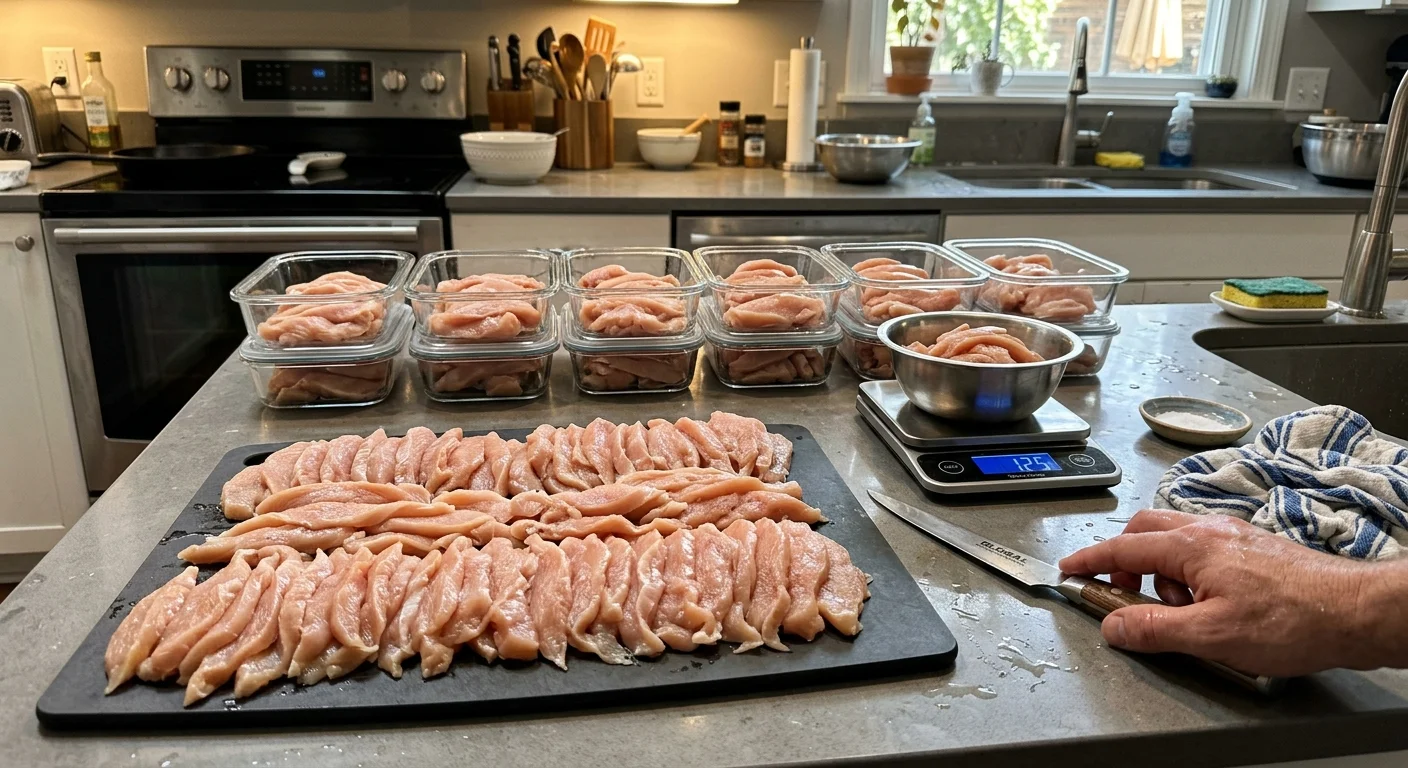
Let us examine a concrete scenario for a budget-focused fitness meal prepper. You buy a ten-pound family pack of fresh boneless, skinless chicken breasts at $2.99 per pound.
After finishing bulk prep, utilizing safe knife storage methods like magnetic strips protects the delicate cutting edge until your next meal prep session.
Your goal is portioning forty 4-ounce cutlets to hit forty grams of protein per meal throughout your workweek. Ten pounds yields approximately twenty large individual raw lobes averaging eight ounces each.
To prepare them, you lay the breasts flat on a parchment-lined baking sheet. You slide the tray into your freezer set at 0°F (-18°C) for thirty-five minutes.
This drop brings the meat’s surface temperature down to 29°F (-1.6°C). The outer layer firms up, while the center remains thawed and malleable.
Now, let us compare the physical effort of slicing these twenty chilled lobes into cutlets using both knife types.
With an eight-inch chef’s knife, horizontal cutlet slicing requires aggressive push-cuts. Because the wide blade face binds inside the cold protein, each lobe requires three distinct sawing motions.
Twenty breasts sliced into forty halves require sixty high-friction strokes. Slicing twenty lobes this way takes twenty-two minutes, requiring three forearm rest breaks to combat wrist cramping.
Now switch to a six-inch stiff boning knife. The ultra-narrow profile slips into the chilled chicken with zero wedging resistance.
Each lobe splits horizontally in one single, fluid draw stroke from heel to tip. Twenty breasts require exactly twenty clean strokes.
The entire cutting process takes nine minutes and fifteen seconds. You slice forty identical cutlets in less than half the time, with zero wrist fatigue.
Over a full calendar year of weekly prep sessions, this switch saves you eleven hours of tedious cutting board labor.
Blade Metallurgy: German Steel, Japanese Steel, and Ceramic Under Cold Stress
Chilled poultry places unique physical stresses on knife steel. Choosing the right blade metallurgy ensures your knife maintains razor sharpness without chipping on dense meat blocks.
To quickly realign and re-bevel durable German cutlery, many busy cooks evaluate whether electric knife sharpeners are worth the investment for high-volume prep tools.
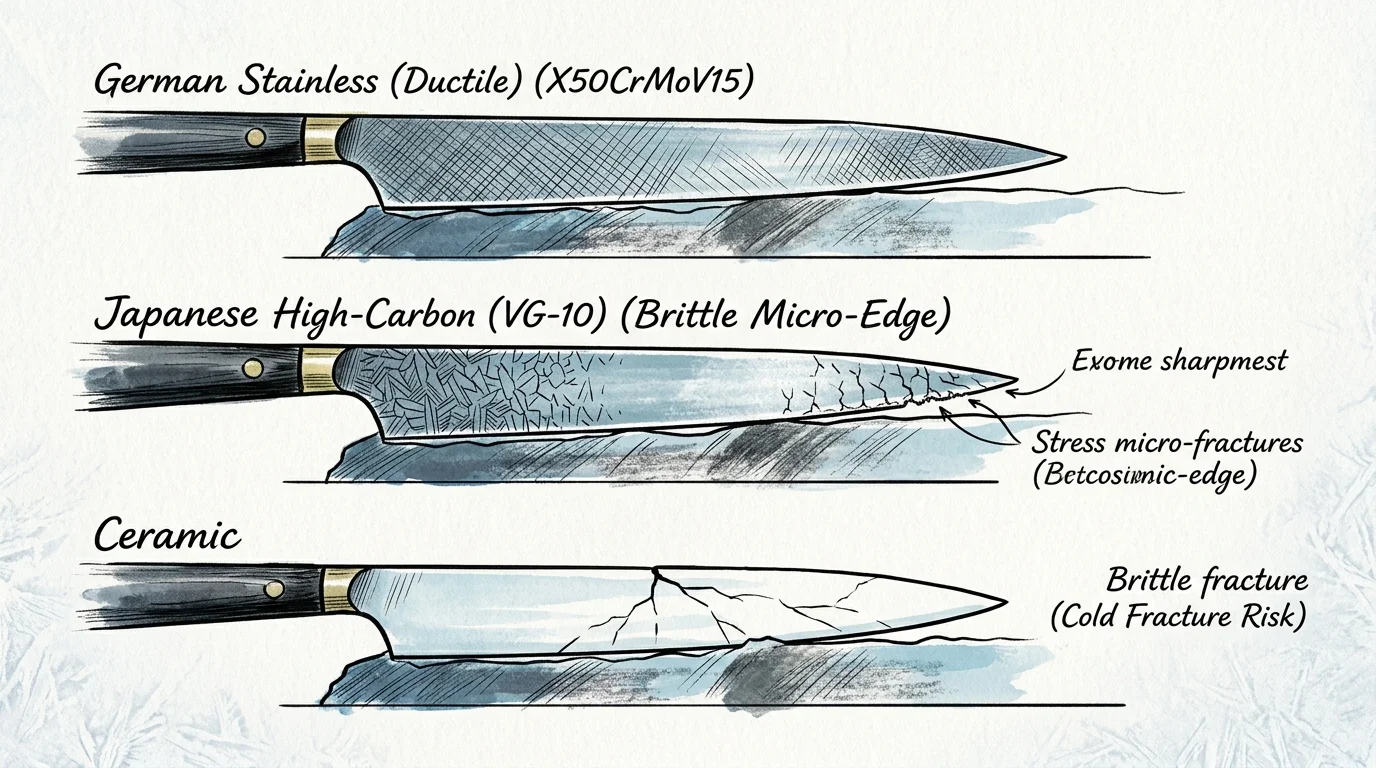
German stainless steel, typically formulated as X50CrMoV15, features a hardness rating between 56 and 58 on the Rockwell Hardness Scale (HRC). This steel contains higher chromium levels for superior rust resistance.
The softer molecular matrix of German steel provides exceptional toughness. When slicing cold meat, the blade flexes slightly at a microscopic level rather than chipping.
If you encounter an accidental frozen ice pocket inside the breast, German steel rolls slightly instead of snapping. You can quickly correct that rolled edge using basic kitchen tools.
Japanese cutlery steels like VG-10, AUS-10, and SG2 powder steel feature higher carbon content, reaching 60 to 62 HRC. These blades take an exceptionally sharp fifteen-degree edge that slices effortlessly.
However, extreme hardness introduces brittleness. If you push a brittle Japanese blade through semi-frozen meat and twist your wrist, the cutting edge can micro-chip.
Use Japanese boning knives only if you maintain strict, straight-line cutting discipline. Never torque or twist a hard steel blade while it is embedded in cold protein.
Ceramic knives represent an absolute hazard for semi-frozen meal prep. Zirconium oxide blades possess extreme surface hardness but near-zero tensile flexibility.
The lateral wedging pressure generated by chilled chicken breast can snap ceramic blades in half. Ceramic knives are completely unsuitable for bulk poultry processing.
For high-volume weekly chicken prep, a German stainless steel stiff boning knife offers the best balance of edge retention, durability, and corrosion resistance.
Step-by-Step Technique for Slicing Chilled Bulk Chicken Safely
Speed during meal prep means nothing if you compromise basic kitchen safety. Slicing cold, slippery raw meat demands structured preparation and proper body mechanics.
If you are concerned about blade slippage while stabilizing slick cutlets, wearing a Kevlar cut-resistant glove on your non-dominant hand offers vital safety insurance.
Begin by establishing your mise en place; mise en place means having all ingredients prepped and ready before cooking. Arrange your chilled meat tray on your left, your cutting board centered, and clean storage containers on your right.
Secure an oversized plastic cutting board to your countertop using a damp paper towel underneath. Never cut raw poultry on unanchored boards or slick glass surfaces.
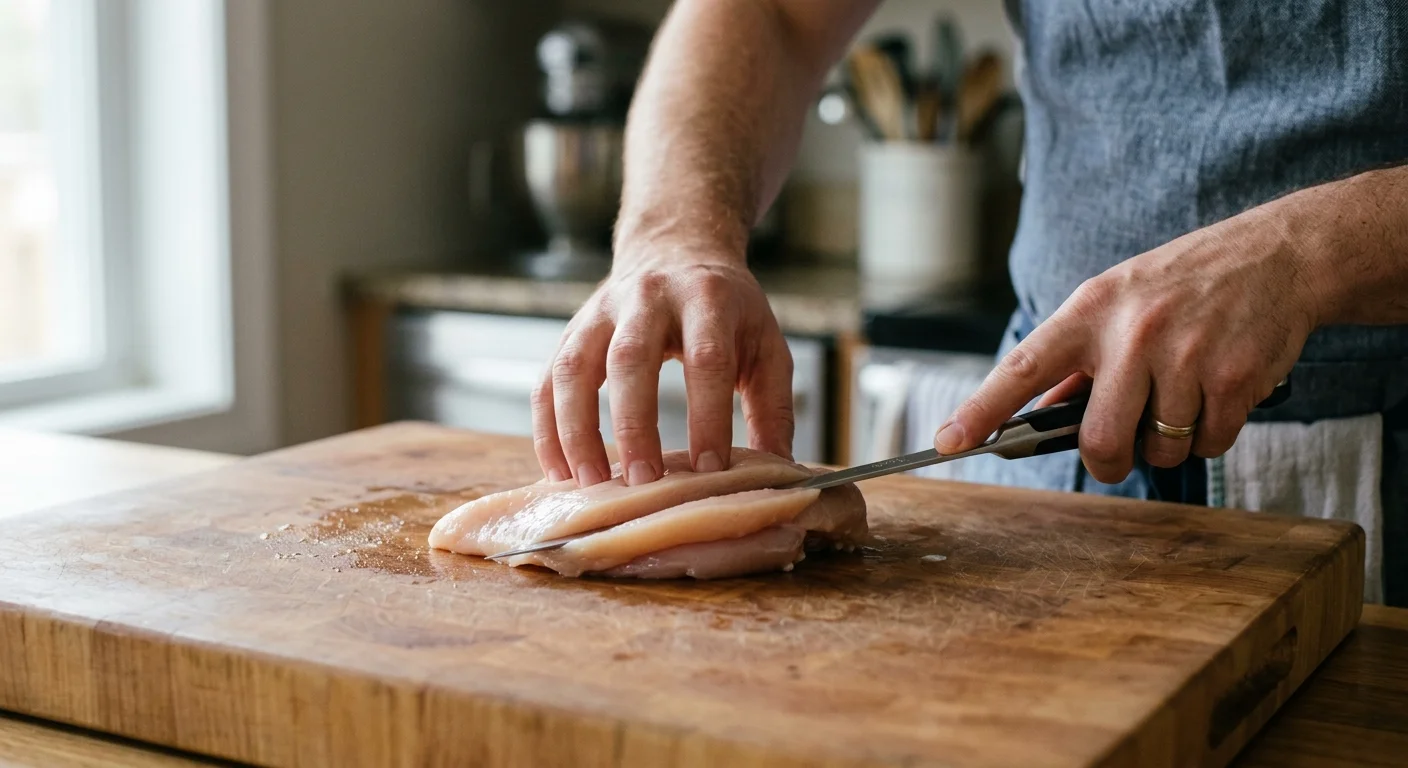
Place one semi-frozen chicken breast flat on your board, with the thick lobe pointing toward your dominant cutting hand. Rest your non-dominant hand flat across the top surface of the breast.
Keep your fingers completely flat and arched upward like a low bridge. Never curl your fingertips downward toward the cutting plane where the blade travels.
Align your stiff boning knife horizontally at the mid-height line of the breast’s thick edge. Keep the blade parallel to the cutting board surface.
Pull the knife backward toward your body in one smooth, continuous draw stroke. Let the sharp edge do the cutting work without pressing down from above.
As Wirecutter notes in their culinary cutlery evaluations, blade stiffness prevents lateral deflection during demanding slicing tasks.
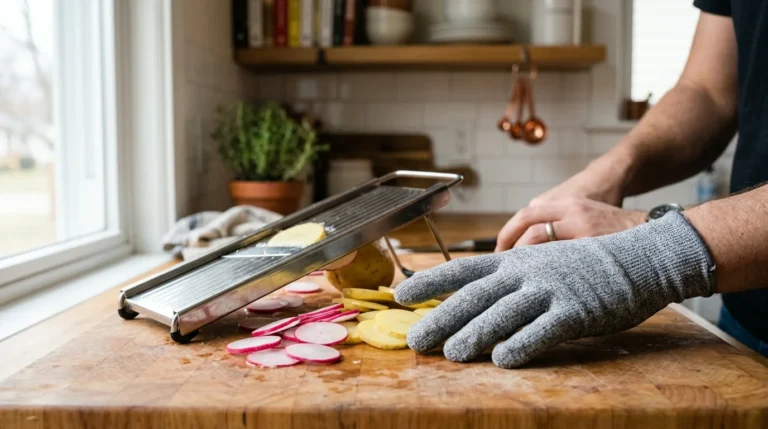
Never attempt bulk poultry slicing with alternative prep tools. A mandoline—a flat cutting tool with adjustable blades for uniform slicing—is exceptionally dangerous for raw chicken because soft meat catches, risking catastrophic finger injuries.
Reserve your mandoline or chef’s knife for vegetable tasks like making a julienne; julienne means cutting vegetables into thin matchstick strips to pair with your chicken.
Similarly, avoid using a food processor for whole cutlets; while the pulse function—short bursts of power on a food processor for better control—works for grinding, it pulverizes semi-frozen breast into an unappealing paste.
Stick to a stiff boning knife to produce beautiful, uniform cutlets that grill or bake evenly every single time.
Top Knife Recommendations for High-Volume Poultry Prep
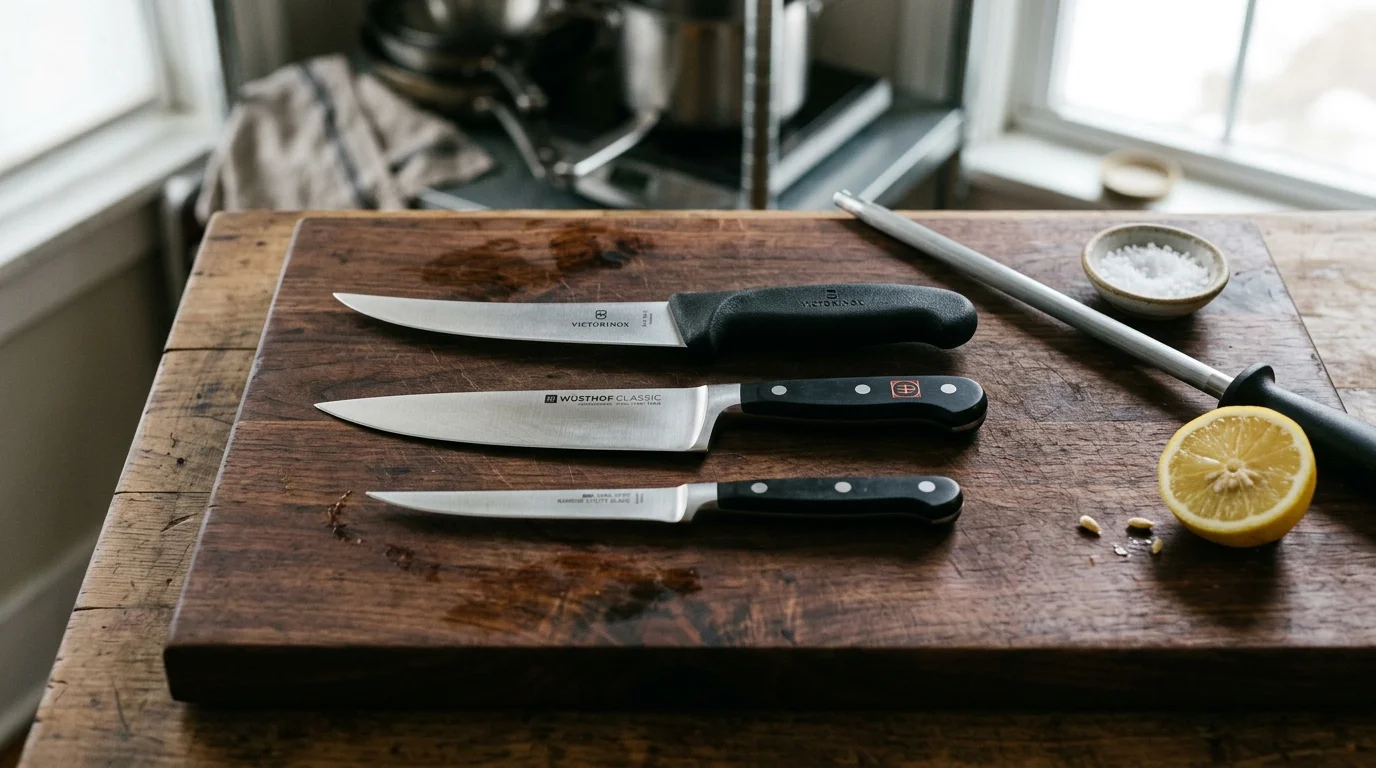
Selecting the right boning knife transforms your weekend prep routine. We evaluated the top three commercial and culinary options suited for handling ten-pound batches of chilled poultry.
Our “Best Value” pick is the Mercer Culinary Millennia 6-Inch Curved Boning Knife (Model M13113). It features high-carbon Japanese steel paired with an ergonomic santoprene-and-polypropylene handle.
The textured handle offers exceptional grip even when your hands become wet or greasy. At roughly fifteen dollars, it provides professional-grade slicing geometry at an unbeatable entry-level price point.
Our “Best for Beginners” recommendation is the Victorinox Fibrox Pro 6-Inch Stiff Boning Knife (Model 5.6003.15). Made in Switzerland from proprietary stainless steel, this blade is an industry standard.
The blade features an ultra-stiff spine that tracks laser-straight through chilled meat. The non-slip Fibrox handle prevents hand fatigue across long cutting sessions.
The Victorinox blade is stamped rather than forged, keeping total knife weight low. This lightweight build lets novice meal-preppers slice for thirty minutes without joint fatigue.
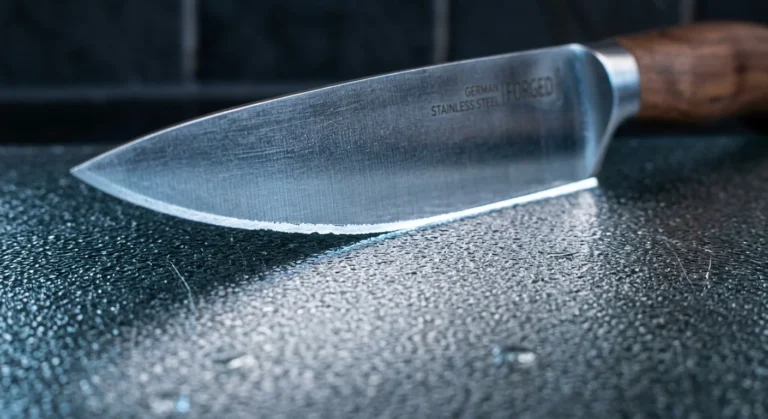
Our “Best for Serious Cooks” selection is the Wüsthof Classic 6-Inch Stiff Boning Knife (Model 1040101416). Forged from a single blank of German X50CrMoV15 steel in Solingen, Germany, it represents exceptional heirloom build quality.
The Wüsthof features a substantial full tang and a precision-crafted bolster for flawless balance. Its 58 HRC edge profile glides effortlessly through cold meat fibers while retaining its edge for months.
“A stiff boning knife should feel like a natural extension of your forearm. Balanced heft and a slip-resistant handle are mandatory when handling cold, slick poultry.”
All three models deliver the narrow blade height required to eliminate lateral drag. Choose the knife that matches your budget and prep frequency.
Blade Maintenance: Honing, Sharpening, and Board Care
Semi-frozen meat is hard on fine knife edges. Cold temperatures stiffen animal collagen, accelerating edge wear on high-carbon and stainless steels alike.
To preserve your knife, you must understand the difference between honing and sharpening. Both techniques are necessary, but they serve entirely different maintenance roles.
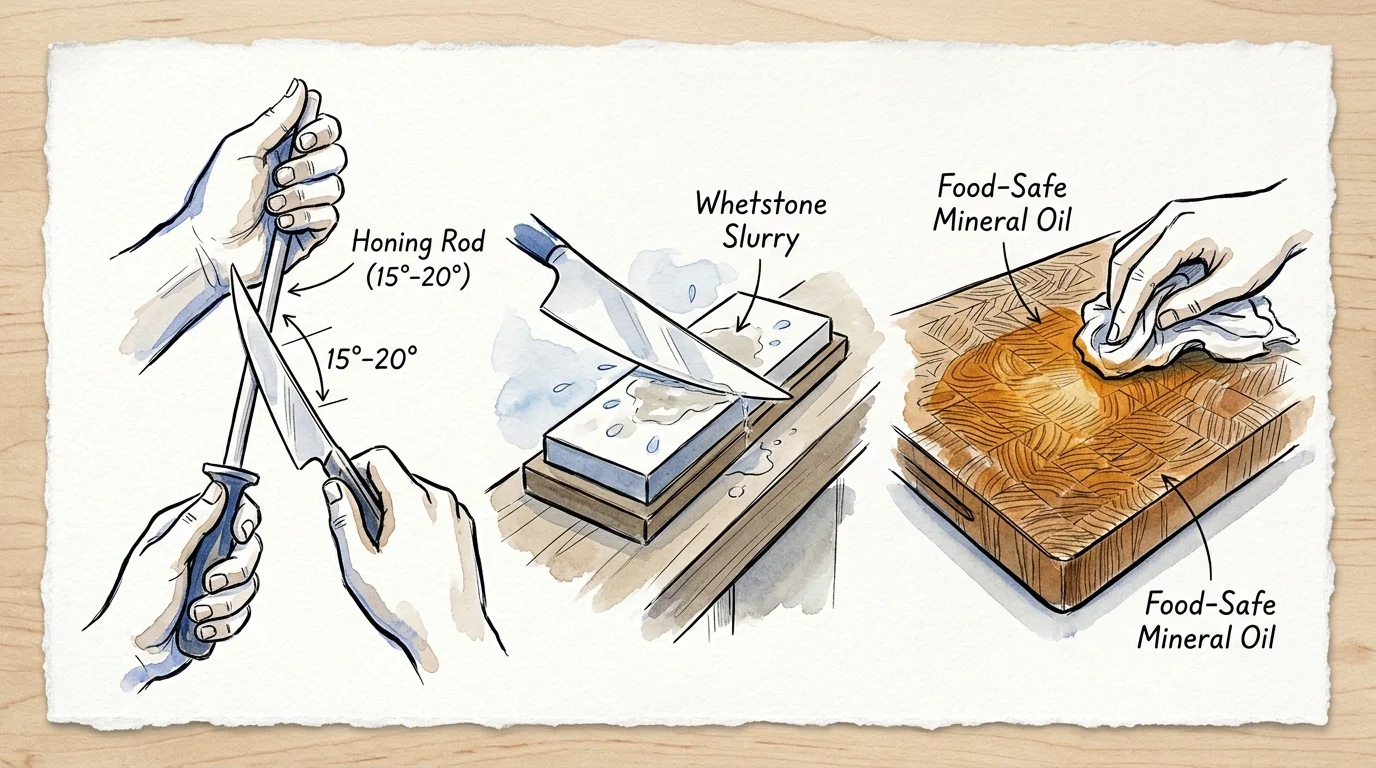
Understand that honing means realigning the blade edge (doesn’t remove metal, just straightens it). Regular honing pushes micro-teeth back into a straight row after hard slicing sessions.
In contrast, sharpening means actually removing metal to create a new edge. Sharpening grinds away worn steel on whetstones to restore a razor-sharp apex.
Before every ten-pound chicken prep session, run your boning knife along a ceramic or grooved steel honing rod. Five gentle passes per side at a fifteen-degree angle restore peak slicing efficiency.
Depending on your prep frequency, plan on sharpening your boning knife every three to four months. Use a 1000-grit water stone to establish a keen primary cutting bevel.
Never put your culinary knives into an automatic dishwasher. Dishwasher detergent contains harsh abrasive salts that erode delicate cutting edges in a single wash cycle.
Furthermore, high heat cycles expand and contract handle scales, degrading rivets and loosening the blade tang. Wash your knife immediately after use with warm water and mild liquid soap.
Dry the blade instantly with a clean towel before storing it in an edge guard or on an in-drawer wooden knife dock.
Pair your knife with an NSF-certified high-density polyethylene (HDPE) cutting board. Plastic boards sanitize thoroughly in hot water and protect your knife edge during heavy weekly prep sessions.
Frequently Asked Questions
Why shouldn’t I use a flexible fillet knife for semi-frozen chicken?
Flexible fillet knives bend under moderate lateral resistance. When you push a flexible blade through semi-frozen meat, the steel wanders, creating uneven cutlet thickness and increasing accidental slip hazards.
How long should I semi-freeze raw chicken breasts before slicing?
Place raw chicken breasts in your freezer on a flat sheet pan for thirty to forty minutes at 0°F. The outer quarter-inch should feel firm to the touch, while the core remains soft and pliable.
Can I slice fully frozen rock-solid chicken breast with a boning knife?
No, you should never attempt to cut rock-solid frozen meat with any kitchen knife. Fully frozen poultry will chip, warp, or crack fine cutlery steel and poses severe slip-and-injury risks.
What edge angle should I use when sharpening my poultry boning knife?
Sharpen your poultry boning knife to an angle of fifteen degrees per side. This angle creates an ideal balance between razor sharpness for slicing chilled meat and structural edge durability.
Disclaimer: Product prices and availability change frequently. Prices shown were accurate at time of writing but may have changed. We may earn a small commission from purchases made through links on this site, at no extra cost to you. Always use cutting tools carefully and follow manufacturer safety guidelines.

1 Comment