
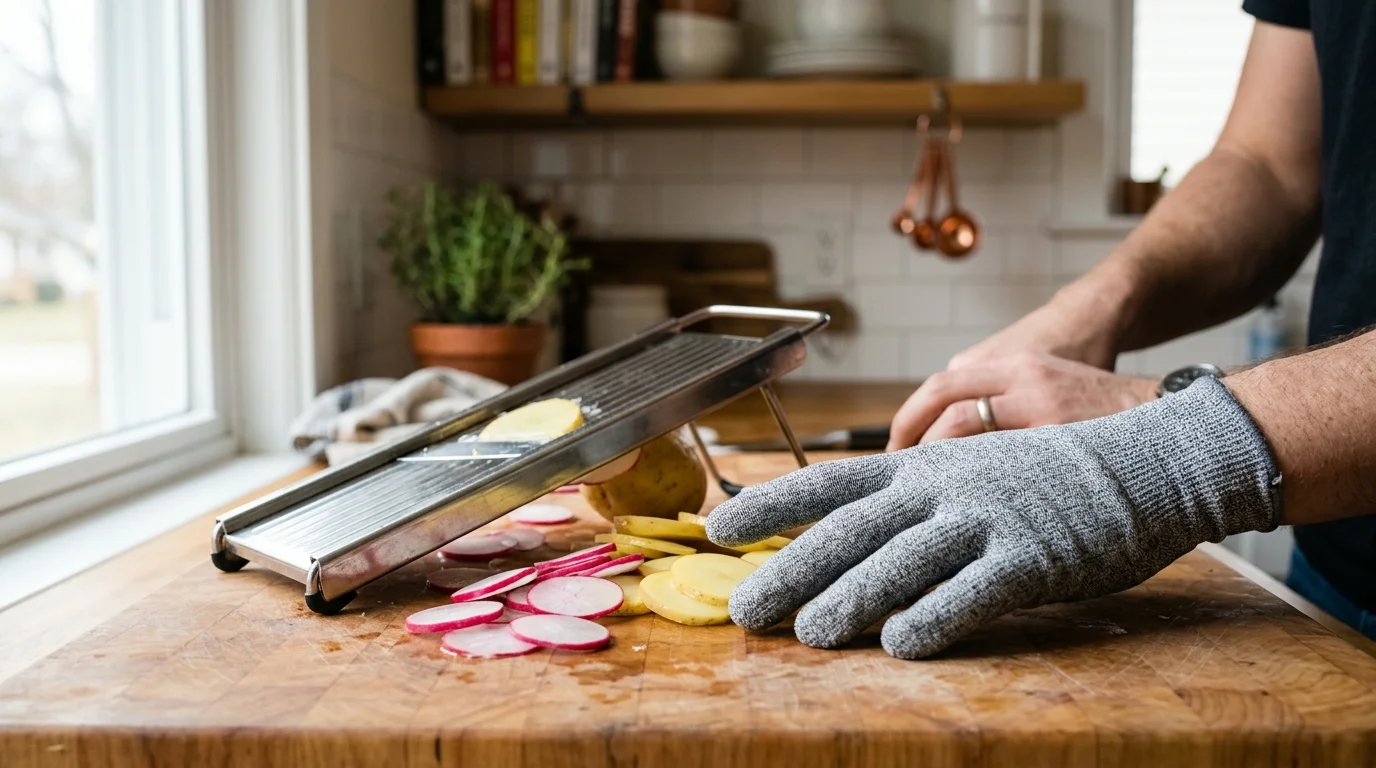
That budget flat-bed mandoline sitting untouched in your kitchen cabinet does not have to remain a source of terror. A mandoline—a flat cutting tool with adjustable blades for uniform slicing—often intimidates cooks after a single close call.
Pairing your mandoline setup with the right vegetable peeler also ensures smooth, slip-free skin removal before any slicing begins.
You can conquer your slicing anxiety without abandoning your sharp flat slicer for an underpowered gadget. Pairing your current slicer with an $11 cut glove delivers faster prep and simpler sanitation than buying a bulky enclosed hopper.
By evaluating cut-resistant weave ratings against spring-loaded mechanical barriers, you can choose the exact safety system that restores your kitchen confidence. Here is how both systems compare when put to the test.

The Mandoline Injury Reality: Avulsions vs. Lacerations
Mandoline slicers send thousands of home cooks to medical facilities every single year. According to data from the U.S. Consumer Product Safety Commission, mandoline slicers account for approximately 16,800 emergency department visits annually.
When breaking down tough root vegetables or squash before slicing, using proper blade geometry for dense produce prevents severe slips during initial prep.
The type of injury sets the mandoline apart from ordinary kitchen cutlery. Standard kitchen knives primarily cause clean lacerations, while avulsions represent only about 3% of knife-related emergency visits.
Mandoline injuries result in tissue avulsions roughly 35% of the time. An avulsion shears off surface skin, fingernail, or subcutaneous tissue completely, leaving a wound that stitches cannot repair.
Most budget mandolines ship with a cheap, spiked plastic food guard. These plastic guards slip off dense vegetables like sweet potatoes and beets, prompting cooks to discard them mid-prep.
Once you discard the guard, a moment of split-second distraction or vegetable slip sends your bare skin into a razor-sharp blade. To prevent mandoline finger injury, you must eliminate bare-skin exposure entirely.

Cut-Resistant Glove Standards: Decoding ANSI A5 and EN 388
Food-prep safety gloves rely on industrial testing standards to prove their defensive capability. The American standard, ANSI/ISEA 105, measures cut resistance using the ASTM F2992-15 test method on a specialized machine called a Tomodynamometer.
Beyond wearing safety textiles, keeping loose mandoline blades and sharp cutlery organized with dedicated knife storage solutions eliminates reaching into dangerous drawers.
Because most cut gloves are completely ambidextrous, they rank among the most adaptable left-handed kitchen tools for cooks frustrated by right-hand biased safety guards.
This test measures how many grams of cutting load a fabric withstands before blade penetration occurs. For mandoline prep, you should look specifically for gloves rated ANSI Level A4 or Level A5.
An ANSI Level A4 glove withstands 1,500 to 2,199 grams of cut force. An ANSI Level A5 glove endures 2,200 to 2,999 grams of direct blade pressure, stopping aggressive slicing slips instantly.
You will also encounter European ratings marked under the legacy EN 388 standard. Older kitchen gloves frequently advertise a “Level 5” score, which represents the highest cut score under the original 1-to-5 scale.
Modern EN 388:2016 standards use an A-through-F rating scale identical to the ANSI framework. A glove rated Level D, E, or F under the updated EN 388 protocol guarantees heavy-duty resistance against straight-edge blades.
Manufacturers weave mandoline cut resistant gloves from high-performance polyethylene (HPPE), Kevlar aramid fibers, or stainless steel wire cores. High-quality pairs retail between $10 and $18, making them an accessible safety upgrade.
Never confuse cut resistance with puncture resistance. Woven fibers stop a sweeping blade edge across your fingers, but pointed knife tips can still push through the weave.
Heat degrades synthetic fibers rapidly. You can wash cut-resistant gloves in your washing machine on a gentle cycle, but you must hang them to air dry away from direct heat.
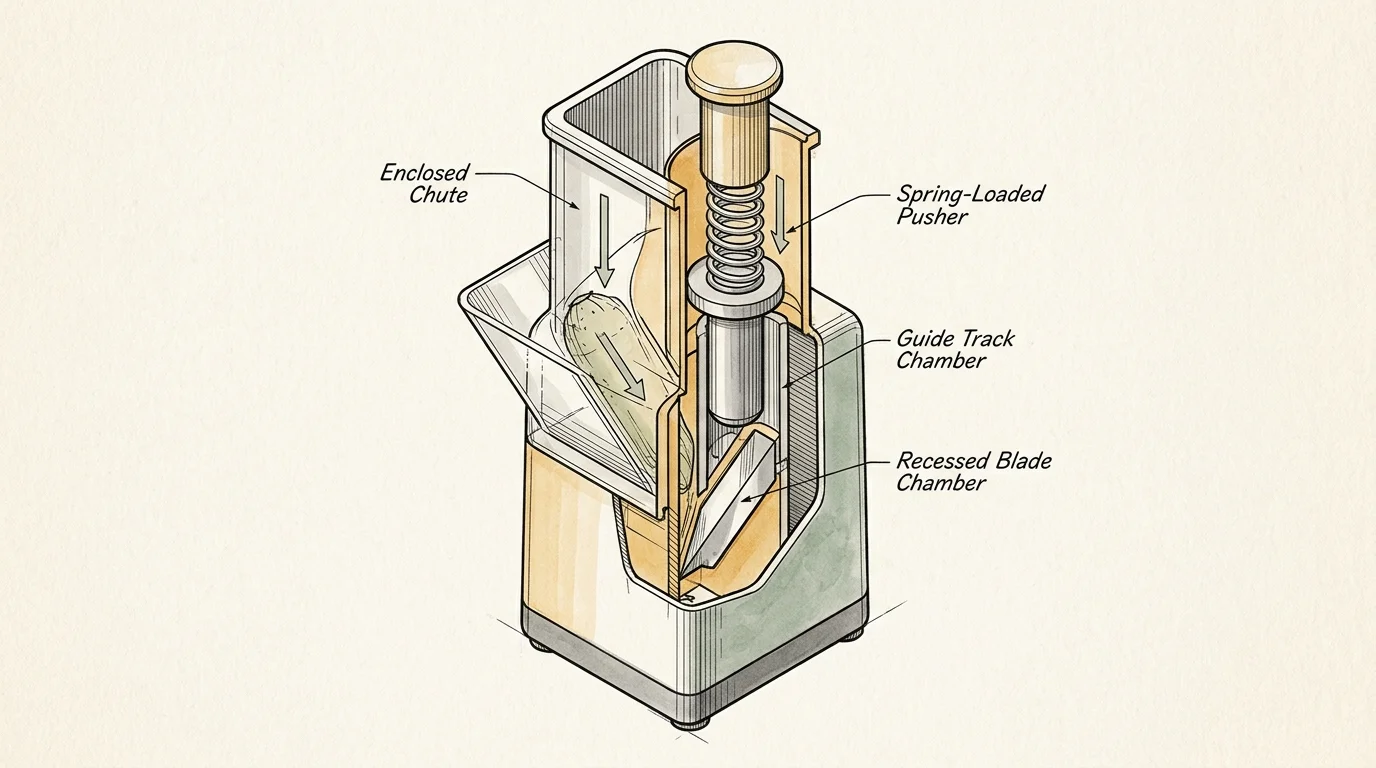
Enclosed Food Chutes: How Spring-Loaded Pushers Work
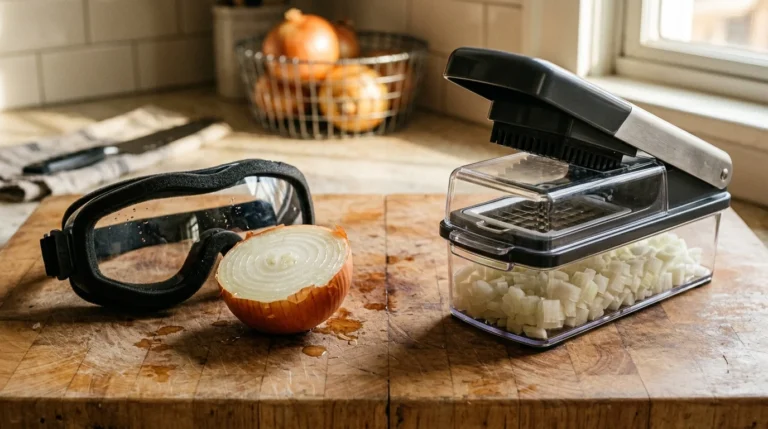
Enclosed chute mandolines take a purely mechanical approach to kitchen safety. Instead of passing your hand over an exposed horizontal blade, you insert produce into a vertical guide chute.
Home cooks who want high-volume shredding without manual lever pumping often opt for electric graters to completely automate their vegetable prep.
In much the same way that rotary graters compare to box graters, enclosed chute slicers sacrifice direct surface speed in exchange for protective mechanical housing.
A spring-loaded plunger pushes the vegetable down toward an internal blade assembly. You depress an external lever or reciprocating top handle to drive the blade through the produce.
This mechanical architecture keeps your fingertips completely outside the cutting zone during operation. Brands like Dash and ONCE FOR ALL have popularized these upright units, pricing them between $30 and $50.
Most enclosed models offer variable slice thicknesses ranging from 1 mm up to 8 mm. You adjust a rear dial to alter blade depth without handling separate metal plates.
These units eliminate the visceral dread that causes cooks to abandon their prep tools. The enclosed housing serves as an absolute physical barrier between moving steel and human tissue.
That mechanical isolation comes with geometric limitations. The feed chute diameter measures between 2.5 and 3 inches on standard models, forcing you to pre-cut large produce before slicing.
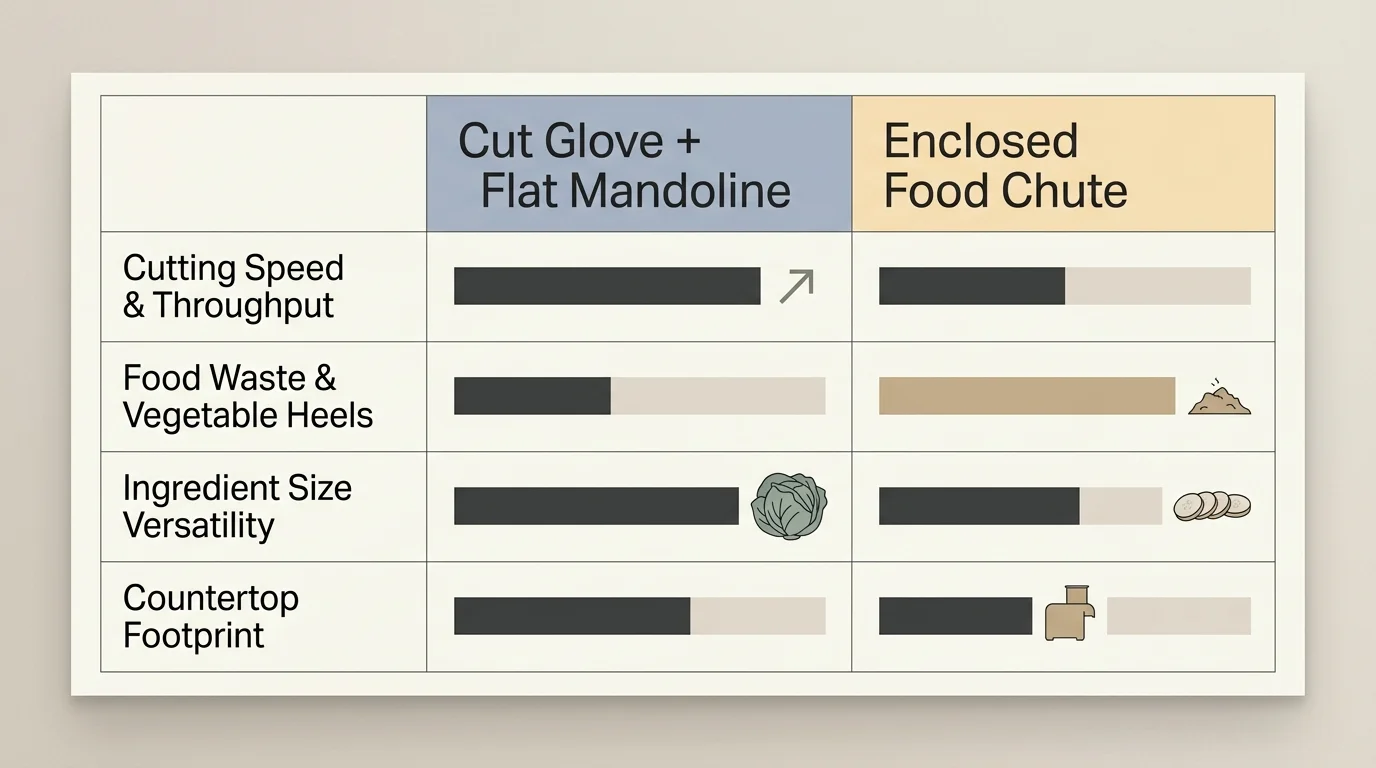
Head-to-Head Comparison: Cutting Speed, Waste, and Versatility
Selecting between cut gloves and enclosed chutes requires balancing slicing efficiency against hand isolation. A traditional flat mandoline with a cut glove allows natural, full-stroke arm movement across the blade.
While mandolines excel at hard produce, soft fruits with slick skins are often prepped more safely using specialized serrated tomato knives to prevent crushing.
While flat slicers create flawless matchsticks, home cooks looking to produce continuous veggie noodles or ribbons often pair their setup with vegetable spiralizers for even more cut variety.
Enclosed chute slicers require a repetitive pumping motion on a mechanical lever. This mechanism creates rapid downward slicing, but dense root vegetables generate significant mechanical resistance on the handle.
Vegetable geometry also dictates how much prep time you spend before slicing begins. On a traditional wide mandoline, you can slice a whole softball-sized onion or beefsteak tomato in seconds.
Enclosed food chutes force you to quarter that same onion to fit the feed tube. This extra knife work undermines the time-saving purpose of owning a specialized slicing appliance.
Traditional flat boards excel at producing long, continuous cuts like eggplant planks or ribboned zucchini. Upright chutes restrict cutting length to the vertical height of the feed chamber.
Both systems can julienne—a technique for cutting vegetables into thin matchstick strips. Flat mandolines use integrated pop-up comb teeth, while vertical pushers use secondary dial-activated blade arrays.
| Feature / Metric | Traditional Slicer + ANSI A5 Glove | Enclosed Food Chute Slicer | Traditional Slicer + Stock Plastic Guard |
|---|---|---|---|
| Safety Isolation Mechanism | Physical cut-resistant textile barrier on hand | Enclosed mechanical blade chamber with plunger | Spiked plastic pusher plate (unsecured) |
| Average Tool Cost | $35–$60 (Slicer) + $12 (Glove) | $30–$50 (Complete unit) | $25–$60 (Complete unit) |
| Chute / Blade Width Capacity | 3.5 to 4.5 inches (Full width) | 2.5 to 3.0 inches (Chute bound) | 3.5 to 4.5 inches (Full width) |
| Slice Thickness Range | 0.5 mm to 9.0 mm (Continuous) | 1.0 mm to 8.0 mm (Indexed stops) | 1.0 mm to 9.0 mm (Indexed stops) |
| Prep Speed (5 lbs Potatoes) | Under 4 minutes | 7 to 9 minutes (Pre-trimming needed) | 6 to 8 minutes (Frequent slippage) |
| End-of-Vegetable Scrap Waste | Under 5% (Glove allows full stroke) | 10% to 15% (Chute base gap) | 15% to 25% (Guard loses grip) |
| Dishwasher Compatibility | Glove: Machine wash; Slicer: Hand wash | Top-rack safe (Difficult crevice drying) | Top-rack safe |
Traditional stock guards consistently produce the highest amount of food waste. When the spikes lose traction, cooks throw away thick vegetable ends rather than risk cutting their fingers.
A glove wearer can hold produce down to the final millimeter with total confidence. The enclosed pusher also leaves an un-sliced nubbin at the base where the plunger stops short.
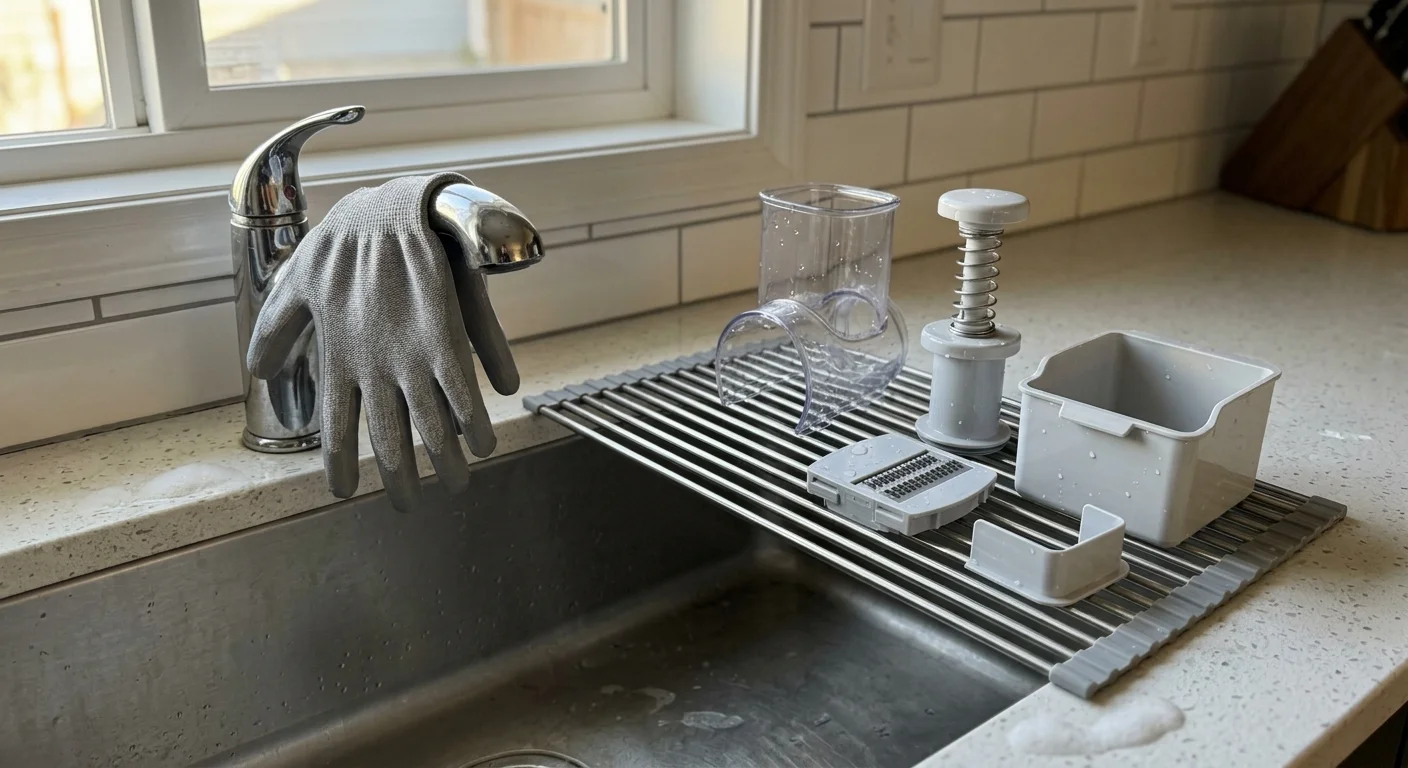
Cleaning and Sanitation: Fabric Care vs. Mechanical Crevices
A safety tool that takes ten minutes to clean will inevitably gather dust in your pantry. Clean-up speed often determines whether a gadget becomes part of your regular cooking routine.
For home chefs who want quick meal prep without washing intricate cutting blades, versatile salad choppers offer a fast and dishwasher-friendly alternative.
When counter and sink space are tight, flat slicers easily rank among the best prep tools engineered to fit slimline dishwashers without jamming upper racks.
Maintaining a cut-resistant glove requires minimal effort after meal prep. You simply rinse the glove under warm running water with dish soap while still wearing it, then peel it off to air dry.
You can also drop food-grade HPPE gloves into a standard washing machine cycle. Always use cold water and mild detergent to avoid breaking down the elastomeric core yarns.
Cleaning an enclosed chute slicer presents mechanical challenges. Starches, seeds, and vegetable fibers pack tightly into the internal blade housing, spring hinges, and gear tracks.
According to Serious Eats equipment reviews, intricate kitchen tools with internal moving parts collect stubborn debris that simple water rinses cannot dislodge. You must use a specialized bristle brush to clear these passages safely.
Never reach your fingers into an enclosed chute to clear a jammed potato wedge. The internal spring mechanism can snap forward, pushing the wedged food and your finger directly into the hidden cutting edge.
Flat mandolines offer a wide-open surface that cleans completely in under sixty seconds. Using an easy clean mandoline shield or glove eliminates the need to negotiate complex internal tracks.
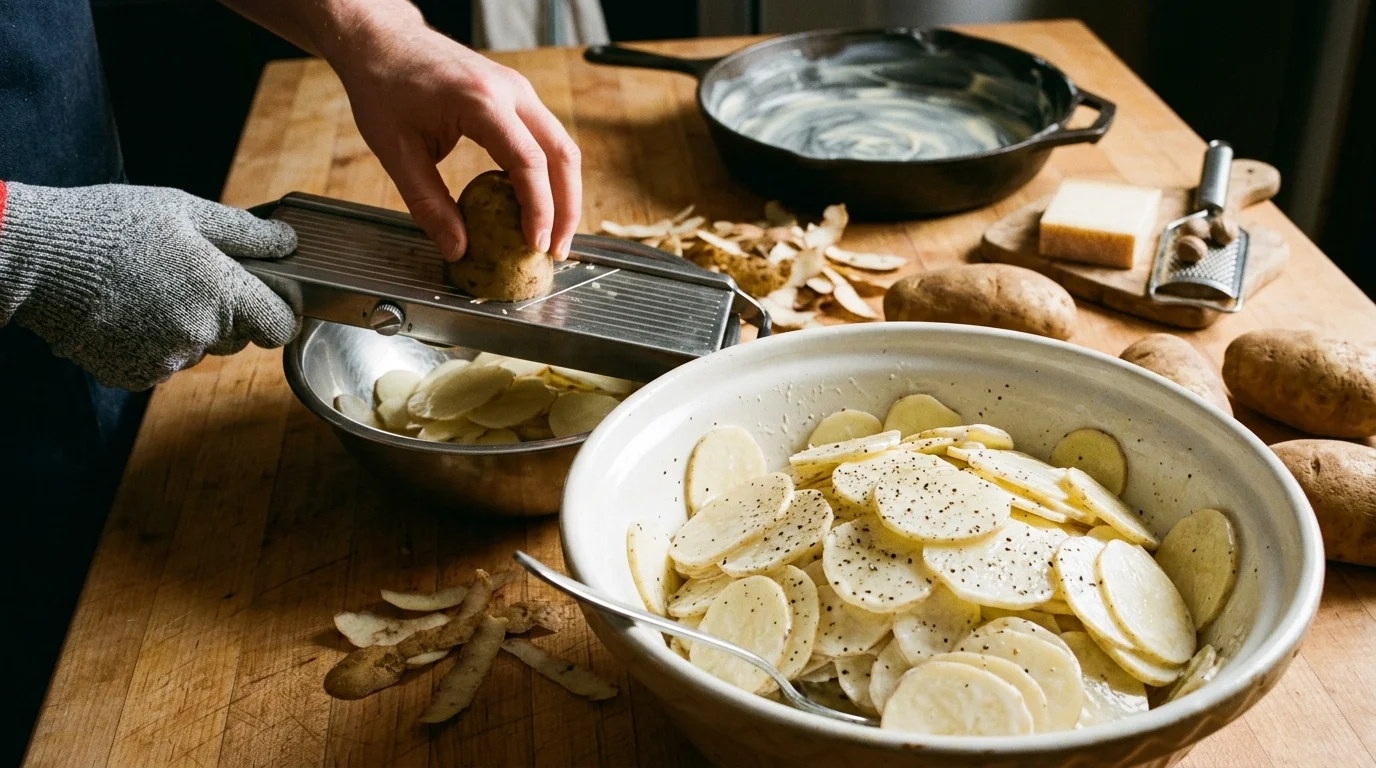
Worked Example: Prepping 5 Pounds of Potatoes for Gratin
Consider a real-world kitchen scenario: preparing a classic Potato Gratin Dauphinois requiring five pounds of Russet potatoes. Achieving uniform cooking demands consistent 2.5 mm slices across eight medium potatoes.
Before slicing five pounds of Russets to exact thickness, using one of the best vegetable peelers streamlines the initial skin removal so your prep station runs efficiently.
This prep job highlights the practical differences between an open flat mandoline and an enclosed vertical chute. It illustrates how tool geometry directly impacts your mise en place—having all ingredients prepped and ready before cooking.
Using a traditional Japanese mandoline (such as a 64 mm Benriner, retail $40) paired with an ANSI Level A5 cut glove ($12), prep begins instantly. You rinse the peeled potatoes and grasp the first tuber directly in your gloved hand.
Each potato glides across the blade in long, fluid strokes without hesitation. You slice all eight potatoes down to paper-thin end skins in exactly 3 minutes and 45 seconds.
Total end scrap measures just 0.4 ounces across the entire five-pound batch. Sinks-side cleanup of the flat cutting board and blade takes 45 seconds under warm water.
Now consider the same task using an enclosed vertical chute slicer (retail $39.99). You set the thickness adjustment dial to the matching 2.5 mm marking.
The chute opening measures 2.8 inches across, but standard Russet potatoes average 3.5 inches in length and 2.5 inches in width. You must spend 2 minutes using a chef’s knife to trim each potato to fit the chamber.
Operating the spring-loaded pump handle requires five to six downward depressions per potato half. Processing all sixteen trimmed halves takes 4 minutes and 30 seconds of active pumping.
The plunger stops 4 mm above the internal blade, leaving an un-sliced scrap slab from every piece. Total discarded potato scrap measures 3.2 ounces—eight times more waste than the glove method.
Clearing potato starch and trapped skin fragments from the internal housing requires 3 minutes and 30 seconds of bristle brush detailing. Total elapsed time reaches 10 minutes, compared to under 5 minutes with the glove setup.
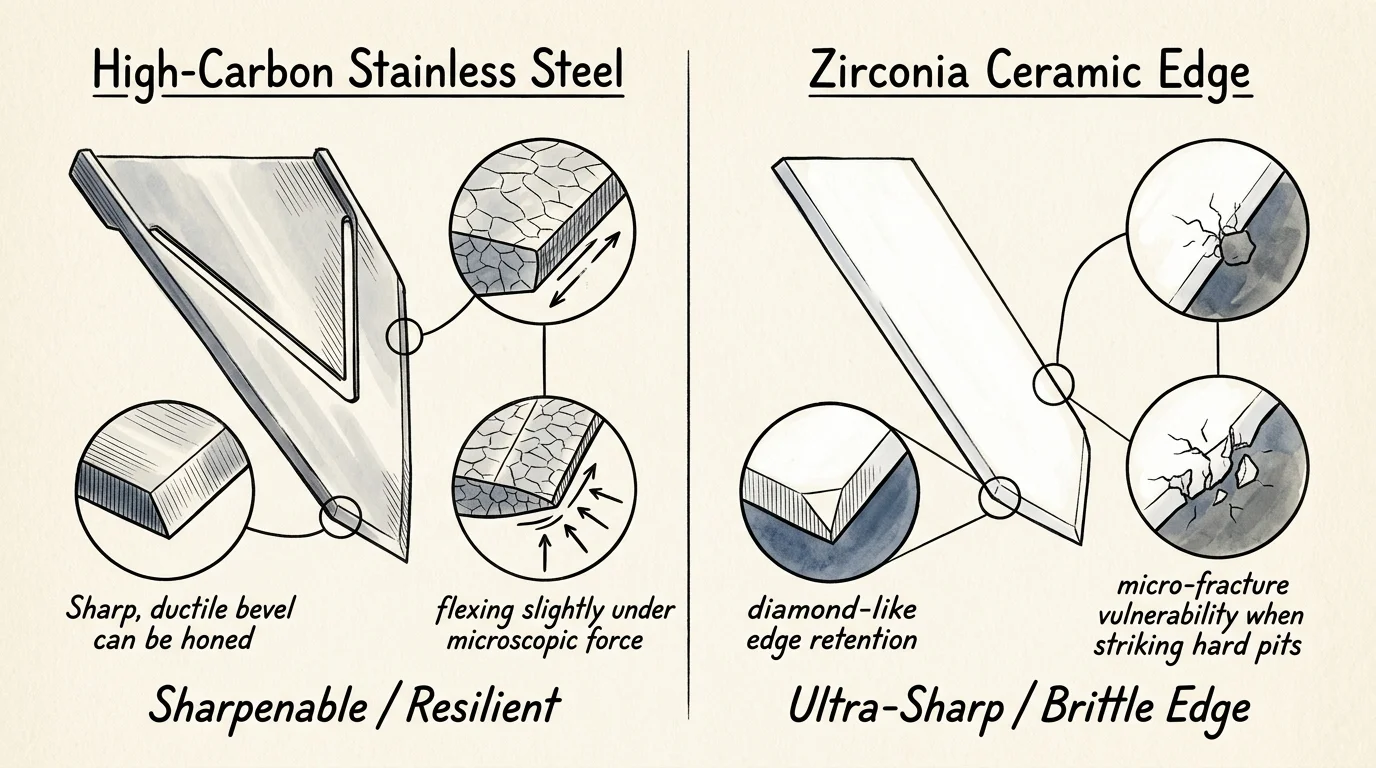
Blade Materials and Edge Longevity: Stainless vs. Ceramic
A mandoline’s safety profile depends heavily on blade sharpness. A dull blade requires excessive downward force, significantly increasing the likelihood of slipping regardless of your chosen safety guard.
Most commercial flat slicers utilize high-carbon Japanese stainless steel blades. This steel holds an acute, razor-sharp bevel angle that parts dense vegetables with negligible resistance.
High-carbon steel resists edge rolling but requires hand drying after washing to prevent micro-corrosion. Many high-end flat models allow you to remove the blade entirely for sharpening on a waterstone.
Enclosed chute mandolines commonly employ stamped 420-grade stainless steel blades fixed permanently inside the housing. Stamped blades hold acceptable utility edges but cannot match the sharpness of ground Japanese cutlery.
You cannot sharpen permanently enclosed blades once they dull from repeated contact with root vegetables. When the internal edge loses its keenness, you must replace the entire plastic appliance.
Ceramic mandoline blades retain their factory sharpness up to ten times longer than budget stamped steel. Ceramic never rusts or reacts with acidic foods like tomatoes and lemons.
Ceramic blades possess zero lateral flexibility and chip easily if you strike an unexpected fruit pit or bone. For heavy-duty meal prep, hardened stainless steel remains the most dependable option.
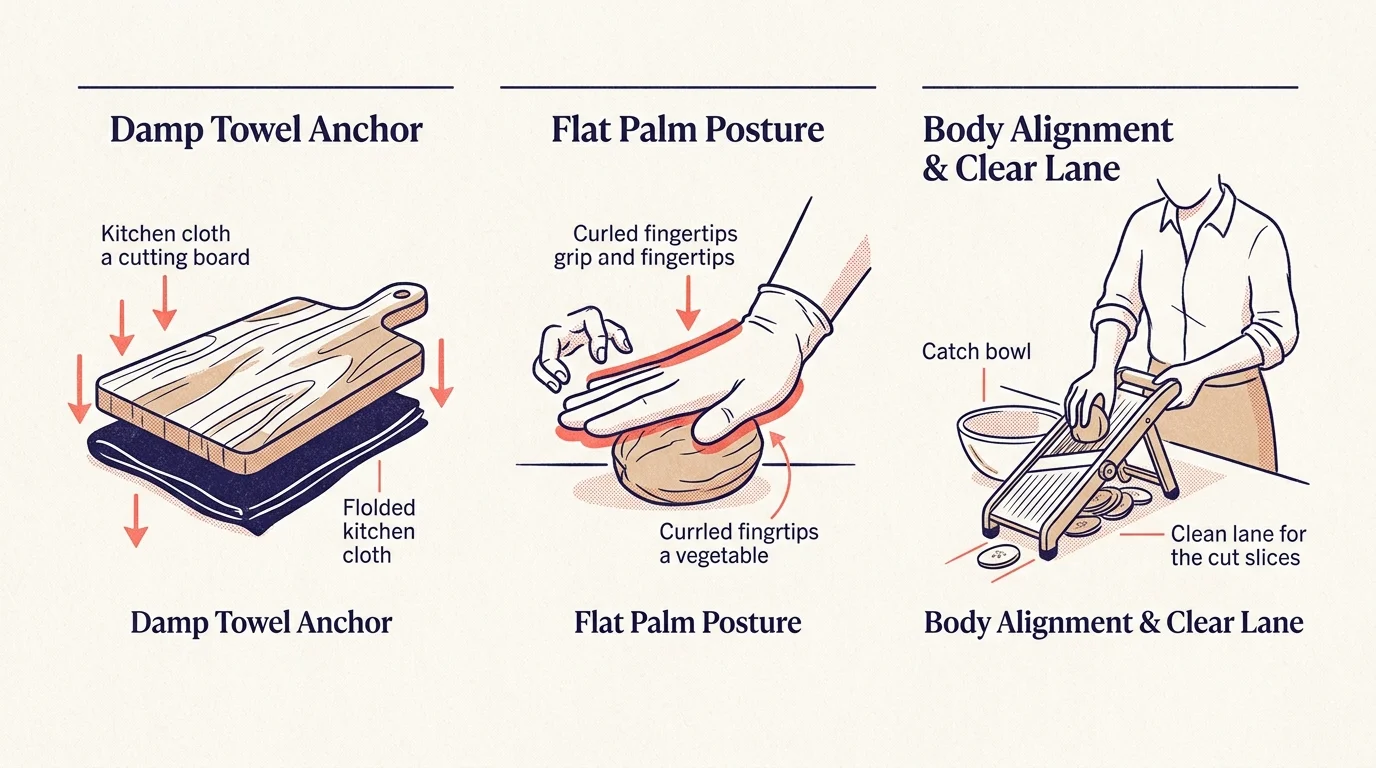
Safety Technique Checklist: Eliminating the Slip Factor
Personal protective equipment functions best when supported by proper kitchen mechanics. Establishing stable cutting conditions dramatically reduces the force required to slice vegetables cleanly.
Always secure your workspace before taking the mandoline out of storage. A tool that slides across the countertop creates immediate danger for the operator.
“A sharp blade is predictable, but an unstable cutting surface creates absolute chaos. Stabilizing your equipment is the first rule of efficient prep.” — Culinary Safety Instructor
Follow these baseline operational steps every time you prep with an open flat slicer:
- Damp Towel Anchor: Fold a damp flour-sack towel or non-slip silicone mat beneath your slicer feet to lock the frame to the counter.
- Glove First, Blade Second: Put your ANSI A5 cut-resistant glove on your dominant guide hand before removing the blade guard or adjusting thickness screws.
- Flat Palm Pressure: Keep your fingers flattened backward and apply force through the center of your palm rather than pinching produce edges.
- Controlled Rhythm: Move at an even, rhythmic pace; rushing increases bounce and causes vegetable wedging.
- Stop at the Stub: When produce wears down to the final half-inch, transfer the remaining nub to your soup scrap container.
Never adjust slice thickness by pulling upward on the cutting bed while facing the blade. Always grip the tool frame from the rear when turning adjustment knobs.
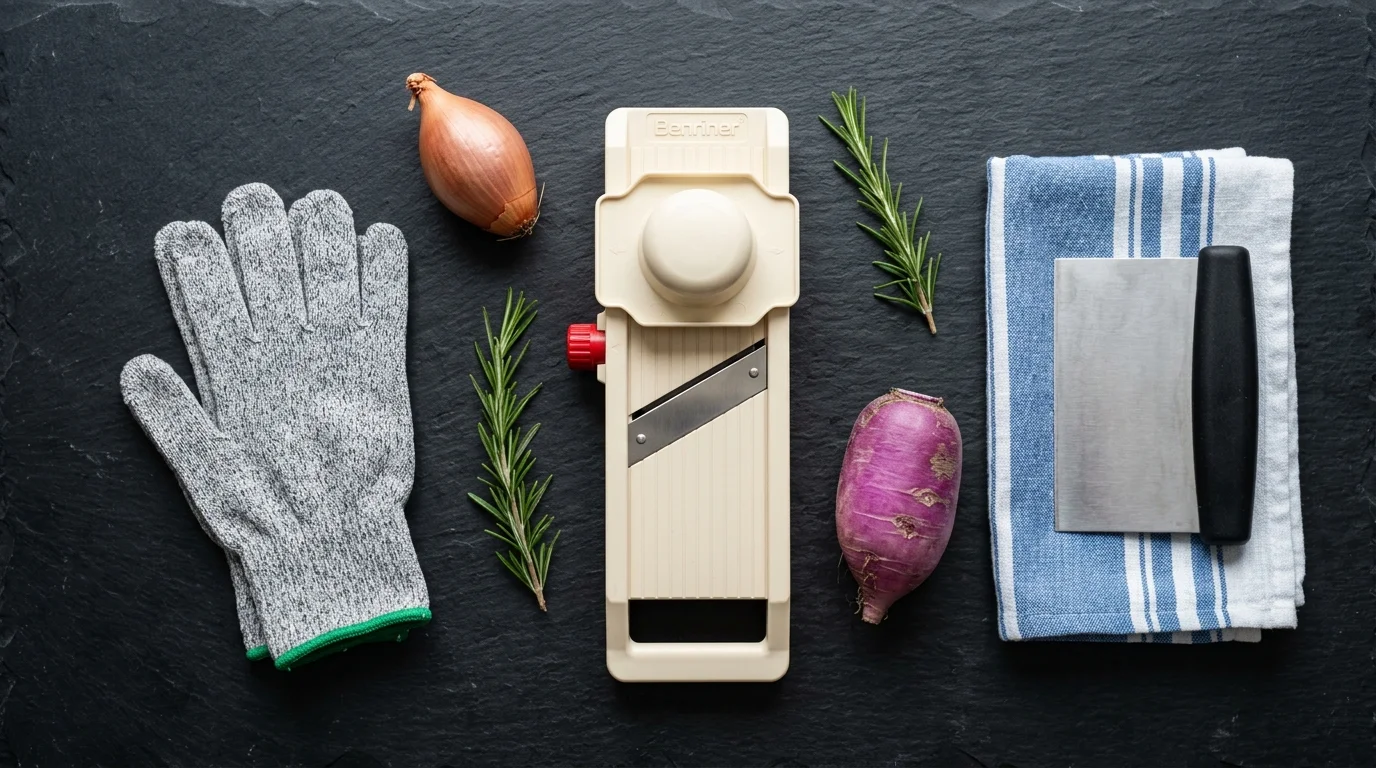
Top Equipment Recommendations for Confident Prep
Selecting the right setup depends on your personal risk tolerance and typical cooking volume. If you already own an open horizontal mandoline, do not throw it away.
Best Safety Solution for Your Existing Slicer: Buy a pair of NoCry ANSI A5 Cut Resistant Gloves ($11.99). They provide industrial-grade protection, full finger dexterity, and machine-washable convenience.
These gloves let you tackle sweet potatoes and cucumbers at full speed using your current mandoline. They eliminate the terrifying slip hazards that cause common kitchen lacerations.
Best Traditional Flat Mandoline: The Benriner Classic Super Slicer ($40) remains the gold standard for home kitchens. Its Japanese carbon steel blade slices paper-thin radishes with surgical precision.
The Benriner includes interchangeable combs for fine, medium, and coarse julienne cuts. Pair this slicer with an ANSI A5 glove to bypass the flimsy stock plastic pusher entirely.
Best Enclosed Option for Anxious Beginners: The Dash Safe Slice Mandoline ($39.99) is ideal if you refuse to expose fingers to a naked blade. Its spring-loaded plunger and enclosed blade assembly completely eliminate blade contact.
The Dash slicer features a convenient thickness dial and fold-out stabilization legs. It works wonders for soft vegetables, though you must trim large produce to fit its 2.8-inch hopper.
Best Value Upright Alternative: The ONCE FOR ALL Upright Food Slicer ($34.99) delivers comparable chute-based safety at a lower price point. Its suction cup feet adhere securely to smooth stone countertops during use.
Frequently Asked Questions
Can a mandoline blade cut through an ANSI A5 glove?
An ANSI A5 glove withstands up to 2,999 grams of cutting force, preventing straight slicing cuts from ordinary mandoline slips. However, excessive downward stabbing force can pierce between the woven threads, as cut gloves are not puncture-proof.
Can I wash cut-resistant gloves in the dishwasher?
You should avoid washing cut gloves in the dishwasher because high drying temperatures degrade the internal elastomeric and polyethylene fibers. Instead, wash them by hand with warm soapy water or run them through a gentle clothes washing cycle, then hang them to air dry.
Are enclosed chute mandolines difficult to clean?
Enclosed chute slicers require more cleaning effort than flat mandolines because food particles become trapped in the internal blade channels and spring hinges. Most manufacturers include a specialized miniature bristle brush to help sweep vegetable fibers out of these tight mechanical recesses.
Why do traditional mandoline food guards slip off vegetables?
Stock mandoline guards rely on short plastic or metal prongs that penetrate hard vegetables by only a few millimeters. Dense root vegetables resist this shallow grip, causing the guard to tear free from the produce during forward slicing strokes.
Disclaimer: Product prices and availability change frequently. Prices shown were accurate at time of writing but may have changed. We may earn a small commission from purchases made through links on this site, at no extra cost to you. Always use cutting tools carefully and follow manufacturer safety guidelines.


1 Comment