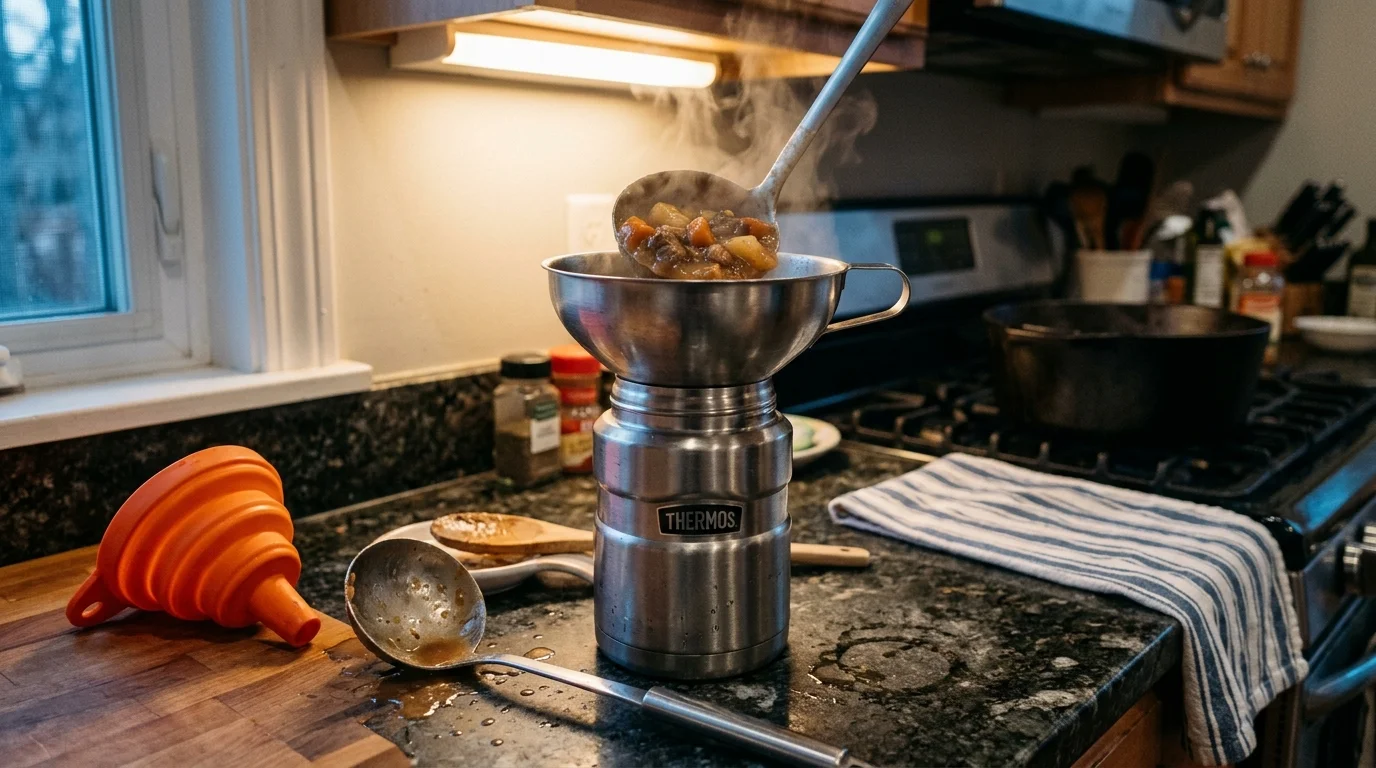
At 5:00 AM before a twelve-hour hospital shift, transferring boiling beef stew into a 2.5-inch thermos neck leaves zero room for error. A sudden spill burns your hands and ruins your schedule.
Much like utilizing insulated containers with neoprene sleeves to manage steam and retain heat during long cooks, hot liquid transfers require hardware engineered to withstand severe thermal stress.
While collapsible accessories save drawer space, they frequently end up as kitchen gadgets you don’t need once you factor in the burns and spills caused by structural failure.
Generic gadget roundups constantly recommend collapsible silicone funnels for easy drawer storage. However, boiling 200°F liquids trigger structural thermal collapse in flexible silicone, risking severe counter scalds.
Investing in a rigid wide-mouth stainless steel food funnel creates a stable, unyielding transfer channel that secures hot meals safely every single morning.
The 5:00 AM Physics: Why Viscous Heat Defeats Silicone
Packing hot meals quickly demands an understanding of fluid dynamics and thermal expansion. Thick stews carry both extreme thermal mass and physical weight.
While home cooks frequently evaluate whether modern silicone kitchen tools are worth the hype for spatulas and baking mats, vertical funnel designs expose the mechanical limitations of flexible polymers.
Manufacturers manufacture flexible funnels using silicone—a flexible, heat-resistant material used in many kitchen tools. Marketing materials frequently claim silicone resists temperatures up to 450°F without melting.
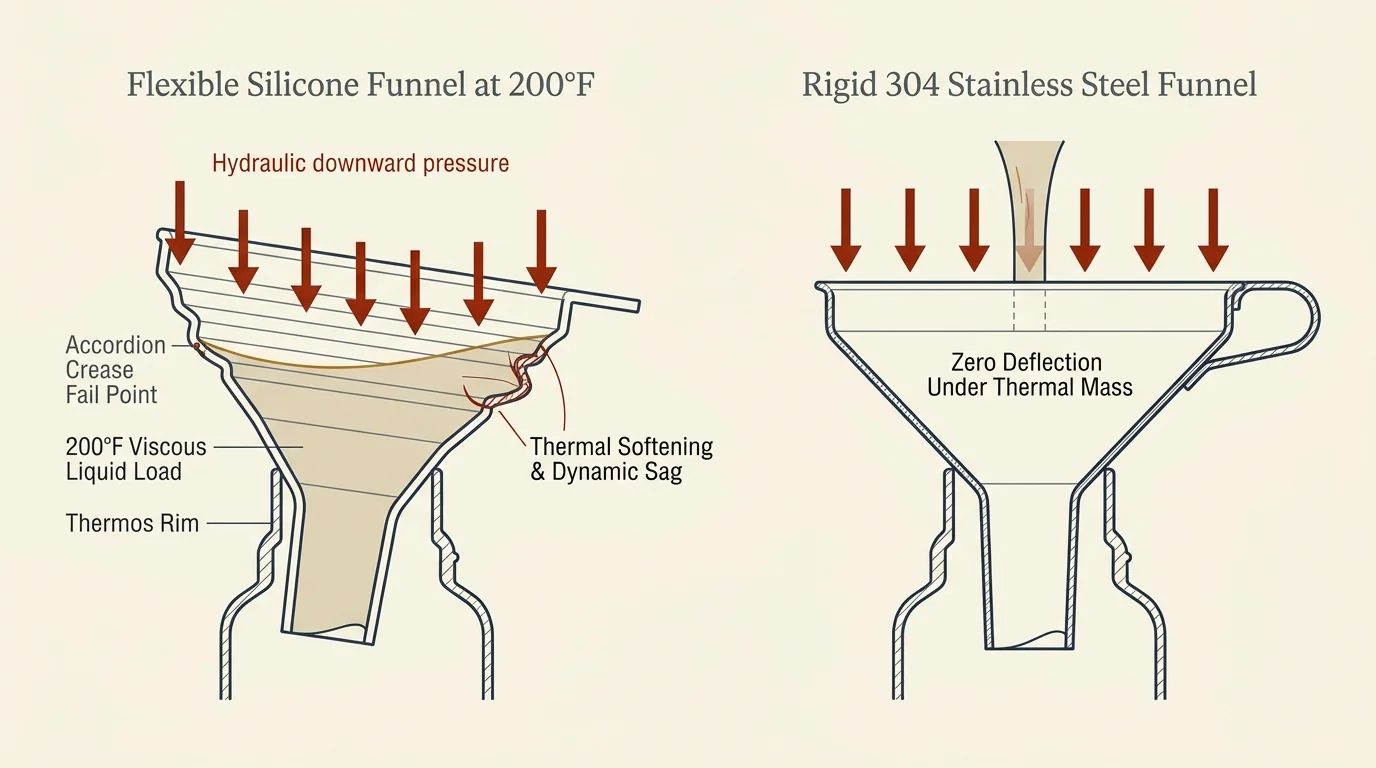
While silicone does not melt at 200°F, extreme heat drastically softens the polymer chains. When hot liquids soften the structure, the material loses its mechanical stiffness.
Pouring dense chili creates heavy downward hydraulic pressure against the funnel walls. If you pour quickly, the funnel cone sags into the opening.
As America’s Test Kitchen observes across equipment testing, structural stability under dynamic load determines whether a hot-prep tool remains safe or becomes a burn hazard.
Collapsible silicone models feature manufactured accordion fold creases. These built-in fold points flex naturally under heat and heavy stews, causing the cone to tilt unexpectedly.
A tilted cone directs boiling gravy over the thermos rim instead of inside the port. You end up with second-degree scalds on your countertop and knuckles.
Material Showdown: 304 Stainless Steel vs. Food-Grade Silicone
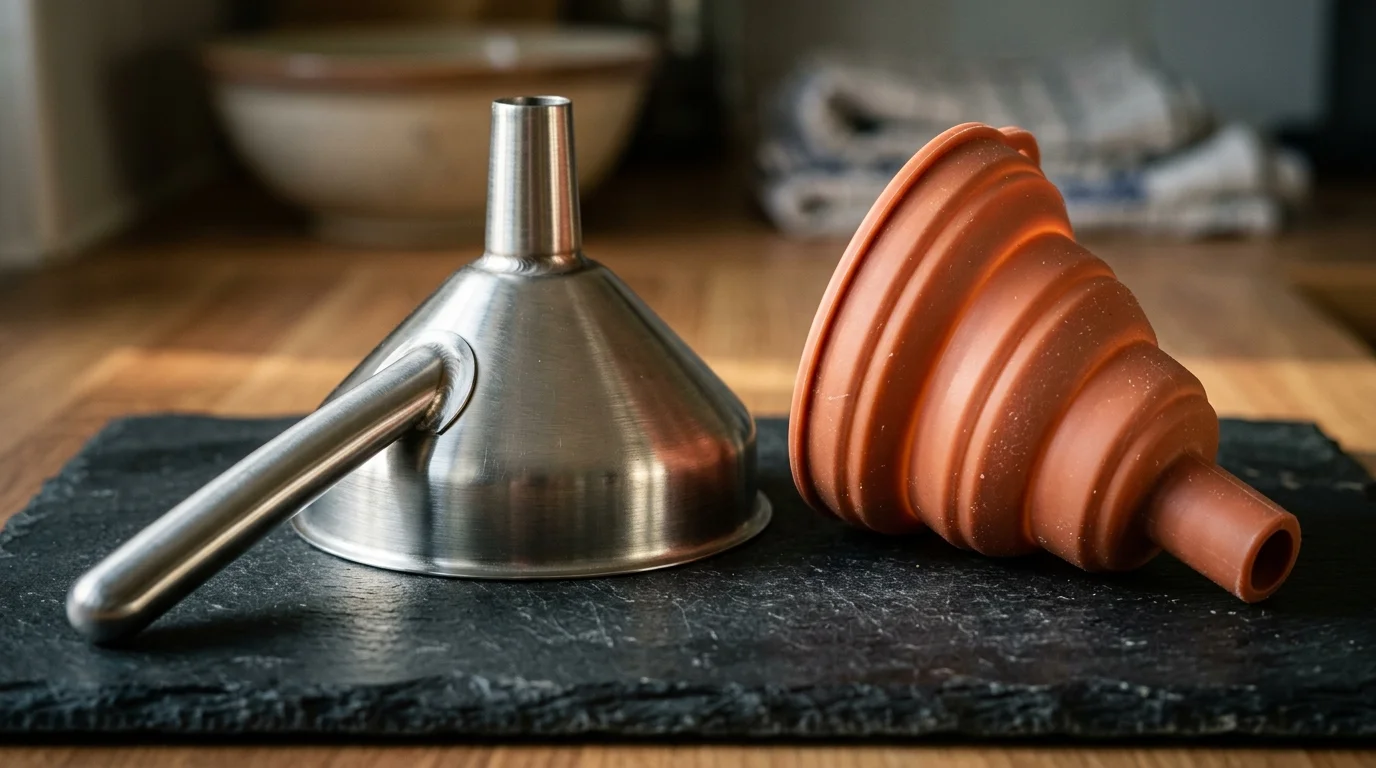
Rigid food transfers require stainless steel—a durable metal that resists rust and staining under extreme temperatures. A proper 304-grade steel maintains rigid geometry whether loaded with iced broth or boiling soup.
This dynamic mirrors the comparison between silicone sink mats and stainless grids, where unyielding metal frameworks consistently outperform pliable alternatives under heavy loads.
While heat-resistant polymers excel in flat formats like silicone baking mats, vertical funnel cones lack the rigidity needed to hold heavy liquids safely.
Silicone brands market their products as BPA-free—made without a chemical (BPA) that some people prefer to avoid. While food-grade silicone remains chemically inert, mechanical flex remains its main operational vulnerability.
“Structural rigidity under dynamic thermal loading separates functional food prep tools from dangerous kitchen gimmicks.” — Industrial Material Standards Review
Because stainless steel absorbs heat rapidly, premium models feature an ergonomic handle. An ergonomic—designed to be comfortable to hold and use—side handle keeps fingers two inches away from hot surfaces.
Some funnels also feature a non-slip grip—handle designed to not slide in your hand, even when wet. This textured grip provides steady control when you hold a three-pound saucepan with the other hand.
Unlike silicone, a metallic wide mouth food funnel cannot buckle, warp, or crimp during a pour. The metal transfers heat to the air without changing shape.
The rigid stem provides a firm mechanical stop against the inner neck of your vacuum flask. This mechanical lock stops the funnel from rocking during heavy transfers.
Neck Clearance and Thermal Flow: Sizing the 2.5-Inch Thermos Port
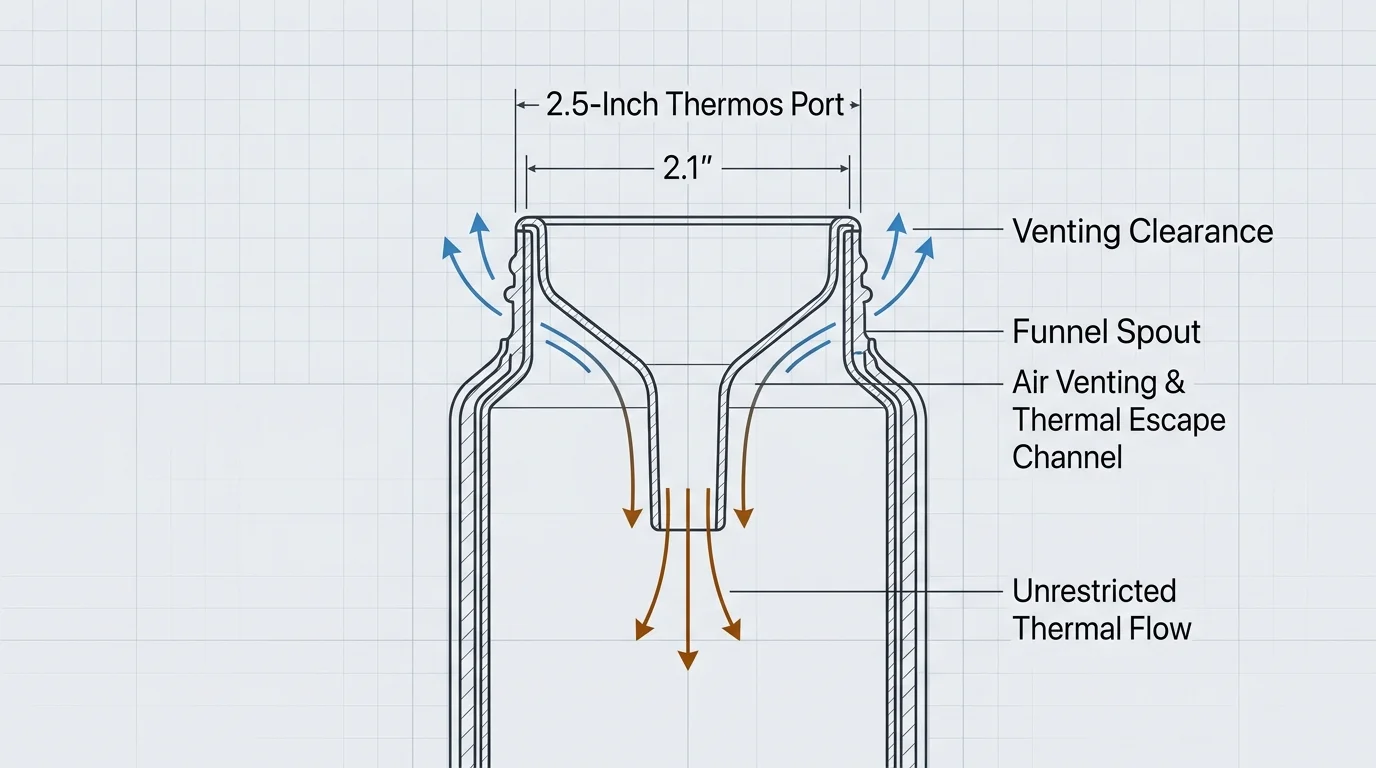
Standard insulated food jars feature internal neck diameters between 2.4 and 2.75 inches. A standard canning funnel for thermos applications needs a base spout diameter between 2.1 and 2.3 inches.
For cooks preparing pureed soups rather than chunky stews, choosing between food mills versus high-shear blenders ensures the liquid reaches an ideal consistency that glides through narrow spouts without resistance.
Similar to choosing the best colanders and strainers, selecting the right transfer tool requires matching opening dimensions directly to the size and density of your ingredients.
If your funnel spout matches the thermos neck width exactly, steam cannot escape around the sides. Trapped thermal air creates an upward vapor lock beneath your stew.
This vapor lock creates giant steam bubbles that burp thick soup backward across your hands. You need a verified 0.2-inch radial exhaust channel around the funnel stem.
Silicone funnels conform to the circular neck, completely sealing off air exhaust pathways. This soft seal traps expanding steam beneath the funnel and leads to messy bubbling.
A heat resistant kitchen funnel made of pressed steel keeps its round profile intact. The steel stem leaves open pathways for escaping steam, which keeps the liquid flowing downward smoothly.
Furthermore, dense meat chunks need at least two inches of internal stem clearance. Narrow funnel necks trap meat pieces, backing up hot gravy into the upper cone.
When the funnel backs up, you must balance a hot pan while dislodging food chunks. A rigid, two-inch steel opening allows large stew chunks to drop straight through without clogging.
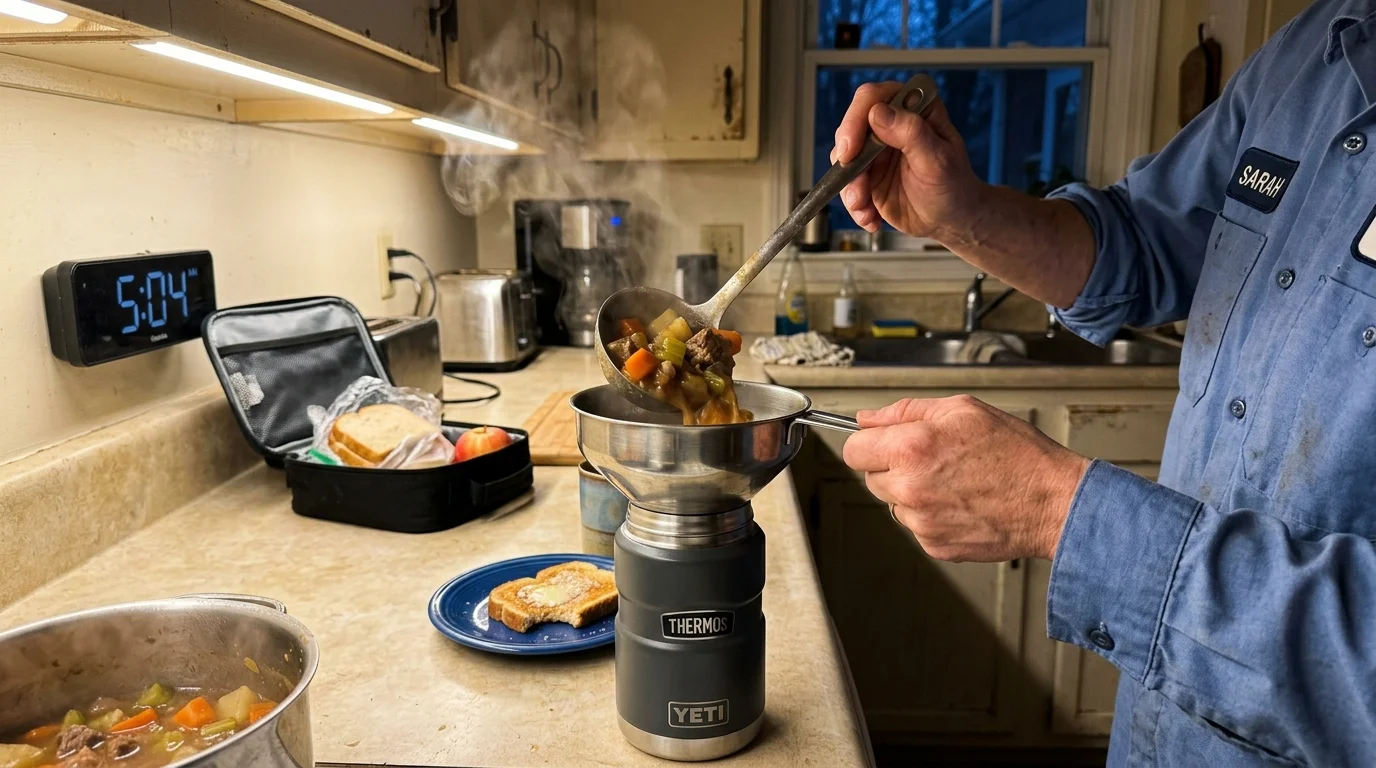
Worked Scenario: The Morning Stew Transfer Calculation
Consider a nurse packing lunch at 5:12 AM before an emergency room shift. The schedule leaves eight minutes to heat food, pack the bag, and commute.
Once sealed, boiling stews cool slightly and create a strong internal vacuum, making under-cabinet jar openers handy for breaking tight lid locks during busy meal breaks.
For busy mornings on the go, packing your soup flask alongside leakproof glass meal prep containers prevents midday leaks and protects work bags.
The nurse heats 16 fluid ounces (473 milliliters) of potato, carrot, and beef stew to 205°F. At an average density of 1.14 grams per cubic centimeter, this meal weighs 540 grams (1.19 pounds).
The target container is a 24-ounce stainless vacuum flask with an internal neck opening of 2.5 inches (63.5 mm). The transfer requires moving 540 grams of boiling mass smoothly into the container.
In Scenario A, the nurse uses a $7.99 collapsible silicone funnel with 1.5-millimeter wall thickness. The user sets the funnel into the container neck and pours half the stew in a single pass.
The 270-gram initial load and 205°F heat soften the lower silicone accordion ring. The weight shifts sideways, and the funnel spout pinches shut from 50 millimeters down to 18 millimeters.
Gravy pools in the upper cone, trapping escaping air until steam burps through the valve. Around 1.5 fluid ounces of 200°F gravy spills over the container edge and burns the counter.
Cleaning the counter, wiping down the thermos body, and changing stained scrubs takes twelve critical minutes. The nurse leaves late, skips breakfast, and carries a messy lunch container.
In Scenario B, the nurse sets an $11.99 Norpro 304 Stainless Steel Wide-Mouth Funnel onto the flask. The 2.25-inch (57 mm) rigid stem sits directly inside the 2.5-inch neck opening.
This fit leaves a 3.25-millimeter air vent all the way around the neck. The nurse pours all 540 grams of stew in one continuous nine-second motion.
The stew drops through the rigid cone without pooling or buckling. Hot steam vents cleanly through the gap, leaving the exterior thermos threads clean and dry.
The entire transfer takes fourteen seconds from stove to sealed thermos lid. The nurse rinses the steel funnel under running water, packs the bag, and leaves on time.

Head-to-Head Comparison: Four Dedicated Food Funnels Evaluated
To choose the best model, compare standard canning and food funnels across key performance metrics. The following specs reveal how these designs handle hot, heavy liquids.
Understanding how to spot quality kitchen tools helps cooks avoid flimsy gadgets by checking metal gauges, weld points, and deflection ratings before buying.
| Funnel Model & Material | Spout Base Outer Diameter | Top Cone Diameter | Wall Deflection (1 lb Load) | Temperature Limit | Dishwasher Safe Rating |
|---|---|---|---|---|---|
| Norpro Stainless Wide-Mouth Funnel (Model 252) | 2.25 in (57 mm) | 4.75 in (121 mm) | 0.00 mm (Zero deflection) | 1,200°F | Yes (Top/Bottom Rack) |
| RSVP International Endurance Wide Funnel | 2.15 in (55 mm) | 4.75 in (121 mm) | 0.00 mm (Zero deflection) | 1,200°F | Yes (Top/Bottom Rack) |
| Kuhn Rikon Stainless Canning Funnel | 2.20 in (56 mm) | 5.50 in (140 mm) | 0.00 mm (Zero deflection) | 1,200°F | Yes (Top/Bottom Rack) |
| Oxo Good Grips Collapsible Silicone Funnel | 1.85 in (47 mm) | 4.10 in (104 mm) | 14.50 mm (Severe sag) | 450°F | Yes (Top Rack Only) |
According to Wirecutter — Kitchen, durable stainless steel canning accessories provide unmatched stability during high-volume pouring. The measurements above show clear differences between these tools.
Rigid metal models show zero wall deflection when loaded with a one-pound test weight. In contrast, the flexible silicone option bends by nearly fifteen millimeters under dynamic pressure.
The Norpro 252 provides an ideal 2.25-inch base spout diameter. This size drops cleanly into 2.5-inch thermos necks while leaving plenty of space for steam to vent.
The RSVP Endurance features a rolled side handle for a secure thumb hold. This feature keeps your hands safe while you tilt a heavy saucepan.
The Oxo silicone funnel saves drawer space, but its 1.85-inch base bottlenecks thick stews. Big beef cubes get stuck inside the narrow stem, stalling your pour.
The Kuhn Rikon model features a wide 5.5-inch upper cone, catching wide pan splashes easily. However, this wider cone requires more storage space in shallow kitchen drawers.
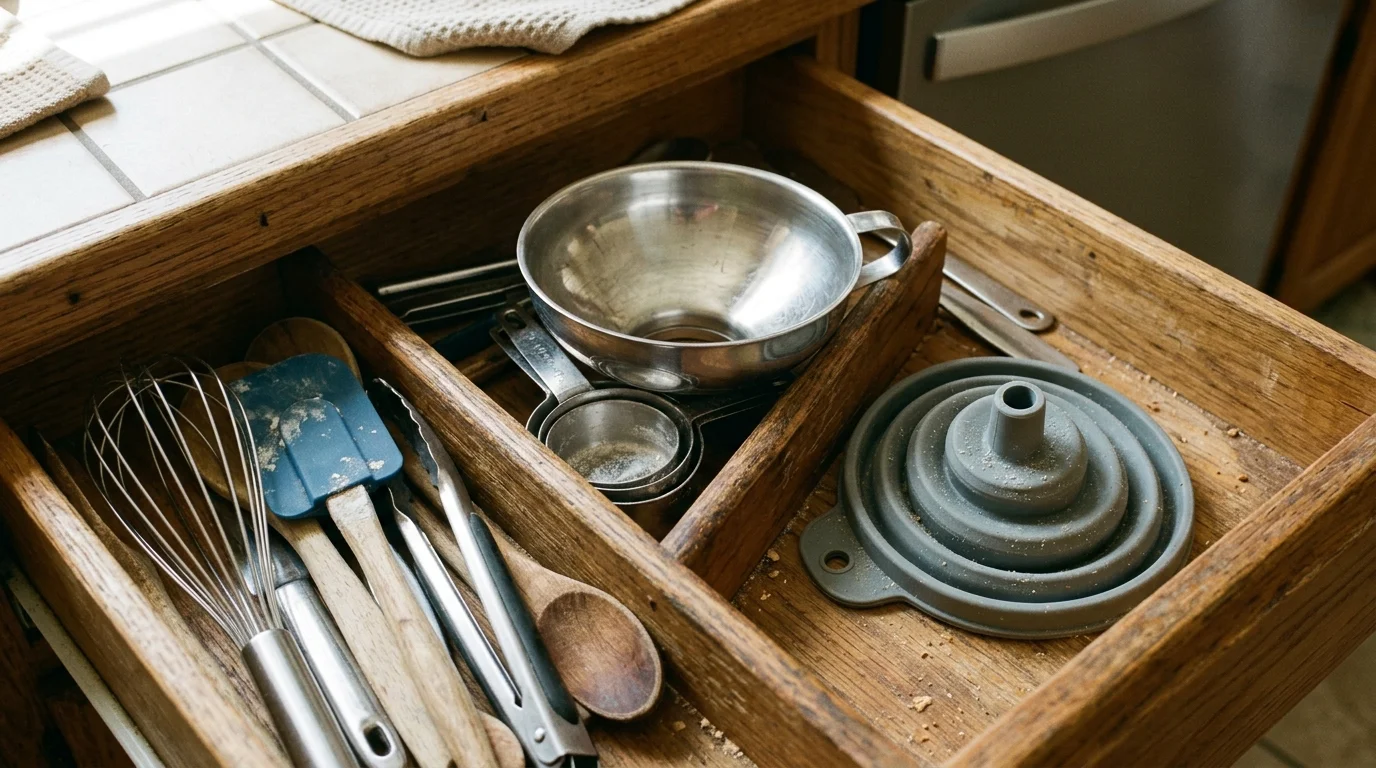
Storage, Cleaning, and Everyday Kitchen Usability
Home cooks often select silicone tools because they collapse flat for compact storage. A collapsed silicone funnel takes up only one inch of vertical drawer space.
The ongoing debate between polymers and metal surfaces also applies at the cleanup station, where silicone sink mats vs. stainless grids present distinct tradeoffs in hygiene and grease retention.
A steel funnel needs three to four inches of vertical drawer clearance. However, most stainless models include a punched hanging hole in the handle.
You can hang the funnel from an adhesive hook inside a pantry cabinet door. This hanging trick keeps the tool handy without cluttering your utensil drawers.
Cleaning shows another clear performance divide between these two materials. Both options carry a dishwasher safe—can be cleaned in a dishwasher without damage—rating, but results vary with oily foods.
Porous silicone attracts animal fats and red tomato pigments. Over time, frequent chili transfers turn translucent silicone an unappealing cloudy orange color.
Worse, heated silicone absorbs volatile spice aromas like cumin, garlic, and curry powder. Washing it in the dishwasher often fails to strip these absorbed stew odors completely.
Stainless steel features a smooth, non-porous surface that sheds food oils instantly. Hot water and dish soap wipe away grease, tomato sauce, and turmeric without staining.
Some shoppers dismiss the steel funnel as a unitasker—a gadget that only does one specific task. In reality, a wide-mouth metal funnel solves many everyday kitchen problems.
Use it to pour dry rice, lentils, or coffee beans into mason jars without spills. It works equally well for straining hot pan broths or transferring pickling brines cleanly.
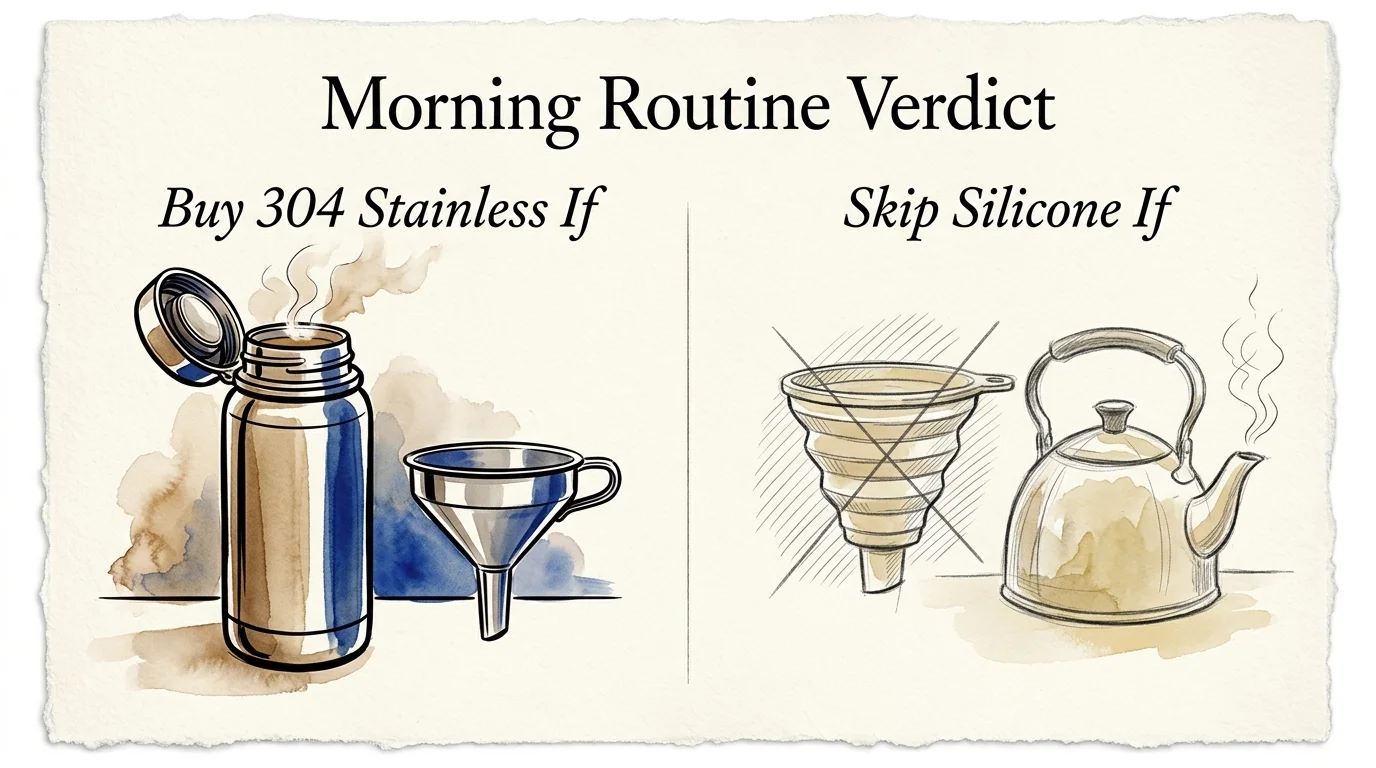
Buy If or Skip If: The Final Verdict for Your Morning Routine
Choose the funnel that matches your daily routine and container sizes. Avoid spending money on gear that fails under real-world morning kitchen conditions.
Buy a Wide-Mouth Stainless Steel Funnel if:
- You transfer 180°F to 212°F stews, chilis, or broths into insulated thermoses every morning.
- Your container features an interior neck opening between 2.4 and 2.75 inches.
- You need an easy-to-clean tool that will not absorb garlic, curry, or tomato odors.
- You want a durable tool that lasts for decades without tearing or warping.
Skip the Stainless Steel Funnel (and Keep Silicone) if:
- You only pour dry ingredients like protein powder, chia seeds, or rolled oats.
- You need a funnel for room-temperature water bottles or thin cold liquids.
- You pack lunches inside an RV or tiny home with minimal storage drawers.
- Your containers have tiny neck openings smaller than 1.5 inches.
As Serious Eats — Equipment Reviews consistently advises, matching equipment geometry and heat limits to your actual routine prevents costly kitchen mistakes. Pick the right tool and keep boiling morning meals safe and clean.
Frequently Asked Questions
Will a stainless steel funnel scratch the rim of my thermos?
Quality stainless funnels feature rounded, deburred edges that will not harm steel thermos necks. However, aggressive twisting on painted rims can leave light surface scuffs over time.
Can I safely use a silicone funnel if I let the stew cool first?
Yes, cooling stew to 140°F restores structural rigidity to the silicone walls. However, cooling your food down ruins the heat-retention performance of your vacuum thermos for long shifts.
Why does stew bubble up when I pour it through a funnel?
When a funnel base seals against the container opening, displaced air cannot escape. This trapped air bubbles back up through the spout, splashing hot food across the counter.
Does the stainless steel handle get too hot to hold during pours?
Stainless steel conducts heat slowly along thin gauge sections, keeping the handle cool during short pours. For long, multi-quart transfers, hold the handle with a silicone pot grabber.
Disclaimer: Product prices and availability change frequently. Prices shown were accurate at time of writing but may have changed. We may earn a small commission from purchases made through links on this site, at no extra cost to you. Always verify current pricing on the retailer’s website before purchasing.