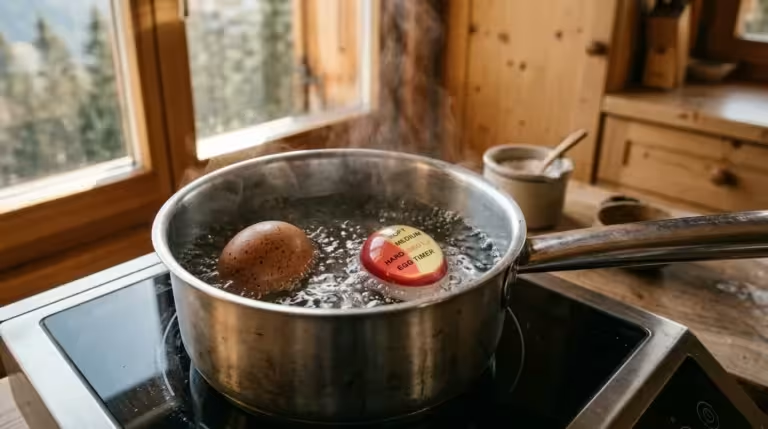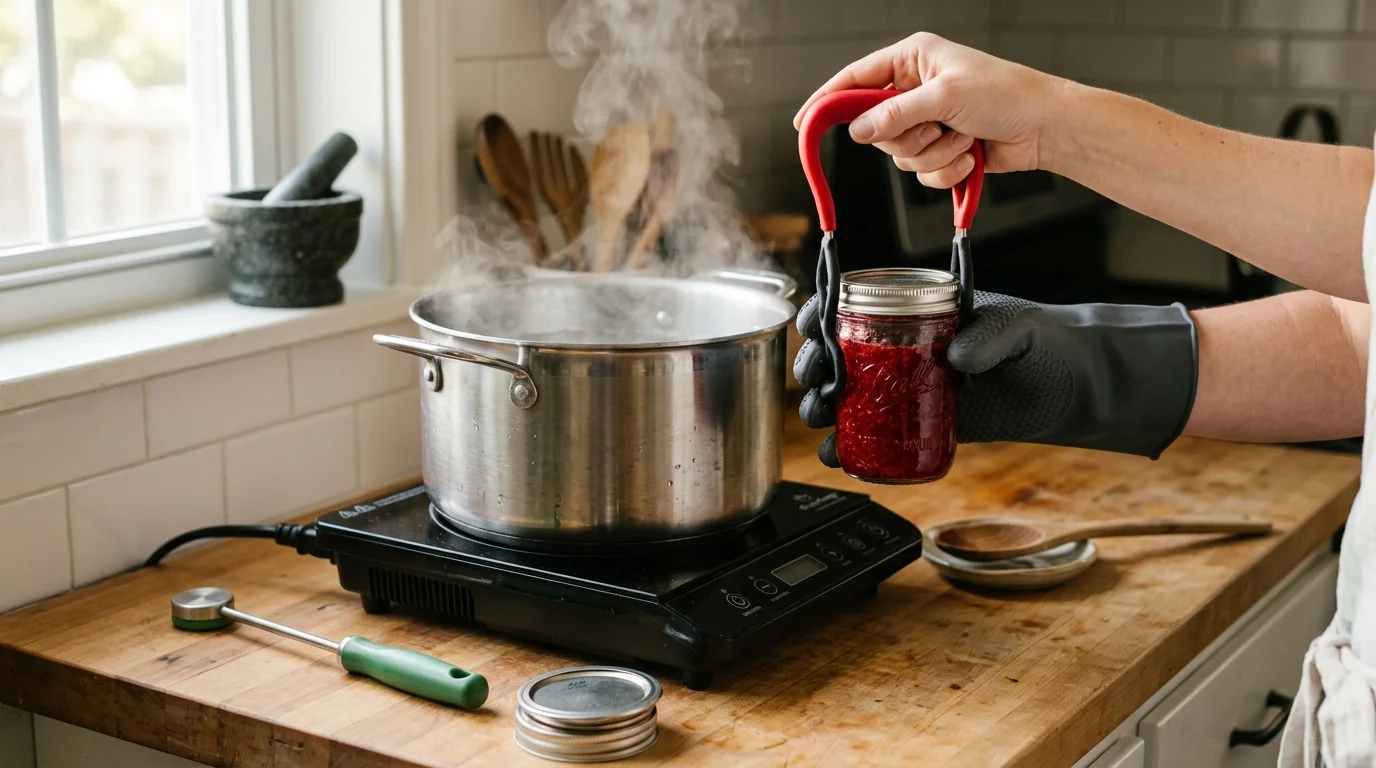
Processing high-acid jams on a portable induction burner in a 6-quart stockpot saves counter space and eliminates boiling gallons of excess water. You can safely preserve small batches without wrestling with a massive 16-quart enamel water bath canner.
While some cooks turn to an enameled Dutch oven as a compact bath substitute, shallow sides present unique clearance challenges during jar extraction.
Most canning tutorials assume you have three inches of open headspace above your jars. In shallow cookware, that false assumption leads to scraped knuckles, kettle rim collisions, and dropped glass jars.
Safe small-batch preserving hinges on maintaining a strict 15 mm vertical grip clearance and selecting heat-tolerant magnetic tools. This guide provides the exact clearances and extraction physics required for compact boiling water processing.
The Geometry of Shallow Pot Canning: Depth, Displacement, and Headroom
Standard home canning guides default to oversized stockpots designed for dozen-jar runs. When preserving three or four 8-ounce jars of jam, that extra water volume wastes time and electrical wattage.
Ensuring your pot features cookware base finishes that won’t scratch glass also prevents scuffing your portable burner surface during long processing boils.
Selecting flat, heavy-bottomed cookware prevents induction cooktop shutoffs caused by warped bases during long processing cycles.
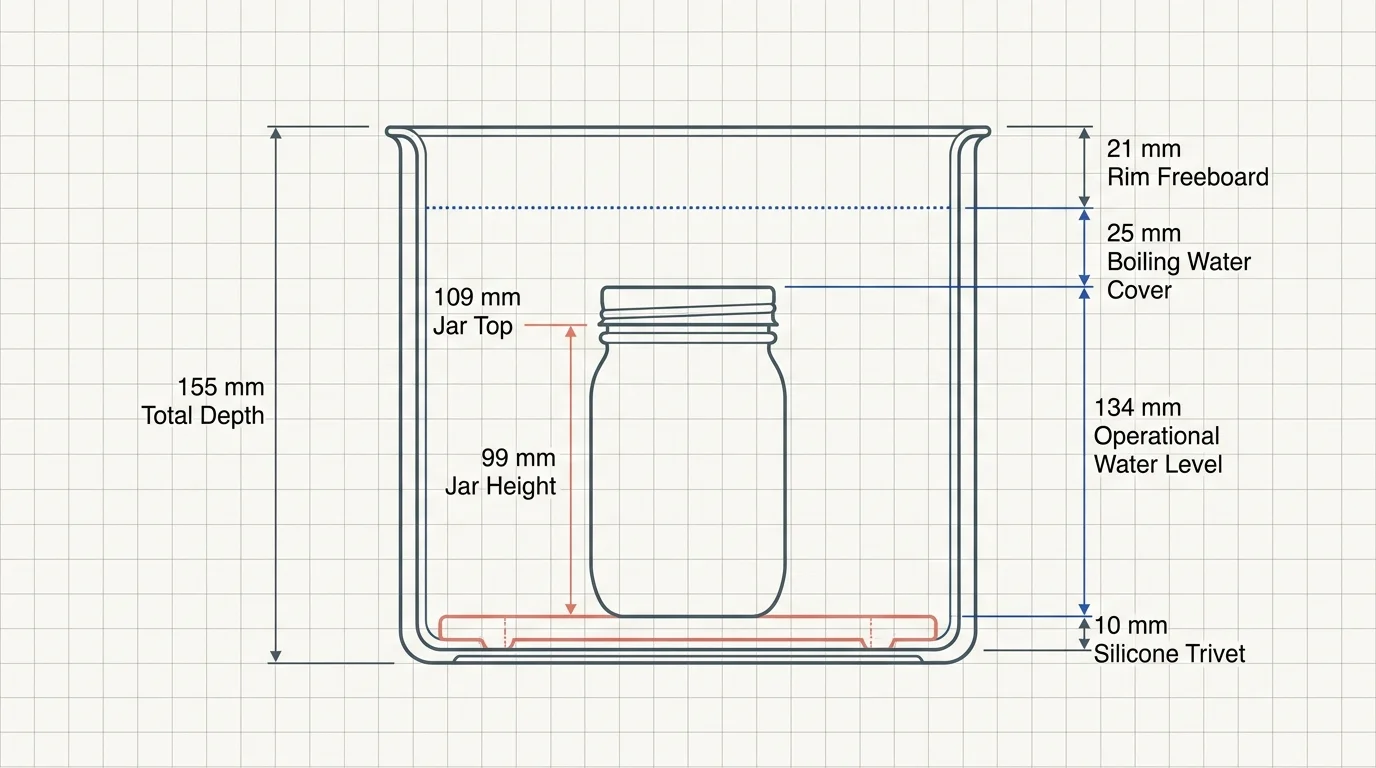
A typical 6-quart stainless steel stockpot measures roughly 150 to 160 mm in vertical depth. Here, stainless steel refers to a durable metal that resists rust and staining under constant boiling.
Standard half-pint (8-ounce) jelly jars stand exactly 99 mm tall. That leaves you less than 60 mm of total vertical tolerance before factoring in safety accessories.
Glass jars must never sit directly against the pot floor. Direct thermal transfer from the base causes localized thermal stress, which fractures glass during a rolling boil.
You must elevate jars using a silicone trivet measuring at least 10 mm in height. Silicone is a flexible, heat-resistant material used in many kitchen tools to cushion delicate cookware.
Adding a 10 mm rack brings the top of your 8-ounce jars to 109 mm from the bottom. Water bath guidelines mandate covering jar lids with 25 mm (one inch) of briskly boiling water.
That raises your total operational water level to 134 mm. In a 155 mm deep stockpot, you are left with just 21 mm of rim freeboard.
Water expands when heated from tap temperature to boiling, and boiling creates rolling surface turbulence. A 21 mm freeboard will splash vigorously unless you control your burner output precisely.
This razor-thin margin transforms jar insertion and extraction into high-precision operations. Any displacement error causes boiling water to overflow the pot rim onto your induction plate.
Jar Lifter Grip Clearance Mechanics and Rim Collision Avoidance
Standard canning tongs use a scissor-pivot hinge designed to reach deep into wide-mouthed, high-capacity kettles. In a narrow, shallow stockpot, that hinge geometry works against you.
Once jar batches are processed, organizing them neatly in tight pantries is much easier with tiered stadium risers for upper cabinets to keep small preserves visible.
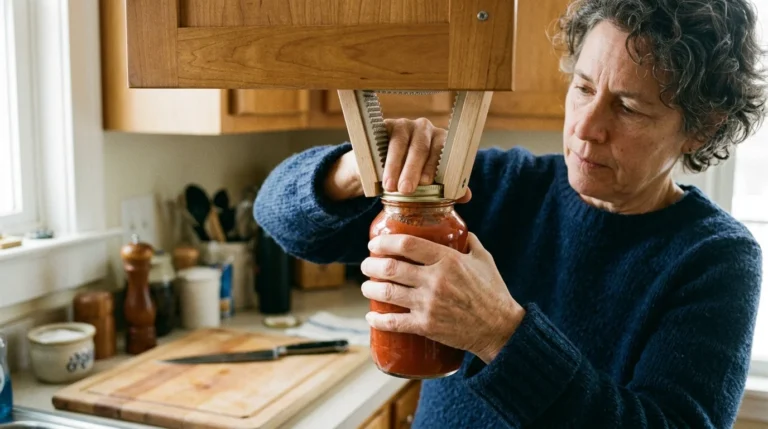
Once your jars have cooled and cured, using under-cabinet jar openers provides safe leverage to open stubborn sealed lids without bending the tinplate.
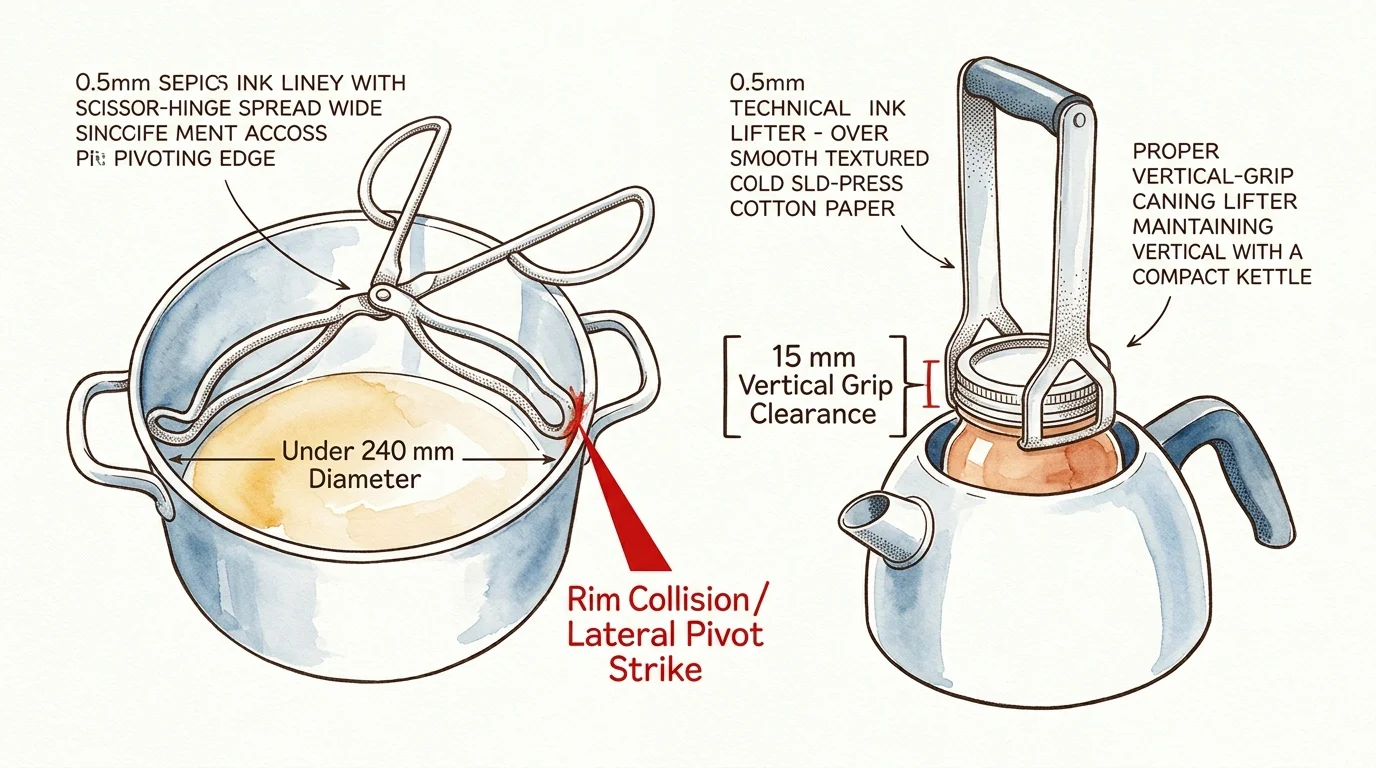
When scissor tongs open around an 8-ounce jar, the pivot point spreads outward laterally. If your pot has an interior diameter under 240 mm, the scissor hinge strikes the pot rim before the claws reach the jar neck.
According to equipment evaluations by Serious Eats, handle pivot points dictate mechanical leverage and user control under load. Striking the pot rim forces the user to tilt the lifter, which compromises the clamp.
A safe grip requires 15 mm of clearance between the lifter hinge and the pot rim. Without that 15 mm margin, the metal arms strike the pot wall and bounce off the glass.
Jar lifters must feature an ergonomic handle that keeps your knuckles elevated. An ergonomic design ensures comfortable holding and reduces wrist fatigue during repetitive lifts.
The gripping claws must provide a non-slip grip, meaning a textured handle or claw designed not to slide, even when wet. Bare metal tongs slip off wet glass rings instantly.
“A jar lifter should grip glass like a precision vise; if the tool deflects against the rim, your scalding preserves become an immediate burn hazard.”
Canning jars feature a raised glass bead directly below the threaded band. Your lifter must clamp firmly around the body directly underneath this bead, not on the threaded band itself.
Clamping the screw band can loosen the lid seal or buckle the metal ring. In shallow pots, low-profile tongs allow you to grip below the bead without scraping the stockpot lip.
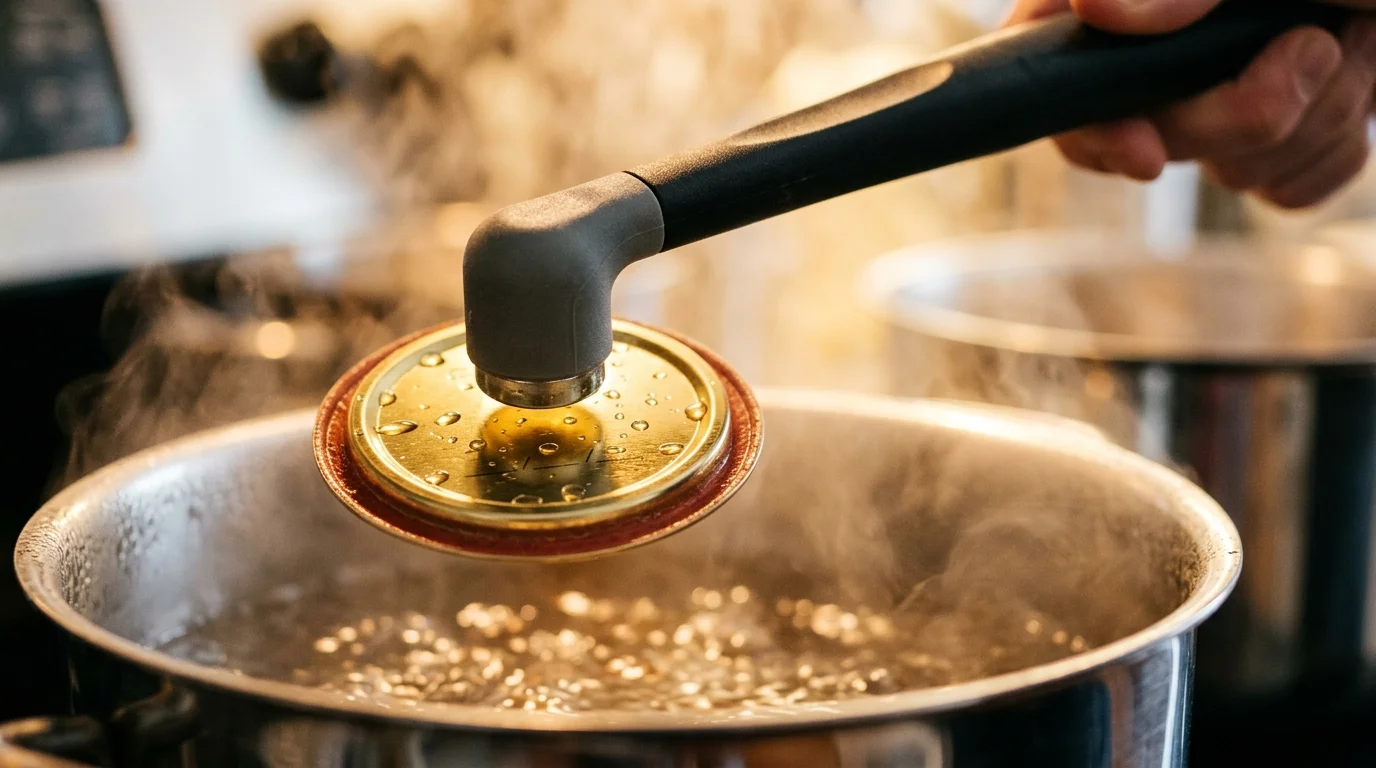
Magnetic Lid Lifters: Thermal Limits and Magnet Degradation
A magnetic lid lifter is a specialized wand tipped with a permanent magnet. Many cooks dismiss it as a unitasker, which is a gadget that only does one specific task.
Many home preservers simmer lids separately in one of the best saucepans for everyday cooking to keep their primary stockpot free for jar immersion.
In small-batch preserving, however, this tool is vital for sanitary handling and burn prevention. Dropping flat metal lids into simmering water sterilizes them and softens their plastisol sealing rings.
Fishing metal lids out of hot water with tongs often bends the thin tinplate or damages the sealing compound. A magnetic wand lifts lids cleanly by their center without touching the rubberized edge.
Not all magnetic wands survive boiling temperatures without physical degradation. Inexpensive wands utilize low-grade neodymium or bonded ferrite magnets sealed inside thin polystyrene housings.
Magnets possess a maximum operating temperature, beyond which they permanently lose magnetic flux. Standard neodymium magnets suffer irreversible demagnetization starting at 80°C (176°F), well below the 100°C (212°F) boiling point.
Look for canning wands constructed from high-temperature ferrite or encapsulated Alnico magnets. These magnetic materials maintain their attractive force up to 250°C (482°F) without thermal flux decay.
The plastic shaft must be BPA-free, meaning made without bisphenol-A, a chemical compound some people prefer to avoid in food preparation. The material must also withstand repeated boiling without warping.
Check whether the manufacturer rates the wand as dishwasher safe, which indicates it can be cleaned in a dishwasher without melting or water ingress. Trapped wash water inside the magnet casing leads to hidden mold growth.
Avoid leaving magnetic wands submerged in boiling water for prolonged periods. Use the wand exclusively to dip in, latch onto the lid center, and withdraw immediately to your prep station.
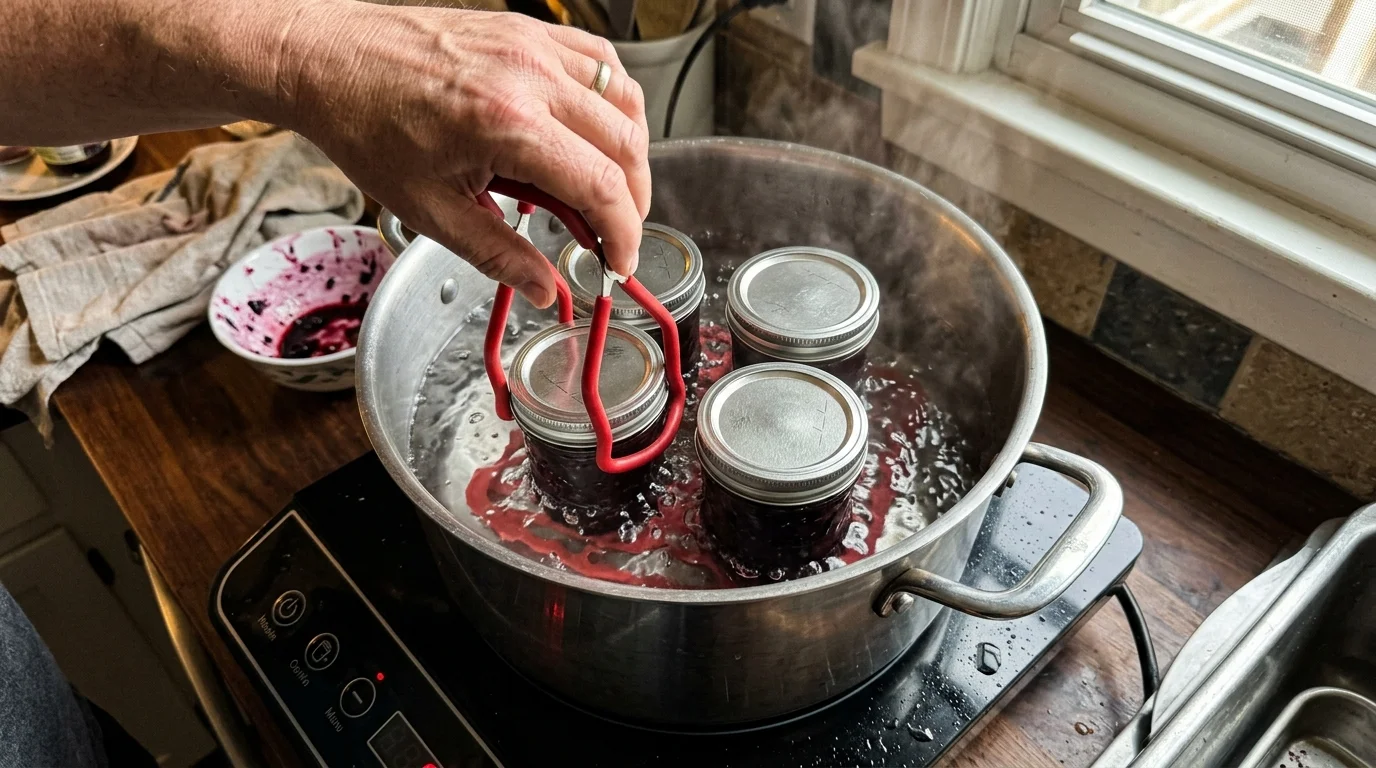
Worked Scenario: Extracting Four 8oz Jams from a 6-Quart Stockpot
Let us examine a real-world small-batch preserving scenario to calculate exact clearances. You are canning four half-pint jars of strawberry jam using an induction-compatible setup.
When prepping the fruit beforehand, using small-capacity immersion blender attachments helps break down berries without incorporating excess air into the mixture.
Your hardware consists of a Duxtop portable induction burner, a Cuisinart 6-quart stainless stockpot, and four regular-mouth Ball jars. The stockpot measures 240 mm across its interior rim with an interior depth of 152 mm.
You place a 10 mm thick silicone canning trivet on the bottom of the vessel. Each 8-ounce jar measures 99 mm in height and 70 mm in outer body diameter.
When placed on the trivet, the top of the jar rings sit at 109 mm from the pot floor. You fill the pot with water to 134 mm, establishing a 25 mm water layer above the lids.
The water level leaves you with exactly 18 mm of dry freeboard below the stockpot rim. Four submerged jars displace roughly 960 milliliters of liquid, raising the water level during insertion.
You set the induction burner to 1000 watts to bring the water to a rolling boil. At this setting, bubbles create vertical surface waves measuring 6 mm to 8 mm in amplitude.
Your actual freeboard during boiling shrinks to roughly 10 mm. This narrow tolerance leaves zero margin for careless movements with wide-handled tools.
To extract jar number one, you grasp your lifter and align its gripping curve around the jar neck. The neck ring sits 12 mm below the lid top, which places your target grip depth at 122 mm from the pot floor.
Your lifter must reach 30 mm beneath the active water surface to clamp the glass securely. As the claws close, the hinge pivots outward toward the pot wall.
The radius of your pot is 120 mm from the center. Two jars sitting side by side take up 140 mm of total width, leaving only 25 mm of lateral space against the interior wall.
A standard 75 mm wide scissor hinge will collide with the pot rim before seating. Using a vertical-grip lifter with a 15 mm clearance profile allows the tongs to close cleanly beneath the neck ring.
You lift the jar straight upward without tilting. Tilting spills hot jam into the jar headspace, disrupting the sealing compound before it hardens.
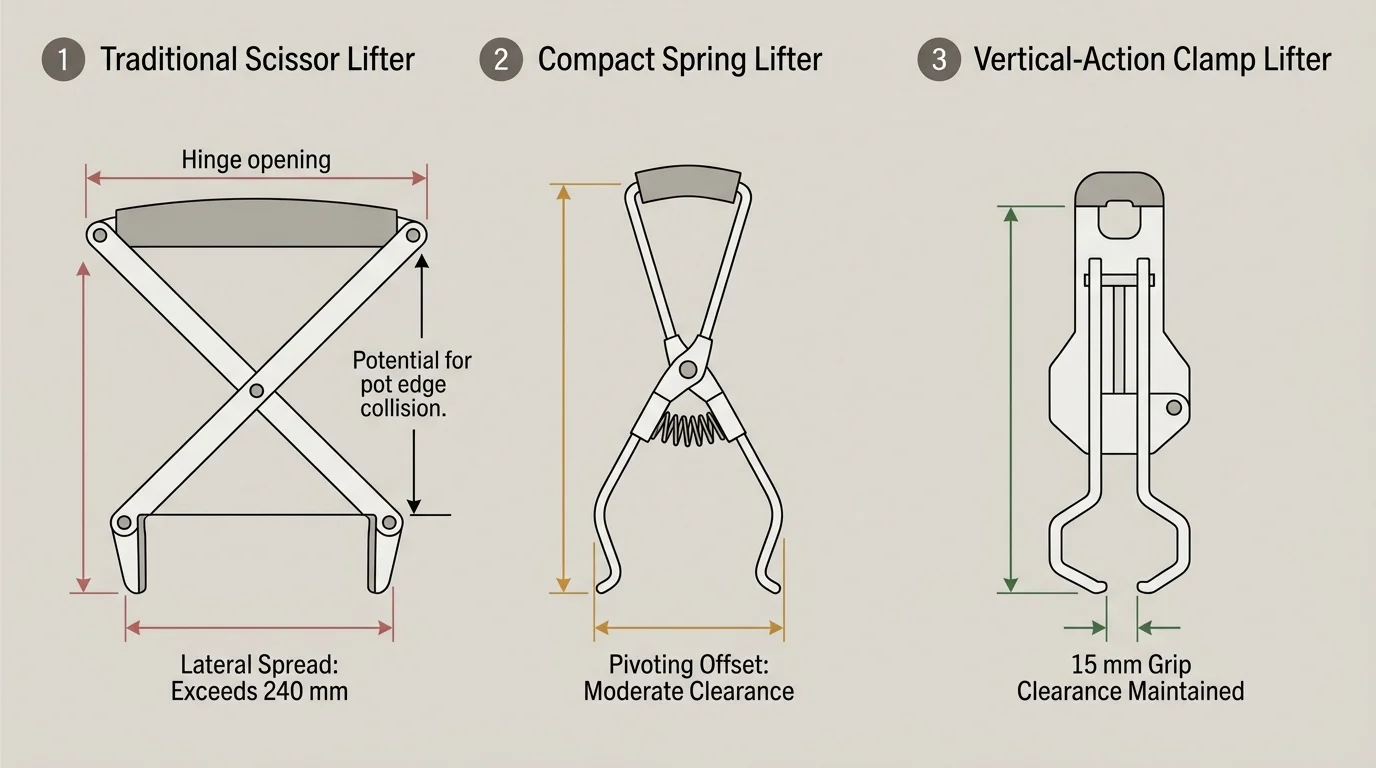
Clearance and Specification Comparison of Popular Lifters
Selecting the right canning tools requires evaluating physical dimensions rather than marketing promises. The table below details measured clearances, hinge spreads, and thermal tolerances across popular models.
For small-kitchen cooks, choosing prep tools engineered to fit inside slimline dishwashers simplifies cleanup after handling sticky preserves.
| Tool Model | Grip Style | Hinge Width at 70mm Spread | Vertical Clearance Required | Thermal Limit of Grip Coating |
|---|---|---|---|---|
| Ball Secure-Grip Jar Lifter | Ergonomic molded vertical handle | 52 mm | 12 mm | 120°C (248°F) |
| Norpro Heavy-Duty Canning Tongs | Traditional scissor pivot | 78 mm | 28 mm | 105°C (221°F) |
| Roots & Harvest Stainless Lifter | Spring-loaded plier grip | 46 mm | 10 mm | 150°C (302°F) |
| Prepworks by Progressive Tongs | Curved scissor handle | 68 mm | 22 mm | 110°C (230°F) |
As the data demonstrates, traditional scissor tongs demand up to 28 mm of clearance to operate. That exceeds the available headspace in a 6-quart shallow stockpot.
Testing from America’s Test Kitchen highlights that spring-tensioned and upright canning grips provide significantly higher lateral stability when hoisting liquid-filled glass. Secure gripping jaws prevent catastrophic slipping when wet.
The Ball Secure-Grip and Roots & Harvest designs keep their hinge mechanisms compact. Their narrower profile prevents the tool arms from bumping against the rim during delicate lifts.
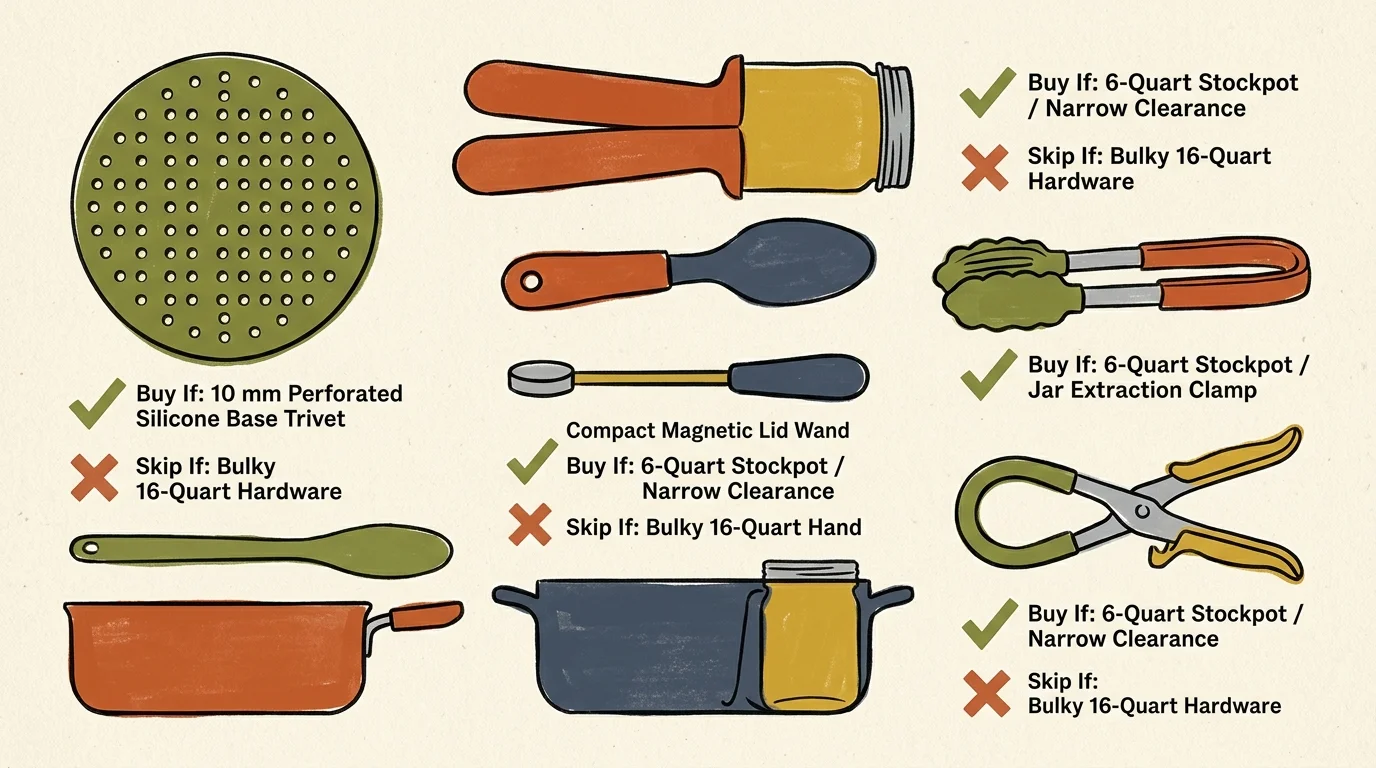
Small-Batch Canning Arsenal: Buy If vs. Skip If
Outfitting a compact kitchen requires buying multi-functional, reliable gear while filtering out clunky drawer clutter. Use this selection matrix to determine whether these tools match your cooking workflow.
In tiny kitchens, choosing prep tools engineered for compact dishwashers simplifies sanitation and preserves precious storage space.
Compact Upright Jar Lifters
- Buy if: You preserve jams or pickles in pots under 8 quarts where rim clearance is less than 30 mm.
- Buy if: You suffer from wrist strain and need an ergonomic grip that maintains neutral wrist alignment.
- Skip if: You only process large batches in 16-quart or 21-quart specialized canning kettles.
- Skip if: You demand a tool that folds completely flat inside a shallow 2-inch kitchen drawer.
Magnetic Lid Wands
- Buy if: You want to position two-piece flat lids without burning your fingertips or contaminating sterile rubber seals.
- Buy if: You value quick magnetic retrieval over chasing floating metal discs with slippery metal forks.
- Skip if: You exclusively use reusable plastic storage caps or one-piece lug caps that do not respond to magnets.
- Skip if: You are unwilling to hand-wash small gadgets to protect the internal magnetic bond from high dishwasher heat.
Standard scissor tongs take up minimal vertical drawer space because they lay completely flat. Upright ergonomic lifters feature molded handles that require roughly 3.5 inches of drawer depth.
If drawer space is limited, choose a spring-loaded stainless steel model with a locking ring. It delivers the narrow hinge profile needed for shallow pots while stowing flat.
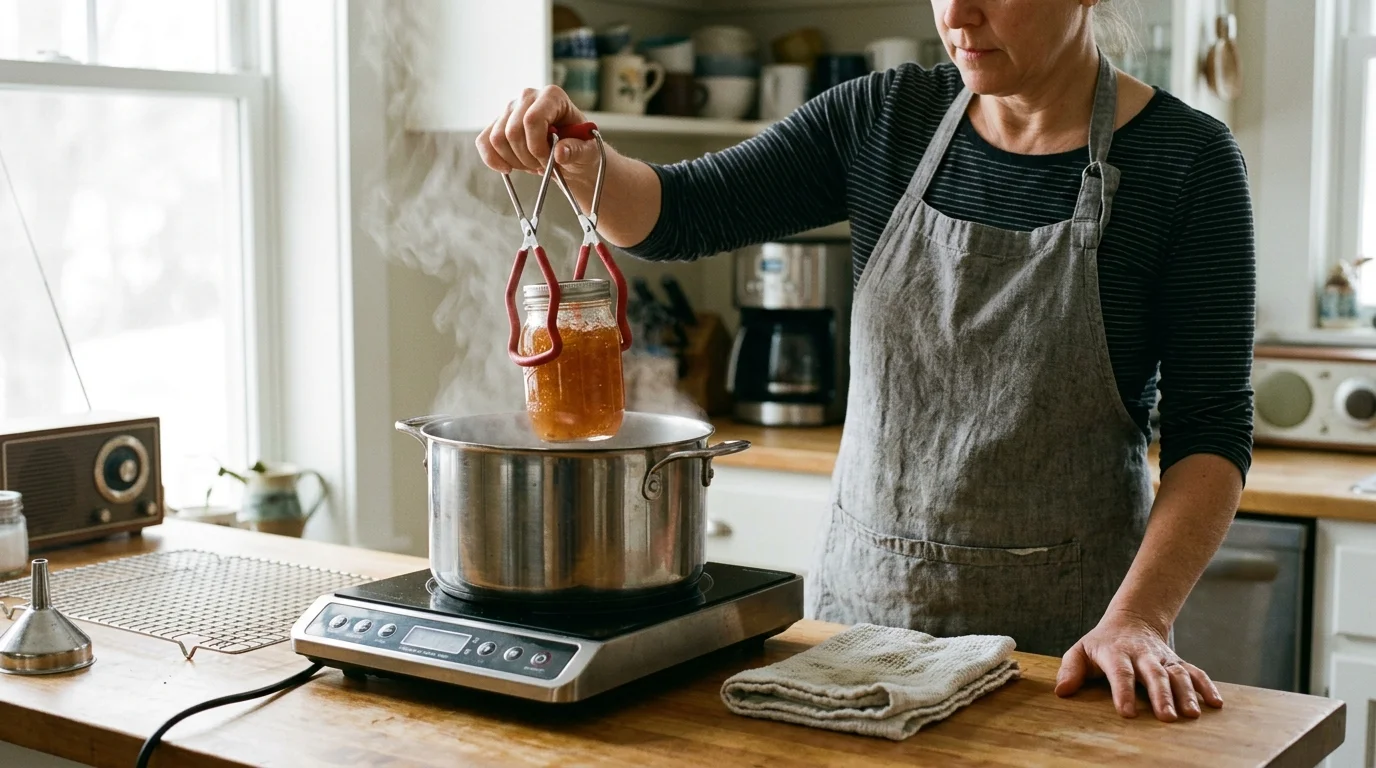
Safe Jar Extraction Protocols on Portable Induction Burners
Canning on a portable induction burner presents unique physical dynamics that open-flame gas ranges do not share. Induction cooktops feature an ultra-smooth, slick ceramic glass surface.
Because there are no burner grates to hold cookware in place, a lightweight stockpot can slide across the glass top easily. Lateral force from a clumsy jar lifter can push the pot off the burner center.
Safety analyses by Wirecutter emphasize that cookware must remain centered over the induction coil to maintain consistent heat transfer. Sudden pot displacement breaks electromagnetic coupling, shutting off the burner instantly.
To extract jars safely, first press the pause button or reduce power to zero before reaching into the bath. This action stops rolling surface bubbles, restoring visual clarity and stabilizing the water line.
Never hold the pot handle with one hand while levering against the rim with your jar lifter. Levering transfers horizontal torque to the vessel, risking boiling liquid spills.
Lower the open lifter vertically into the pot until the coated claws drop below the glass neck bead. Keep your knuckles elevated well above the rising steam column to prevent thermal burns.
Squeeze the handle firmly to lock the jaws around the glass circumference. Raise your forearm straight up vertically, lifting the jar cleanly out of the water column.
Hold the jar suspended over the pot for two seconds to allow water trapped on the lid to drain back into the bath. Never tilt the jar sideways to dump surface water off the lid.
Tilting jars can break the partial vacuum forming beneath the disc, drawing unsterilized water past the seal. Carry the jar straight to a wooden cutting board or thick cloth towel to cool undisturbed for 24 hours.
Frequently Asked Questions
Can I safely water bath can in a regular 6-quart stockpot?
Yes, provided the stockpot is deep enough to accommodate a 10 mm bottom rack, your jars, and 25 mm of boiling water overhead with room to boil without overflowing. For standard 8-ounce half-pint jars, your pot requires an interior vertical depth of at least 150 mm.
Why did my magnetic lid wand stop picking up canning lids?
Inexpensive magnetic wands use low-temperature neodymium magnets that permanently lose their magnetism when exposed to temperatures above 80°C (176°F). If you boil the wand tip or run it through a heated dishwasher dry cycle, the magnet degrades permanently.
Do I really need a jar lifter, or can I use silicone oven mitts?
You must use a dedicated jar lifter. Silicone oven mitts lack the narrow profile needed to reach into boiling water and will displace significant liquid, causing the shallow pot to overflow and burn your hands.
Why can’t canning jars sit directly on the bottom of a shallow pot?
Direct contact with the metal bottom exposes glass to intense conductive heat from the burner coil, causing rapid thermal expansion and base blowout. A silicone or stainless steel rack cushions the jars and permits boiling water to circulate underneath.
Disclaimer: Product prices and availability change frequently. Prices shown were accurate at time of writing but may have changed. We may earn a small commission from purchases made through links on this site, at no extra cost to you. Always verify current pricing on the retailer’s website before purchasing.