
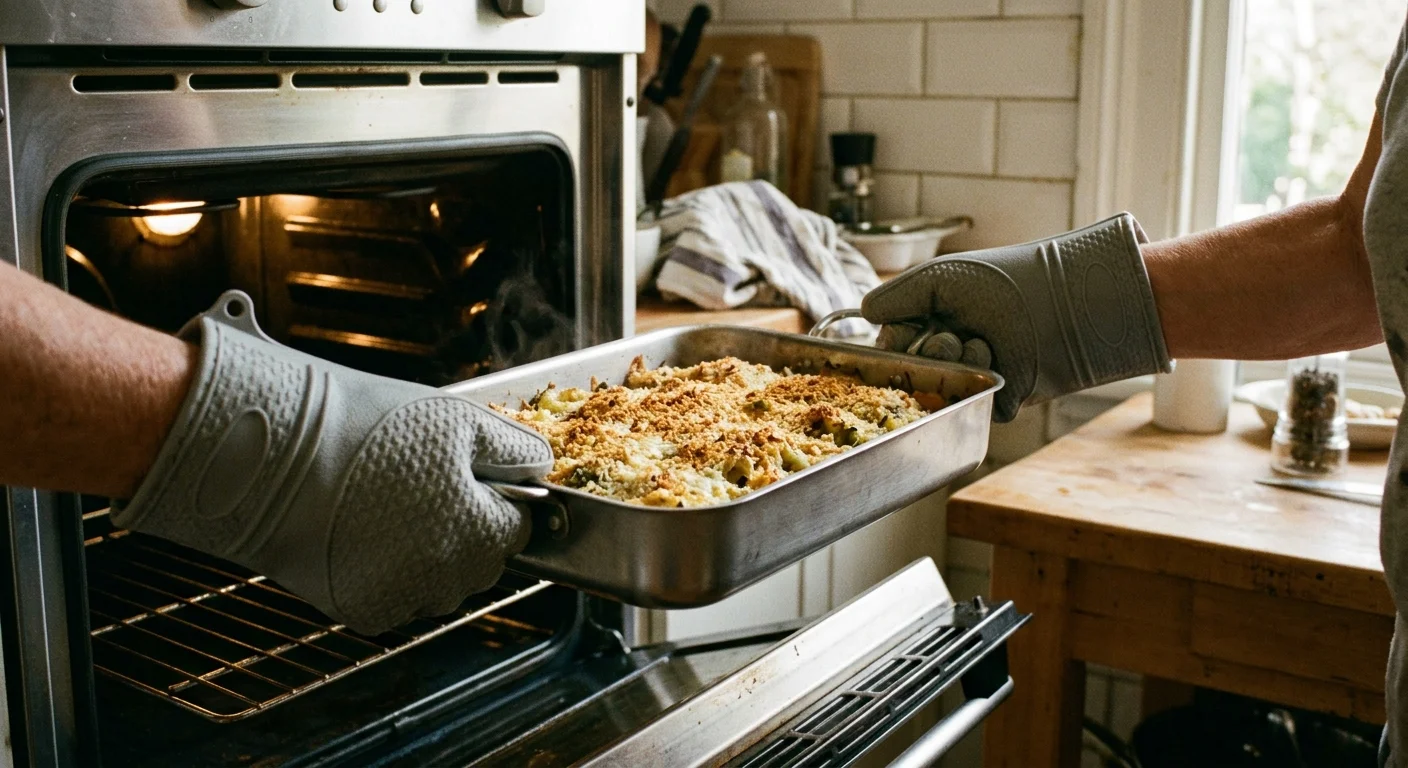
Lifting a bubbling five-pound casserole out of a hot oven requires substantial wrist torque. If you suffer from carpal tunnel syndrome or osteoarthritis, standard ceramic dishes force an agonizing pinch grip that triggers sudden nerve failure.
While many home cooks start with general bakeware sets for beginners, managing chronic pain requires prioritizing specialized handle geometry over bundled variety.
Most kitchen reviews ignore how rim geometry dictates joint load. This guide evaluates bakeware specifically by handle clearance and dry-tare-to-capacity ratios, proving that cutting deadweight and widening grip spans eliminates the mechanical leverage that causes disastrous drops.
By swapping dense stoneware for engineered aluminized steel or pass-through glass, you can safely halve the strain on your median nerve without sacrificing baking performance.
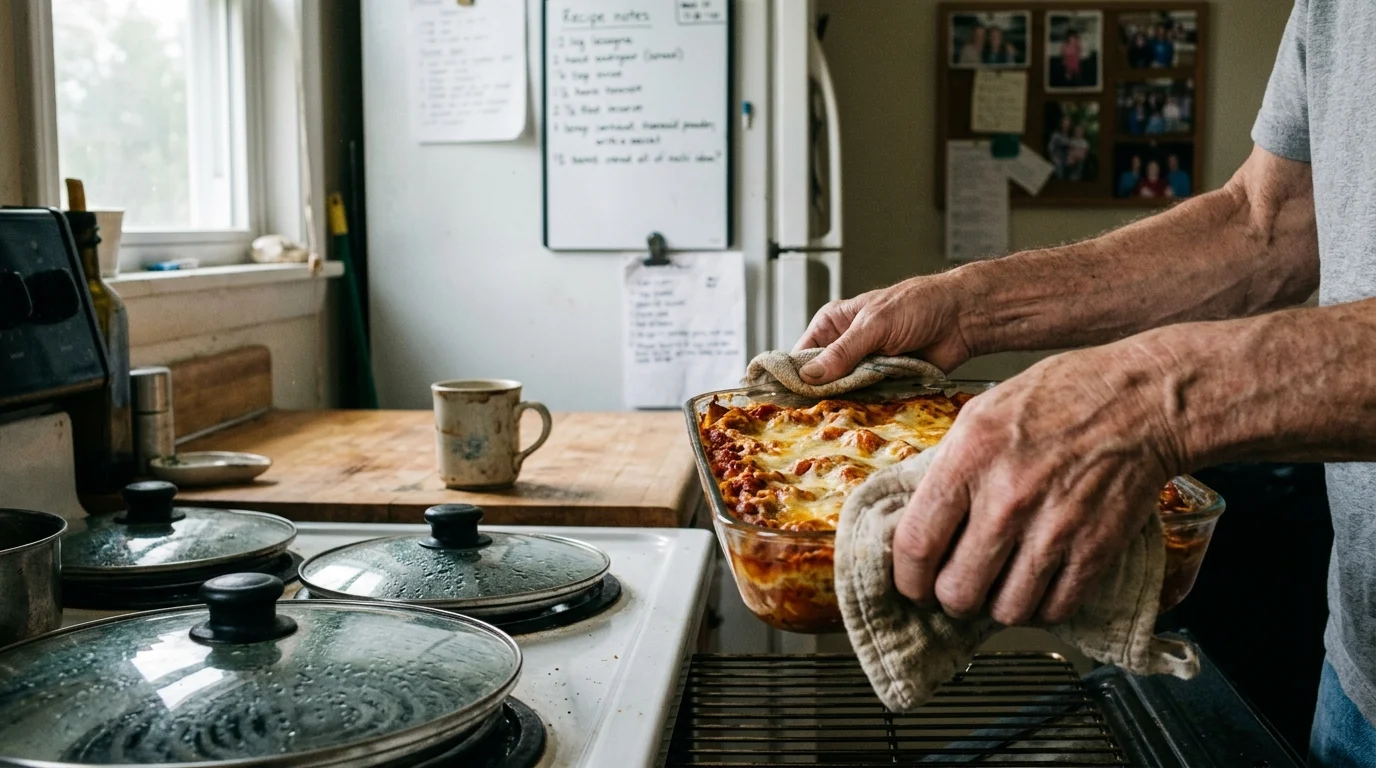
Biomechanics of Oven Transfers: Why Standard Bakeware Fails Arthritic Joints
According to the Centers for Disease Control and Prevention, roughly 58.5 million American adults live with doctor-diagnosed arthritis. Over 25 million of those individuals experience severe physical activity limitations in their daily routines.
Exploring broader categories of kitchen tools for seniors and accessibility can help identify other ergonomic adaptations that protect fragile joints during daily food preparation.
Lifting a hot, loaded dish from a low oven rack demands a punishing combination of wrist flexion, forearm pronation, and sustained pinch force. When carpal tunnel syndrome compresses the median nerve, sustained fingertip pressure rapidly numbs the hand.
As testing from America’s Test Kitchen highlights, pan weight and balance directly determine kitchen safety when handling hot fats. An unstable vessel easily leads to severe burns.
Bulky silicone oven mitts compound this mechanical problem. The thick heat-shielding fabric robs you of tactile feedback and prevents your fingers from closing tightly against smooth, narrow pan rims.
When you cannot close your fingers around a handle, you must pinch the rim with your thumbs and index fingers. That localized pinch exerts immense pressure directly across the carpal tunnel and thumb basal joint.
Under this high tension, fatigued tendons can suddenly fail. The result is an uncontrolled drop back onto the metal oven rack or your kitchen floor.
“Lifting safety begins with rim architecture; an open handle shifts the lifting burden from delicate finger joints to your robust forearm muscles.” — Ergonomic Kitchen Specialist
Dry Tare Weight: Comparing Aluminum, Glass, and Stoneware
Cookware makers measure metal thickness in gauge; lower numbers mean thicker metal with better durability. Thicker walls resist warping, but every extra millimeter adds physical heft to the vessel.
Material weight differences also matter when baking sweets, as seen in how pie plates across glass, ceramic, and metal balance thermal insulation against physical heft.
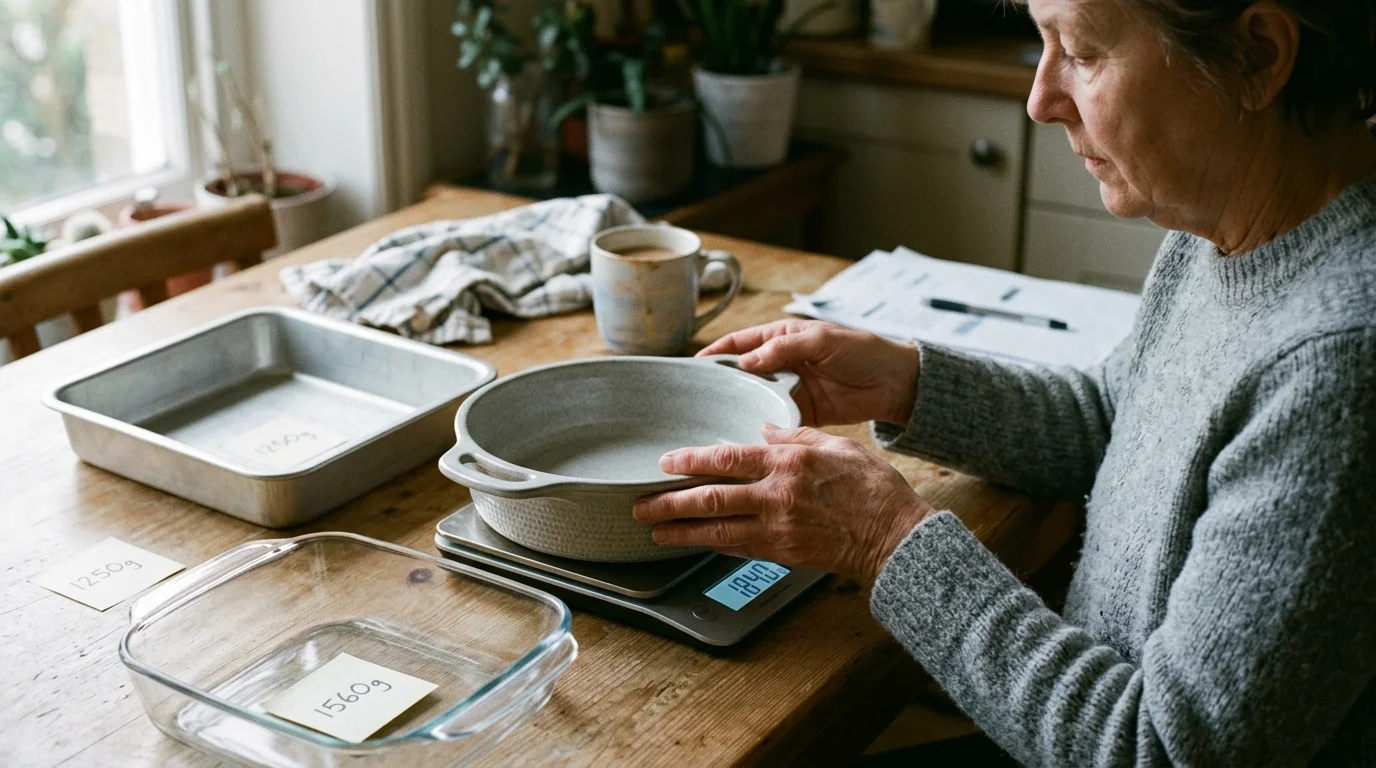
Tare weight describes the empty mass of your cookware before you add food. Standard 9×13 ceramic and stoneware bakers often weigh five pounds or more before you layer in a single ingredient.
According to Serious Eats, aluminum bakeware promotes faster and more uniform heat transfer than thick glass or earthenware. It also eliminates unnecessary physical strain during kitchen prep.
Natural aluminum and aluminized steel deliver the lowest tare weights among all standard baking materials. A commercial-grade aluminum 9×13 pan averages between 1.4 and 1.9 pounds, reducing deadweight by up to 75% compared to stoneware.
Tempered soda-lime and borosilicate glass sit in the middle of the weight spectrum. A typical 9×13 glass vessel weighs between 3.6 and 4.7 pounds straight out of the cabinet.
Stoneware dishes from luxury brands look beautiful on dining tables, but they severely punish inflamed wrists. Their massive ceramic walls routinely push empty weights past 5.3 pounds, making routine handling needlessly perilous.
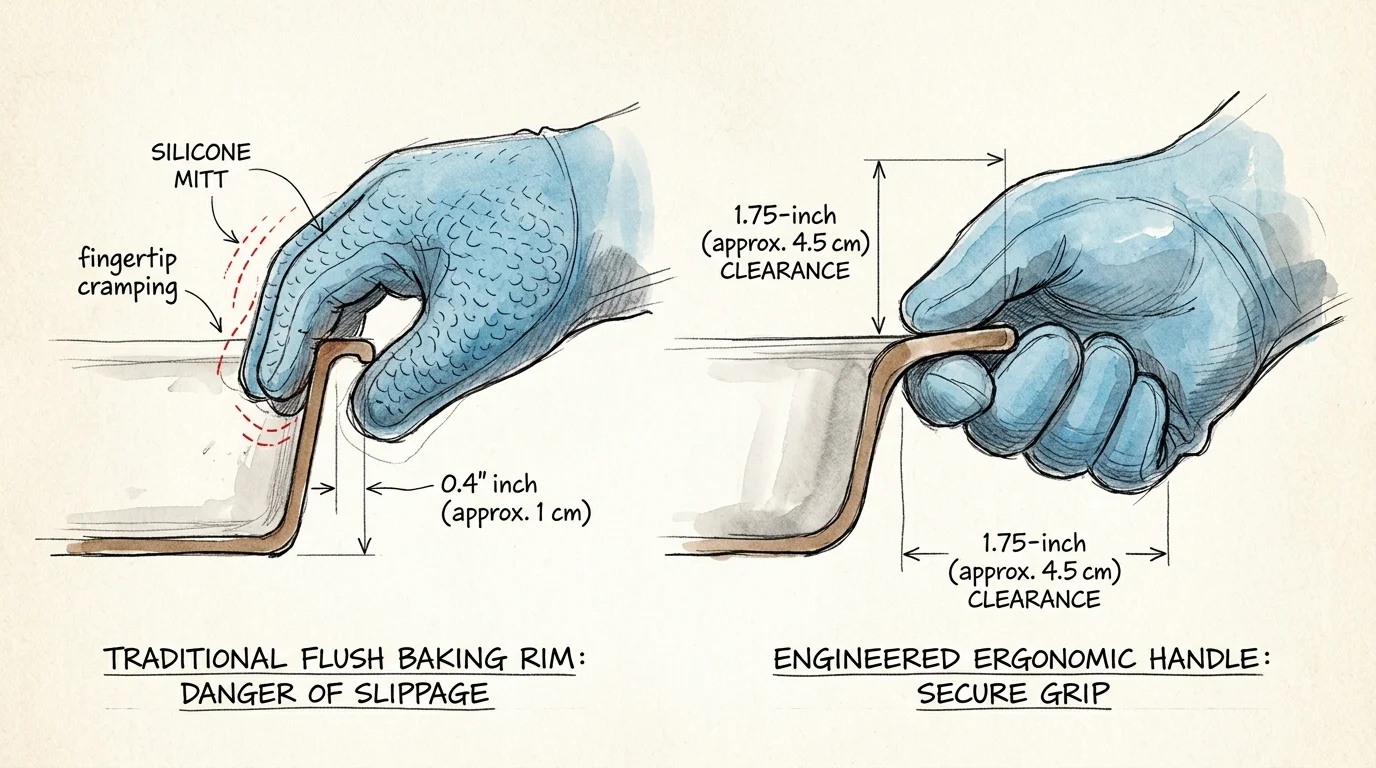
Rim Geometry and Mitt Clearance: Pinch Grips vs. Power Grips
Conventional casserole dishes feature miniature molded tabs extending less than half an inch from the dish body. These tiny ears force you to execute an unassisted pinch grip while hoisting extreme loads.
A true casserole dish with large handles provides open apertures that accommodate your entire hand. This layout engages a full power grip, recruiting your forearm flexors rather than straining isolated finger ligaments.
In comprehensive reviews published by Wirecutter, wide loop handles consistently outperform molded side tabs during blind handling trials. Secure grips prevent slips when wearers use padded mitts.
Effective accessible baking pans require at least 1.25 inches of clear handle depth beyond the baking well. That clearance lets bulky mitts slide through completely without touching the scorching outer walls.
Other ergonomic models feature wide, flared lateral shelves instead of cutout holes. These flared wings allow you to slide the heels of your palms beneath the edges, transferring gravity loads directly to your forearms.
When shopping for a lightweight 9×13 baking dish, exterior pan length tells you everything about handling safety. If the outer span matches the interior 13 inches, the dish lacks the extended handles you need.
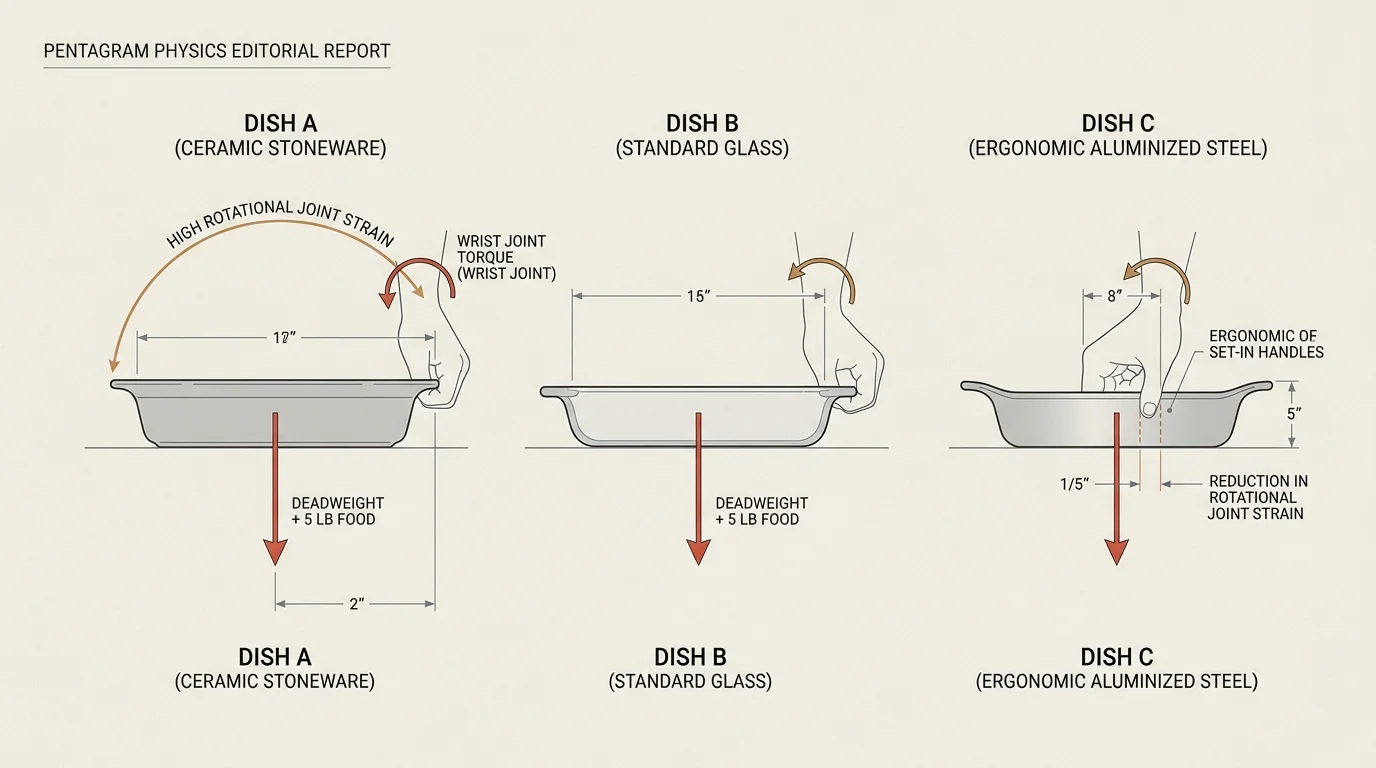
Worked Calculation: Joint Torque Across Three 9×13 Baking Dishes
To understand the mechanical advantage of accessible bakeware, consider a concrete kitchen scenario. You are baking a four-pound family ziti casserole at 375°F for 45 minutes.
The same principles of torque reduction apply to tabletop tasks, where using electric pepper grinders for severe hand arthritis replaces agonizing manual twisting with effortless dispensing.
In Scenario A, you prepare the ziti in a Staub 9×13 ceramic baking dish. The empty dish weighs 5.31 pounds, resulting in a total lifted mass of 9.31 pounds.
The Staub dish features 0.6-inch molded ceramic ear tabs. Because you cannot slip your fingers through the ears, you must maintain a pinching clamp against smooth enamel using silicone mitts.
Your wrist flexor tendons must exert over 28 pounds of internal clamping force just to prevent that 9.31-pound mass from sliding downwards through the slick mitt fabric.
In Scenario B, you bake that identical meal in an OXO Good Grips 3-quart borosilicate glass dish. The empty dish weighs 4.6 pounds, producing an 8.6-pound total load.
The OXO dish extends to an exterior length of 15.65 inches with flared, palm-supporting lateral ledges. The dish rests directly on your palms, reducing finger pinch demand by roughly 40%.
In Scenario C, you switch to a Nordic Ware Naturals 9×13 aluminum pan. The empty pan weighs a modest 1.4 pounds, bringing total lifted mass down to just 5.4 pounds.
By eliminating 3.91 pounds of ceramic deadweight, you instantly reduce overall joint load by 42%. Your median nerve experiences minimal shear stress, allowing a smooth, pain-free extraction from the rack.
“A lightweight metal pan transfers thermal energy faster while shielding your wrists from the grueling deadweight of traditional earthenware.” — Culinary Equipment Editor
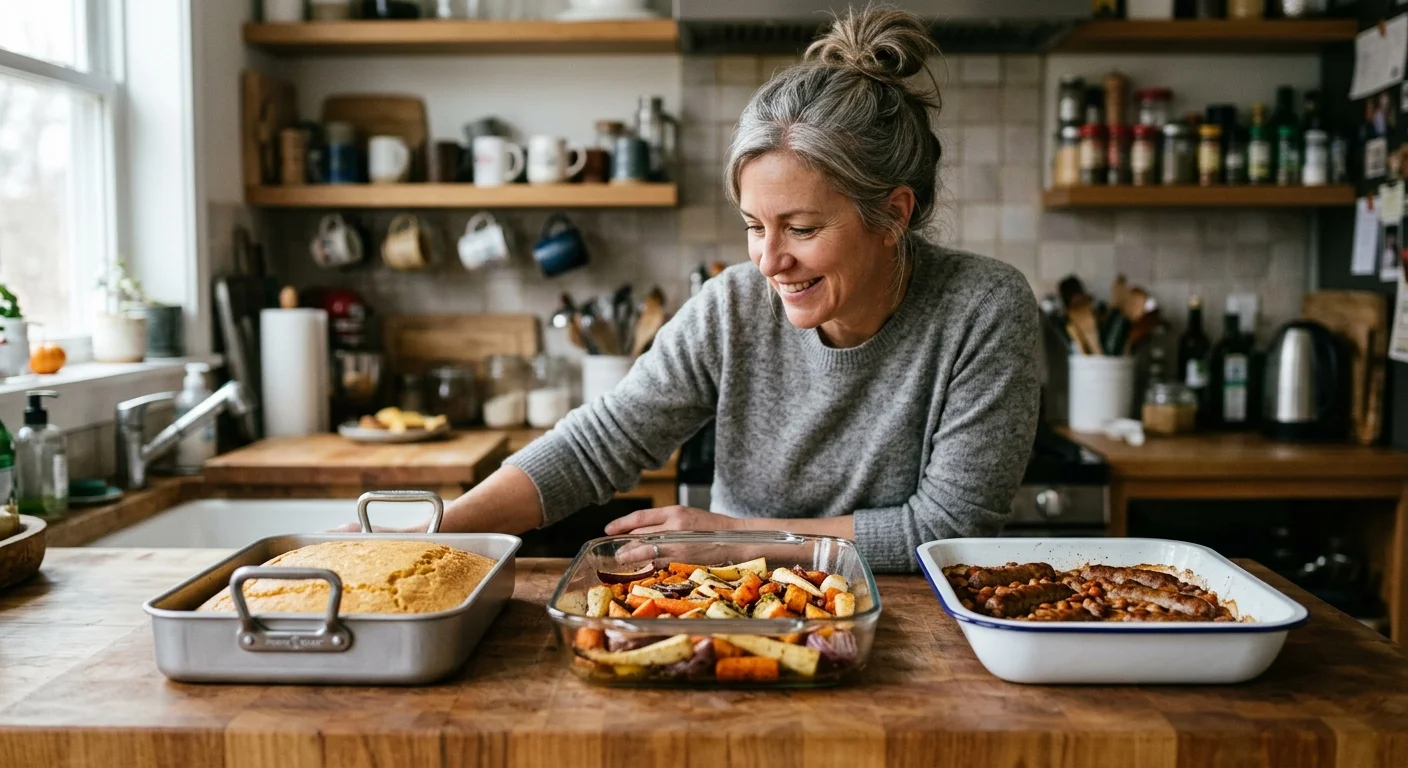
The Best Accessible 9×13 Baking Dishes Evaluated
The following selections address the structural issues that cause wrist fatigue. Each model provides either reduced tare weight, superior handle clearance, or a combination of both traits.
Nordic Ware Naturals 9×13 Rectangular Cake Pan
The Nordic Ware Naturals pan is the ultimate lightweight 9×13 baking dish for arthritic wrists. Weighing only 1.4 pounds empty, this pan cuts tare weight to the absolute minimum.
Aluminum is also the preferred material among top-rated cake pans because it distributes heat rapidly without overburdening weak wrists.
The pan features reinforced encapsulated steel rims that prevent high-heat warping while creating a rounded lip for lifting. It is oven-safe up to 500°F and retails between $16.00 and $25.00 with an optional storage lid.
USA Pan Bakeware 9×13 Rectangular Cake Pan
Constructed from commercial-grade aluminized steel, this USA Pan model weighs roughly 1.85 pounds. It offers an incredible balance of rigid durability and manageable physical heft.
The pan features a corrugated fluted base for even heat flow and wide, rolled outer rims that catch easily on gloved thumbs. It retails between $22.00 and $26.00 with a 450°F maximum temperature threshold.
Pyrex Easy Grab 3-Quart Glass Baking Dish
If you prefer transparent glass for monitoring browned edges, the Pyrex Easy Grab represents the gold standard in accessible bakeware. The dish weighs 3.6 pounds empty and retails for $16.00 to $22.00.
Pyrex extends the outer span to 16.25 inches by incorporating large cutout loop handles. These generous openings allow gloved fingers to slide completely through, enabling a rock-solid power grip.
OXO Good Grips 3-Quart Borosilicate Glass Baking Dish
The OXO Good Grips dish weighs 4.6 pounds and features commercial borosilicate glass. This glass construction tolerates rapid thermal shock, letting you move dishes directly from the freezer to a hot oven.
Priced at $26.99 MSRP, it features flared lateral ledges measuring 15.65 inches across. The wide ledges transfer the pan’s physical weight onto the heel of your hands rather than your finger joints.
Great Jones “Hot Dish” Ceramic Casserole
For cooks who insist on serving table-ready stoneware, the Great Jones Hot Dish solves the traditional rim problem. It incorporates oversized circular loop handles spanning 16.5 inches total length.
However, the dish weighs a substantial 5.0 pounds empty and costs $105.00 MSRP. While the handles facilitate a secure power grip, cooks with advanced carpal tunnel may still find the total mass overwhelming.
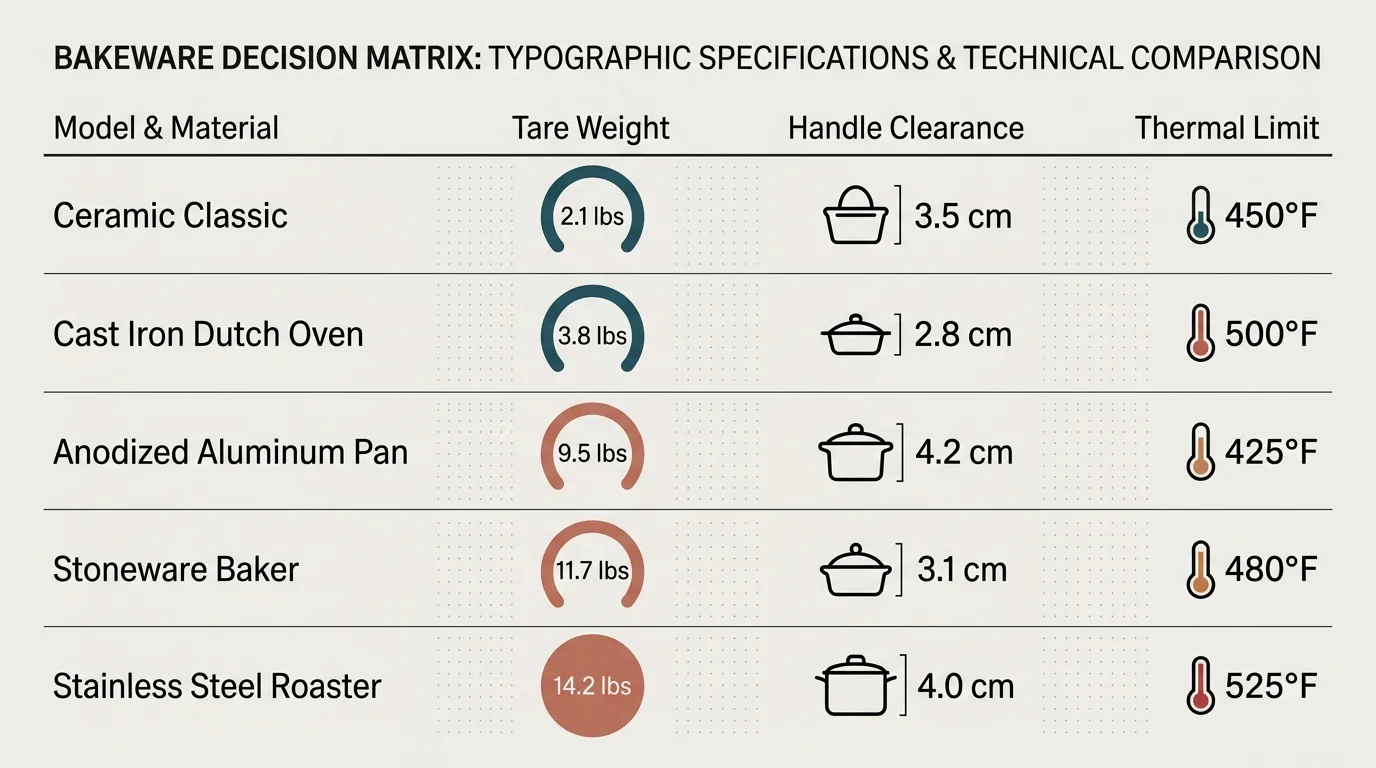
Specifications Matrix: Empty Weight, Handle Width, and Thermal Limits
Use the data below to compare structural dimensions, total tare weights, and handle designs across the leading accessible baking pans on the market today.
Once you have selected manageable bakeware, adopting vertical bakeware organization prevents the strain of lifting and unstacking heavy pans from low cupboards.
| Model Name | Material | Empty Weight | Exterior Length | Handle Style | Max Oven Temp | MSRP |
|---|---|---|---|---|---|---|
| Nordic Ware Naturals 9×13 | Natural Aluminum | 1.40 lbs | 13.63 in | Rolled Steel Rim | 500°F | $18.00 |
| USA Pan Rectangular 9×13 | Aluminized Steel | 1.85 lbs | 13.75 in | Extended Wire Lip | 450°F | $24.00 |
| Pyrex Easy Grab 3-Qt | Tempered Soda-Lime Glass | 3.60 lbs | 16.25 in | Open Cutout Loops | 425°F | $19.99 |
| OXO Good Grips 3-Qt | Borosilicate Glass | 4.65 lbs | 15.65 in | Flared Palm Ledges | 450°F | $26.99 |
| Great Jones The Hot Dish | Glazed Ceramic | 5.00 lbs | 16.50 in | Oversized Loop Handles | 450°F | $105.00 |
| Staub Rectangular 9×13 | Vitrified Stoneware | 5.31 lbs | 15.20 in | Small Solid Tabs | 572°F | $79.99 |
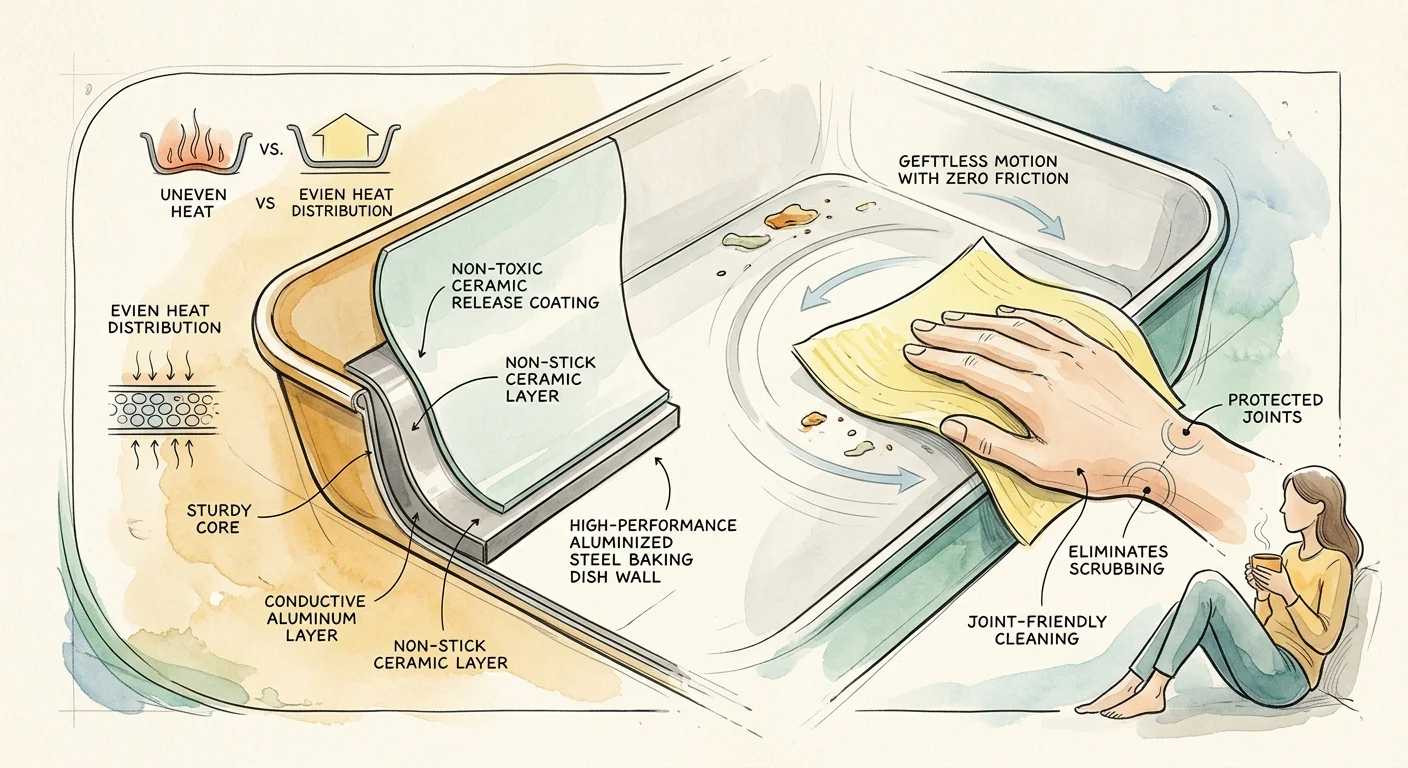
Thermal Performance, Non-Stick Chemistry, and Joint Preservation
Heat distribution describes how evenly a pan spreads thermal energy across its surface. Aluminum offers rapid heat distribution, which eliminates hot spots and browns your casseroles predictably.
Bakeware marked oven-safe can withstand high baking temperatures without structural cracking or finish deterioration. Always verify safe temperature ranges before placing metal pans under high-heat broilers.
Scrubbing baked-on food creates agonizing wrist friction that exacerbates joint inflammation. Choosing cookware with smooth release surfaces protects your joints long after dinner ends.
PTFE stands for polytetrafluoroethylene, the synthetic fluoropolymer used in traditional non-stick coatings. It offers unmatched food release, letting burnt cheese glide off under light sponge pressure.
A ceramic coating provides a non-stick surface made from inorganic silica rather than synthetic chemicals. While eco-friendly, silica-based non-stick surfaces generally degrade faster than commercial fluoropolymers.
USA Pan coats its bakeware with Americoat, a proprietary clear silicone coating free of PTFE and heavy metals. This coating allows effortless hand-washing without demanding aggressive scrubbing force.
Cookware makers craft tri-ply pans by bonding three metal layers for stovetop balance. However, high-performing 9×13 baking dishes rely instead on single-layer heavy-gauge sheet metal or molded glass.
Bakeware must be induction compatible to work on magnetic cooktops, though rectangular baking dishes function strictly inside radiant or convection ovens. If you need dishwasher convenience, stick with tempered glass over hand-wash-only bare aluminum.
Frequently Asked Questions
Why do glass baking dishes cause more wrist drops than metal pans?
Glass dishes weigh more than twice as much as aluminum equivalents. When combined with slick molded tabs that prevent a full power grip, the extra mass easily overtaxes fatigued wrists.
What is the safest way to hold a 9×13 baking dish with carpal tunnel?
Use two hands and choose a casserole dish with large handles that allow your fingers to curl entirely through the openings. This power grip transfers strain away from your carpal tunnel and into your forearms.
Can I put an aluminum baking pan in the dishwasher to protect my joints?
Dishwasher detergents contain harsh alkaline agents that cause bare aluminum to oxidize and discolor. To protect your wrists without scrubbing, soak the pan with warm water and dish soap before wiping gently.
What makes borosilicate glass safer than regular tempered glass?
Borosilicate glass incorporates boron trioxide, which gives the material exceptional thermal shock resistance. You can transfer an OXO borosilicate dish from a cold freezer straight into a hot oven without fear of shattering.
Disclaimer: Product prices and availability change frequently. Prices shown were accurate at time of writing but may have changed. We may earn a small commission from purchases made through links on this site, at no extra cost to you. Always verify current pricing on the retailer’s website before purchasing.
1 Comment