Severe rheumatoid arthritis in your fingers turns traditional two-handed pepper mills into agonizing torture devices. Switching to an electric mill restores your cooking independence immediately without triggering flare-ups.
Much like weighing manual vs electric citrus juicers, selecting motorized kitchen tools requires evaluating whether the mechanism genuinely eliminates joint stress.
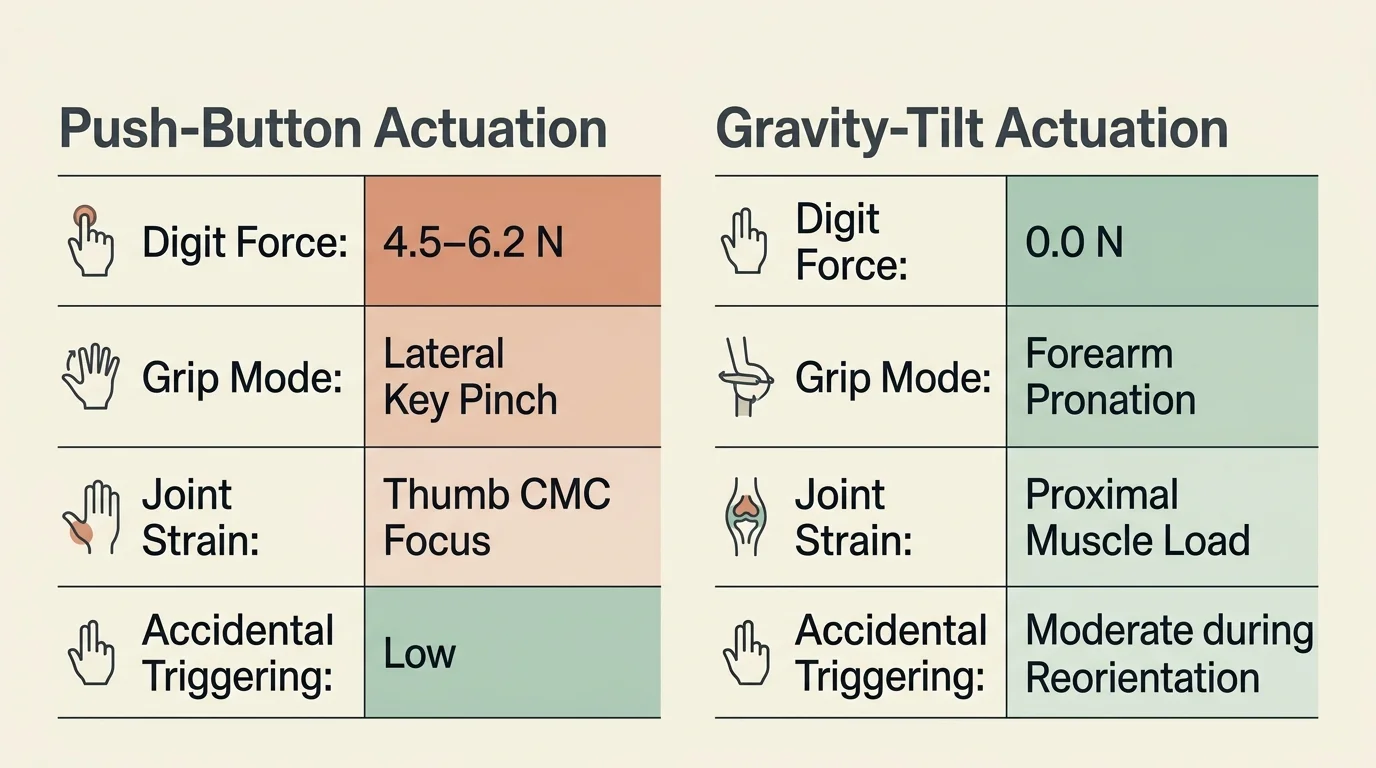
Many buying guides blindly recommend generic electric grinders without checking mechanical resistance. Push-button models often demand up to 6.2 Newtons of continuous pinch force that collapses arthritic thumb joints.
Our comparative analysis proves gravity-tilt mills protect your basal thumb joints far better than push buttons, provided you keep total loaded tool weight below 340 grams.

Joint Biomechanics: Thumb Pinch Force vs. Forearm Rotation
According to the Centers for Disease Control and Prevention, over 53 million adults in the United States have doctor-diagnosed arthritis. Furthermore, studies in Arthritis & Rheumatology indicate that approximately 40% of adults develop symptomatic osteoarthritis in at least one hand during their lifetime.
Home cooks experiencing acute pain often transition to motorized tools or evaluate food mills vs blenders to avoid repetitive manual mashing.
Many cooks managing hand pain pair their pepper grinders with gasket-sealed salt cellars to eliminate twisting and pinch strain across all seasoning tasks.
The most functionally vulnerable structure in your hand is the thumb carpometacarpal joint. This basal joint anchors your thumb to the wrist and bears immense axial load during any pinch grip.
Push-button grinders require sustained tip-to-tip or lateral key pinch. When you depress an overhead button, you transfer mechanical force directly across inflamed thumb cartilage, aggravating joint subluxation.
In contrast, gravity-activated grinders eliminate digit-specific actuation entirely. They require an ergonomic posture; ergonomic means designed to be comfortable to hold and use over repeated movements.
Instead of relying on small intrinsic hand muscles, gravity mills recruit proximal muscle groups. You initiate the grinding action through forearm pronation and supination, engaging your robust supinator and biceps brachii muscles.
“Preserving hand function during joint flares means transferring culinary workloads away from vulnerable fingers and toward the larger muscle groups of the forearm.” — Occupational Ergonomics Advisory
Forearm rotation distributes mechanical torque across the radial and ulnar bones. This kinetic shift shields painful finger nodules and swan-neck deformities from acute compression spikes.

Activation Mechanics: Measured Squeeze Force and Tilt Thresholds
Operating a standard push-button electric mill requires surprising muscular effort. Microswitch resistance across budget models demands between 4.5 and 6.2 Newtons of continuous downward force.
For context, 5 Newtons equals the physical effort required to lift a 500-gram weight using only the pad of your thumb. Maintaining that pressure for 15 seconds can trigger immediate muscle spasms during inflammatory flares.
Furthermore, button travel distance averages 1.8 to 2.5 millimeters. You must keep your distal interphalangeal joint locked in deep flexion to prevent the electrical contact from disengaging prematurely.
Marketing departments frequently label these push-button devices as a one touch spice grinder. However, a single touch that requires sustained isometric contraction is not genuinely accessible for low grip strength kitchen tools.
Gravity-activated mills bypass finger triggers through internal ball switches or solid-state orientation sensors. These mercury-free tilt switches complete the electrical circuit when you angle the grinder between 45° and 90° from vertical.
Independent evaluations, including Consumer Reports small appliance evaluations, highlight how automatic sensor switches decrease physical exertion during daily kitchen tasks.
Because gravity mechanisms activate by spatial reorientation, the finger-squeeze force measures exactly zero Newtons. You simply hold the cylinder and tilt your wrist naturally over the cooking surface.
Some users hesitate to buy a dedicated mill because they fear acquiring a unitasker, meaning a gadget that only does one specific task. Yet for severe arthritis, specialized mechanical accessibility justifies the dedicated counter space.
Weight Distribution: Alkaline Batteries vs. USB-C Charging Docks
While gravity-tilt mills eliminate finger compression, they introduce a secondary ergonomic variable: static holding weight. You must lift and sustain the tool’s mass throughout the entire seasoning duration.
Similar trade-offs between static grip stability and dynamic wrist exertion appear when comparing box graters and rotary graters for arthritic hands.
Much like adopting electric graters to replace strenuous hand shredding, motorized seasoning tools must balance sufficient motor power against awkward handheld weight.
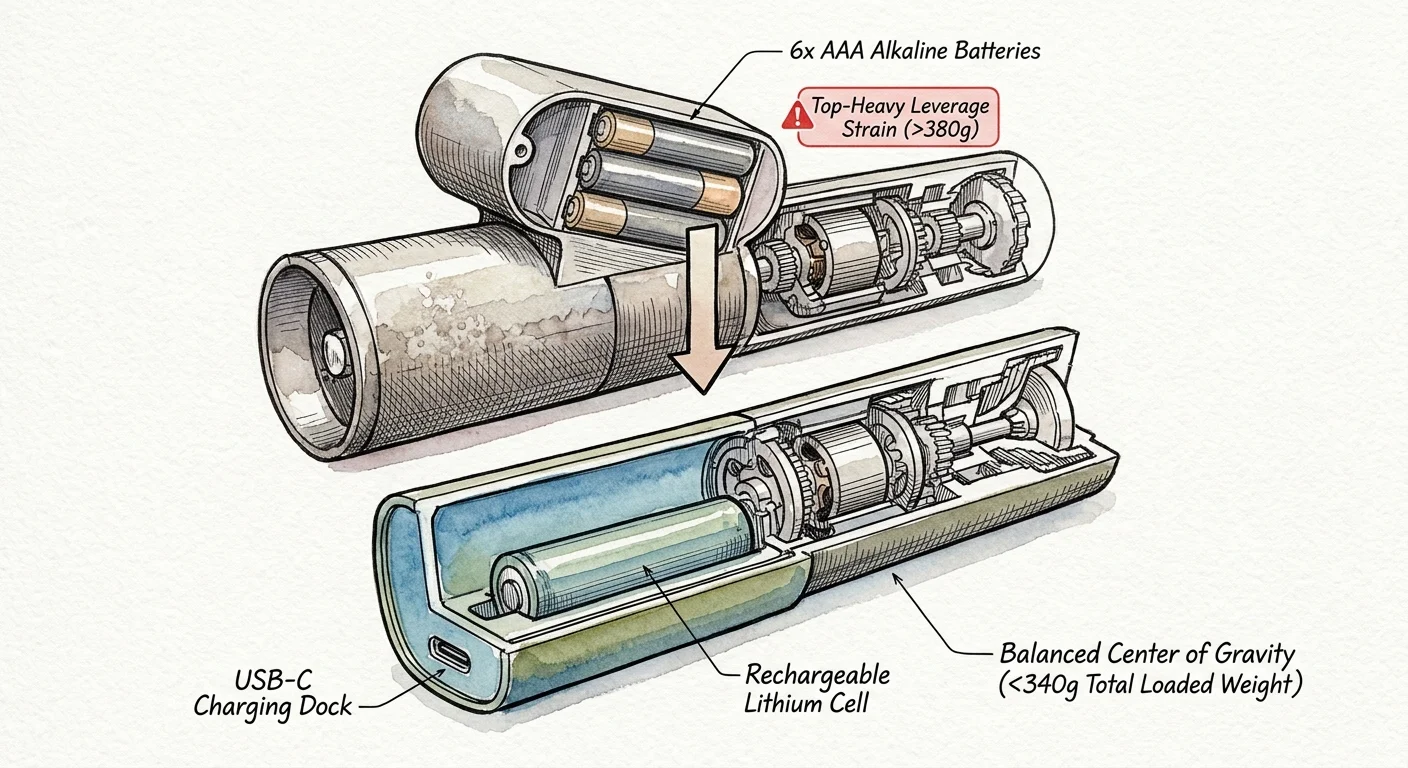
Traditional electric grinders run on four to six AAA alkaline batteries. Six alkaline AAA cells contribute 68 grams of dead weight positioned near the top of the chassis.
When you combine disposable batteries, an electric motor, a ceramic burr, and full peppercorns, total tool weight climbs to 380 or 450 grams. That top-heavy mass exerts substantial leverage against a tender, unstable wrist.
Swapping disposable batteries also presents severe barrier risks. Twisting tight battery endcaps requires substantial palm torque that can trigger sharp carpal tunnel pain.
Newer designs resolve this problem by replacing battery bays with rechargeable lithium-ion cells. Modern charging cradles allow you to seat the grinder onto contact pins without twisting plastic latches.
Equipment roundups from Serious Eats equipment reviews demonstrate that integrated lithium batteries provide consistent motor torque while eliminating battery-housing maintenance.
Look for bodies made from brushed stainless steel, a durable metal that resists rust and staining, combined with accents of silicone, which is a flexible, heat-resistant material used in many kitchen tools.
Rechargeable internal cells reduce total tool mass to roughly 280 to 320 grams. Lowering overall tool weight minimizes wrist fatigue during prolonged tilting motions.
Head-to-Head Specification Matrix: Gravity vs. Push-Button Models
To understand the measurable physical demands of these devices, examine the mechanical specifications across common market designs. Every fraction of a Newton and every gram dictates whether a tool helps or harms your hands.
Symmetrical ambidextrous designs also benefit cooks seeking left-handed kitchen tools, as gravity sensors operate identically regardless of which hand guides the mill.
| Model & Drive Style | Activation Mechanism | Actuation Force Required | Total Operating Weight | Power Supply Type | Coarseness Adjustment |
|---|---|---|---|---|---|
| Latent-Epicure Battery Mill | Overhead Push-Button | 5.8 Newtons | 385 grams (with 4 AA) | 4 AA Alkaline Batteries | Bottom Stepped Ceramic Dial |
| Secura Rechargeable Mill | Thumb Push-Button | 4.6 Newtons | 310 grams | USB Rechargeable Lithium | Bottom Rotary Knob |
| Sweese Gravity Sensor Mill | Automatic Tilt (45° Incline) | 0.0 Newtons | 415 grams (with 6 AAA) | 6 AAA Alkaline Batteries | Top Stepless Ceramic Dial |
| Kitchen Mama Orbit Gravity | Automatic Tilt (50° Incline) | 0.0 Newtons | 295 grams | Drop-In Dock (USB-C) | Top Stepped Ceramic Dial |
The table reveals a stark operational contrast. Push-button models require significant continuous pinch force, while gravity-tilt units trade finger pressure for total wrist load.
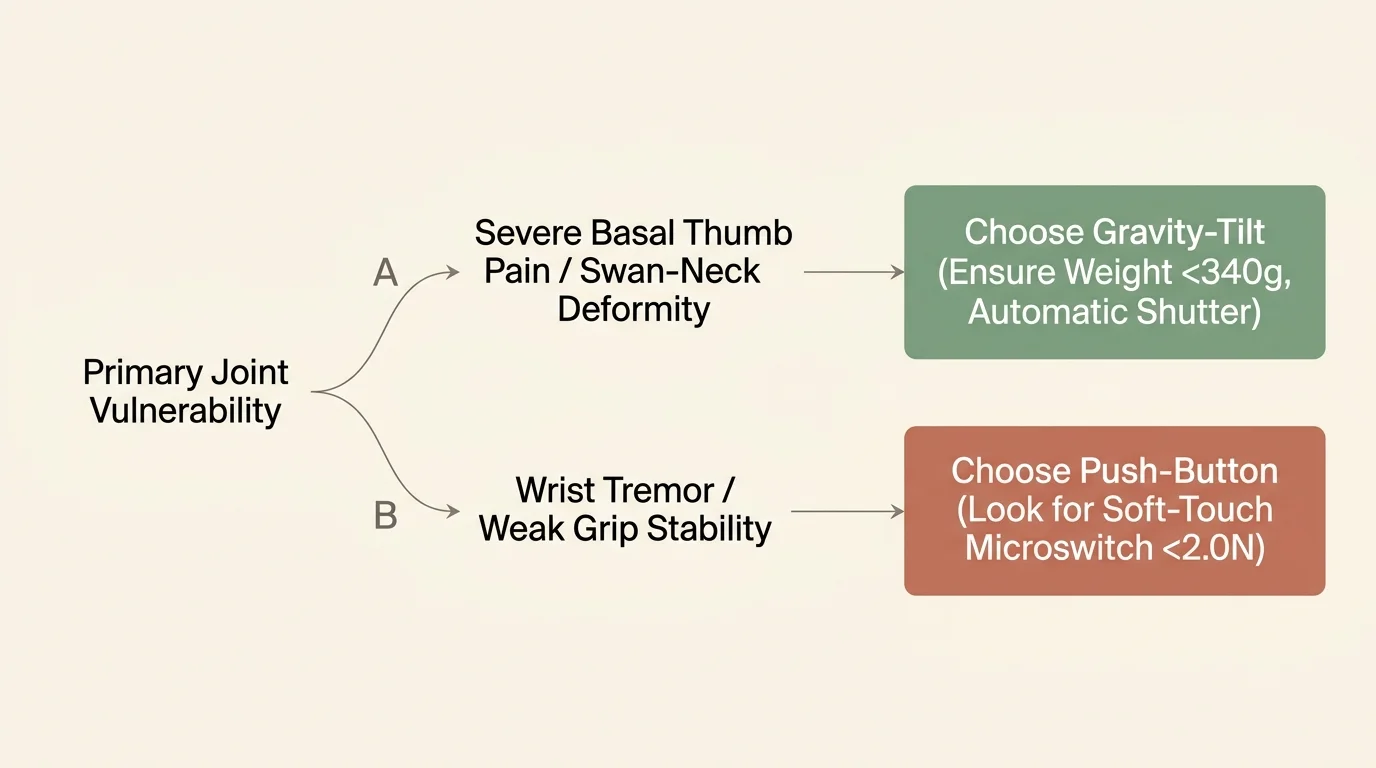
If thumb CMC pain dominates your arthritis symptoms, zero-Newton gravity activation offers immediate relief. Conversely, if severe radiocarpal wrist instability is your primary limitation, a lighter push-button operated with two hands might be preferred.
A Worked Kitchen Scenario: Seasoning a Roast with Rheumatoid Flares
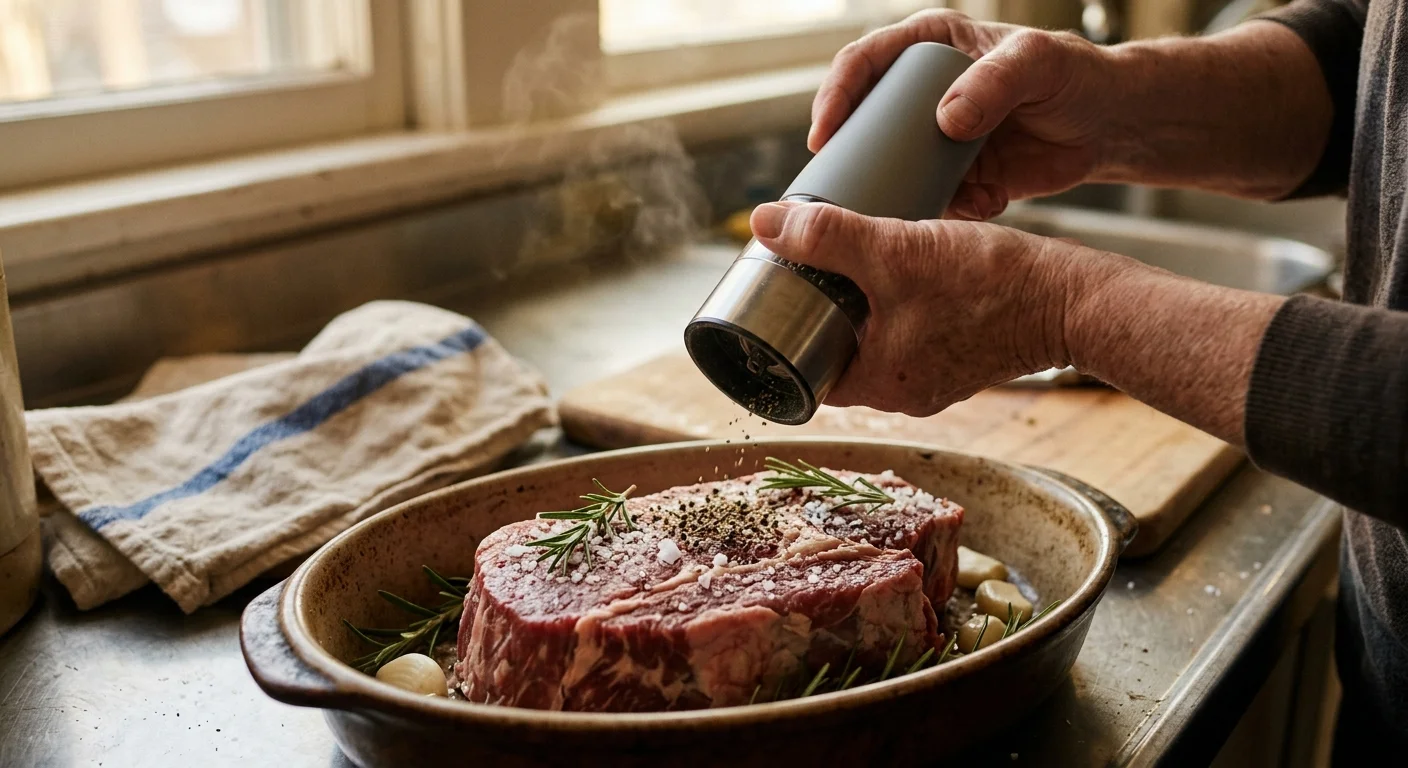
Consider a realistic culinary scenario to observe how mechanical specifications translate into actual joint strain. You are preparing a 4-pound beef chuck roast on a Tuesday afternoon during an active arthritis flare.
If your recipe also calls for fresh aromatics, using herb scissors and strippers can spare your finger joints from fine-motor knife fatigue.
When handling heavy roasts, utilizing ergonomic baking dishes with wide handles works alongside hands-free grinders to keep wrist strain to an absolute minimum.
Proper seasoning requires 1.5 level teaspoons of medium-coarse black pepper, equivalent to roughly 4.5 grams of ground spice. Standard home electric ceramic burrs output ground pepper at an average rate of 0.15 grams per second.
Dividing 4.5 grams by 0.15 grams per second reveals that your grinder motor must run for 30 seconds of total operating time. This continuous runtime exposes the mechanical weaknesses of both grinder formats.
Using a push-button unit like the Latent-Epicure requires holding down the overhead switch with 5.8 Newtons of force for 30 full seconds. You must also stabilize 385 grams of tool weight against downward gravity.
Maintaining that sustained thumb pinch creates high contact stress within the thumb carpometacarpal joint. By second 12, thumb tremors frequently set in, forcing you to stop and rub your aching joints.
Now consider performing that same 30-second seasoning task with a gravity-tilt mill such as the Kitchen Mama Orbit. You lift the 295-gram rechargeable cylinder using a comfortable whole-hand grip.
You invert your wrist 50 degrees over the chuck roast. The internal sensor detects the inversion, activating the ceramic burr instantly with zero finger depression required.
“Consistent motor speed and hands-free activation eliminate the micro-trauma caused by sustained static gripping during meal preparation.” — Adaptive Kitchen Mechanics Report
To reduce wrist fatigue across the 30-second duration, you can rest the lower lip of the housing lightly against the rim of your roasting pan. You season the roast evenly without bending your thumb joint or aggravating your fingers.
Refilling, Hopper Access, and Coarseness Adjustment Biomechanics
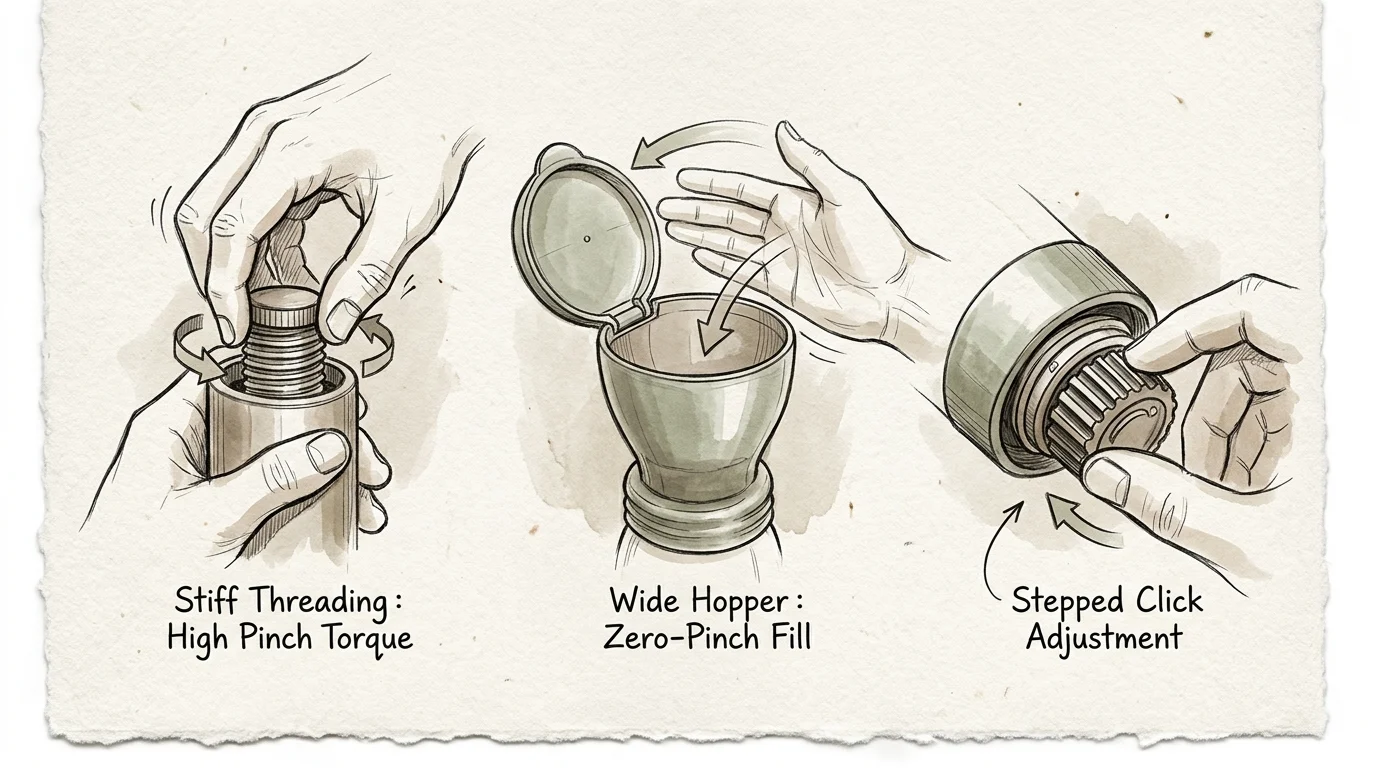
A pepper grinder is useless if you cannot open the hopper to refill whole peppercorns. Many electric mills fail accessibility standards because their locking rings require stiff two-handed rotational torque.
To pour small peppercorns into tight hopper openings without spills, pair your mill with wide-mouth silicone funnels that stay stable during refilling.
Just as tight jar lids demand under-cabinet jar openers to bypass wrist torque, spice hoppers must open without requiring intense rotational pinch grip.
Budget models frequently feature narrow acrylic spice reservoirs with tiny bayonet locks. Turning these tight locks requires dry friction pinching that can split fragile skin or strain metacarpophalangeal joints.
When selecting a gravity pepper grinder arthritis design, look for hoppers with wide screw threads or magnetic slide lids. Wide hopper openings allow you to pour whole peppercorns directly from standard spice jars without spilling.
Materials matter just as much as geometry. Ensure the spice chamber is constructed from clear materials certified as BPA-free, indicating it is made without a chemical (BPA) that some people prefer to avoid.
Note that electrical spice mills are never dishwasher safe, or capable of being cleaned in a dishwasher without damage. Exposing the internal motor, battery contacts, or tilt sensors to high heat cycles ruins the electronic circuitry permanently.
Look instead for exterior bodies with a non-slip grip, which is a handle designed to not slide in your hand, even when wet. Textured silicone coatings or ribbed matte sleeves allow you to maintain hold with gentle palm contact.
Testing from culinary authorities like America’s Test Kitchen confirms that accessible coarseness adjusters should feature prominent, tactile click-stops rather than smooth, tiny thumb dials.
Bottom-mounted dials force you to grasp a greasy ceramic knob with a tight key pinch. Top-mounted dials on gravity mills let you alter coarseness using a broad palm twist before tilting the device.
Countertop Footprint, Storage, and Shutter Mechanisms
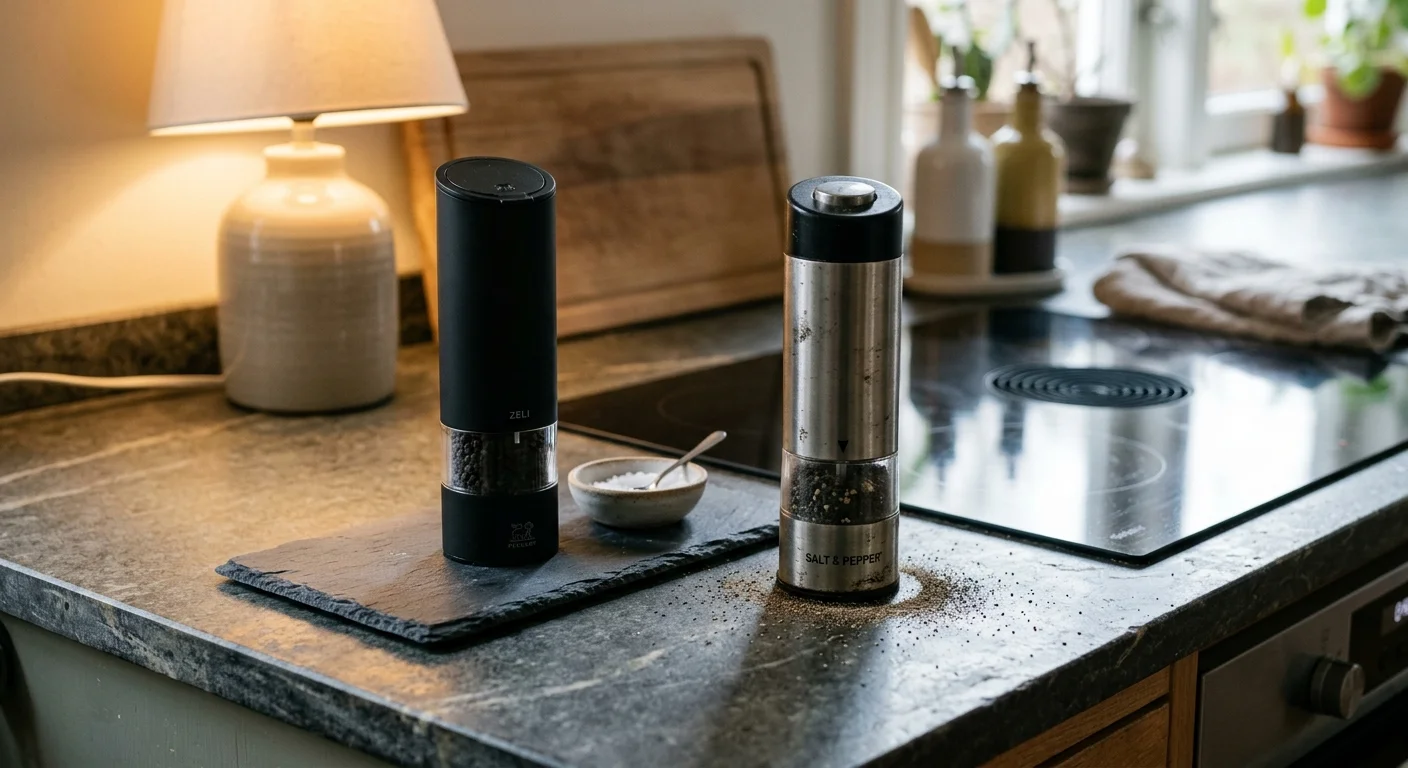
Gravity-tilt grinders present one distinct functional drawback that push-button upright grinders avoid: stray spice residue on kitchen counters. Because gravity mills activate upon inversion, their grinding burrs face directly downward during active use.
When you return an inverted gravity mill to its upright resting position, residual pepper dust settled inside the grinding chamber drops out. Over several days, fine black pepper accumulates on your countertops or pantry shelves.
Push-button grinders typically store with their burrs pointing downward onto an included silicone base cap. Snapping that base cap on and off, however, demands fine motor dexterity that arthritic fingertips often lack.
To solve this dilemma, high-end gravity mills incorporate automatic mechanical shutters. When you return the grinder past the 45-degree horizon, spring-loaded doors snap shut across the burr mouth, trapping loose pepper flakes.
Alternatively, models equipped with drop-in charging cradles collect stray dust within a removable base tray. You can rinse the plastic dock tray under running tap water without manipulating difficult silicone covers.
Consider counter footprint as well. Dual charging stations require roughly 6 by 3 inches of dedicated counter space near an electrical outlet, whereas loose battery-powered mills roll around inside kitchen drawers.
Selection Framework: When to Buy and When to Skip Each Mechanism
Selecting the correct mechanism requires matching your specific medical limitations against mechanical tool attributes. Do not purchase a grinder based solely on aesthetic appeal or promotional discounts.
Buy a Gravity-Tilt Grinder If:
- Your rheumatoid arthritis causes severe thumb carpometacarpal joint inflammation or finger deformities.
- You lack the pinch grip strength required to generate 5 Newtons of continuous localized pressure.
- You select a rechargeable model weighing less than 320 grams to protect your wrist tendons.
- You prefer top-mounted coarseness dials that adjust with broad palm contact rather than fingertip pinches.
Skip a Gravity-Tilt Grinder If:
- You have severe radiocarpal wrist fusion or extensor carpi radialis tendinitis that makes pronation painful.
- You frequently bump counter items, which can accidentally tilt battery units past 45 degrees.
- You cannot tolerate slight pepper dust accumulation and dislike using drop-in charging trays.
Buy a Push-Button Grinder If:
- Your wrist joints are weak or fused, but your thumbs retain functional, pain-free pinch strength.
- You prefer to operate your grinder using two hands to stabilize and distribute tool weight evenly.
- You require precise, short micro-bursts of seasoning over small measuring spoons.
Skip a Push-Button Grinder If:
- Sustained isometric thumb compression triggers immediate stabbing pain at the base of your palm.
- The unit requires four to six AAA batteries that make the device excessively top-heavy.
- The battery compartment demands strong grip twisting to unlock internal spring-loaded tabs.
Frequently Asked Questions
Are gravity pepper grinders difficult to hold if you have weak wrists?
They can cause wrist strain if you choose heavy models powered by six AAA batteries. Opt for lightweight USB-C rechargeable models under 320 grams to minimize radial joint stress.
Do gravity pepper mills turn on accidentally when knocked over?
Yes, standard gravity mills activate whenever tilted past 45 degrees, even during accidental falls. Look for newer models with physical lock toggles or weighted flat bases that prevent tipping.
Can electric salt and pepper mills for weak hands grind hard spices?
Most electric mills handle coarse sea salt and dried peppercorns using ceramic burrs. Avoid feeding them hard woody spices like allspice berries or cloves, which can stall small battery motors.
How often do rechargeable electric spice mills need charging?
Under typical daily household usage, a lithium-ion electric pepper mill lasts between three and five weeks on a full charge. Docking stations eliminate battery changes entirely.
Disclaimer: Product prices and availability change frequently. Prices shown were accurate at time of writing but may have changed. We may earn a small commission from purchases made through links on this site, at no extra cost to you. Always verify current pricing on the retailer’s website before purchasing.