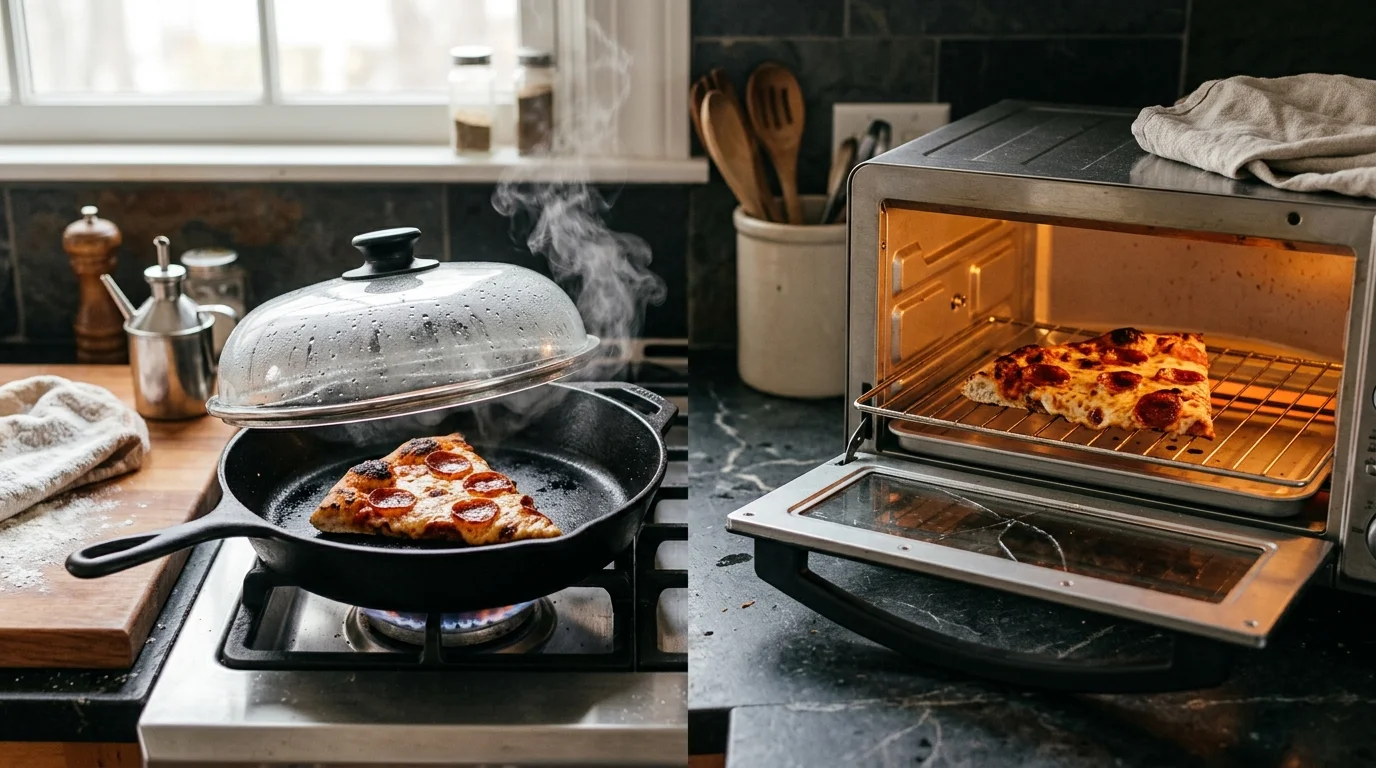
You can revive cold pizza in under six minutes without waiting twenty minutes for an oven to preheat. Placing a slice into a hot pan with water droplets delivers a blistered crust while trapping steam to melt cold cheese.
While toaster oven broiling cooks via radiant heat, covered skillet steaming uses direct conduction and rapid thermodynamics to restore retrograded starch without drying toppings.
This guide evaluates thermal conduction, pan materials, and dual-heating toaster ovens so you can choose the best way to reheat pizza without soggy bottom crusts ruining your meal.
The Science of Stale Pizza Crust and Retrogradation
Refrigerating leftover pizza triggers starch retrogradation. As baked crust cools below 40°F, gelatinized amylose and amylopectin molecules realign into rigid crystalline structures.
While compact tools like microwave crisper pans attempt to reduce sogginess, standard microwave heating simply cannot match true conductive searing.
This crystallization forces trapped moisture out of the starch matrix, causing that characteristic leathery, stale chew. Simultaneously, water from the tomato sauce migrates into the porous dough beneath it.
Microwaves fail because they agitate water molecules uniformly throughout the slice. That process turns bound moisture into unvented steam, leaving the dough spongy before it rapidly hardens into rubber.
To reverse retrogradation, dough starches must reach approximately 140°F to 150°F in the presence of heat. At this temperature, starch crystals dissolve and re-absorb moisture.
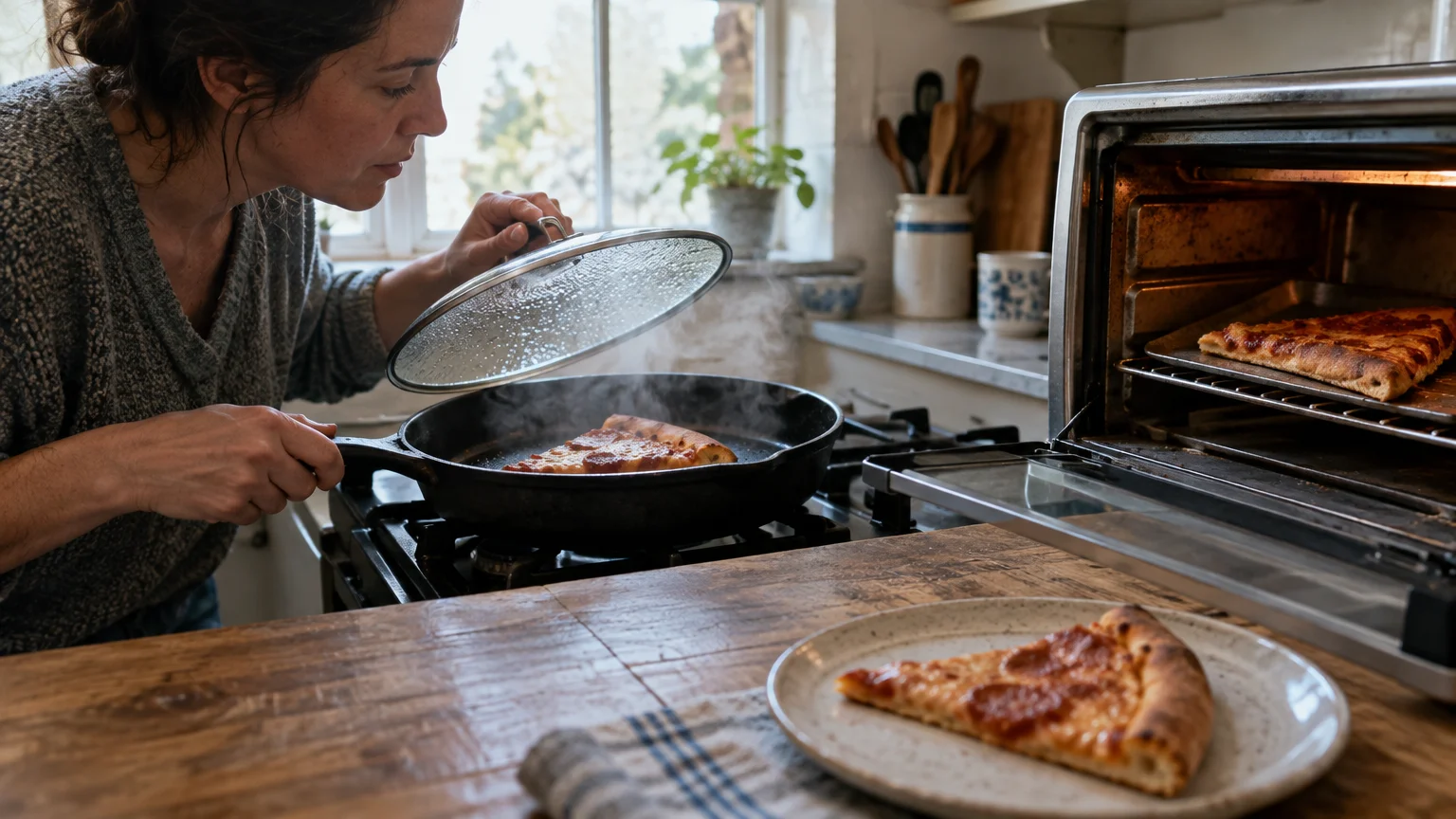
Direct conductive heat from a hot cooking surface vaporizes water in the bottom crust, restoring crispness. Meanwhile, warm atmospheric steam re-softens cheese fats without baking away sauce hydration.
“Direct conductive contact transfers thermal energy twenty times faster than countertop air. Water droplets flash into steam instantly, re-melting dairy fats without baking crust into cardboard.”
According to culinary equipment evaluations by Serious Eats, controlling bottom crust contact while managing ambient moisture represents the absolute gold standard for reheating bakery starches.
The Covered Skillet Steam Method: Step-by-Step Mechanics
The covered skillet technique relies on two distinct thermodynamic phases: conductive searing and convective steaming. You can execute this method on any gas, electric, or induction burner.
Once your slice is crisped and heated through, using a rocker or wheel pizza cutter makes it easy to portion before serving.
First, place your dry pan over medium heat for two to three minutes. A properly heated pan surface ensures the bottom dough starts crisping the second it touches the metal.
Set one or two cold slices directly onto the bare pan surface. Do not add oil; day-old pizza dough already contains residual fats that render under moderate heat.
Toast the slice uncovered for approximately two minutes. During this initial contact, monitor the undercarriage until the crust turns golden brown and regains its rigid structure.
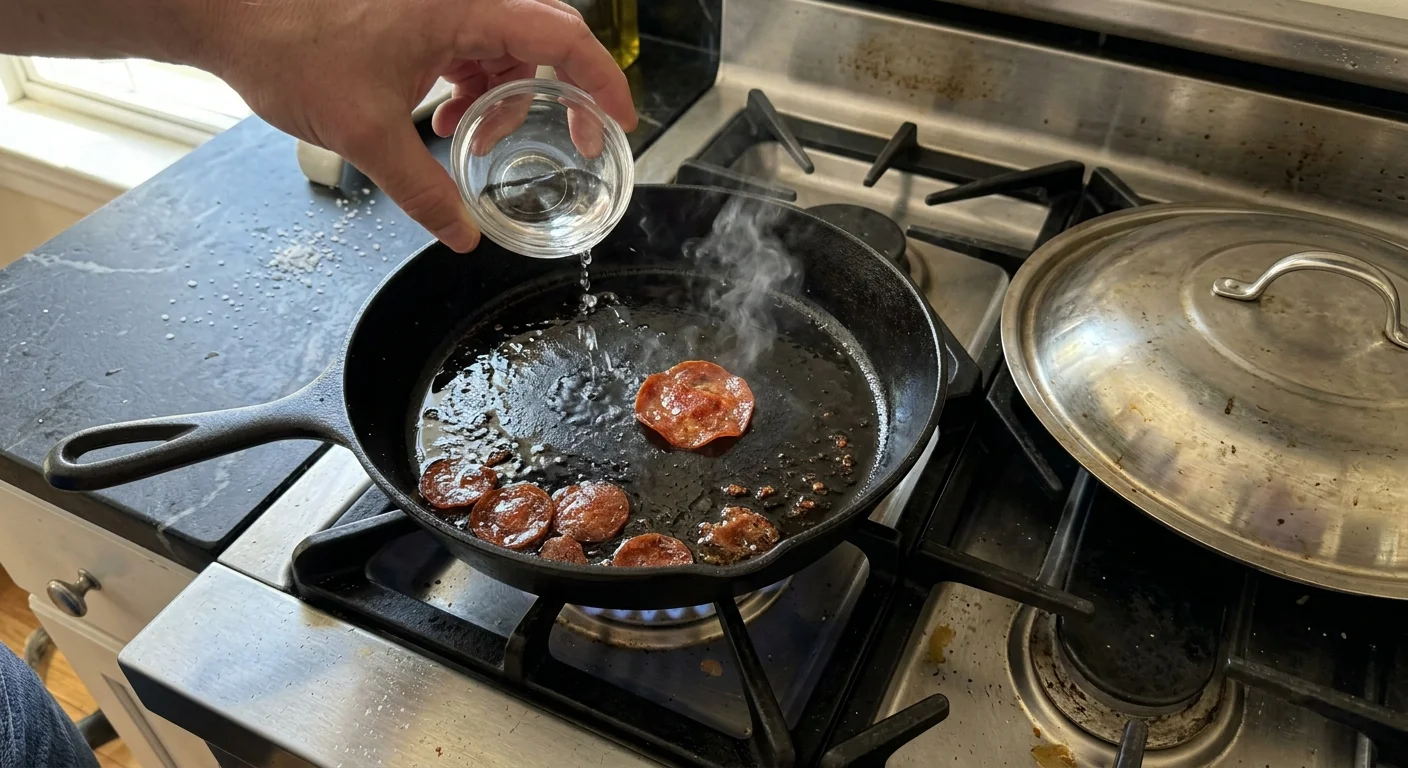
Next, introduce the steam component. Pour three to four drops of water—roughly one-quarter teaspoon—onto the cooking surface alongside the slice, keeping the liquid away from the dough.
Cover the pan immediately with a tight lid. The water flashes into high-temperature vapor instantly upon hitting the hot metal base.
Trap the steam for 60 to 90 seconds. The vapor condenses on the cold cheese, liquifying milk solids and reheating toppings without dampening the toasted crust below.
Remove the lid during the final thirty seconds. This vents residual airborne moisture and guarantees the bottom remains crunchier than when fresh from the delivery box.
This method lets you reheat pizza crispy crust pan style in under five minutes, eliminating any risk of soggy crust.
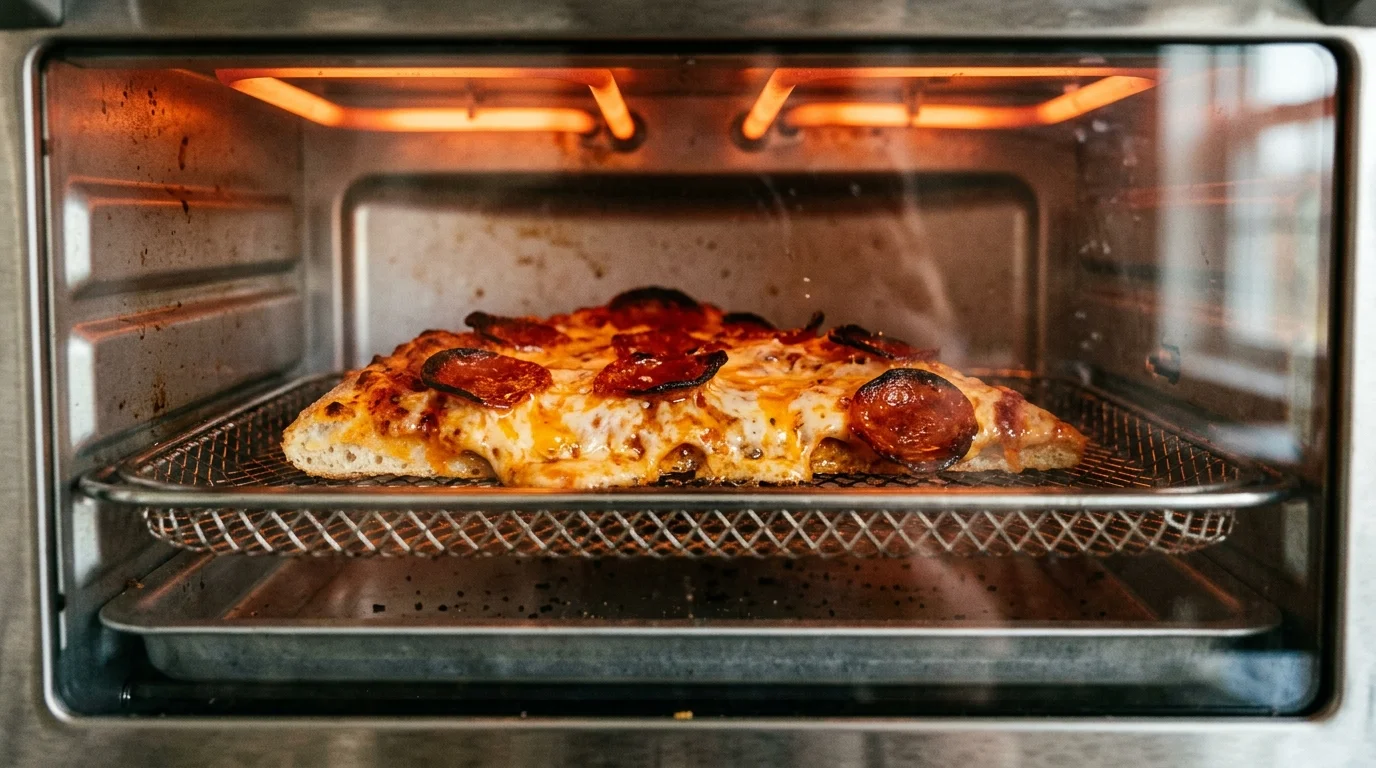
Toaster Oven Broiling: Direct Radiation and Top-Down Heat
Countertop toaster ovens use radiant heat from calrod or quartz heating elements. In broil mode, the upper elements operate at full wattage while lower elements run at reduced output or switch off entirely.
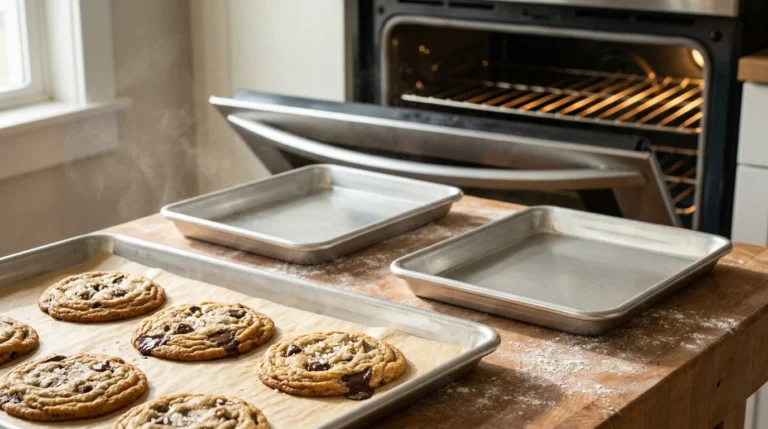
Opting for sturdy rimmed baking sheets helps prevent warping and ensures more uniform heat transfer when preheating trays.
If counter space is tight, consider a compact 2-slice toaster oven with proper upper-cabinet heat clearance before broiling.
Infrared radiation travels across the chamber to heat toppings, brown cured meats, and caramelize shredded mozzarella cheese. This produces blistered, bubbly cheese surfaces that stovetop pans struggle to mimic.
However, toaster ovens struggle with heat transfer beneath the crust. Wire racks allow hot air to circulate, but convective air transfers thermal energy significantly slower than direct metal contact.
Placing slices directly on a cold aluminum toaster tray slows heat transfer even further. The cold metal absorbs energy slowly, allowing tomato sauce moisture to soften the crust before bottom searing begins.
To overcome this limitation, preheat the toaster oven pan or a small baking stone for five minutes at 425°F. Slide the cold slice onto the hot metal, then engage the broil setting.
Broiling requires vigilance because pepperoni edges and cheese oils ignite or scorch quickly under intense top elements. Keep the pizza at least three inches below the upper elements.
Cook the slice for three to four minutes until the cheese bubbles actively. Check the bottom crust with a thin spatula to confirm it has reached sufficient rigidity.
Independent testing by Consumer Reports shows that countertop ovens deliver inconsistent bottom crispness unless users preheat high-mass accessories inside the chamber first.
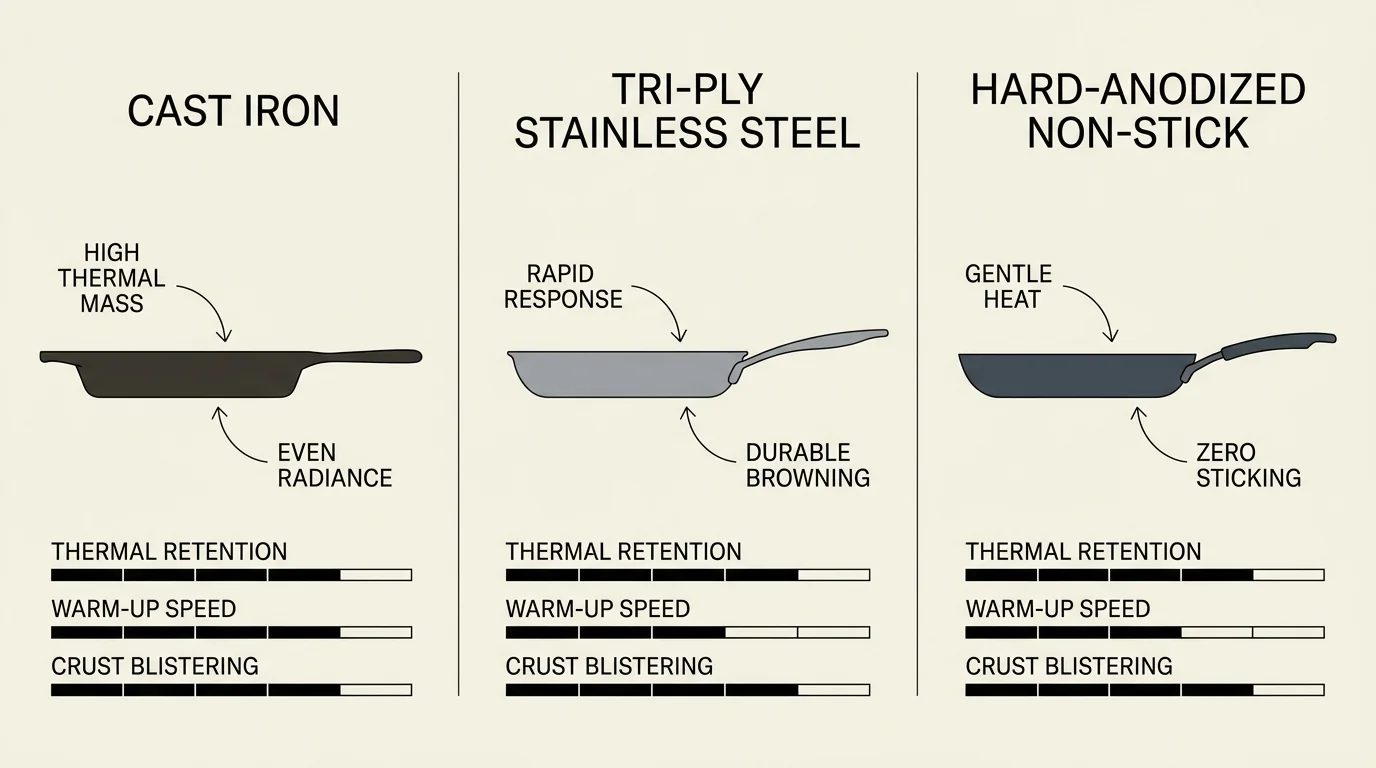
Skillet Materials Compared: Cast Iron, Stainless Steel, and Non-Stick
Pan material plays a massive role when executing skillet vs toaster oven pizza techniques. Each alloy handles thermal mass and heat retention differently.
Home cooks looking for rapid heat transfer can also consider carbon steel as a lighter cast iron alternative for crisping undercarriages.
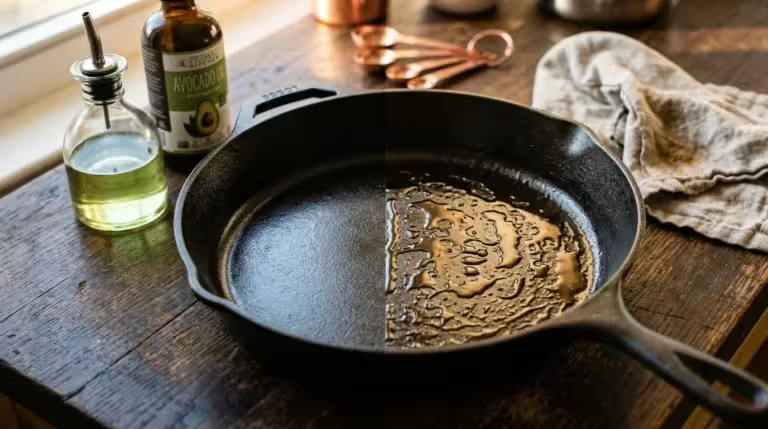
Heavy cast iron serves as the premier vessel for this technique. The term “seasoned” refers to a protective coating built up on cast iron through polymerized oil and heat over time.
Cast iron boasts high volumetric heat capacity, meaning it absorbs vast thermal energy and releases it steadily. When a cold slice hits seasoned cast iron, the pan temperature does not drop.
To reheat pizza cast iron skillet lid setups provide the best results because heavy iron retains heat and creates an effective moisture seal. A 10.25-inch Lodge cast iron skillet handles two medium slices easily.
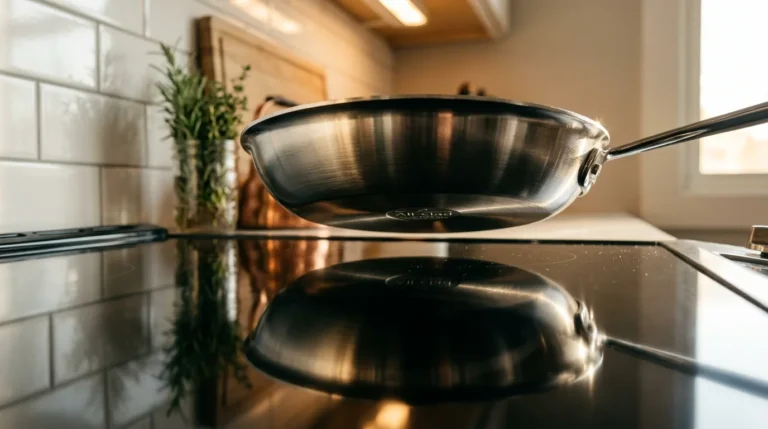
Tri-ply stainless steel cookware presents a capable alternative. The term “tri-ply” refers to three layers of metal bonded together for better heat distribution, typically an aluminum core sandwiched between stainless steel.
In metallurgy, “heat distribution” measures how evenly the pan spreads heat across its surface without creating erratic hot spots. Aluminum conducts heat rapidly, providing uniform browning across the slice footprint.
However, melted cheese sticks aggressively to bare stainless steel. If topping shreds spill over the crust edges, they will adhere to the steel and scorch before the steam melts the upper surface.
Non-stick cookware features either PTFE or ceramic coatings. The acronym “PTFE” is the chemical name for Teflon-style non-stick coatings, valued for exceptional surface slickness.
A “ceramic coating” describes a newer non-stick surface made from silica-based inorganic compounds. While both coating varieties prevent cheese from sticking, they limit cooking performance.
Non-stick pans generally use a thin metal gauge. The term “gauge” defines the thickness of the metal, where lower numbers mean thicker materials that resist warping under high thermal stress.
Thin non-stick coatings cannot achieve the deep crust blistering produced by raw iron. Furthermore, trapping dry pan heat beneath a lid can degrade delicate PTFE coatings over time.
Most commercial cookware is “oven-safe,” meaning it can go from stovetop to oven without damage, typically rated up to 500°F for cast iron or stainless steel. Non-stick pans often top out at 400°F.
Cooks with modern cooktops must also verify that their cookware is “induction compatible.” This term means the vessel works on induction cooktops, which require magnetic materials such as cast iron or magnetic stainless steel.
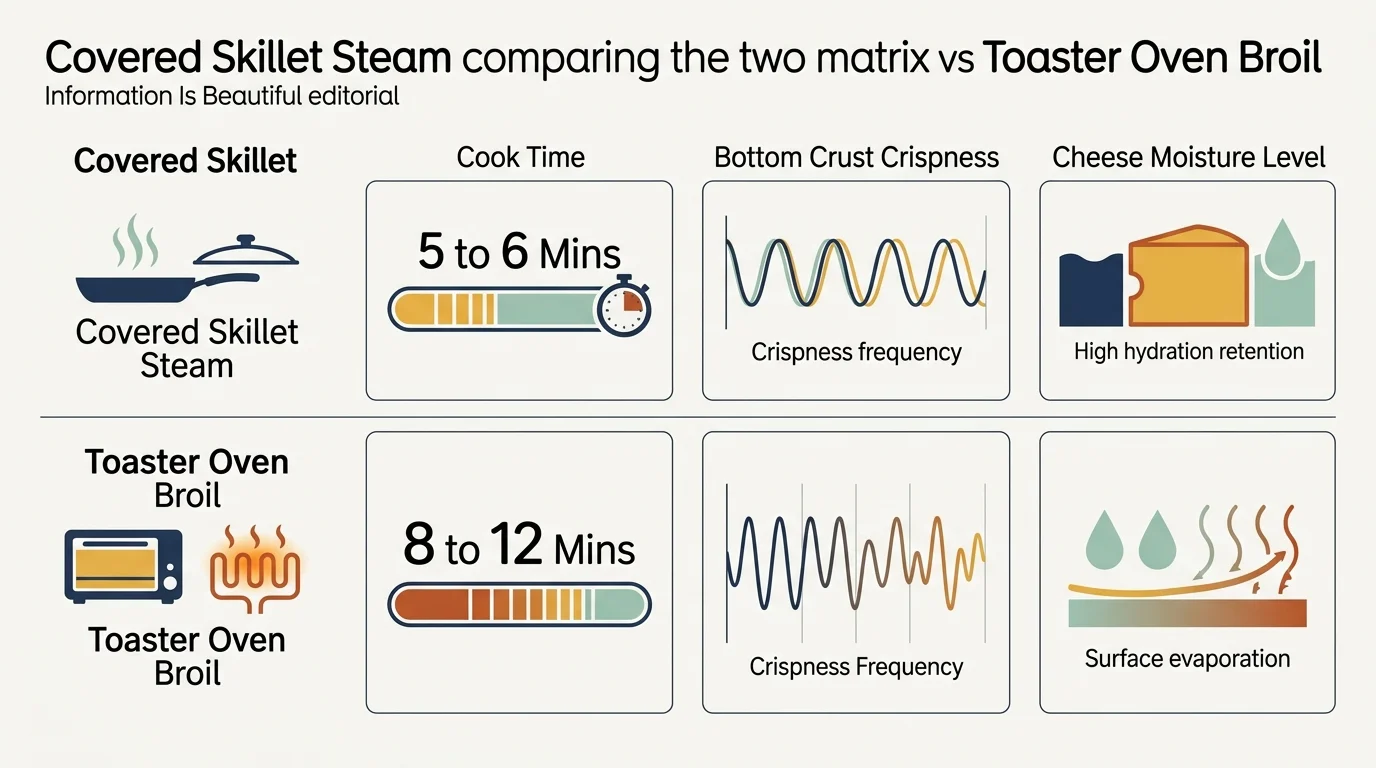
Head-to-Head Performance Comparison: Crust, Cheese, and Time
Choosing between stovetop steaming and toaster oven broiling depends on whether you prioritize crust crunch, cheese caramelization, or speed. Both techniques outperform full-size kitchen ovens.
Cooks comparing countertop gadgets may also weigh an air fryer against a convection toaster oven to balance rapid air circulation with cheese melting control.
The following performance breakdown compiles observable thermal metrics, surface crispness ratings, and preparation timings across both methods.
| Reheating Method & Cookware | Preheat Time | Active Cook Time | Bottom Crispness (1–10) | Cheese Melt Uniformity | Energy Consumption |
|---|---|---|---|---|---|
| Covered Cast Iron Skillet (Lodge 10.25-inch) | 2.5 minutes | 3.5 minutes | 9.5 / 10 | Thorough, soft, hydrated | 0.08 kWh equivalent (Gas/Induction) |
| Tri-Ply Stainless Pan (All-Clad D3 10-inch) | 2.0 minutes | 3.0 minutes | 8.5 / 10 | Thorough, soft, hydrated | 0.07 kWh equivalent (Gas/Induction) |
| Toaster Oven Broil on Wire Rack (1800W) | 4.0 minutes | 4.5 minutes | 6.0 / 10 | Bistered, bubbly, dry edges | 0.25 kWh (Electric Countertop) |
| Toaster Oven on Preheated Sheet Pan | 5.0 minutes | 4.0 minutes | 7.5 / 10 | Blistered, bubbly, moderate melt | 0.27 kWh (Electric Countertop) |
| Non-Stick Skillet with Glass Lid (PTFE) | 1.5 minutes | 4.0 minutes | 7.0 / 10 | Thorough, soft, hydrated | 0.06 kWh equivalent (Gas/Induction) |
The covered cast iron method achieves superior crust crunch. Direct conductive contact delivers crisping heat into the lower dough layer far faster than radiant oven elements.
Broiling in a toaster oven excels at browning upper toppings. If your pizza features thick layers of mozzarella, ricotta, or wet vegetables, radiant overhead broiling dries excess surface moisture efficiently.
Pan steaming wins decisively on time efficiency. You can heat, crisp, and melt two slices on the stovetop before a standard toaster oven finishes its internal preheat sequence.
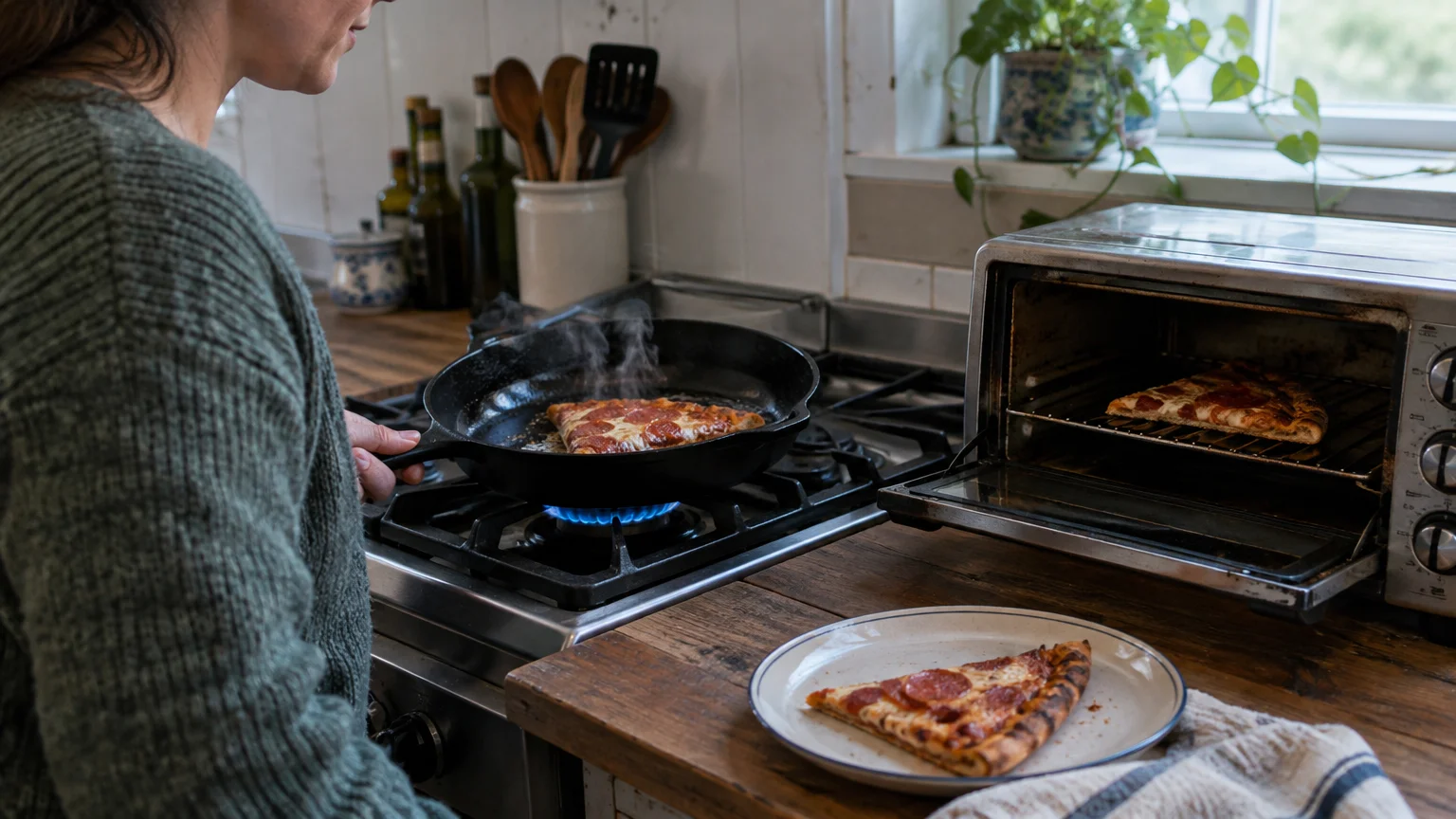
Worked Scenario: Energy Consumption and Cook Times
Consider a practical scenario: reheating two slices of cold, thick-crust pepperoni pizza retrieved from a 38°F refrigerator. We track cooking progress using an instant-read probe thermometer.
The target internal temperature is 165°F, aligning with food safety guidelines established by the United States Department of Agriculture for reheating cooked leftovers.
In Method A, we place a Lodge 10.25-inch seasoned cast iron skillet onto a 9,000 BTU gas cooktop burner set to medium heat. The pan preheats for two minutes, reaching 375°F across its center base.
We drop the two cold slices into the dry skillet. Over the next two minutes, the cold bottom crust draws conductive heat, raising the dough base to 210°F while the upper pepperoni remains cold at 55°F.
We measure 2.5 milliliters (one-half teaspoon) of tap water and splash it onto the outer metal edge. We cover the skillet with a tight lid for 90 seconds.
The water vaporizes instantly into 212°F steam. The trapped vapor transfers latent heat across the cheese, elevating the center of the slices to 168°F while cheese oils liquify completely.
Total time elapsed: five minutes and thirty seconds. Total energy spent: approximately 750 BTUs of gas power, leaving the bottom crust crackling and toppings rich and glossy.
In Method B, we fire an 1800-watt countertop toaster oven set to Broil at 450°F. The dual quartz elements require four minutes to heat the small oven chamber fully.
We position the two slices on a quarter-sheet aluminum baking tray placed four inches below the heating elements. The cheese begins sizzling at three minutes, and pepperoni edges char at four minutes.
An instant-read probe confirms the top cheese reaches 175°F. However, inserting the probe into the center dough reveals an internal temperature of just 142°F.
The aluminum pan shielded the crust from direct radiation. The bottom crust measures somewhat dry and brittle rather than blistered and crisp.
Total elapsed time: eight minutes and thirty seconds. Energy drawn: 0.255 kilowatt-hours of residential electricity. Method A proved three minutes faster while delivering a crisper crust.
Cookware assessments published by America’s Test Kitchen highlight that pan conduction consistently yields superior textural contrast compared to standard radiant toaster heating.
Essential Cookware and Countertop Recommendations
Achieving ideal results requires matching your technique with the right culinary gear. The following models deliver dependable temperature management and lasting durability.
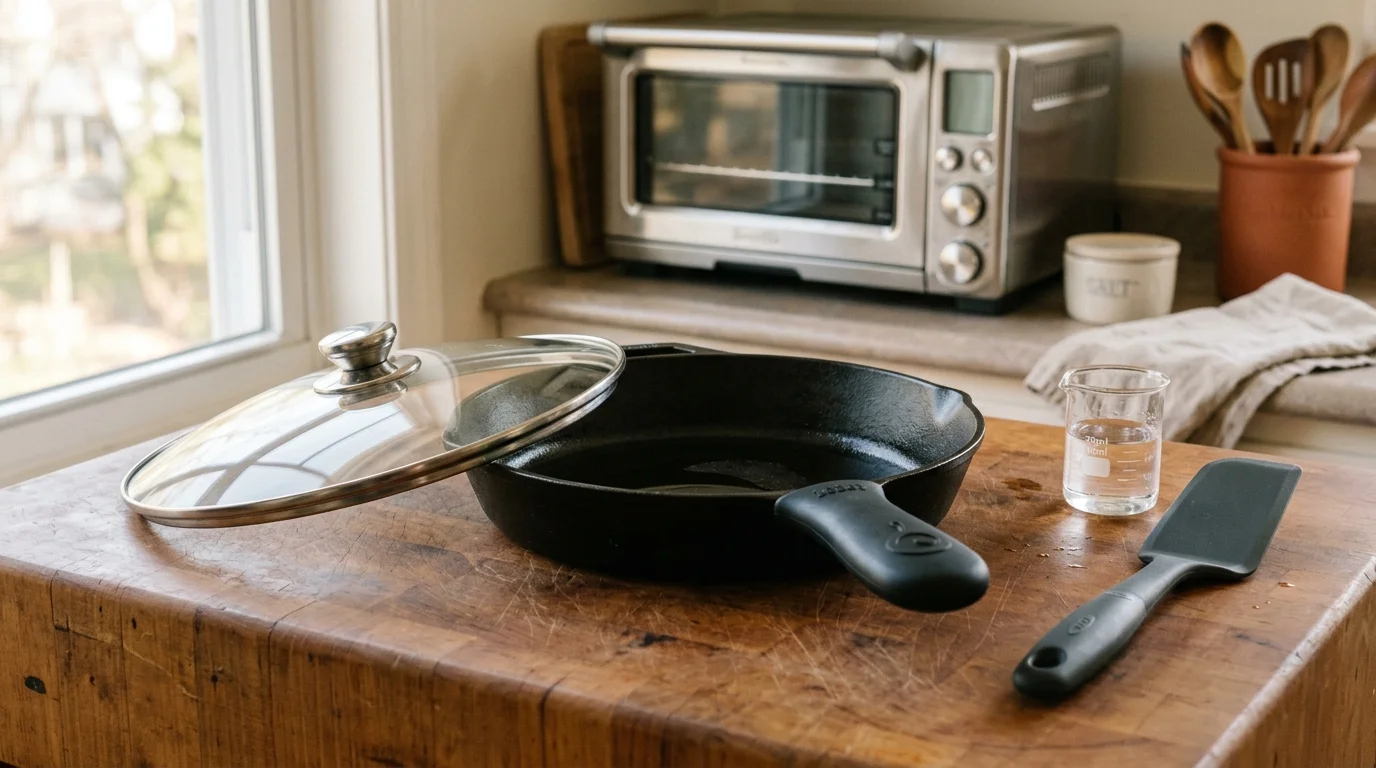
For the covered steam method, the Lodge 10.25-inch Seasoned Cast Iron Skillet serves as the best overall choice. Its heavy iron body holds onto heat effectively when chilled slices hit the surface.
Pair this pan with the Lodge tempered glass lid or a heavy cast iron lid. A snug lid traps boiling water droplets instantly, generating the steam pocket needed to liquify toppings.
If you prefer lightweight gear, consider the All-Clad D3 10-inch Tri-Ply Stainless Steel Fry Pan. Its bonded aluminum core eliminates hot spots, delivering uniform browning across wide New York-style slices.
When cooking on stainless steel, watch pan temperatures closely. A quick swipe of high-smoke-point avocado oil prevents errant cheese drips from burning onto the bare cooking surface.
If you prefer toaster ovens for large four-slice batches, select the Breville Smart Oven Pro (model BOV845BSS). Its dual-wall quartz elements distribute radiant energy far more evenly than budget wire-element appliances.
To maximize crispness in any countertop oven, pair it with a preheated Nordic Ware Natural Aluminum Eighth Sheet pan. Preheating the pan mimics stovetop conduction while overhead elements broil the cheese.
According to comprehensive evaluations by Wirecutter, investing in heavy multi-clad skillets or thick cast iron pans offers the most flexible utility for everyday cooking tasks.
Frequently Asked Questions
Why does putting water in the skillet make the crust crispier?
Water does not make the crust crispier; direct metal conduction crisps the base. Splashing water droplets around the pan creates steam, which melts upper cheese quickly without requiring extra pan time that might scorch the crust.
Can you reheat pizza in a non-stick skillet without ruining the coating?
Yes, you can use non-stick cookware if you maintain low to medium burner temperatures. Never preheat empty non-stick pans on high heat, and use a silicone spatula to avoid scratching delicate PTFE or ceramic linings.
Does putting a toaster oven on broil dry out leftover pizza toppings?
Yes, broiling relies entirely on dry radiant heat that strips moisture from sauce and cured meats. If you broil, keep cook times under four minutes and place slices lower in the oven chamber to prevent scorch marks.
What is the best way to reheat deep-dish or Sicilian pizza slices?
Thick-crust pizza requires moderate stovetop heat for three minutes, followed by two minutes under a covered lid with a splash of water. This transfers heat through dense dough without burning the bottom crust.
Disclaimer: Product prices and availability change frequently. Prices shown were accurate at time of writing but may have changed. We may earn a small commission from purchases made through links on this site, at no extra cost to you. Always verify current pricing on the retailer’s website before purchasing.