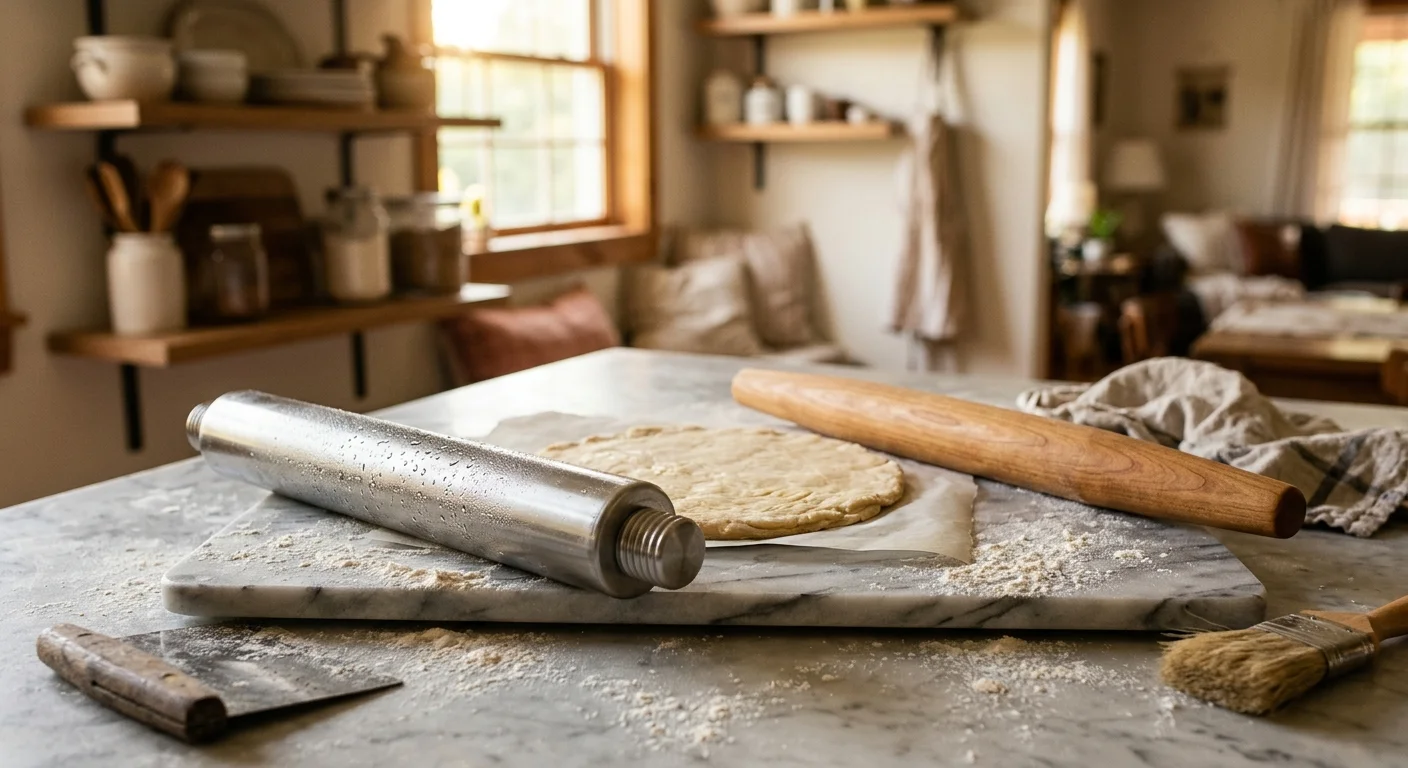
Rolling butter-rich pastry in an un-airconditioned, 82°F summer kitchen quickly turns laminated dough into a greasy, torn mess. You can save your crust without racing against melting butterfat.
Managing workspace temperatures is a year-round challenge, whether chilling buttery dough in August or using sourdough fermentation boxes and heat mats to foster dough warmth in winter.
Many bakers buy hollow, water-filled chillable metal rolling pins to combat ambient heat. Yet surface condensation and rapid thermal rebound often make them inferior to a traditional French wooden dowel.
A tapered French maple dowel paired with disciplined bench chilling preserves delicate pastry layers far more reliably than cold steel. Understanding surface physics will transform your warm-weather pie baking.
The Thermal Physics of Butterfat in Warm Summer Kitchens
Pastry dough relies on distinct fat pockets suspended between sheets of flour and water. When heat hits the oven, water in the butter converts to steam, expanding those pockets into flaky layers.
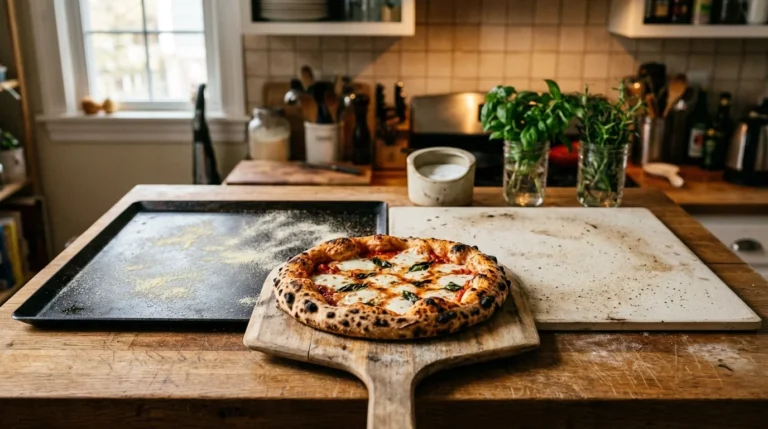
Baking pastry directly on a preheated baking steel or cordierite pizza stone delivers the rapid bottom heat necessary to puff laminated layers before the butter completely liquefies.
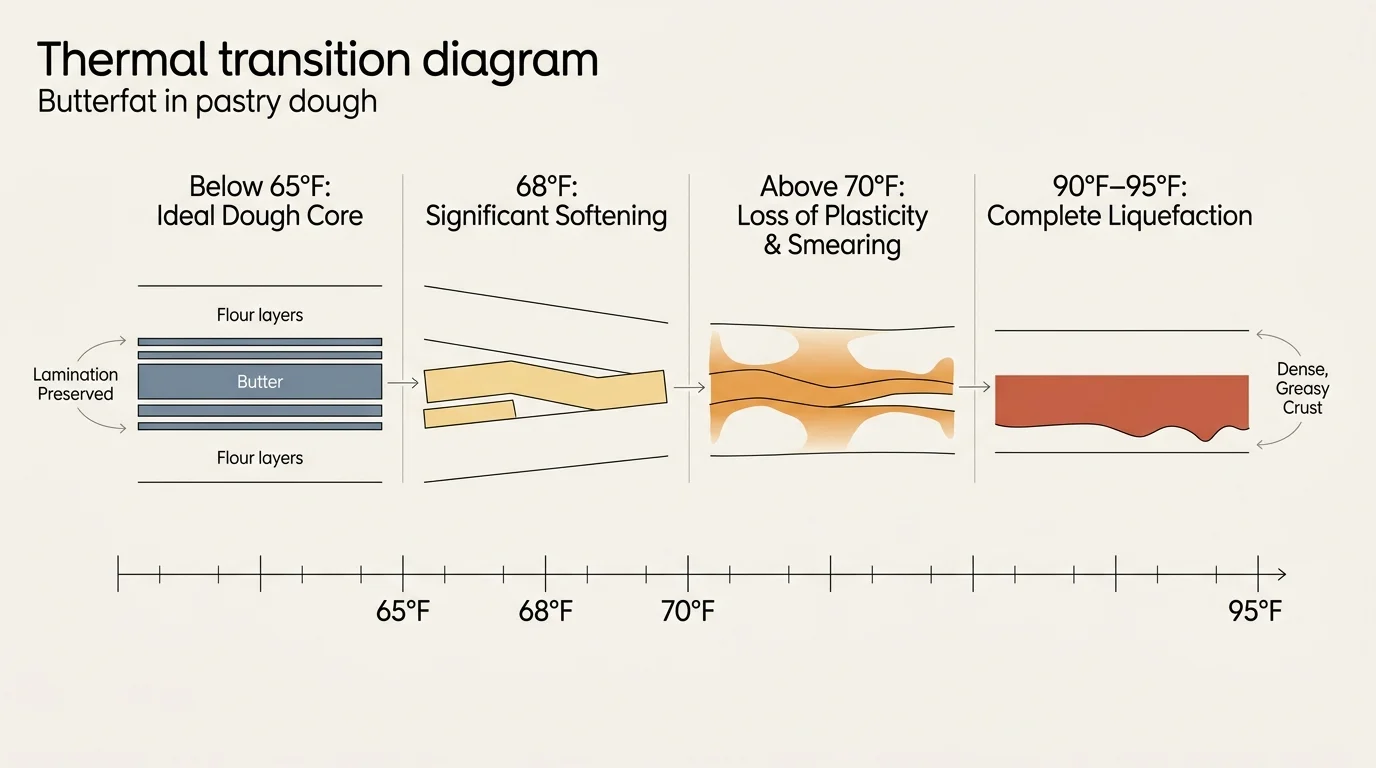
Standard American butter melts between 90°F and 95°F, but it softens significantly at 68°F. Above 70°F, butter loses its plasticity and begins smearing into the flour matrix.
Once butterfat liquefies on your counter, lamination vanishes entirely. The flour absorbs the liquid fat, turning what should be a flaky crust into a dense, greasy shortbread.
To pastry rolling in warm kitchen environments, you must keep the dough core below 65°F. Managing this boundary requires understanding how rolling tools absorb and transfer ambient room heat.
Ambient kitchen air heats both your pastry slab and your rolling tool continuously. Every pass of a warm pin transfers thermal energy directly into the fragile butter sheets.
Controlling surface friction matters just as much as ambient temperature. Excessive drag generates localized heat that quickly melts butterfat directly beneath the rolling pin barrel.
Chillable Metal Pins: Temperature Retention and Condensation
Hollow metal pins allow bakers to pour ice water directly into the cylinder. Manufacturers claim this chilling action keeps your dough cold while rolling across warm counters.
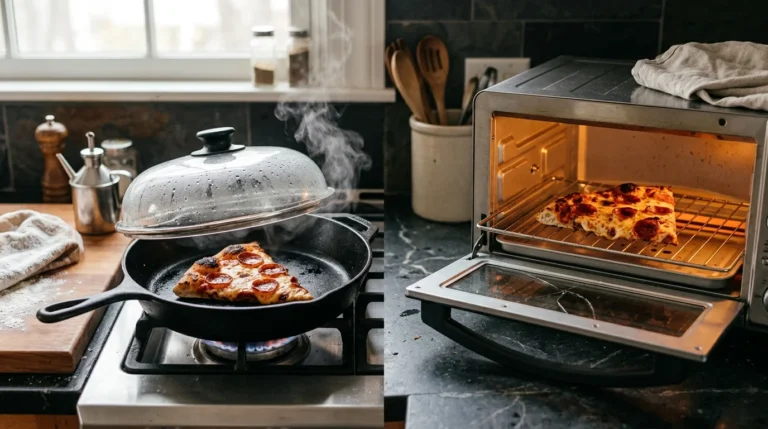
Similar thermodynamic properties explain why metal surfaces transfer heat much more rapidly than ceramic when selecting baking loaf pans for breads.
A chillable rolling pin review reveals a critical thermodynamic flaw: metal has exceptionally high thermal conductivity. Stainless steel transfers heat roughly thirty times faster than solid hardwood.
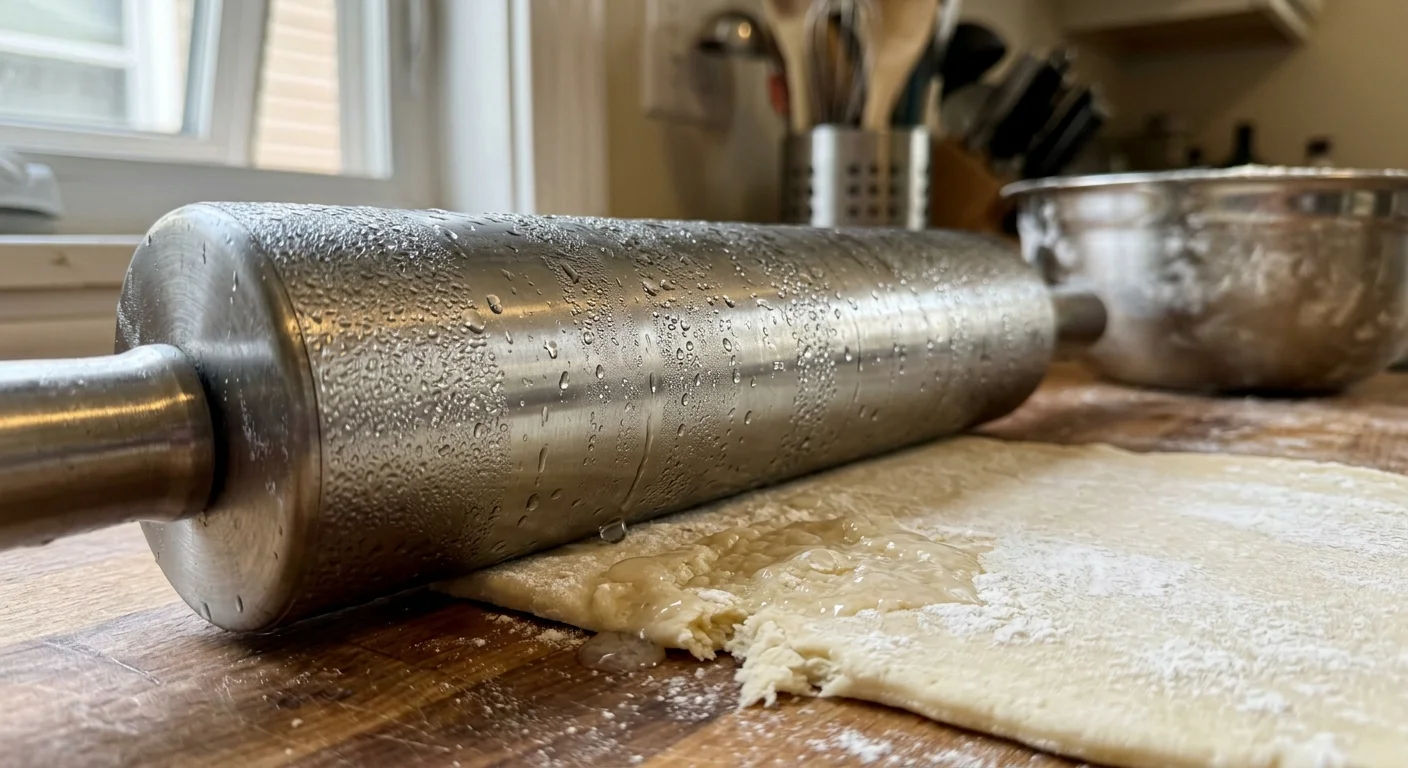
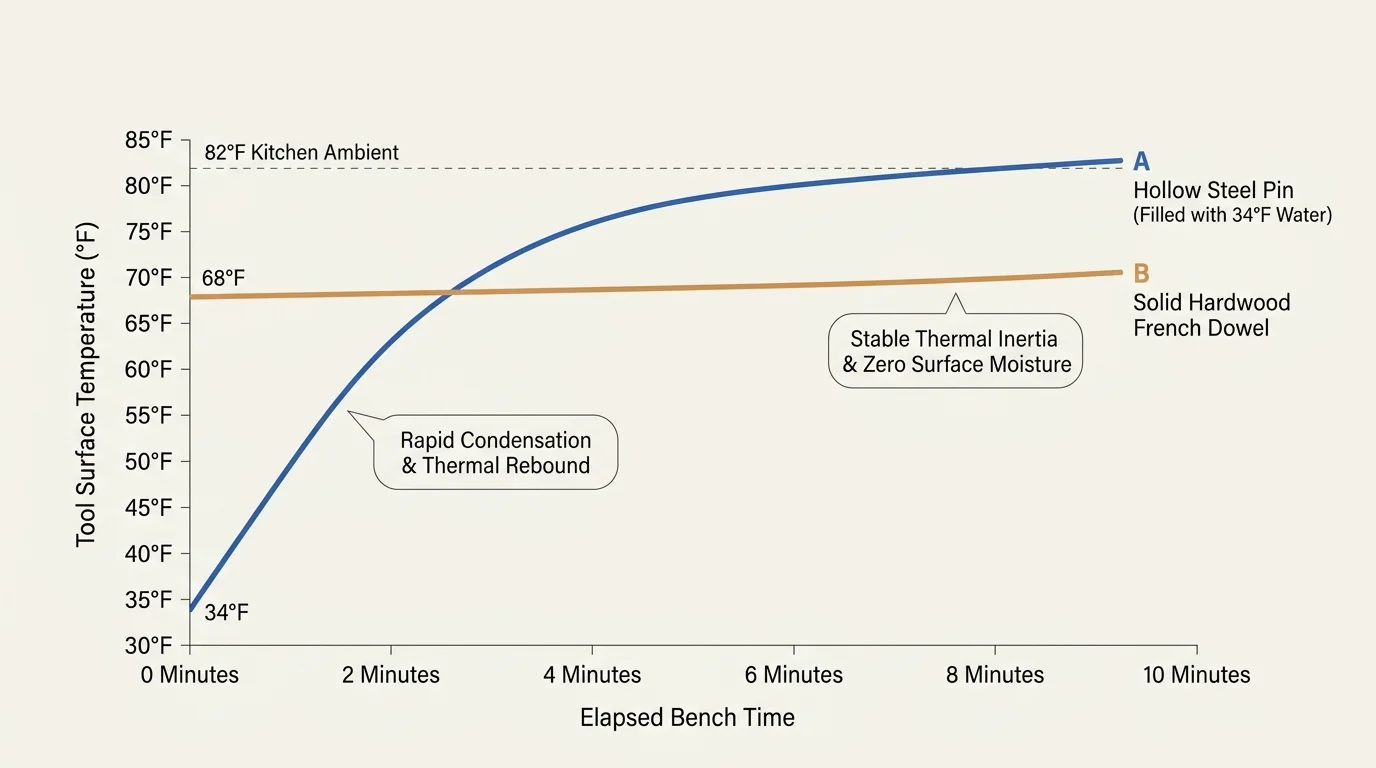
When you fill a steel cylinder with 34°F ice water, the outer surface drops below the room dew point within seconds. Ambient moisture in a warm kitchen instantly condenses on the exterior barrel.
This surface condensation drips straight onto your carefully calibrated pastry flour. Excess surface water hydrates gluten proteins prematurely, creating tough, leathery patches along the crust.
“Surface condensation on iced metal introduces unmeasured moisture directly into dry pastry flour. That excess moisture accelerates gluten development and ruins flaky crusts.”
Furthermore, water inside a hollow chamber sloshes during every forward and backward stroke. This shifting liquid weight disrupts your rolling rhythm and produces uneven crust thickness.
The thin metal casing also warms rapidly from contact with your hands. Heat from your palms migrates through the steel barrel, warming the chilling reservoir faster than anticipated.
While the internal ice water stays cool, the working surface reaches room equilibrium surprisingly fast. Within eight minutes of bench use, the chilled pin loses its competitive cooling advantage.
French Wooden Dowels: Thermal Inertia and Dough Feedback
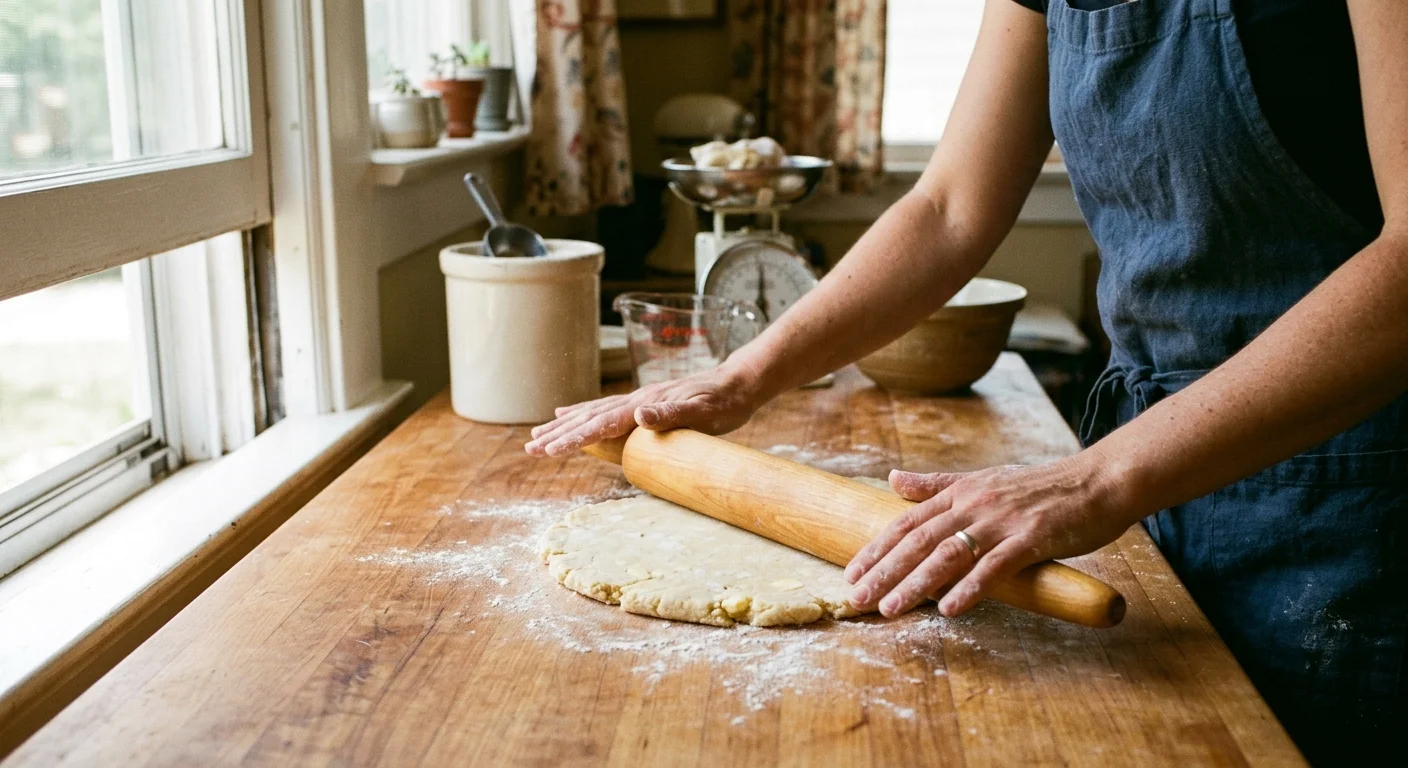
A classic French wooden dowel consists of a solid piece of hardwood, typically sugar maple or beech. It features gently tapered ends without mechanical bearings, internal cavities, or handles.
Just as bakers favor maple and hardwood boards over glass surfaces for prep work, dense sugar maple provides a forgiving, temperature-stable surface that protects delicate dough.
Wood functions as an effective natural thermal insulator. Its low thermal conductivity prevents rapid heat exchange between ambient kitchen air and your chilled butter layers.
When evaluating a french dowel vs metal rolling pin, tactile feedback proves decisive. The solid wood structure transmits subtle variations in dough thickness directly to your fingertips.
According to equipment testing from Serious Eats, straight and tapered wooden dowels provide superior rolling precision compared to heavy, mechanical rolling tools.
The tapered profile lets you pivot effortlessly across the dough circle. You can feather pressure over thin spots and concentrate force on thick edges with minimal effort.
Wood also absorbs minute amounts of surface flour, creating a non-stick patina over time. It glides over raw dough without generating excessive frictional heat or tearing butter sheets.
Unlike ice-filled metal, a wooden dowel never sweats in humid air. Its dry surface keeps your lamination intact and prevents unwanted gluten formation during rolling.
You can chill a solid wooden dowel in the refrigerator for twenty minutes before rolling. It retains a comfortable, cool surface temperature without ever crossing the condensation dew point.
Ten-Minute Bench Scenario: Surface Temperature Over Time
To keep pie dough cold while rolling, you must monitor surface temperature decay under realistic conditions. Consider a typical summer kitchen scenario set at 84°F with 62% relative humidity.
Pairing your rolled crust with baking sheets designed for even browning ensures consistent heat distribution once your pastry finally enters the oven.
Some bakers roll out their pastry on silicone baking mats to reduce sticking, though direct surface friction still plays a major role in dough warmth.
In this environment, the ambient dew point sits at approximately 69°F. Any surface dropping below 69°F will attract liquid moisture directly from the surrounding air.
Below is a comparative breakdown of four rolling tool configurations tested over a ten-minute rolling cycle. Each tool rested on a standard maple pastry board between 30-second rolling intervals.
| Tool Configuration | Initial Surface Temp | Temp at 5 Minutes | Temp at 10 Minutes | Condensation Risk |
|---|---|---|---|---|
| Hollow Stainless Steel (Ice Water Filled) | 36°F | 52°F | 64°F | Severe (Immediate droplet formation) |
| Hollow Aluminum Pin (Freezer Gel Insert) | 28°F | 48°F | 61°F | Severe (Surface sweating and frosting) |
| Solid Maple French Dowel (Chilled 30 min) | 55°F | 63°F | 71°F | None (Remains above dew point) |
| Solid Maple French Dowel (Ambient 84°F) | 84°F | 82°F | 81°F | None (Zero moisture accumulation) |
The data highlights an unavoidable trade-off with iced metal barrels. While the steel starts dramatically colder, it forces severe surface condensation throughout the entire first five minutes.
That liquid moisture dissolves your bench flour into paste, causing dough to stick aggressively. Bakers often over-flour to compensate, which dries out the pastry and toughens the baked crust.
The pre-chilled wooden dowel stays safely between 55°F and 71°F. It provides gentle cooling without dipping below the 69°F dew point, keeping the workspace completely dry.
Even an ambient-temperature wooden dowel outperforms dripping metal when rolling quickly. Because wood transfers heat sluggishly, it leaves the dough core cold during rapid rolling passes.
Worked Example: Rolling a Double Crust in an 84°F Kitchen
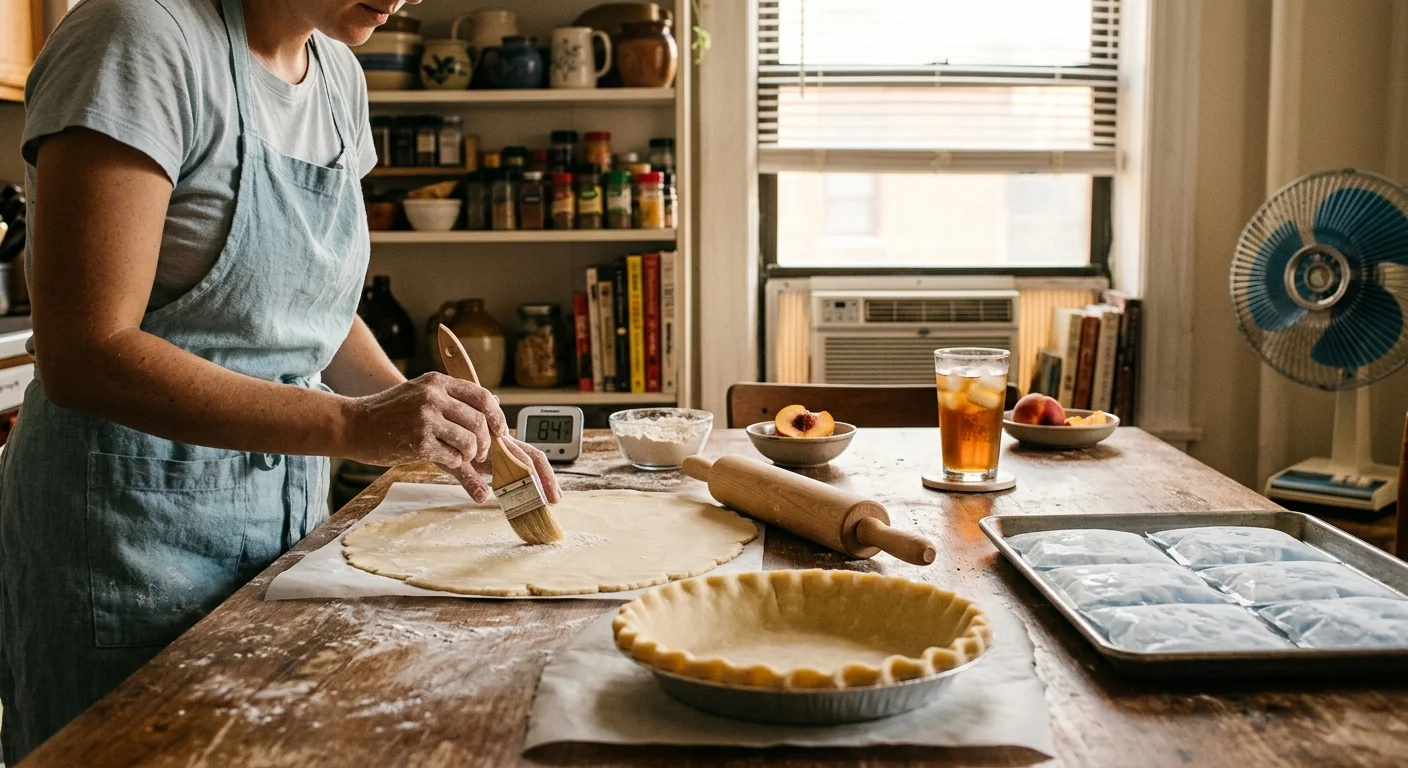
Here is a complete, real-world rolling protocol designed for an un-airconditioned, 84°F kitchen space. This scenario prepares a 9-inch double-crust pie using an all-butter pastry dough.
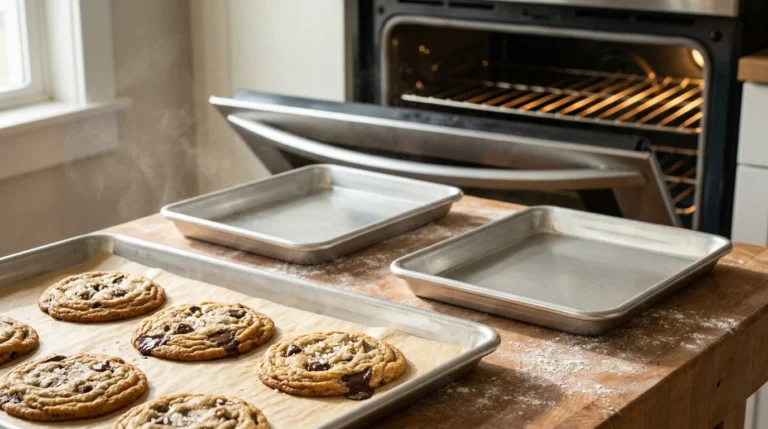
Resting rolled pastry rounds between parchment on a heavy-duty half-sheet pan keeps the sheets flat and supported during interim refrigeration.
Having dependable bench scrapers and dough cutters on hand helps you lift delicate dough rounds cleanly without overworking the butter.
Begin with 350 grams of unbleached all-purpose flour, 5 grams of fine sea salt, and 227 grams of high-fat European butter. European butter contains 82% butterfat, making it melt faster than standard butter.
Cut the butter into thin flakes and hydrate the mixture with 115 grams of ice-cold water. Form the dough into two equal 345-gram discs, wrap tightly in plastic, and chill at 38°F for two hours.
Place your 20-inch French maple dowel into the refrigerator alongside the dough discs for 30 minutes. Chilling stabilizes the wood core at roughly 52°F without dropping below room dew point.
Dust your marble board or wooden counter with exactly 15 grams of bench flour. Retrieve only the first 345-gram dough disc, leaving the second portion inside the refrigerator.
Set a timer for 120 seconds. Roll from the center outward, rotating the pastry disc 45 degrees after every two strokes to ensure a uniform 1/8-inch thickness.
Use the tapered ends of the dowel to feather the edges without crushing the delicate center. Stop rolling when the disc reaches 12 inches in diameter, which takes roughly 90 seconds.
Transfer the rolled sheet immediately into a 9-inch pie dish and return it to the refrigerator. The internal dough temperature will read approximately 61°F, well below the dangerous 68°F softening threshold.
Wipe the wooden dowel with a dry towel and roll the second disc following the identical 90-second cadence. Both crusts remain cold, dry, and perfectly laminated without ice chambers or sweating steel.
Material Specifications, Gauge, and Maintenance Realities
Understanding kitchen equipment requires looking closely at material engineering and manufacturing tolerances. Metal rolling pins vary substantially in build quality and wall thickness.
Material thickness and thermal conductivity play equally critical roles when evaluating aluminized steel versus stoneware bakeware for sensitive baked goods.
When storing your rolling tools and pans, optimizing your setup with smart vertical or horizontal bakeware organization protects fine wooden dowels from nicks and scratches.
In metal manufacturing, gauge means the thickness of the metal, where lower numbers mean thicker and usually better material. Premium stainless pins use 18-gauge steel, whereas cheaper versions use flimsy 22-gauge walls.
Thin metal cylinders dent easily if dropped on tile floors. A single surface ding creates an uneven ridge that gouges your pastry dough every time the barrel completes a rotation.
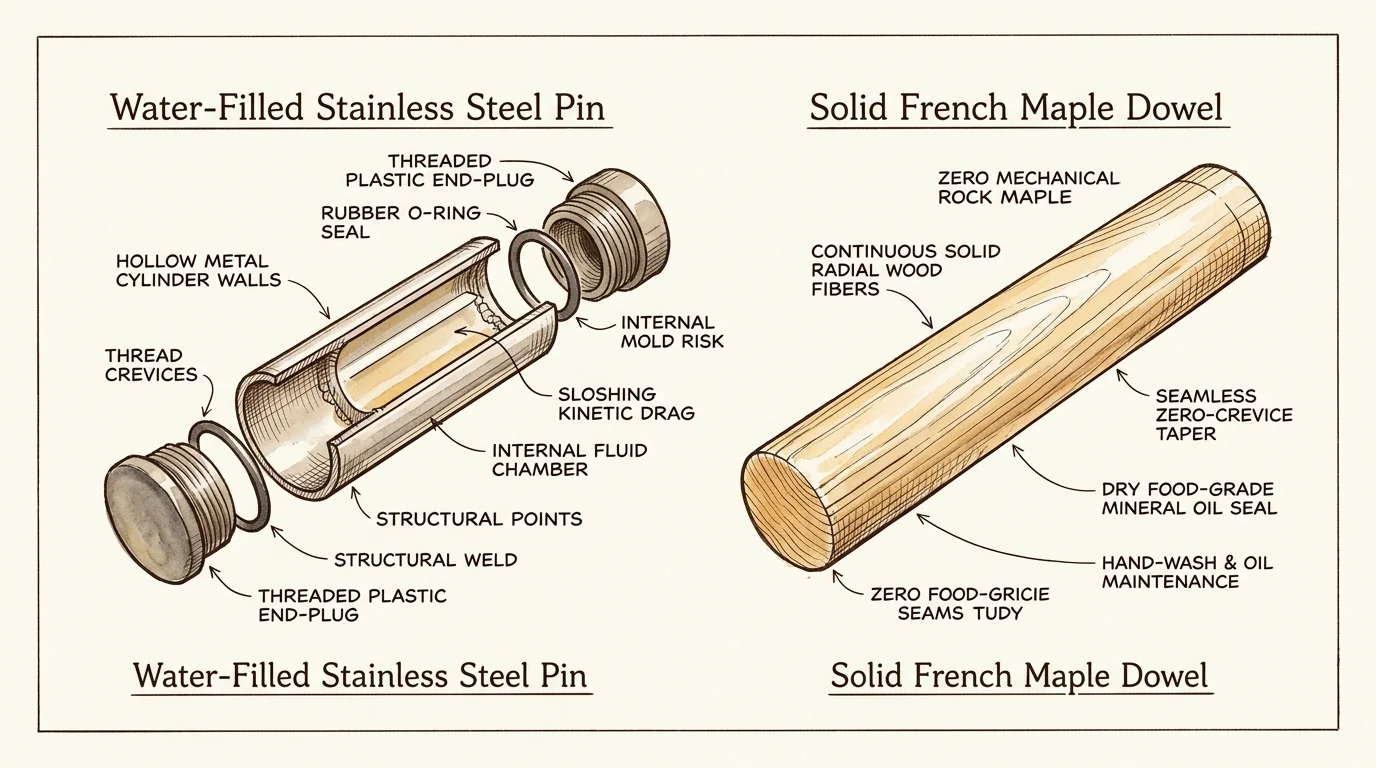
Hollow pins also rely on threaded plastic plugs or synthetic rubber gaskets to seal water inside. Repeated expansion from freezing water degrades these seals, causing dirty water to leak into your flour.
Cleaning hollow pins introduces additional sanitary concerns. Moisture trapped inside an empty steel chamber fosters mold growth if stored with the plug tightly sealed.
Solid French dowels eliminate mechanical failure points entirely. Crafted from solid American hard maple, a high-quality 20-inch dowel withstands decades of daily bakery use.
Maintaining a hardwood dowel requires minimal effort but strict habits. Never submerge wood in a sink, and never clean it inside a residential dishwasher.
Wipe the dowel with a damp cloth immediately after use and scrape stubborn flour with a bench knife. Rub food-grade mineral oil into the grain every six months to prevent splintering.
Bakeware Synergy: Heat Distribution for Bottom Crusts
Preserving butter lamination during rolling is only half the battle. Your crust must hit intense heat immediately upon entering the oven to crisp before butterfat leaks out.
Baking over one of the best baking sheets for even browning also catches butter run-off while directing steady heat across the base.
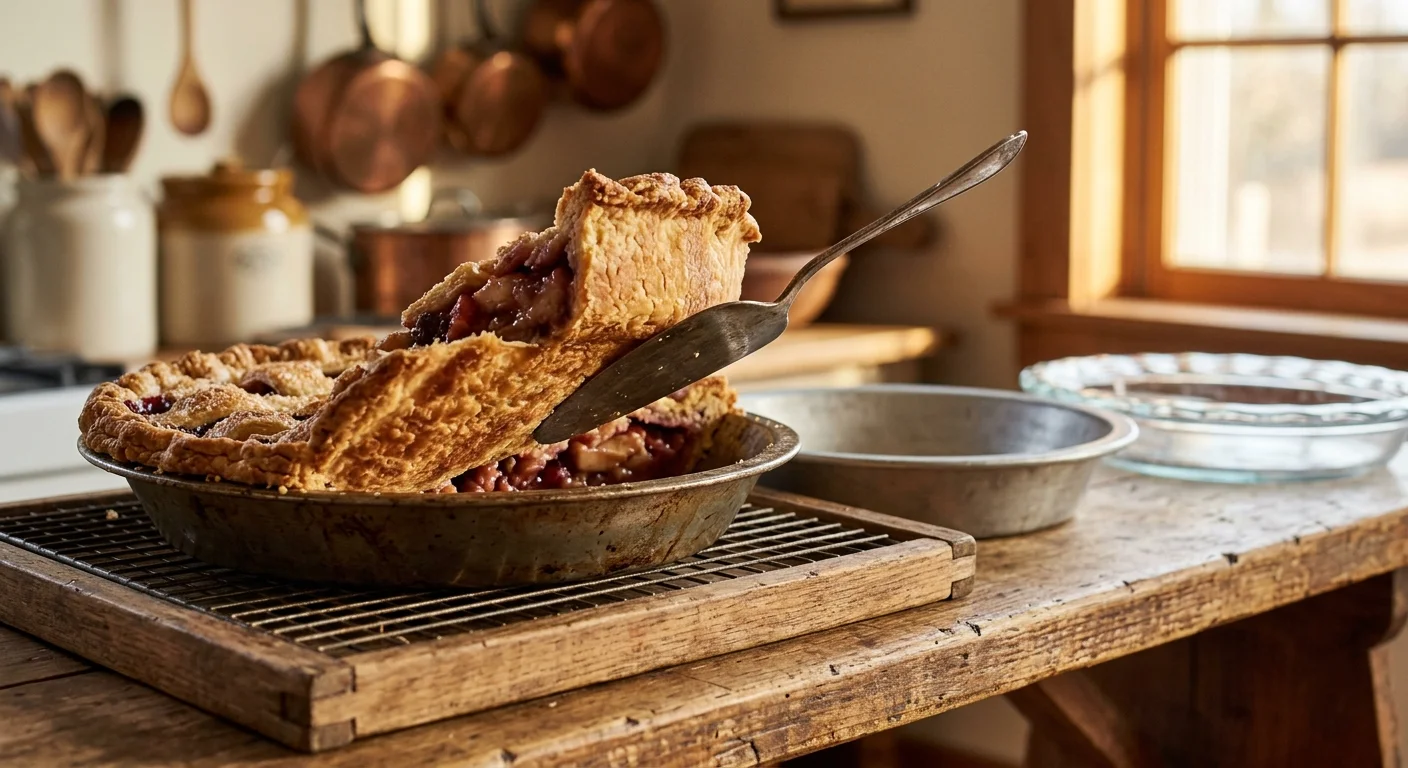
Placing your pie dish directly on a preheated baking surface—much like using a heavy baking steel or pizza stone—rapidly drives bottom heat to prevent soggy crusts.
Heat distribution describes how evenly a pan spreads thermal energy across its surface. Inferior bakeware with poor heat distribution creates localized hot spots while leaving the center soggy.
Standard glass and ceramic pie dishes heat very slowly. In hot summer kitchens, butter in the base melts into a puddle before the dish gets hot enough to set the flour.
To guarantee a crisp bottom crust, place your pie dish directly on a preheated heavy metal sheet. Commercial baking sheets made from 16-gauge aluminum conduct intense bottom heat rapidly into the pie pan.
Many bakers utilize tri-ply sheet pans for baking support. Tri-ply refers to three layers of metal bonded together for better heat distribution, usually aluminum sandwiched between stainless steel.
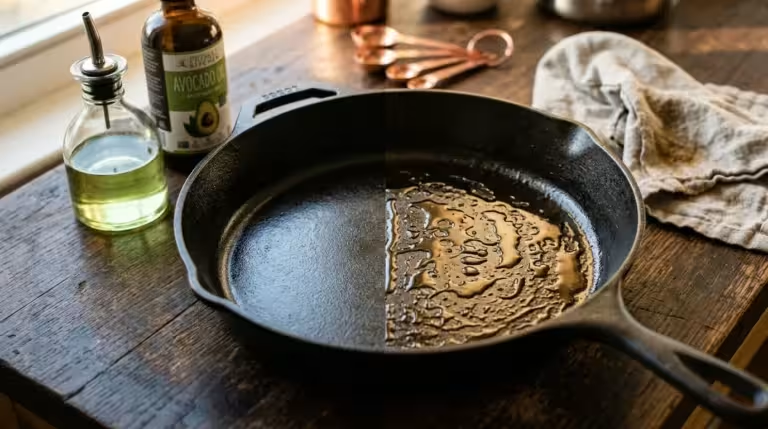
If you prefer seasoned cast iron bakeware, preheat the pan thoroughly. Seasoned surfaces feature a protective coating built up on cast iron through polymerized oil and heat.
Cast iron delivers massive thermal mass that prevents the oven floor from cooling when cold pastry enters. That intense thermal shock crisps the bottom crust within the first twelve minutes.
Baking guidelines from America’s Test Kitchen highlight that preheating heavy metal surfaces eliminates soggy bottom crusts in butter-heavy pies. Their testing confirms that bottom-loaded heat sets lamination before butterfat can pool.
Ensure any supplementary bakeware is rated as oven-safe. The term oven-safe means the tool can transition into high-heat ovens without warping, melting, or degrading structural coatings.
Avoid non-stick sheets coated with PTFE when baking at 425°F or higher. PTFE represents the chemical name for Teflon-style non-stick coatings, which degrade under intense heat.
Similarly, inspect any ceramic coating on modern baking pans. A ceramic coating uses an inorganic silica-based non-stick surface that can chip if exposed to thermal shock.
When selecting baking trays for induction cooktops, verify induction compatible status. An induction compatible pan contains magnetic metals, like cast iron or 400-series steel, to engage magnetic coils.
Combining a French wooden dowel for rolling with heavy, conductive bakeware provides end-to-end pastry control. You keep butter cold during preparation and vaporize it instantly during baking.
Reviews published by Wirecutter consistently name heavy-gauge aluminum baking sheets as the most reliable, warp-free platform for high-heat pastry baking.
“Baking pastry on a preheated, heavy aluminum sheet solves the dreaded soggy bottom. It drives heat into the base crust faster than ceramic or glass ever could.”
Frequently Asked Questions
Why does my pie dough get sticky even when using a chilled metal pin?
Cold metal drops below the dew point in humid kitchens, causing ambient air moisture to condense directly on the barrel. That condensed water dissolves dry bench flour into sticky glue.
Can I chill a wooden French rolling pin before rolling pastry?
Yes, placing a wooden dowel in the refrigerator for 20 to 30 minutes cools the wood gently. It lowers surface temperature without dropping below room dew point, preventing surface condensation.
What length and diameter French dowel is best for home bakers?
A dowel measuring 20 inches long and 1.5 to 1.75 inches in diameter offers ideal leverage. This dimension accommodates wide 12-inch pie crusts while maintaining precise tactile feedback under your palms.
How do I prevent dough from sticking to an un-chilled wooden dowel?
Keep your dough properly chilled at 38°F before rolling, and dust your work surface lightly with flour. Work in quick, deliberate strokes so the butter stays solid and never adheres to the wood.
Disclaimer: Product prices and availability change frequently. Prices shown were accurate at time of writing but may have changed. We may earn a small commission from purchases made through links on this site, at no extra cost to you. Always verify current pricing on the retailer’s website before purchasing.