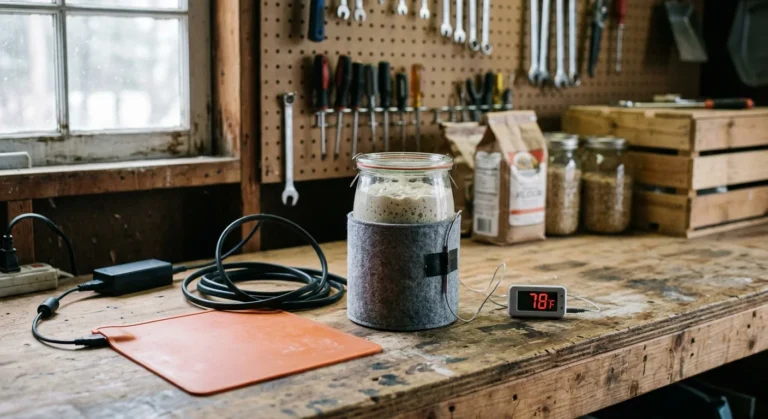
Maintaining a predictable 78°F bulk fermentation in a 58°F basement apartment often feels impossible without artificial heat. If your dough sits in an unheated room, a cheap seedling mat might seem like an effortless fix.
While tools like bench scrapers and dough cutters streamline handling high-hydration dough, managing ambient temperature remains the primary hurdle for winter bakers.
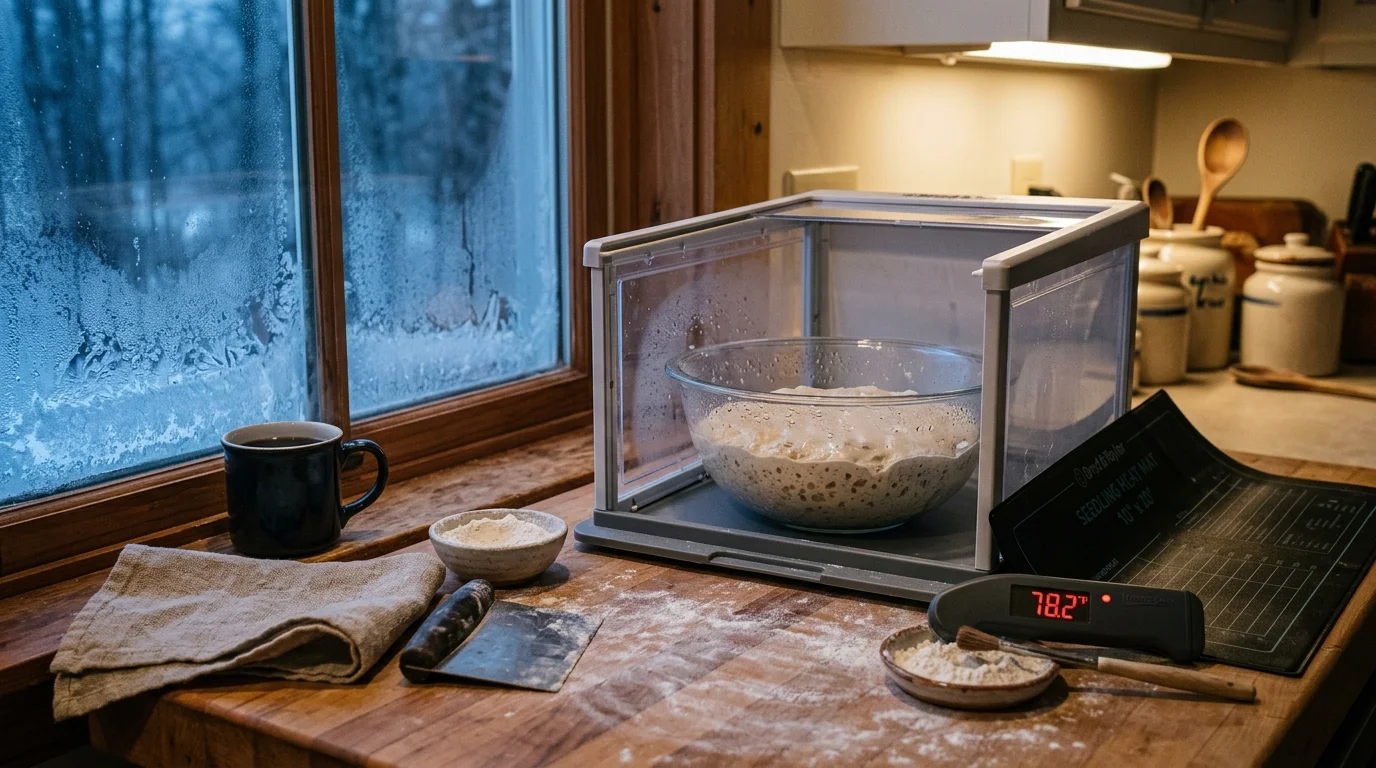
However, placing your bowl directly on a heat mat creates conductive hot spots that degrade dough structure, while a dedicated folding box circulates ambient radiant warmth to protect your loaf.
This guide analyzes the thermal stability, energy consumption, and total cost of proofing dough in cold house conditions so you can bake consistent sourdough all winter.
The Physics of Cold-Kitchen Fermentation and Yeast Activity
Sourdough relies on a delicate biological partnership between wild yeast and lactic acid bacteria. These microorganisms respond dramatically to ambient temperature shifts inside your kitchen.
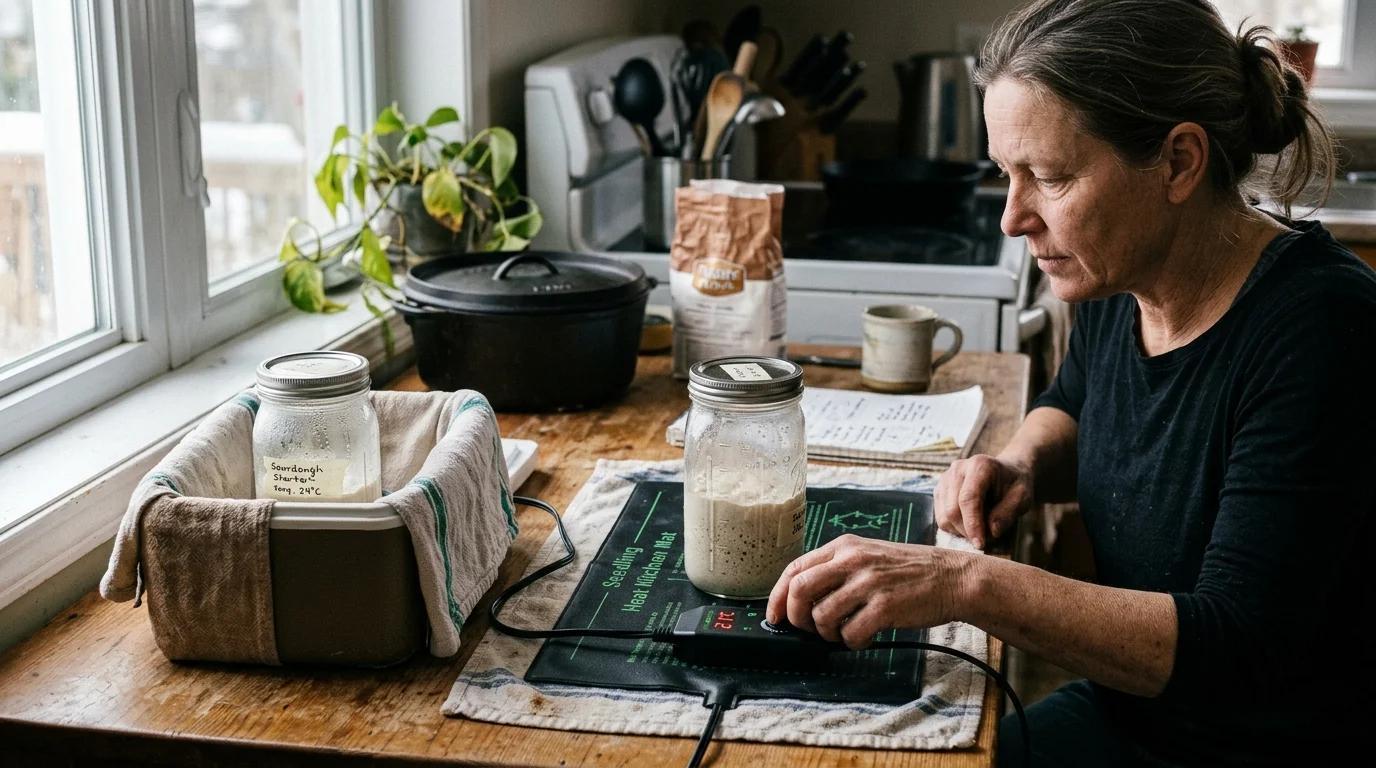
If you only need to keep a mother culture active rather than a full mixing bowl, specialized heating setups for starter incubation deliver steady microbial warmth at a fraction of the footprint.
The optimal metabolic growth window for both Saccharomyces cerevisiae and lactic acid bacteria sits squarely between 75°F and 82°F (24°C to 28°C). Within this zone, acid production and ethanol fermentation advance in balance.
When room temperature plummets below 65°F (18°C), wild yeast cell division drops sharply. Dough volume stalls, extending your primary fermentation from five hours to twelve hours or more.
According to culinary equipment testing from Serious Eats, maintaining tight ambient thermal control is essential for delicate microbial reactions. Temperature dictates enzymatic reaction speed in raw flour.
Amylase enzymes break complex starches into fermentable maltose and glucose. If dough chills below 60°F, enzyme activity slows to a crawl, starving the few active yeast cells of essential sugars.
Conversely, wild yeast suffers cellular damage when exposed to intense temperatures above 120°F (49°C). Uneven heating risks destroying the living culture at the container base while leaving the surface chilled.
To keep bread warm winter conditions demand tools that heat the surrounding air rather than scorching the dough container. Yeast requires ambient stability to generate uniform gas retention throughout the gluten matrix.
Seedling Heat Mats: Thermal Conduction Flaws in Sub-60°F Rooms
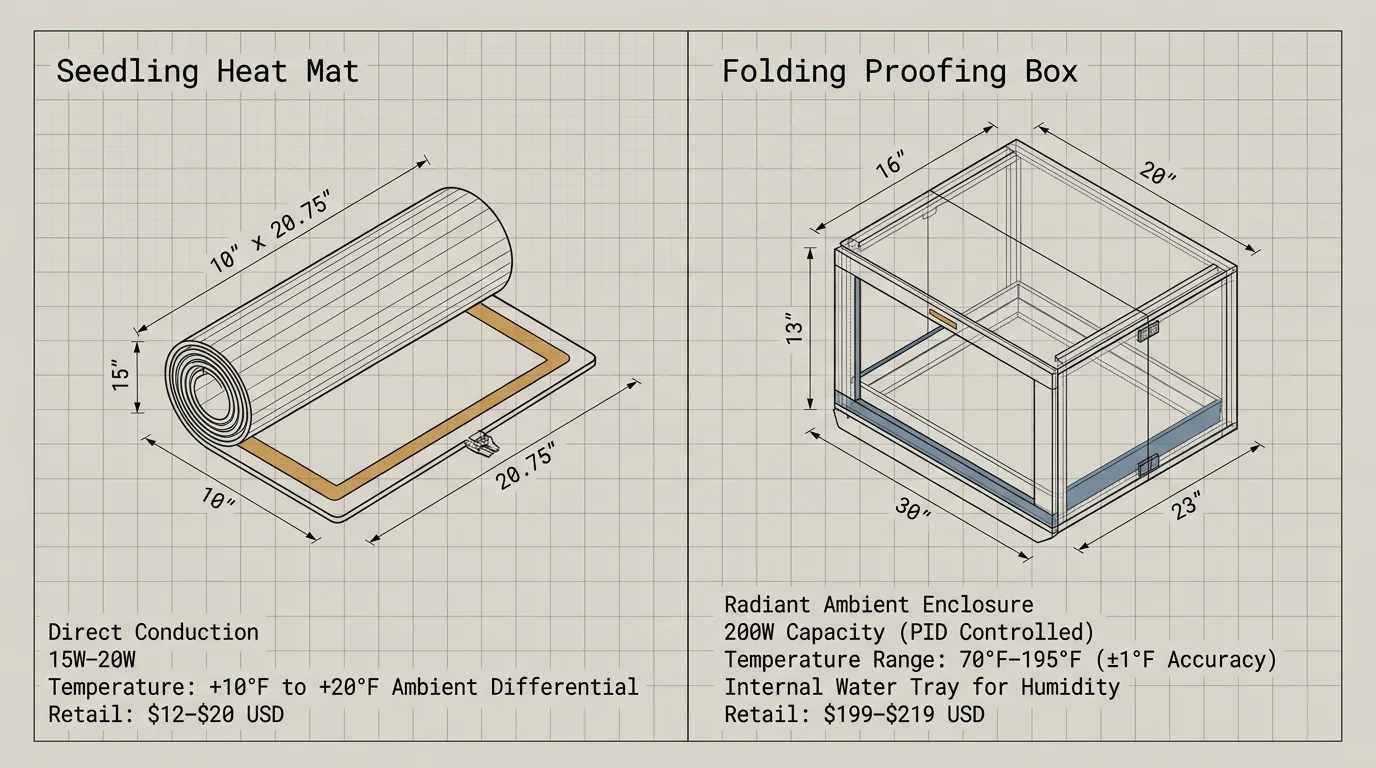
Many home bakers turn to gardening heat mats as a low-cost warming method. A standard 10-inch by 20.75-inch seedling mat draws roughly 15W to 20W and retails for $12 to $20 USD.
Bakers looking for a self-contained alternative often turn to programmable bread machines that feature dedicated proofing settings to protect rising dough from drafty rooms.
These mats operate through direct conductive heat transfer. They warm only the solid surfaces that sit in direct physical contact with their thin rubberized heating elements.
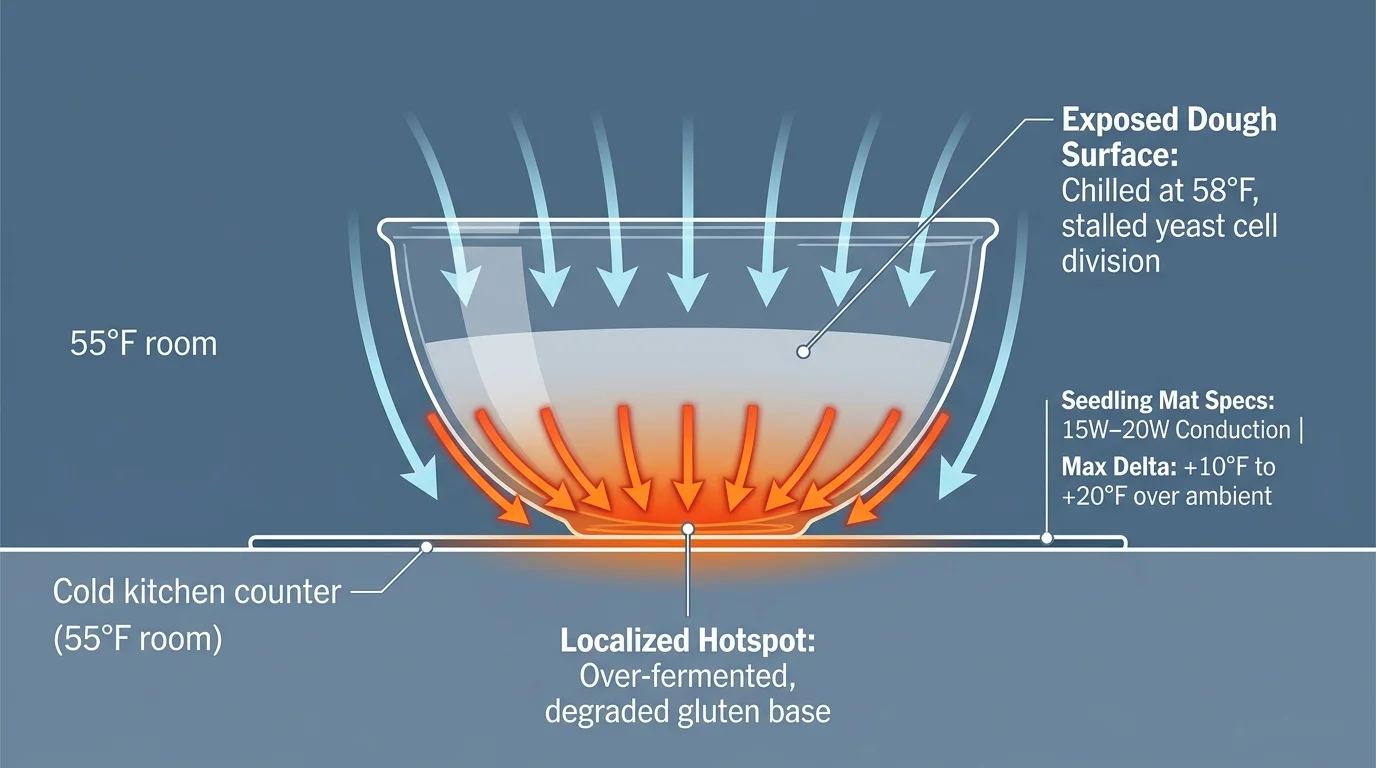
Manufacturers engineer seedling mats to raise temperatures only 10°F to 20°F (5.5°C to 11°C) above ambient room temperature. If your basement kitchen sits at 55°F, the mat struggles to exceed 70°F.
A digital probe controller bundled with a mat allows setting limits between 68°F and 108°F (20°C to 42°C). However, the probe only measures heat at a single point on your container wall.
Placing your dough directly onto the mat produces an intense vertical thermal gradient. The bottom layer of your dough may register 88°F while the top surface remains trapped at 58°F.
This uneven thermal profile causes severe localized over-fermentation. Gluten strands at the bottom break down through excessive proteolysis, while the top of the dough mass barely ferments.
A seedling warmer can easily become a frustrating unitasker, which is a gadget that only does one specific task poorly outside its original design scope. Soil warming does not match dough fermentation requirements.
Some bakers attempt to fix this issue by buffering the surface with silicone, a flexible, heat-resistant material used in many kitchen tools. While silicone dampens contact heat, it cannot warm the cold room air above.
Without an enclosed space, cold room air draws heat away from your dough through convection. The upper crust dries out, forming a leathery rind that restricts oven spring during baking.
Folding Proofing Boxes: Radiant Enclosures and Humidity Control
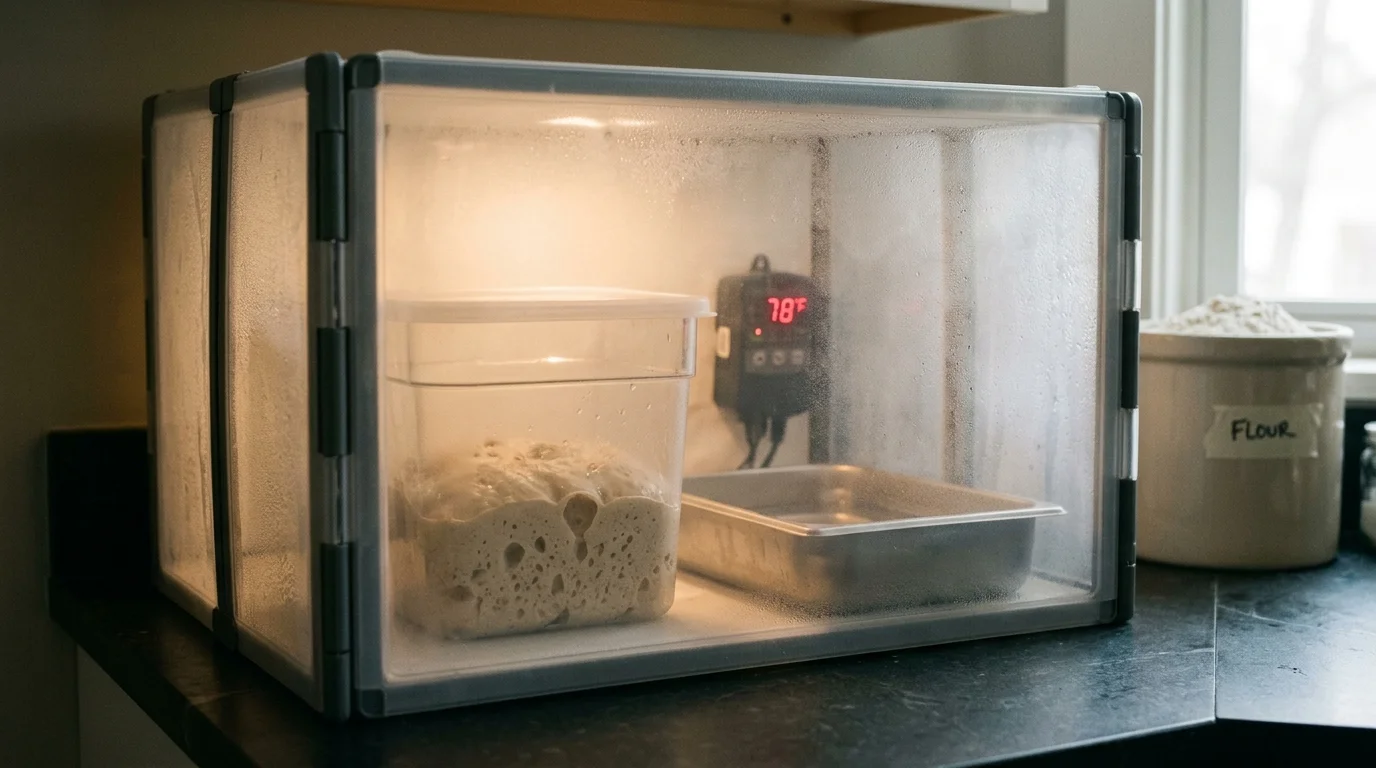
A dedicated dough proofing box for sourdough approaches temperature management through insulated radiant heating. Instead of heating just the container base, it creates a fully controlled microclimate.
These radiant chambers also accommodate standard loaf pans for sandwich bread, ensuring an even second rise regardless of cold draft conditions.
The Brød & Taylor Folding Proofer (model FP-105 or FP-205) represents the benchmark for home bakers, retailing between $219 and $230 USD. It features an adjustable temperature range of 70°F to 195°F.
As detailed in extensive kitchen appliance reviews by Wirecutter, enclosed proofing boxes provide superior thermal consistency compared to makeshift heating setups. Radiant heat warms your mixing vessel evenly from all sides.
The unit uses an anodized aluminum base plate beneath an insulated folding body. Heat radiates into the chamber, raising the internal air temperature to your exact setpoint regardless of cold room drafts.
This ambient warming mechanism eliminates bottom scorching entirely. The internal dough core reaches thermal equilibrium with the enclosed air, ensuring identical microbial activity from top to bottom.
These boxes also feature a dedicated water tray that maintains 60% to 80% relative humidity. This ambient moisture prevents dough skins from forming without requiring messy plastic wrap covers.
The proofer housing relies on thick, durable plastic panels that are BPA-free, made without a chemical (BPA) that some people prefer to avoid in food preparation. The walls retain radiant heat efficiently.
For routine maintenance, the removable wire rack and aluminum water tray are dishwasher safe, meaning they can be cleaned in a dishwasher without damage. Cleanup requires only a quick wash cycle.
You can proof dough in stainless steel, a durable metal that resists rust and staining, or in traditional ceramic bowls. The radiant chamber warms both materials smoothly without hot spots.
“Uniform ambient warmth preserves dough structure far better than direct base conduction. When the dough core stays balanced, fermentation predictability follows automatically.” — Artisan Baking Science
Energy Consumption and Cost Comparison: 200W vs. 20W
Bakers working in drafty rentals often worry about the electricity expense of running specialized appliances. Comparing rated wattage alone gives an incomplete picture of total energy consumption.
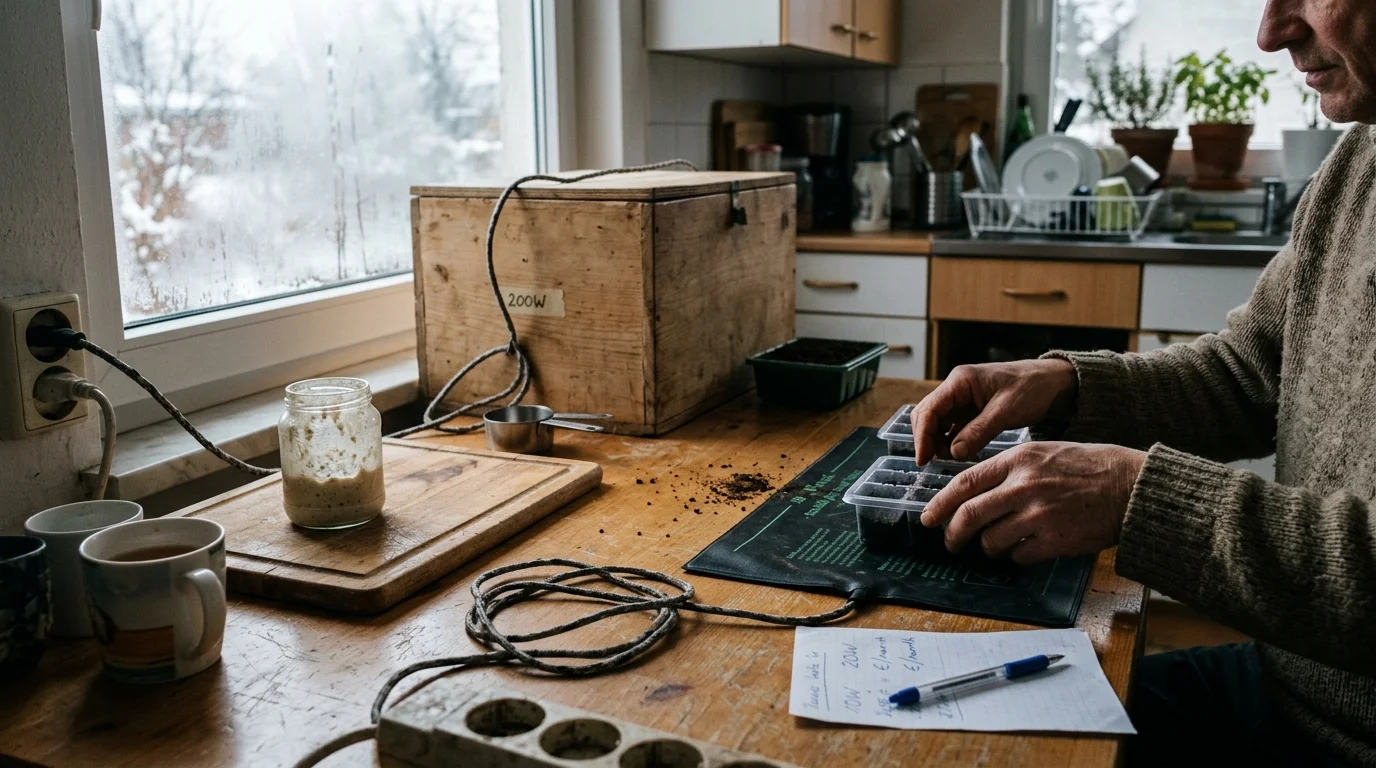
A seedling mat draws between 15W and 20W continuously when operating in a cold basement. Because the ambient room is cold, the controller thermostat rarely shuts off the power flow.
In contrast, a dedicated proofing box features a maximum rated power draw of 200W. That maximum rating applies only during the initial heating cycle when warming the empty chamber.
Once the insulated chamber reaches your target 78°F, the internal thermostat duty cycle activates. The heating plate pulses intermittently to counteract minor thermal dissipation through the insulated walls.
In a 58°F room, a folding proofer averages an active power draw of roughly 30W to 45W over a five-hour cycle. The insulated shell traps thermal energy far better than exposed countertop surfaces.
Based on the average United States residential electric rate of $0.16 per kilowatt-hour (kWh), running a 20W seedling mat for five hours consumes 0.10 kWh, costing approximately $0.016 per bake.
Running a folding proofer for five hours at an average load of 40W consumes 0.20 kWh. That translates to approximately $0.032 per bulk fermentation cycle in your home kitchen.
The operational cost difference between both methods equals less than two cents per loaf. Energy savings therefore do not justify using an uninsulated mat over an insulated cabinet.
A Worked Scenario: Bulk Fermenting in a 55°F Basement Kitchen
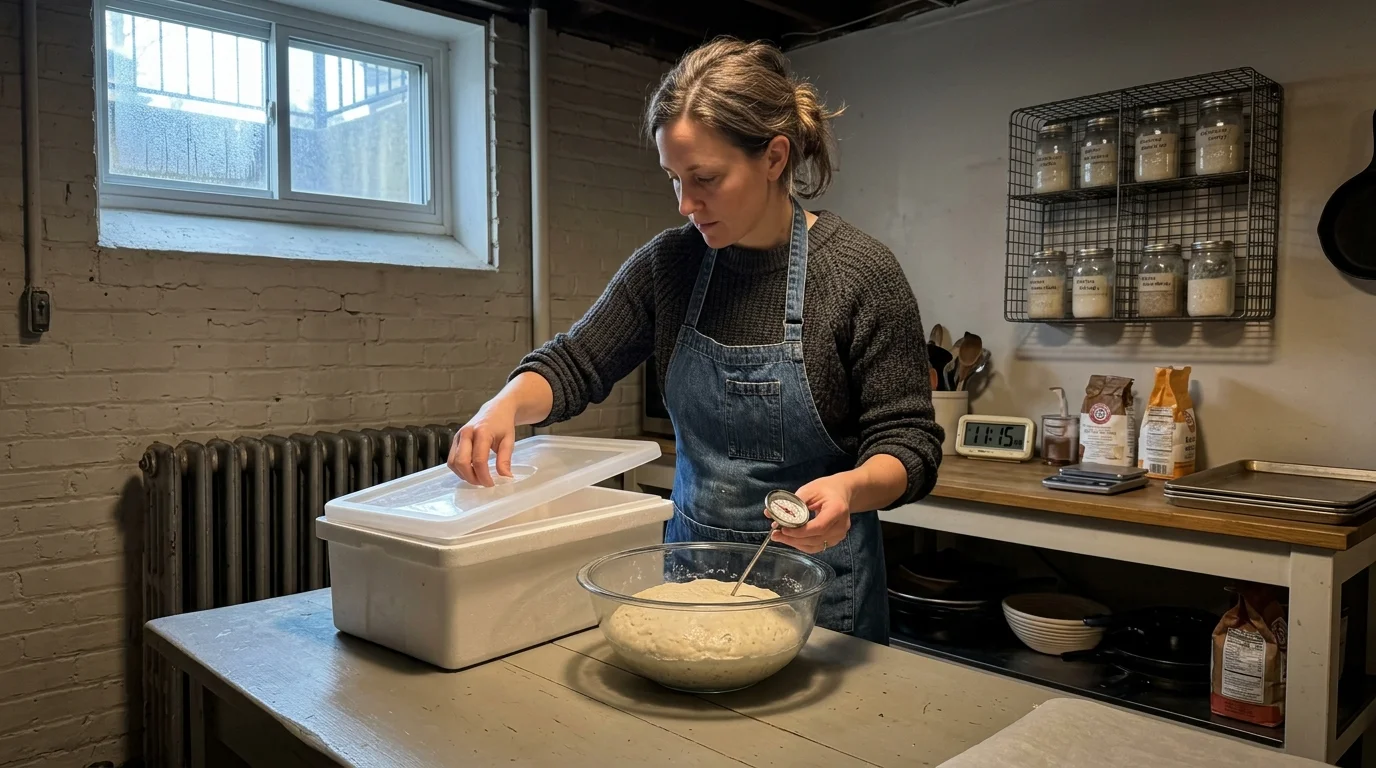
To examine real-world performance, consider a concrete bulk fermentation scenario recorded on a cold morning in late November. The ambient kitchen temperature remained steady at 55°F (12.8°C).
Once bulk fermentation produces an airy dough structure, baking inside an enameled Dutch oven captures the steam necessary to maximize vertical oven spring.
The dough formula used standard artisan parameters: 1,000 grams bread flour, 750 grams water (75% hydration), 200 grams active starter, and 20 grams fine sea salt. The target internal dough temperature was 78°F.
In the first scenario, the baker mixed dough with 85°F water to hit a final mix temperature of 78°F. The glass bowl was placed directly onto a 20W seedling mat set to 80°F.
Within 90 minutes, ambient 55°F air cooled the upper surface of the dough to 61°F. Simultaneously, direct thermal conduction drove the bottom dough layer to 87°F.
The seedling probe, taped to the glass exterior, registered 80°F and cut power prematurely. The bulk fermentation stalled unevenly, requiring eight hours and resulting in weak, gummy bread with uneven crumb.
In the second scenario, the baker placed the identical dough formulation inside a Brød & Taylor FP-205 set to 81°F. The ambient internal box temperature settled within fifteen minutes.
Core temperature probes inside the dough tracked internal warmth at 77.4°F across both the bottom and upper layers. The enclosed box prevented thermal loss to the drafty 55°F room.
The dough expanded by 75% in exactly four hours and thirty minutes. The resulting loaf showed balanced acidity, excellent gas pocket distribution, and strong vertical oven spring.
Side-by-Side Hardware Comparison and Specifications
Reviewing concrete specifications clarifies the performance differences between basic heating pads and enclosed proofing systems. The table below outlines key metrics for cold-kitchen fermentation tools.
| Device Option | Retail Price | Power Draw | Ambient Delta | Humidity Control | Temperature Range |
|---|---|---|---|---|---|
| Brød & Taylor FP-205 | $229.00 | 200W (Max) / ~40W (Avg) | +40°F to +60°F | Included Water Tray (60–80%) | 70°F to 195°F |
| Seedling Mat + BN-LINK Controller | $29.99 | 20W (Continuous) | +10°F to +20°F | None (Exposed Air) | 68°F to 108°F |
| Sourhouse Goldie Starter Warmer | $119.00 | 8W (Continuous) | +15°F to +25°F | Sealed Jar Only | 75°F to 82°F (Preset) |
| DIY Foam Box + Seedling Mat | $45.00 | 20W (Thermostatic) | +25°F to +35°F | Manual Cup of Water | 68°F to 105°F |
The performance metrics demonstrate why a standalone seedling mat struggles in cold basements. When ambient air is 55°F, a maximum delta of 20°F fails to reach the sourdough target window.
Enclosed systems maintain larger temperature deltas because insulated walls prevent rapid heat radiation into the room. This makes enclosure design far more critical than raw heating element power.
Starter warmers like the Sourhouse Goldie work well for small jars but cannot hold mixing bowls. They represent a targeted solution strictly for maintaining your wild culture mother.
According to consumer research from Consumer Reports, dedicated counter appliances provide higher temperature calibration accuracy than loose modular assemblies. Accurate thermal control protects costly baking ingredients from waste.
Building a DIY foam enclosure with a seedling mat offers a budget compromise. However, raw foam surfaces are difficult to sanitize properly if sticky dough spills inside the chamber.
Storage Footprint, Build Quality, and Kitchen Usability
Apartment kitchens rarely have unlimited counter space. Equipment must either earn a permanent counter position or fold away cleanly when baking concludes.
The Brød & Taylor folding box measures 22 inches by 14.5 inches on your counter when fully deployed. It accommodates two large mixing bowls or two standard rectangular bread pans simultaneously.
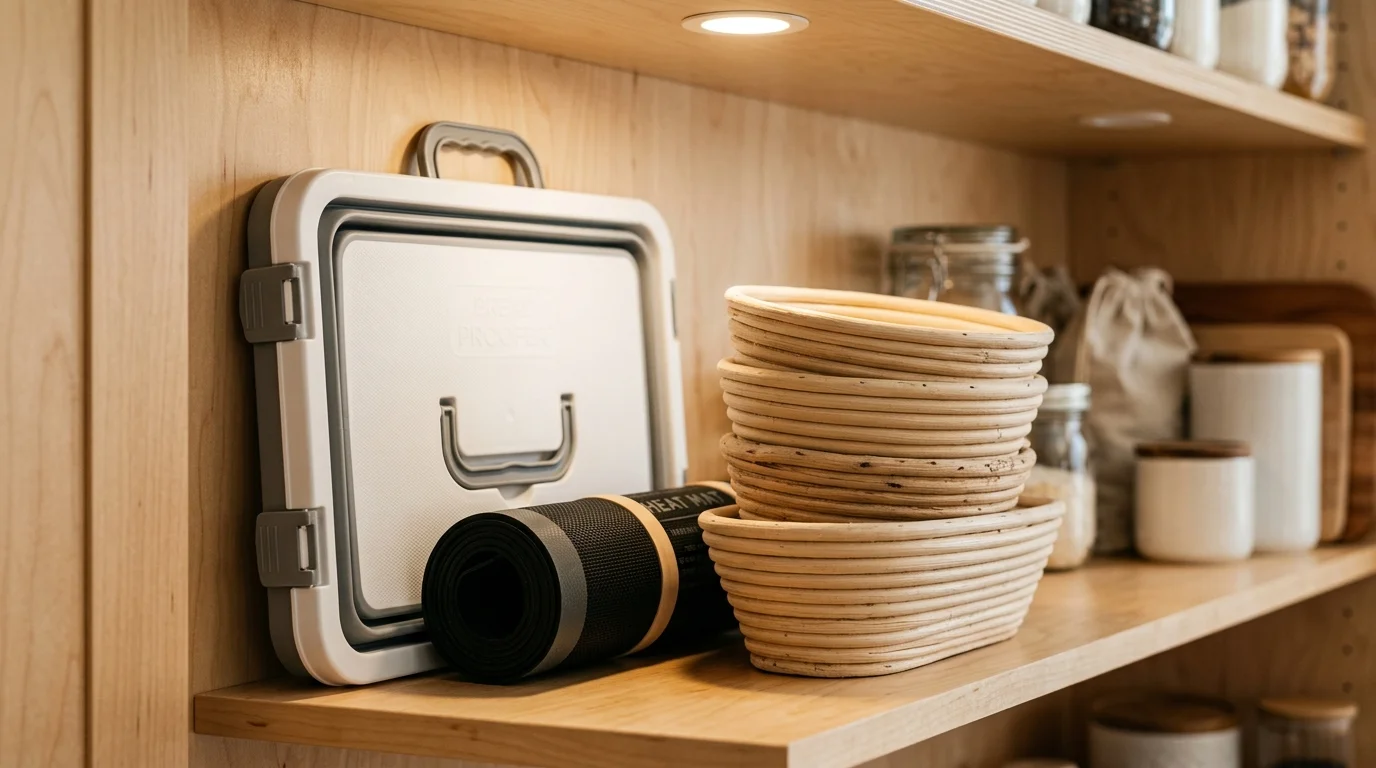
When collapsed, the box folds down to a height of under 3.5 inches. You can slide it vertically next to a refrigerator or store it flat on a pantry shelf without crowding daily cookware.
The unit features latches with an ergonomic design, meaning they are designed to be comfortable to hold and use even with wet hands. Smooth folding hinges minimize setup frustration.
The rubber feet beneath the cabinet provide a reliable non-slip grip, meaning a base designed to not slide on slick countertops during dough folds. Stability prevents kitchen accidents during delicate prep.
In contrast, a seedling mat rolls into a compact cylinder measuring only three inches across. It stores easily inside any shallow kitchen utility drawer alongside rolling pins and parchment paper.
However, seedling mats use thin PVC or polymer outer sheaths. Heavy glass or cast iron Dutch ovens can pinch internal wires over time, creating potential electrical safety hazards.
The folding proofer utilizes heavy polypropylene walls paired with an anodized aluminum radiant heating plate. This combination withstands years of heavy mixing bowls without structural fatigue or cracking.
Which Tool Should You Choose for Your Kitchen?
Deciding between these options depends directly on your ambient kitchen temperatures, baking frequency, and available cabinet storage. Different environments demand distinct thermal strategies.
Buy a dedicated folding proofing box if your kitchen routinely drops below 62°F (17°C) throughout the winter months. An insulated enclosure is mandatory when drafty rooms steal surface heat faster than flat mats generate it.
Choose the proofer if you bake two or more loaves per week and value repeatable fermentation timing. Predictable microbial activity removes guesswork and prevents wasted flour and discarded dough.
Buy a seedling heat mat and digital controller if your kitchen stays above 68°F (20°C) and you only need a mild thermal nudge. In moderate rooms, conductive heat transfer causes fewer severe vertical dough gradients.
Choose the mat setup if you pair it with a secondary insulated enclosure, such as a clean picnic cooler. This DIY method creates a functioning radiant box for less than fifty dollars total.
Skip both gadgets if your home maintains a steady 72°F year-round, or if your home oven features an accurate low-temperature proofing mode. Always verify oven temperatures with a calibrated probe first.
Many electric oven lights generate excessive internal heat, driving enclosed temperatures above 110°F (43°C). Exposure to that level of sustained heat will weaken your starter culture and degrade dough elasticity.
Frequently Asked Questions
Can a seedling heat mat kill sourdough starter yeast?
Yes, if you place a glass jar directly onto an unregulated mat without a thermostat. Direct thermal conduction can heat container bases past 120°F, killing wild yeast cells and beneficial bacteria.
What is the correct sourdough heat mat temperature setting?
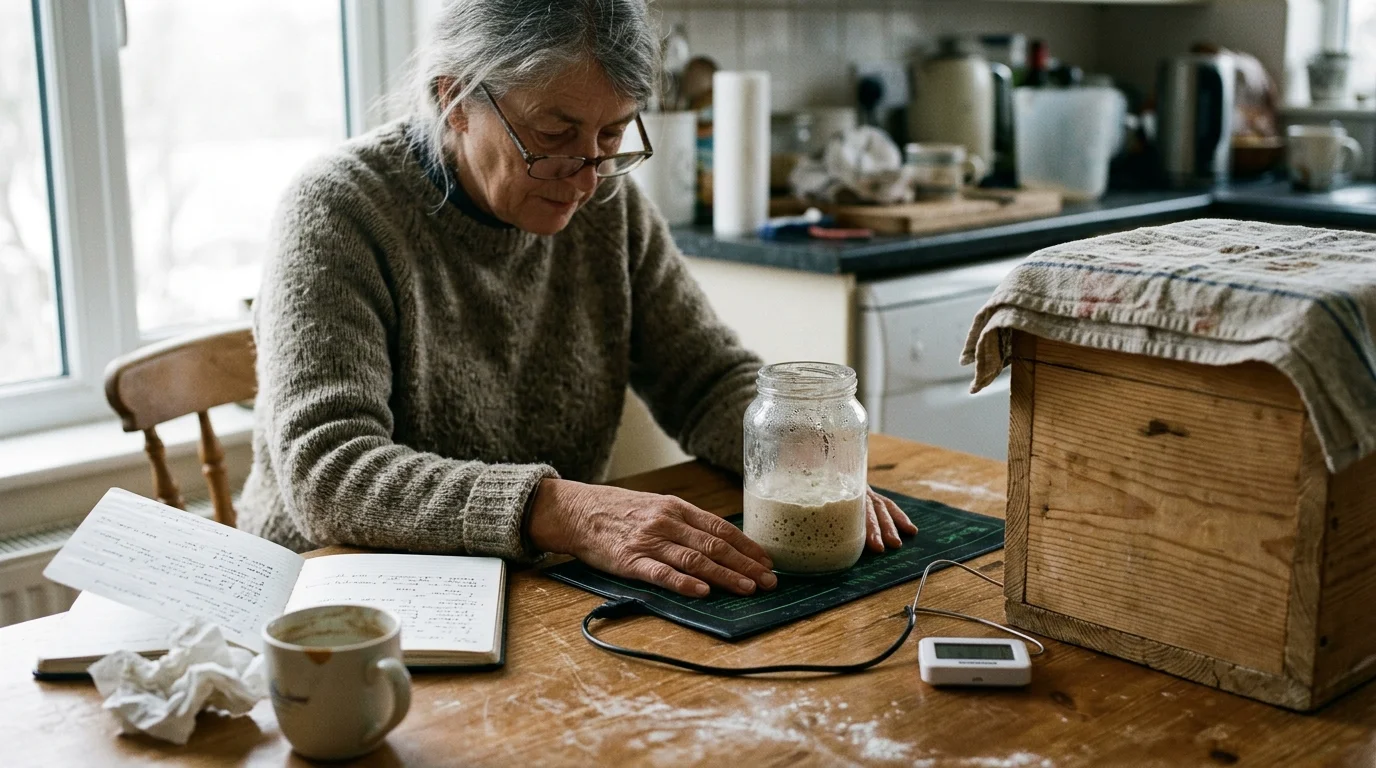
Set your digital thermostat controller between 75°F and 78°F (24°C to 26°C). Elevate your mixing bowl slightly off the mat surface using a metal wire rack to prevent direct scorching.
Can I leave a folding proofer running overnight?
Yes, folding proofers use low-wattage radiant elements engineered for continuous operation. They operate safely for extended periods when proofing dough or fermenting yogurt and sourdough starter cultures.
Why does my dough dry out when proofing dough in cold house conditions?
Cold winter air carries low relative humidity, which rapidly pulls moisture from exposed dough. Using a humidified proofing box or sealing dough containers tightly prevents hard crust skins from forming.
Disclaimer: Product prices and availability change frequently. Prices shown were accurate at time of writing but may have changed. We may earn a small commission from purchases made through links on this site, at no extra cost to you. Always verify current pricing on the retailer’s website before purchasing.