
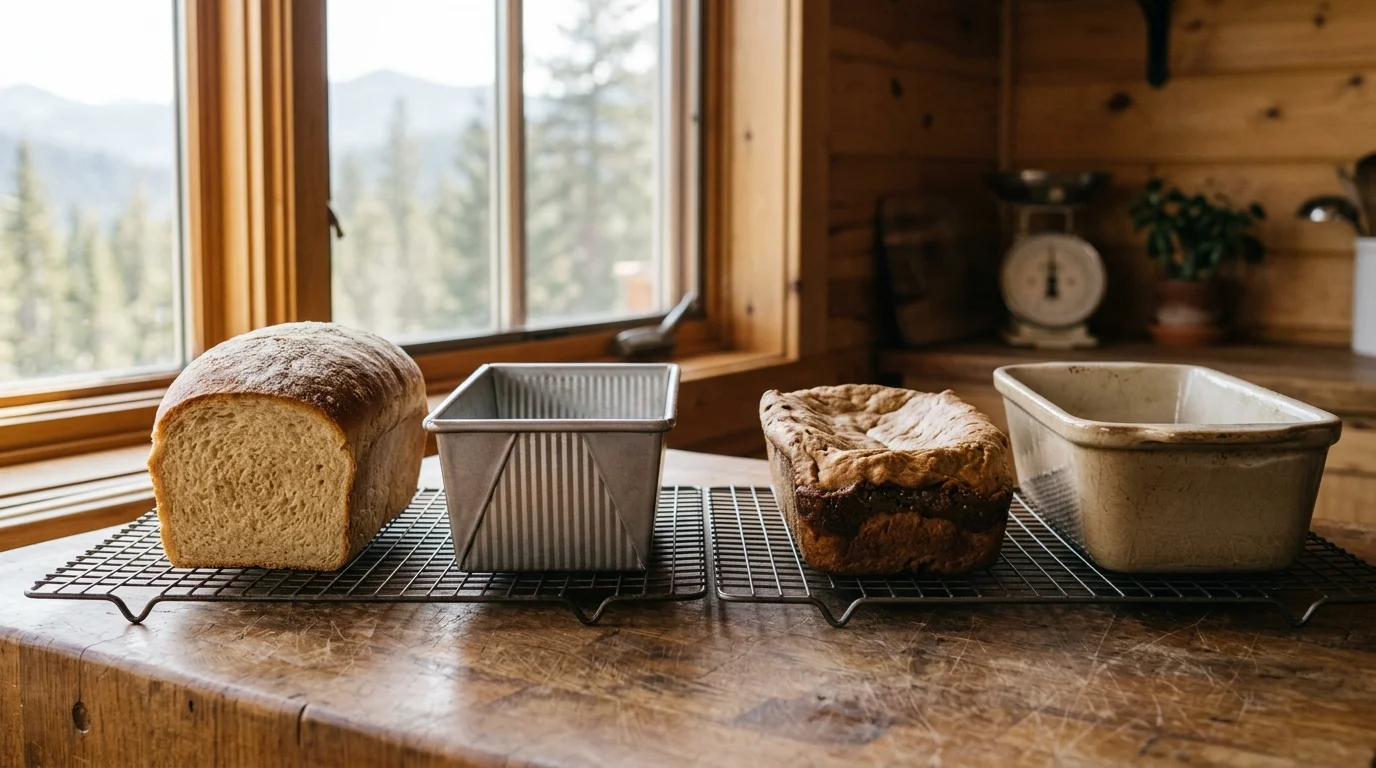
If you bake at 6,500 feet, your sandwich bread often collapses into a sunken, gummy crater or dries out completely. Thin metal pans warp under rapid oven heat, while heavy ceramic dishes take too long to warm up.
Standard high-altitude recipes tell you to adjust yeast or hydration, but your bakeware material actually controls structural success. Stoneware fails at elevation because thermal lag delays crumb setting, whereas aluminized steel transfers heat instantly to lock gluten before gas cells rupture.
Choosing the right pan eliminates dense bottoms and cratered tops on your mountain loaves. Here is how material physics directly dictates your altitude baking results.
The Physics of 6,500-Foot Elevation on Yeast Dough
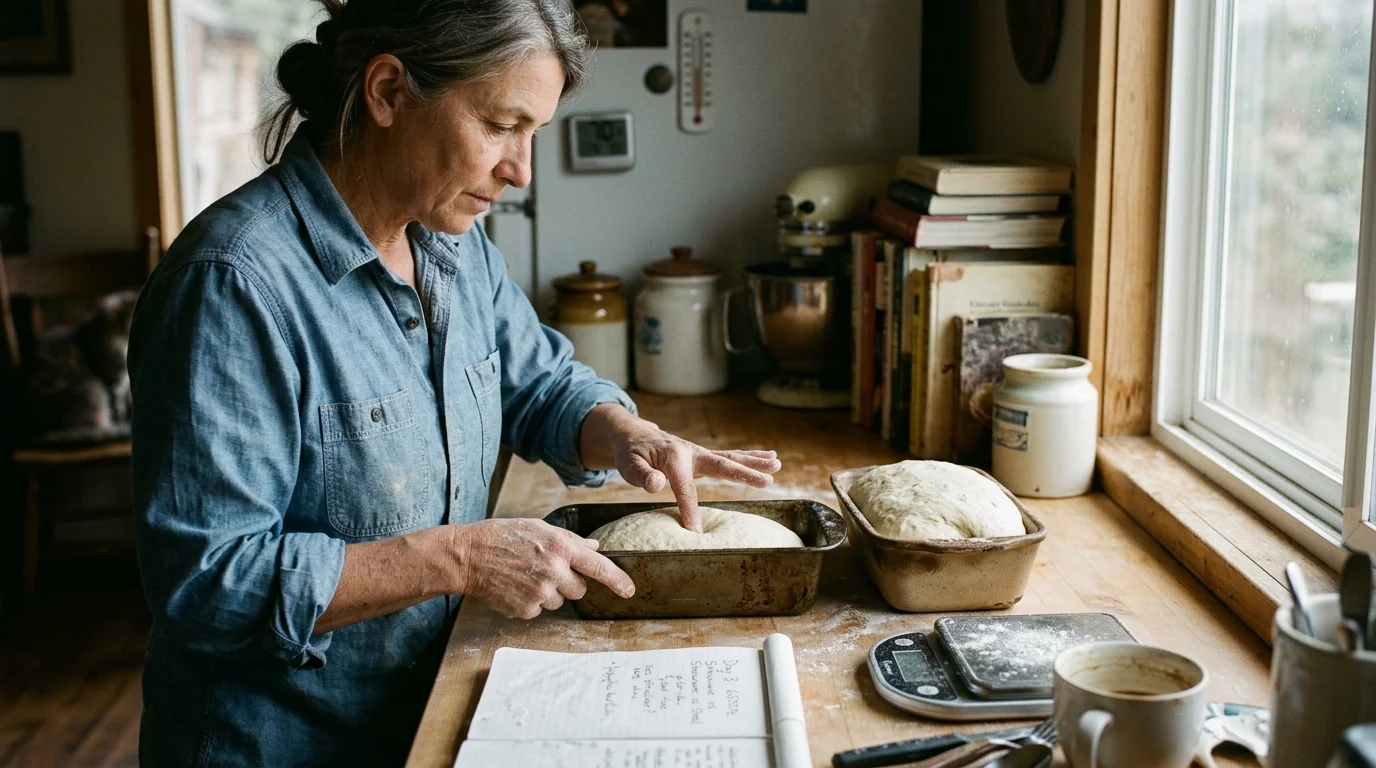
At 6,500 feet above sea level, atmospheric pressure drops from the standard 14.7 pounds per square inch down to roughly 11.5 psi. This lower barometric pressure creates less atmospheric resistance against your rising dough.
Managing proofing temperatures with a temperature-controlled fermentation box can also prevent high-elevation dough from overproofing prematurely in drafty rooms.
As a consequence, carbon dioxide produced by baker’s yeast expands faster and with greater volume. Your bread dough rises in roughly two-thirds the time required at sea level.
Lower atmospheric pressure also forces water to boil at approximately 200°F instead of the sea-level benchmark of 212°F. Moisture within your dough evaporates rapidly into thin, arid mountain air during the initial baking phase.
This rapid moisture loss presents a severe structural dilemma for home bakers. If moisture evaporates before the starch gelatinizes, your gluten lattice weakens.
Starch gelatinization occurs when flour starches absorb ambient water and swell, typically between 144°F and 180°F. Gluten proteins coagulate simultaneously, setting the permanent crumb framework of your loaf.
When gas bubbles expand faster than the crumb can solidify, cell walls stretch beyond their tensile limits. The interior gas pockets rupture, causing your loaf to collapse into a sunken trench.
High altitude baking pans must therefore compensate for low pressure by delivering rapid, targeted thermal energy. Material selection determines whether your loaf sets gracefully or implodes under its own weight.
Material Science: Thermal Conductivity vs. Thermal Mass
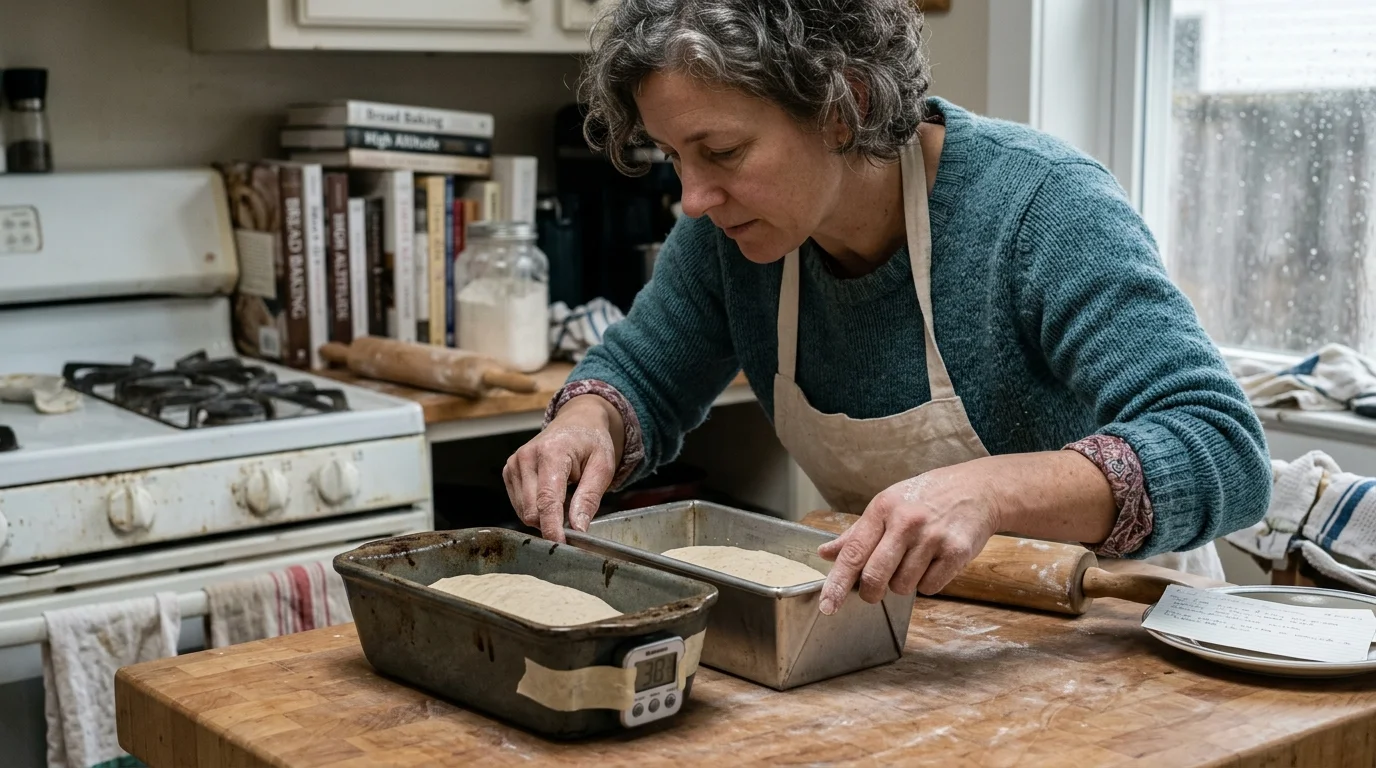
Bakeware performance hinges on two distinct physical properties: thermal conductivity and thermal mass. Thermal conductivity measures the speed at which heat transfers through a material.
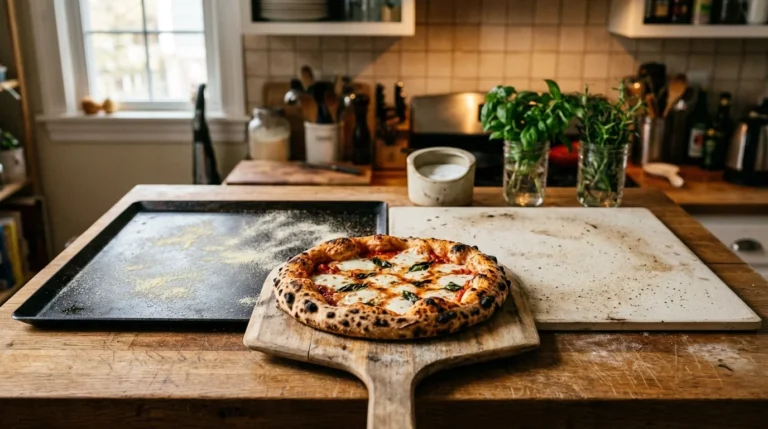
This stark contrast between rapid metallic heat transfer and ceramic insulation also governs the choice between baking steels and cordierite stones when baking crisp crusts.
Thermal mass, conversely, refers to a material’s capacity to absorb and store thermal energy. Bakeware with high thermal mass requires considerable energy and time to reach oven temperature.
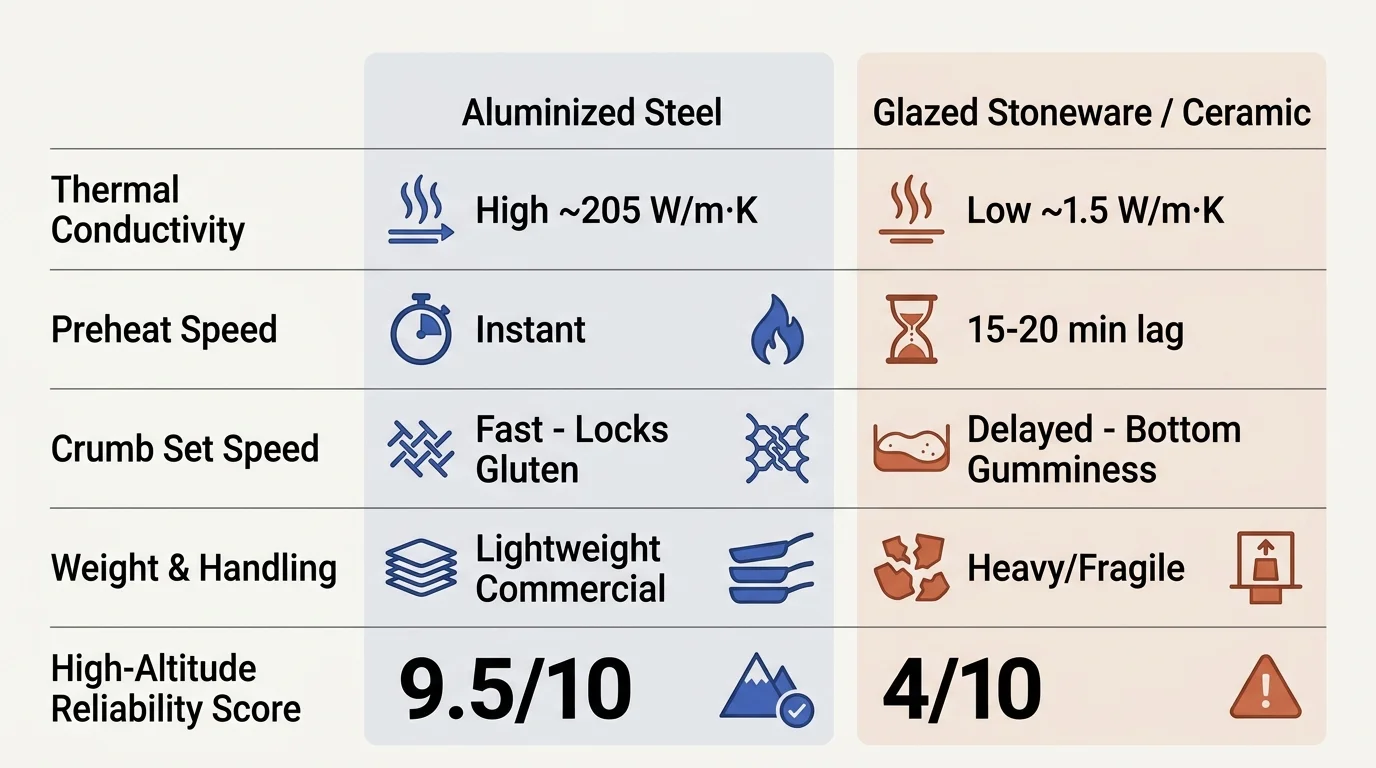
Aluminized steel consists of a heavy-gauge carbon steel core hot-dipped in an aluminum-silicon alloy. The aluminum coating provides exceptional thermal conductivity rated near 205 Watts per meter-Kelvin.
In metal bakeware, gauge measures the thickness of the metal, where lower numbers mean thicker and usually better structural integrity. Most professional aluminized loaf pans utilize 22-gauge or 20-gauge steel sheets.
This rigid steel core prevents physical warping when exposed to sudden temperature swings. Meanwhile, the outer aluminum layer ensures rapid, uniform heat distribution across the entire pan surface.
We define heat distribution as how evenly the pan spreads heat across its surface to prevent hot spots. Uniform thermal transfer ensures your bread bakes consistently from base to rim.
Stoneware, manufactured from dense fired clay, exhibits an exceptionally low thermal conductivity of roughly 1.5 Watts per meter-Kelvin. That is less than one percent of aluminum’s heat-conducting capability.
Dense stoneware acts like an insulating heat sink inside your oven. While it retains heat for extended periods once heated, it warms up remarkably slowly.
Unlike tri-ply cookware—which features three layers of metal bonded together for better heat distribution—stoneware features no conductive metallic core to accelerate heat transfer.
Bread Pan Heat Transfer in Mountain Kitchens
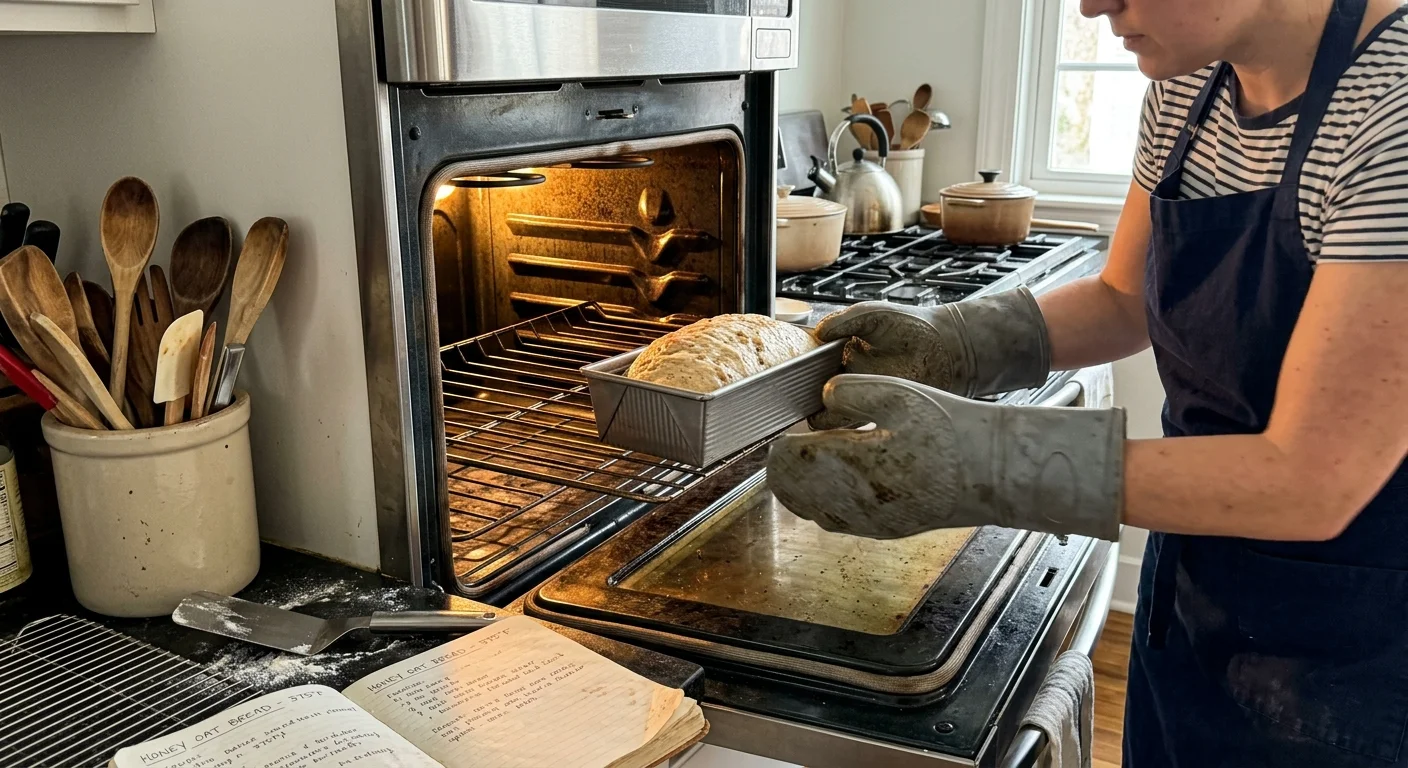
Understanding bread pan heat transfer explains why your mountain loaves fail in ceramic bakeware. At 6,500 feet, you are engaged in a race against atmospheric physics.
A similar thermal dynamic explains why bakers carefully weigh glass, ceramic, and metal bakeware to achieve properly browned bottom crusts in other baked goods.
Your yeast dough expands aggressively within the first ten minutes of entering the oven. To prevent a catastrophic collapse, heat must penetrate the dough core immediately to gelatinize starches.
Aluminized steel transfers heat from the oven air directly into the dough boundary within minutes. This rapid conductive surge creates strong side crusts that support the bread’s vertical rise.
According to America’s Test Kitchen, aluminized steel bakeware conducts heat far more rapidly and evenly than ceramic alternatives, preventing slumping edges.
When you place cold dough into room-temperature stoneware, the ceramic walls absorb the oven’s ambient heat before passing it inward. This phenomenon creates a critical thermal lag of fifteen to twenty minutes.
During this thermal delay, your yeast produces expanding carbon dioxide gas unchecked by structural resistance. By the time the stoneware warms sufficiently to set the dough, the overexpanded cell walls have collapsed.
Furthermore, prolonged exposure to dry mountain heat causes dough moisture to flash off prematurely. Loaves baked in stoneware at altitude regularly emerge with leathery tops, gummy bottoms, and collapsed centers.
Quality aluminized steel pans are fully oven-safe up to 450°F or higher. We define oven-safe as bakeware engineered to endure oven baking temperatures without structural warping or coating degradation.
That heat tolerance allows you to utilize elevated baking temperatures required at high altitudes without risking structural pan failure.
The Pullman Loaf Pan Elevation Advantage
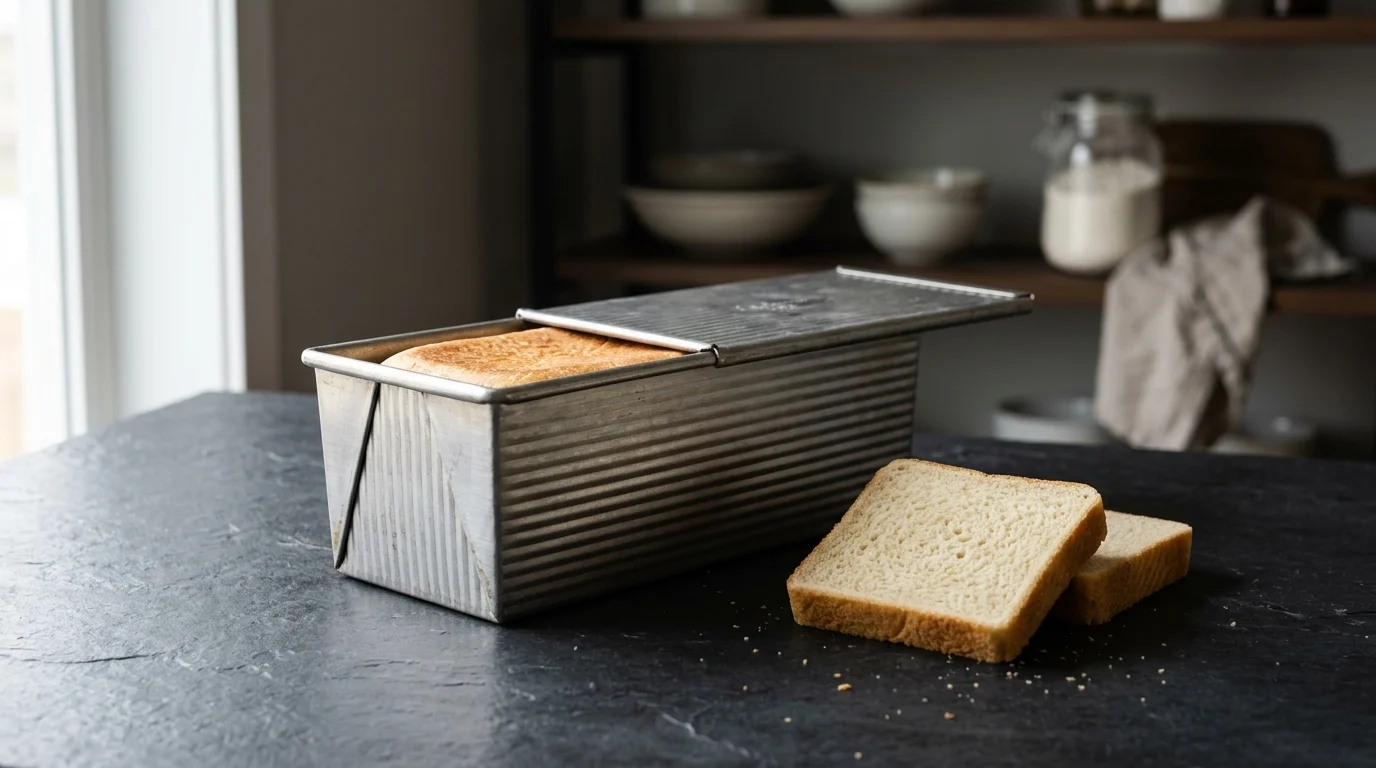
The Pullman loaf pan elevation advantage provides an indispensable mechanical solution for mountain bakers. A Pullman pan features straight vertical walls and an integrated, sliding flat lid.
Much like trapping steam inside a heavy cast iron Dutch oven for artisan boules, an enclosed pan shields the dough surface from arid mountain airflow.
Baking with a closed Pullman pan creates a sealed microclimate that traps internal steam as dough water vaporizes. This trapped humidity prevents your bread crust from drying out and hardening prematurely.
In thin mountain atmospheres, premature crust hardening traps raw dough beneath an impenetrable shell, preventing natural oven spring. The Pullman pan keeps the exterior supple until maximum vertical expansion occurs.
Moreover, the sliding lid acts as a rigid ceiling that physically halts runaway yeast expansion. Even if reduced atmospheric pressure encourages extreme rise, the dough cannot overexpand and collapse.
As the expanding dough meets the lid, it compresses into a tight, velvety crumb structure ideal for sandwich slicing. This process produces perfectly square slices with tender crusts and uniform cell density.
Commercial bakeries operating in mountainous regions rely almost exclusively on aluminized steel Pullman pans to ensure consistent crumb uniformity. The metal’s rapid conductivity pairs perfectly with the physical confinement of the lid.
“Trapping steam inside an aluminized steel Pullman pan stabilizes crust expansion before arid mountain air can rob your loaf of vital moisture.” — Commercial Bakery Consultant
If you struggle with cratered sandwich loaves at 6,500 feet, switching to a lidded Pullman pan resolves structural failure instantly. It circumvents the erratic behavior of low atmospheric pressure entirely.
Worked Example: High-Altitude Sandwich Loaf Formulation
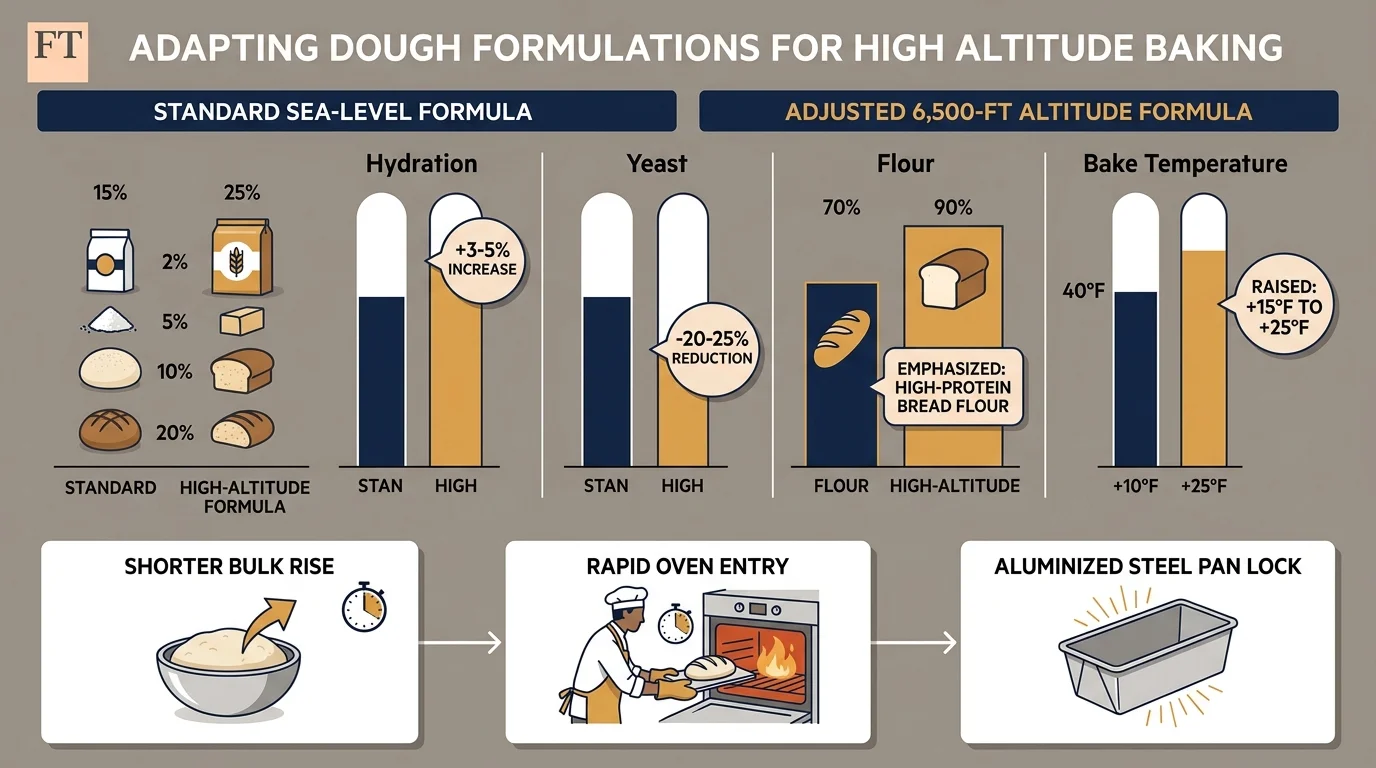
Let us examine a fully worked sandwich loaf scenario at exactly 6,500 feet elevation. We compare an aluminized steel pan directly against a heavy stoneware baker using identical dough formulations.
The baseline formula utilizes 500 grams of unbleached bread flour with 12.7% protein content. At sea level, a standard recipe calls for 340 grams of water, representing 68% hydration.
At 6,500 feet, arid air accelerates evaporation, requiring a hydration increase to 370 grams of water (74% hydration). We reduce instant dry yeast from 7.0 grams down to 4.5 grams to prevent premature overproofing.
The remaining ingredients include 10 grams of fine salt (2%), 25 grams of unsalted butter (5%), and 20 grams of honey (4%). We knead the dough to full windowpane development and ferment for 45 minutes.
We shape the dough into two equal 460-gram portions. Portion A goes into an 8.5 x 4.5-inch USA Pan 22-gauge aluminized steel pan; Portion B enters a 9 x 5-inch Le Creuset stoneware pan.
Both pans rest for a 35-minute second proof before entering an oven preheated to 400°F (204°C). We raise the oven temperature 25 degrees above standard sea-level baking recipes to accelerate starch setting.
At minute 8, Portion A in aluminized steel achieves full oven spring, rising 1.5 inches above the pan rim. The metal walls transmit heat immediately, setting side crusts and locking gluten architecture.
Conversely, Portion B in stoneware expands excessively, ballooning 2.25 inches above the cold ceramic rim by minute 12. The slow heat transfer fails to gelatinize starches before gas bubbles rupture.
At minute 16, Portion B’s center collapses downward by 1.25 inches, producing a distinct crater. Meanwhile, Portion A bakes steadily without sinking or tearing.
At minute 32, Portion A registers an internal temperature of 202°F and emerges with a golden, crisp perimeter. Portion B requires 44 minutes to reach 200°F, emerging with a sunken center and pale bottom.
Slicing confirms the verdict: the aluminized steel loaf exhibits an airy, tender, uniform crumb. The stoneware loaf displays a dense, gummy moisture band across its lower half and a collapsed top crust.
Aluminized Steel vs. Stoneware Metric Comparison
To choose your high altitude baking pans wisely, you must evaluate measurable material specifications rather than marketing claims. We evaluated four prominent loaf pans across critical mountain baking parameters.
Our evaluation includes thermal conductivity ratings, wall thickness, empty pan weight, non-stick coatings, and actual structural performance at 6,500 feet. The quantitative differences explain the stark variations in bread crumb quality.
Some pans utilize a modern ceramic coating, which is a newer non-stick surface made from silica, while others use silicone glazes. Traditional non-stick pans utilize PTFE, the chemical name for Teflon-style non-stick coatings.
None of these loaf pans require induction compatibility, meaning they do not need magnetic properties to function on induction cooktops. They focus purely on conductive heat transfer within high-heat radiant oven chambers.
| Model Name | Material & Gauge | Thermal Conductivity | Max Temp | Weight | Altitude Score (6,500 ft) |
|---|---|---|---|---|---|
| USA Pan Bakeware 8.5 x 4.5 Loaf Pan | 22-Gauge Aluminized Steel | ~205 W/m·K | 450°F | 1.2 lbs | 9.8 / 10 |
| Chefmade Pullman Loaf Pan with Lid | 0.8 mm Aluminized Steel | ~200 W/m·K | 428°F | 1.6 lbs | 9.9 / 10 |
| Le Creuset Heritage Loaf Pan | High-Density Stoneware | ~1.5 W/m·K | 500°F | 2.4 lbs | 4.2 / 10 |
| Emile Henry Modern Classics Baker | HR Burgundy Ceramic Clay | ~1.4 W/m·K | 520°F | 2.3 lbs | 4.5 / 10 |
As the data illustrates, the thermal conductivity of aluminized steel exceeds stoneware by over 130-fold. That immense conduction advantage enables rapid starch gelatinization before atmospheric expansion destabilizes your dough.
Stoneware pan weight also penalizes your baking process. A pan weighing over two pounds acts as an insulative thermal barrier, soaking up oven BTUs while your yeast overexpands.
While cast iron bakeware is often seasoned—meaning a protective coating is built up through oil and heat—stoneware uses vitrified glazes. These slick glazes offer release but do nothing to accelerate sluggish thermal transfer.
Care, Maintenance, and Bakeware Myths
Persistent culinary myths frequently mislead home bakers working at high altitudes. One widespread myth claims stoneware creates superior sandwich bread because it holds heat longer than metal.
While heat retention benefits slow-braised stews, it sabotages yeast bread at elevation. Mountain yeast baking demands rapid heat delivery, not sluggish thermal accumulation that delays crust setting.
Another myth asserts that all metal loaf pans leach harmful chemicals or stick aggressively to baked goods. Commercial-grade aluminized steel uses food-safe, proprietary silicone glazes that release cleanly without petroleum chemicals.
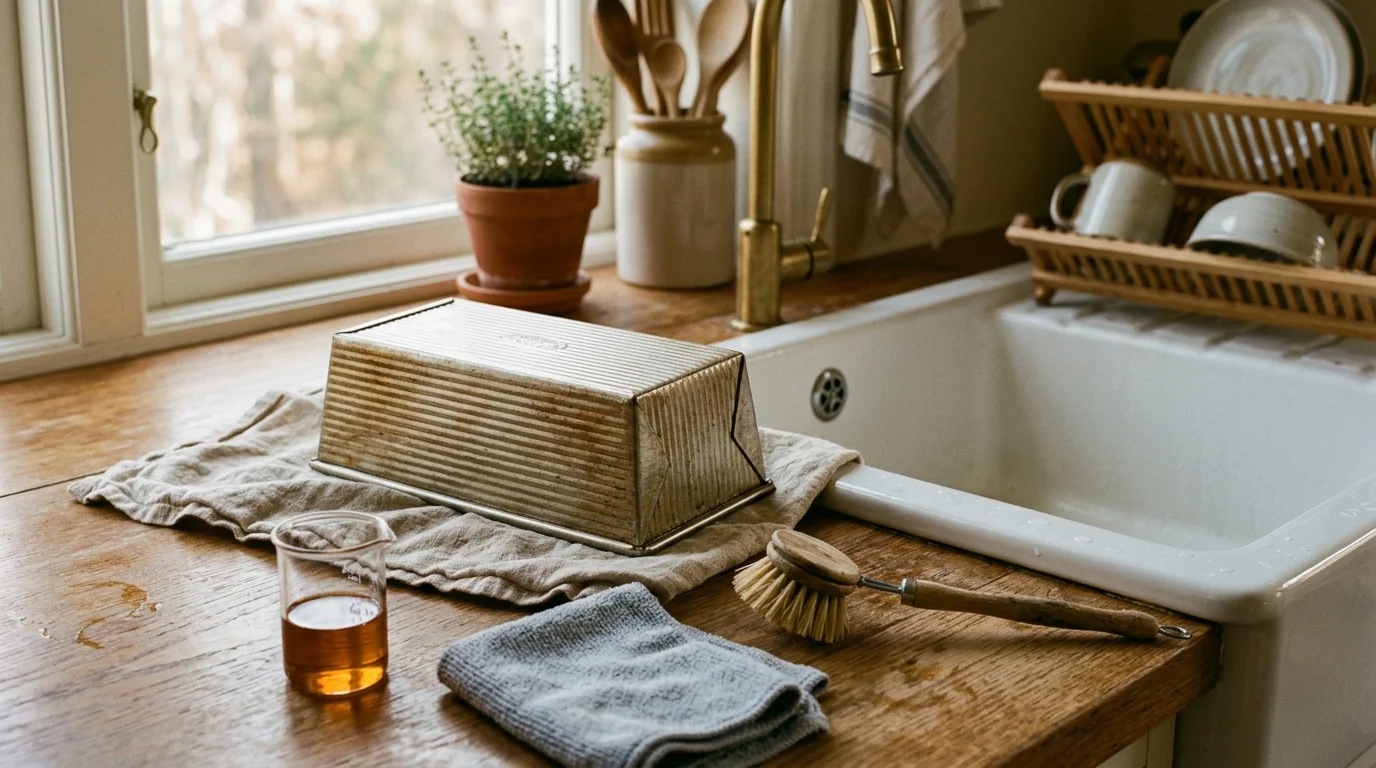
Proper care preserves these high-performance silicone non-stick surfaces for decades. As reported by Serious Eats, hand-washing high-grade aluminized steel maintains non-stick release properties far better than harsh automated dishwashing detergents.
Always wash aluminized steel pans in warm water using mild dish soap and a soft sponge. Never use abrasive scouring pads, which strip the protective aluminum-silicon layer and expose raw carbon steel.
For stoneware, maintenance centers on avoiding catastrophic thermal shock. Plunging a hot ceramic baker into cold sink water or placing it on cold granite can crack the clay body instantly.
Avoid scouring enameled stoneware with wire brushes, which scratch the glassy surface and ruin its natural release capabilities. Thorough hand drying prevents mold from taking root in unglazed ceramic footing rims.
Top Loaf Pan Recommendations for High Elevation
Upgrading your bakeware provides the fastest path to eliminating collapsed mountain loaves. We selected specific models that satisfy the demanding thermal requirements of high-altitude yeast baking.
According to Wirecutter, commercial aluminized steel pans reliably outperform both glass and ceramic alternatives in crust development and release.
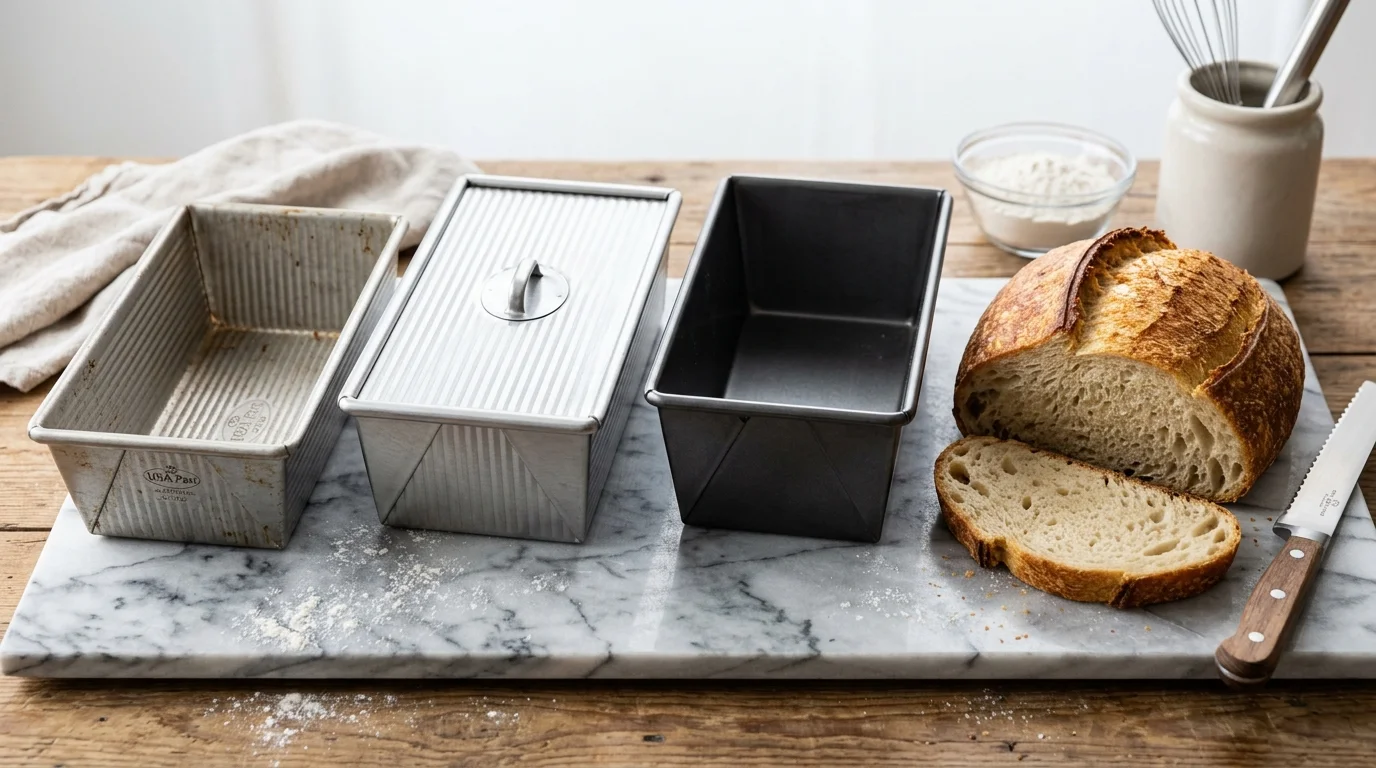
Our pick for Best for everyday is the USA Pan 8.5 x 4.5-inch Aluminized Steel Loaf Pan. Crafted from heavy 22-gauge steel, it features a corrugated surface that promotes air circulation and rapid heat distribution.
The proprietary Americoat silicone coating releases loaves effortlessly without requiring parchment paper or excessive shortening greasing. It provides the ideal balance of fast heat transfer and structural durability for daily sandwich bread.
Our pick for Best for searing crust and locking shape is the Chefmade Pullman Loaf Pan with Lid (9 x 4 x 4 inches). Its 0.8-millimeter aluminized steel core delivers blistering heat transfer directly into the dough boundary.
The tight-sliding lid captures steam to keep crusts pliable during initial oven spring before locking them into a crisp, uniform golden crust. It eliminates high-altitude loaf collapse completely by setting rigid structural bounds.
Our pick for Best value is the Chicago Metallic Commercial II Traditional Uncoated 1-Pound Loaf Pan. This budget-friendly workhorse features durable 22-gauge aluminized steel without expensive surface treatments.
It delivers professional-grade thermal responsiveness at an accessible price point. You must grease this uncoated surface thoroughly before depositing dough, but the pan will easily outlast your kitchen appliances.
If you are outfitting a new mountain kitchen, invest in an Essential starter set. We recommend pairing one standard 8.5 x 4.5-inch aluminized steel pan with one 9 x 4 x 4-inch lidded Pullman pan.
This two-pan combination equips you to bake open-top artisan loaves and perfectly uniform, non-collapsing sandwich bread with equal reliability.
Frequently Asked Questions
Why does my sandwich bread sink in the middle when baking at 6,500 feet?
Low atmospheric pressure allows yeast gas to expand faster than the crumb can gelatinize and set. Using a slow-heating pan like stoneware delays structure formation, causing the overexpanded center to collapse.
Should I preheat a stoneware loaf pan before adding yeast dough?
Preheating stoneware can accelerate crust setting, but transferring shaped, delicate dough into a scorching loaf cavity often deflates proofed dough. Switching to fast-conducting aluminized steel solves this thermal lag safely without hazardous pan transfers.
What gauge aluminized steel pan is best for high-altitude baking?
Choose 20-gauge or 22-gauge aluminized steel for the optimal balance of strength and thermal transfer speed. Thinner pans below 24-gauge warp under elevated baking temperatures, leading to uneven crumb development.
How do I adjust oven temperature when baking bread at high altitude?
Increase your oven temperature by 15°F to 25°F above standard recipe directions when baking at 6,500 feet. This elevated heat accelerates starch gelatinization and locks your loaf’s vertical structure before gas pockets rupture.
Disclaimer: Product prices and availability change frequently. Prices shown were accurate at time of writing but may have changed. We may earn a small commission from purchases made through links on this site, at no extra cost to you. Always verify current pricing on the retailer’s website before purchasing.
1 Comment