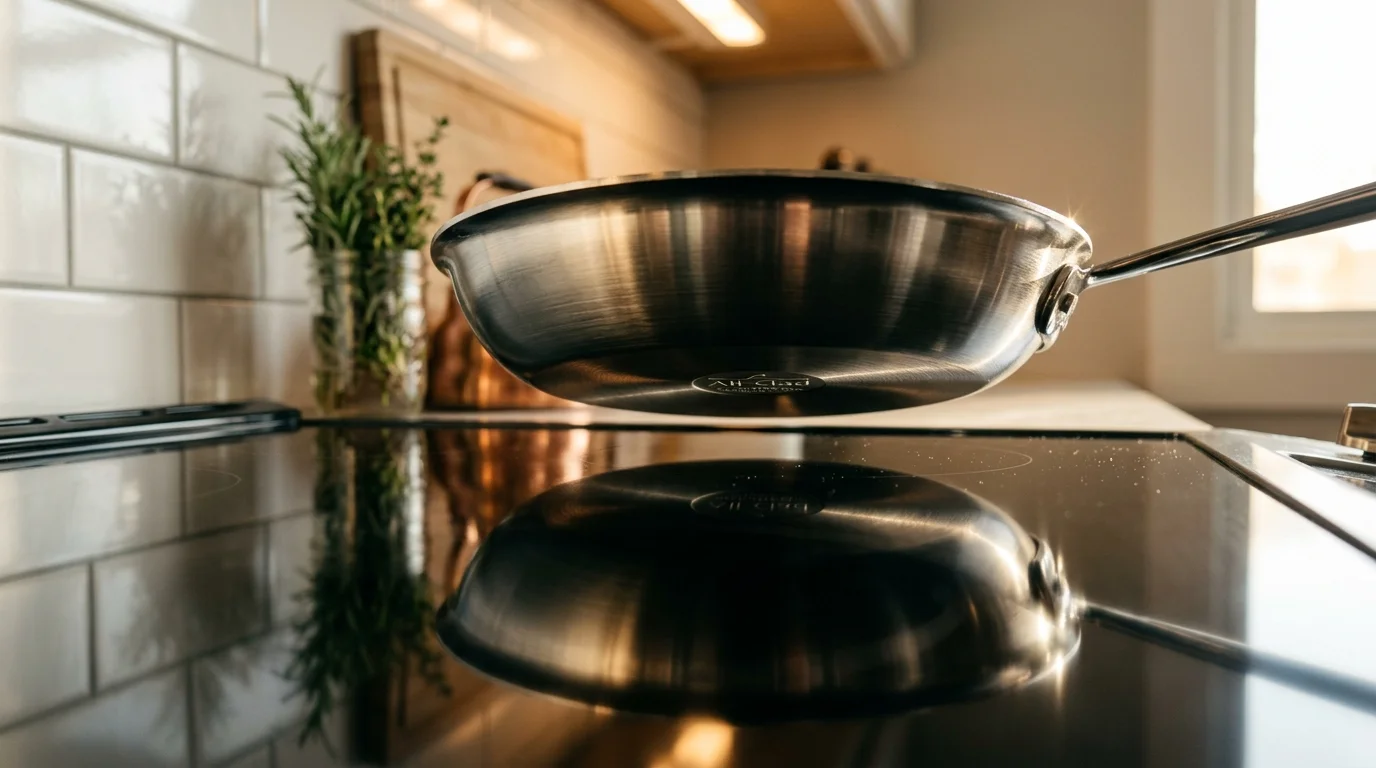
You can slide heavy cookware across your smooth electric cooktop without etching permanent haze into the surface. Micro-scratches do not originate from soft cookware metals, but from abrasive base textures trapping quartz grit and coarse salt under downward cooking pressure.
Home cooks outfitting a new kitchen should also review how to build a cookware set on a budget to find affordable pieces that protect glass surfaces.
This guide breaks down the physical contact mechanics of turned, brushed, stamped, and enameled bases against glass-ceramic panels like Schott Ceran. You will discover which specific pan profiles preserve your stovetop while delivering rapid thermal conductivity for weekday family meals.
The Physics of Cookware Contact on Schott Glass
Glass-ceramic cooktop panels consist of lithium-aluminosilicate glass engineered to resist thermal shock. Brands like Schott Ceran withstand direct heat shifts up to 1,300 degrees Fahrenheit without cracking or shattering.
If you want responsive high-heat searing without coarse sand-cast nodules, carbon steel pans offer a cast iron alternative with significantly smoother machined contact areas.
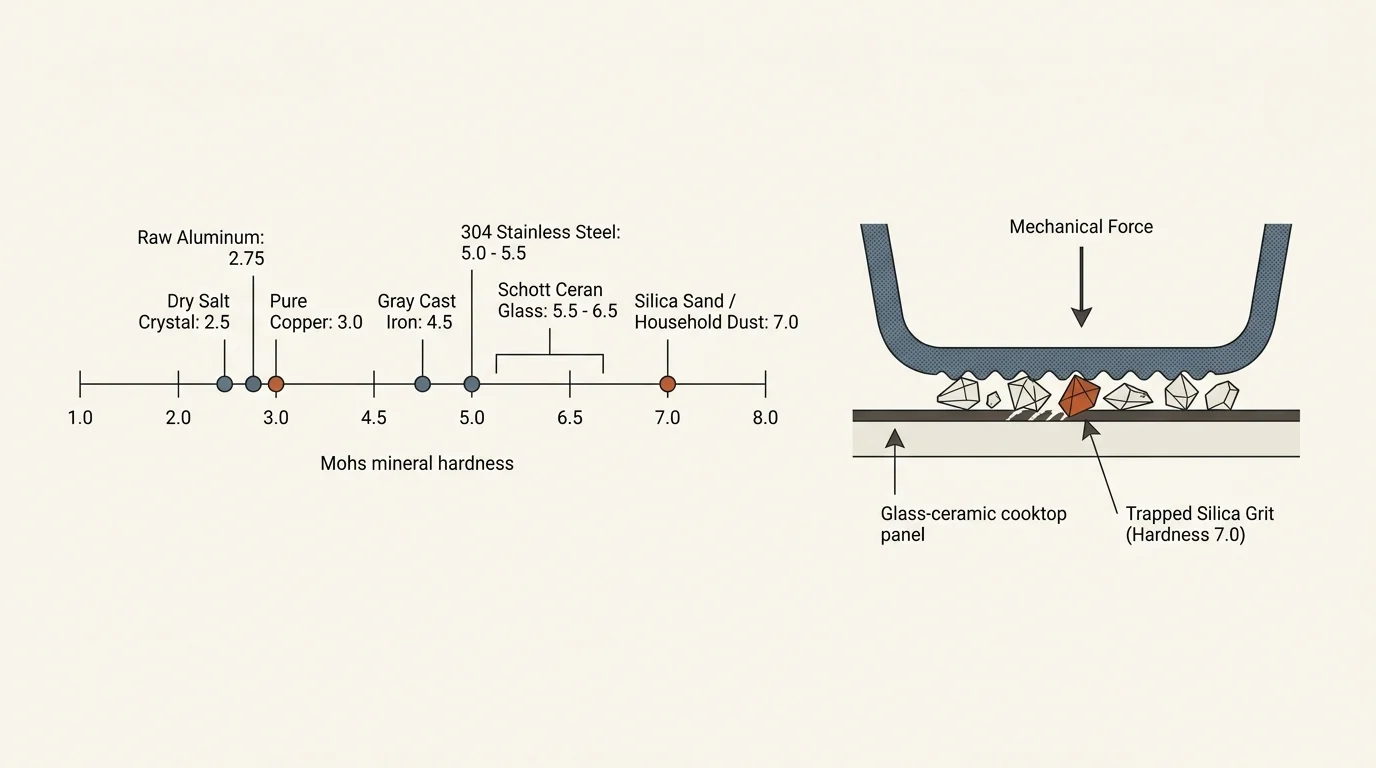
Material hardness dictates whether one object can mechanically cut another. On the Mohs scale of mineral hardness, Schott Ceran rates between 5.5 and 6.5.
Standard cookware metals sit far below this threshold. Pure copper rates at 3.0, raw aluminum registers around 2.75, and 304 cooking-grade stainless steel hovers between 5.0 and 5.5.
Gray cast iron registers at roughly 4.5 on the Mohs scale. Because these metals are softer than the glass substrate, bare metal contact alone cannot physically scratch your cooktop panel.
The damage you see on radiant cooktops comes from third-body abrasion. Ambient household dust contains silica sand, which measures 7.0 on the Mohs scale.
Dry cooking seasonings like coarse kosher salt register around 2.5, but form sharp crystalline structures. When trapped under a heavy pot, these crystals act as tiny cutting chisels.
“Metal does not scratch cooktop glass; uncleaned cooking salt and ambient grit trapped beneath heavy pans cause micro-abrasions under heat and friction.”
Cookware base geometry dictates how heavily this trapped grit bites into the glass. Textured bases concentrate entire pan weights onto microscopic ridges, multiplying downward mechanical pressure.
Planar, ultra-smooth bases spread that same downward mass across broad surface areas. This low pressure allows the pan to glide harmlessly over micro-debris rather than gouging it inward.
Ranking Cookware Base Textures by Scratch Risk
Cookware manufacturers finish pan bases using five distinct machining methods. Each method produces a unique surface roughness, measured as Ra in micro-inches or microns.
While smooth glass surfaces demand absolute base flatness, cooks working with traditional coil ranges should consider heavy-base skillets that counteract uneven heat on tilted electric coil burners.
Vitreous porcelain enamel ranks as the safest contact surface for smooth glass ranges. Manufacturers fuse liquid glass to cast iron or steel at 1,500 degrees Fahrenheit, creating an Ra below 0.2 microns.
Linear satin brushed finishes rank second. High-end multi-clad cookware uses directional mechanical abrasives to flatten the base, yielding a microscopic profile with an Ra around 0.4 microns.
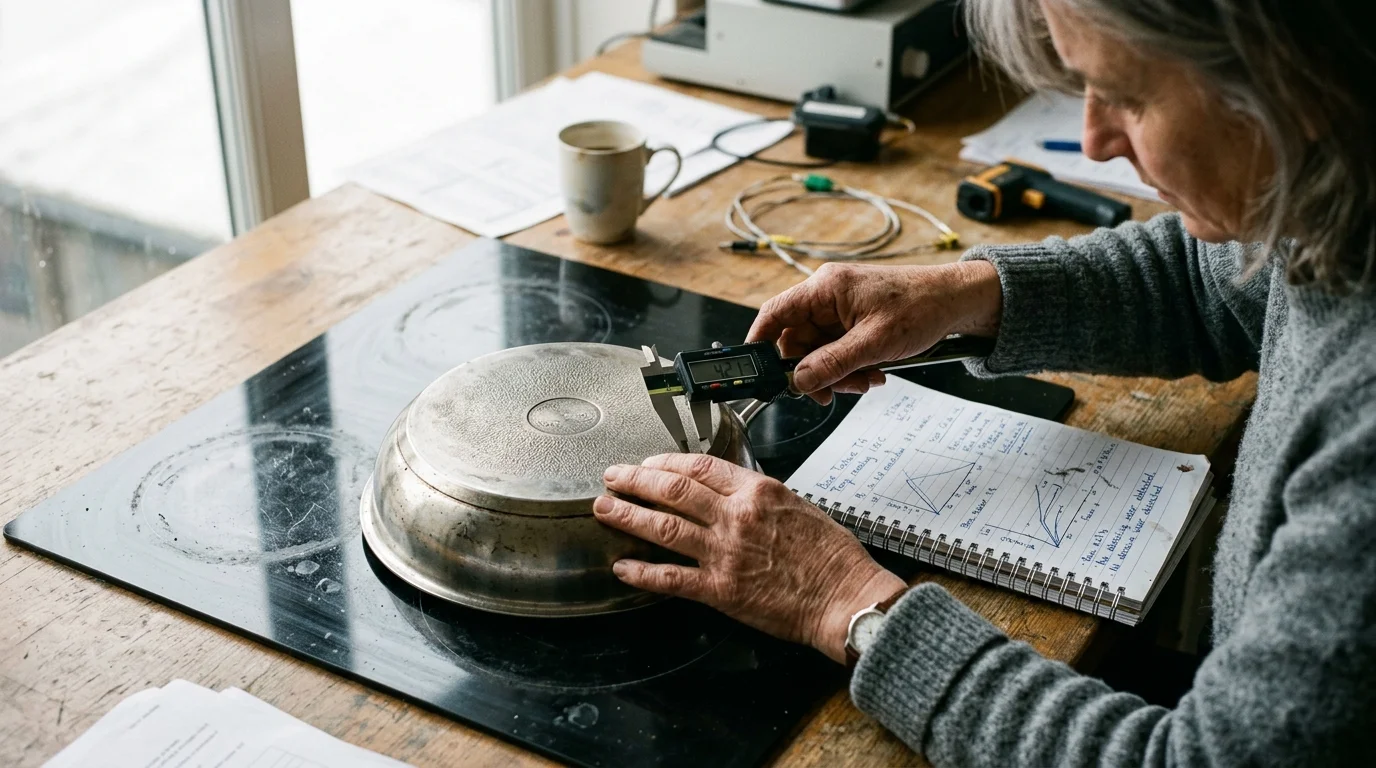
Stamped and coined aluminum bases rank third, carrying moderate scratch risks. These pans feature recessed manufacturer logos, waffle stamping, or sharp exterior rim edges that collect kitchen debris.
Spiral-turned aluminum bases feature machined concentric grooves that feel like a vinyl record. These micro-grooves act as abrasive files, locking onto coarse salt and dragging it across the glass surface.
Raw as-cast iron ranks as the most abrasive finish. Sand-casting creates irregular iron nodules with surface roughness exceeding 9.0 microns, creating extreme point pressure when moved.
| Base Texture Style | Roughness (Ra) | Contact Surface Area | Pressure Distribution | Scratch Hazard Rating |
|---|---|---|---|---|
| Vitreous Porcelain Enamel | 0.1 to 0.2 µm | 95% Planar Contact | Even, Low PSI | Very Low |
| Satin Brushed Stainless | 0.3 to 0.5 µm | 90% Planar Contact | Even, Low PSI | Low |
| Stamped / Coined Disc | 1.2 to 2.5 µm | 60% Intermittent | Edge-Weighted | Moderate |
| Concentric Spiral-Turned | 3.5 to 6.0 µm | 35% Ridged Contact | Concentrated on Ribs | High |
| Raw Sand-Cast Iron | 8.0 to 12.0 µm | 15% Peak Contact | Severe Point Loading | Critical |
Testing from Consumer Reports reveals that pan flatness directly dictates boiling efficiency on smooth electric burners. Warped bases waste energy and wobble dangerously under heavy stirring.
Grooved and sand-textured pans also suffer from reduced contact conduction. Smooth bases optimize energy transfer by maximizing direct physical contact with the glass pane.
Heat Distribution and Material Performance
Radiant glass stovetops rely on two heating mechanisms: direct contact conduction and infrared radiation. Direct conduction through the glass panel delivers heat fastest to the cooking vessel.
If you are deciding between clad metal and coated surfaces for daily cooking, our guide on stainless steel vs non-stick pans compares their longevity and care requirements.
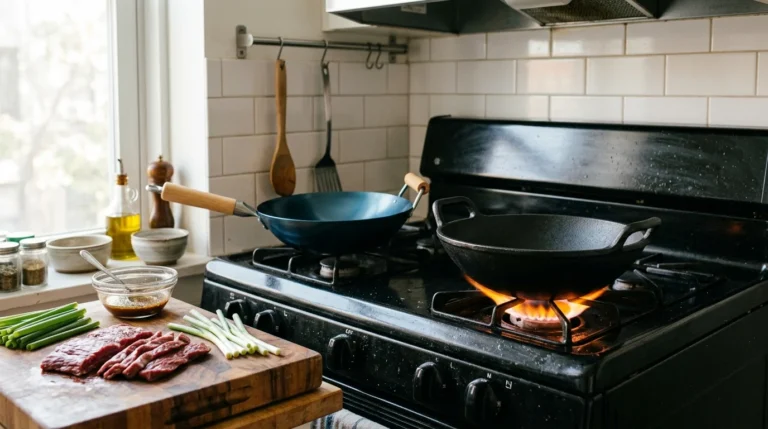
Home cooks who prepare stir-fries should look for the best wok for electric stoves featuring a broad, flat base that will not rock or scrape during cooking.
Home cooks exploring different smooth-top technologies can also compare the pros and cons of induction cooktops to see how magnetic burner requirements contrast with radiant glass.
Understanding heat distribution helps you select stable cookware. Heat distribution measures how evenly the pan spreads heat across its surface, eliminating hot spots that burn food.
Metal gauge determines how well a pan resists heat warping on high-wattage burners. Gauge refers to the thickness of the metal; lower numbers mean thicker material and greater structural durability.
Thin 12-gauge stamped pans bow downward or upward when exposed to radiant heating elements. Upward bowing creates an oil pool ring, while downward bowing creates a spinning pivot point that scratches glass.
Tri-ply construction prevents thermal warping through metallurgical bonding. Tri-ply means three layers of metal bonded together for better heat distribution, usually sandwiching aluminum between durable stainless steel sheets.
Aluminum distributes thermal energy at 237 Watts per meter-Kelvin, compared to stainless steel at just 16. A thick internal aluminum core absorbs radiant heat rapidly and distributes it outward across the pan floor.
This uniform expansion keeps the base flat against the cooktop. When the bottom stays completely flat, you eliminate wobbling and prevent abrasive friction during aggressive stirring.
Worked Example: A Weekday Dinner Thermal and Cost Analysis
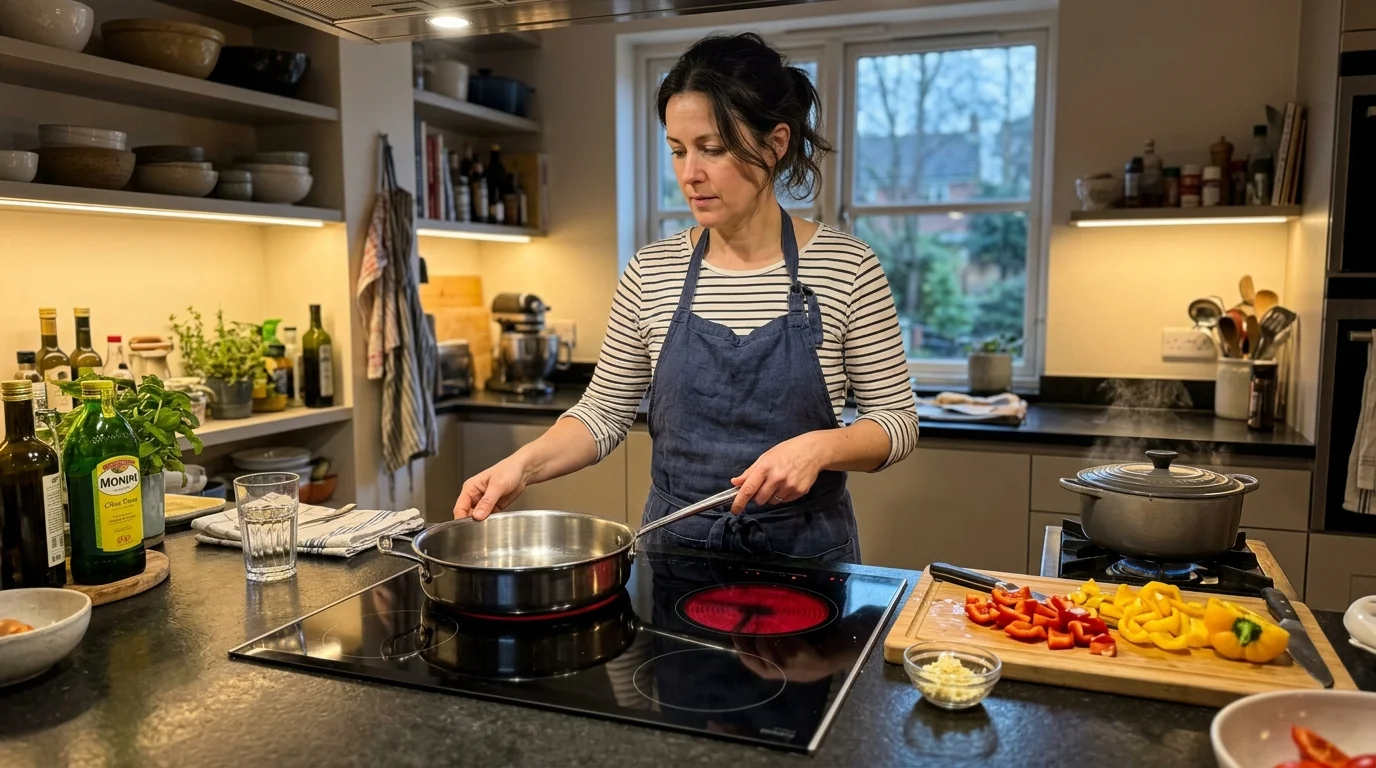
Consider a busy parent preparing a weekday bolognese sauce for four people. The meal requires browning 1.5 pounds of ground beef and simmering 24 ounces of marinara sauce on a radiant glass range.
Mastering how to prevent food from sticking to stainless steel pans also keeps your cooking clean, reducing the aggressive spatula pressure that can shift pans unexpectedly.
The cooktop is a standard 30-inch radiant electric range with a 2,500-watt, 9-inch burner element. The parent evaluates three pans: a raw cast iron skillet, a clad stainless skillet, and an enameled Dutch oven.
Option A is a Lodge 10.25-inch raw cast iron skillet costing $24.90. The pan weighs 5.4 pounds empty, with a sand-cast base roughness measuring 9.5 microns Ra.
Adding food brings the total weight to 7.9 pounds. Because only 15 percent of the rough nodules touch the glass, point pressure reaches 42 pounds per square inch.
Stirring the meat causes minor pan shifts. The coarse iron peaks trap dropped kosher salt grains, grinding them across the glass with 42 PSI of concentrated force and etching visible tracks.
Option B is a Tramontina 10-inch Tri-Ply Clad stainless skillet costing $44.95. The pan weighs 2.6 pounds empty, featuring a satin brushed base measuring 0.4 microns Ra.
With food, the total weight reaches 5.1 pounds. Because 90 percent of the planar brushed surface touches the glass, downward pressure drops to a harmless 0.08 pounds per square inch.
The pan preheats to 375 degrees Fahrenheit in two minutes and 15 seconds. It browns the beef evenly without warping, sliding smoothly without gouging stray salt crystals into the glass.
Option C is a Le Creuset 4.5-quart Enameled Round Dutch Oven costing $390.00. The vessel weighs 9.3 pounds empty, but features an ultra-smooth fire-glazed vitreous enamel base.
With sauce and meat, the assembly weighs 15.3 pounds. Despite this heavy mass, the glass-on-glass contact plane exhibits an Ra of 0.15 microns, distributing weight broadly with zero abrasive bite.
The enameled vessel holds simmering temperatures on low burner settings, saving electrical wattage. The parent avoids costly stovetop replacement bills, which average $450 to $700 for replacement glass-ceramic panels.
Serious Eats emphasizes that smooth enameled iron retains heat as effectively as raw iron. The vitreous glaze completely isolates the rough iron core from delicate cooking surfaces.
Non-stick pans present different structural challenges on smooth electric cooktops. Many budget non-stick pans utilize PTFE linings on cheap stamped aluminum shells.
PTFE is the chemical name for Teflon-style non-stick coatings that provide slick, low-friction food release. However, thin PTFE pans often feature coarse spiral-grooved bases designed to cut production costs.
Ceramic coating options have surged in popularity for family kitchens. Ceramic coating is a newer non-stick surface made from silica that resists higher heat without chemical breakdown.
Ensure any ceramic-coated or PTFE pan features a flat, heavy-gauge base. Avoid cheap stamped steel discs pressed into pan bottoms, as their sharp outer seams can scratch glass.
As culinary guides from Wirecutter demonstrate, tri-ply stainless cookware balances lightweight handling with exceptional heat uniformity. This balance protects your glass while searing proteins evenly.
Preventative Maintenance: Keeping Radiant Cooktops Pristine
Protecting your smooth cooktop requires simple operational adjustments during meal preparation. Follow the lift-and-set rule: always lift pans completely when moving them between burners.
Never shake pans back and forth across radiant glass elements. Rapid agitation acts like sandpaper if tiny quartz dust particles sit between the pan base and the glass.
Establish a strict three-second microfiber wipe-down routine before every cooking session. Wipe both the radiant burner zone and the bottom of your cookware base before applying heat.
Thermal expansion bonds microscopic debris quickly. When an electric element reaches 800 degrees Fahrenheit, trapped organic debris carbonizes onto the glass surface under pan weight.
Sugar boil-overs represent the greatest chemical hazard to glass-ceramic ranges. Table sugar and sweet marinara sauces melt at 367 degrees Fahrenheit, bonding chemically to silicate glass.
If sugar cools against the cooktop, thermal contraction pulls micro-chips of glass away from the surface. Always scrape liquid sugar spills away immediately using a fresh single-edge razor blade.
Avoid cleaning smooth glass cooktops with coarse scouring powders or steel wool pads. These harsh abrasives create micro-scratches that weaken the glass matrix and cause permanent surface hazing.
Use dedicated ceramic cooktop creams containing microscopic polishing agents like cerium oxide. These creams lift baked oils and restore clear optical clarity without cutting into the glass.
Recommended Cookware Models for Smooth Glass Surfaces
Selecting safe cookware for glass top stoves requires verifying base flatness, weight distribution, and finish smoothness. Every pan you choose must balance cooking performance with gentle surface contact.
Verify whether pieces are oven-safe before purchasing for multi-stage recipes. Oven-safe means the pan can go directly from stovetop to oven without structural damage or handle failure.
Consider whether you need induction compatible gear for future kitchen upgrades. Induction compatible means the pan bottom contains magnetic ferrous metal that operates on electromagnetic induction cooktops.
For everyday searing and sautéing, choose the Tramontina 10-Inch Tri-Ply Clad Stainless Steel Skillet. It features a precision-machined satin brushed base that glides smoothly across glass without micro-scratching.
The All-Clad D3 12-Inch Fry Pan represents an exceptional premium alternative. Its heavy 2.6-millimeter aluminum core prevents base bowing under high searing heat, keeping the bottom completely planar.
For family stews and braises, choose the Le Creuset Signature 5.5-Quart Round Dutch Oven. Its vitreous porcelain enamel base guarantees smooth, non-abrasive surface contact across radiant electric elements.
For delicate eggs and pancakes, pick the OXO Good Grips Pro Hard Anodized 10-Inch Skillet. This pan features a heavy-gauge aluminum body and a flat base with no sharp edge seams.
A reliable starter set for family cooking on glass cooktops includes three essential vessels. Combine one 10-inch tri-ply skillet, one 3-quart stainless saucepan, and one 5.5-quart enameled Dutch oven.
This compact trio handles 90 percent of family dinner tasks efficiently. More importantly, every piece features a base profile that preserves your glass-ceramic cooktop for decades.
Frequently Asked Questions
Can you use cast iron on ceramic glass stovetops without scratching?
You can safely use cast iron if you choose enameled pieces or pans with CNC-machined flat bases. Always lift the pan to reposition it, and never slide rough sand-cast bottoms across the glass.
How do I know if my cookware base is smooth enough for a glass stove?
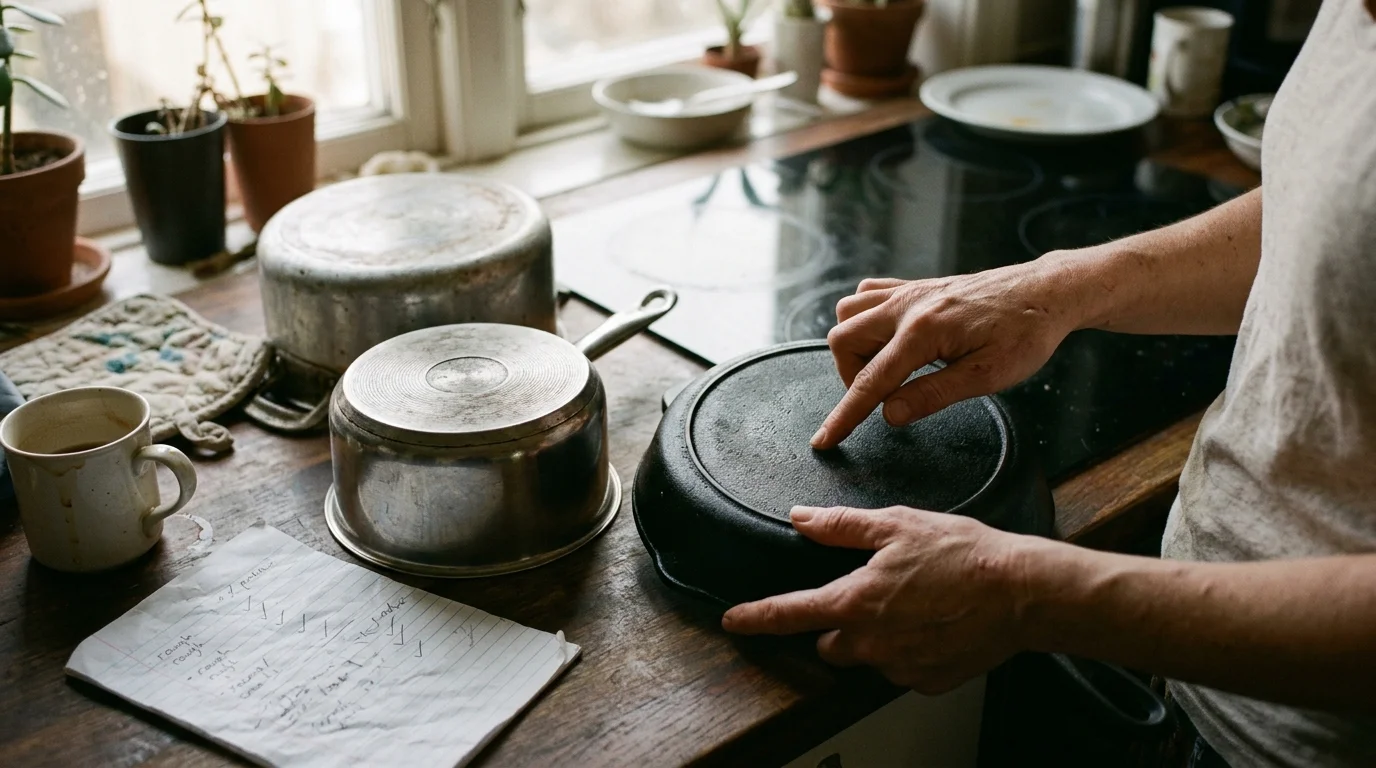
Run your fingertips across the entire underside of the cool pan to detect ridges or nodules. If you feel sharp stamping, coarse grit, or concentric grooving, the pan can trap debris and scratch glass.
Will dragging an aluminum pan leave permanent scratches on a glass top?
Aluminum rarely cuts into glass-ceramic because it is significantly softer than the glass. However, sliding aluminum leaves silvery metal transfer streaks that require specialized cooktop cleaner to buff out.
What is the fastest way to remove metal transfer marks from a smooth cooktop?
Apply a dime-sized drop of ceramic cooktop cleaning paste and buff firmly with a dry microfiber towel. The mild polishing compound lifts the bonded metal deposit without scratching the glass substrate.
Disclaimer: Product prices and availability change frequently. Prices shown were accurate at time of writing but may have changed. We may earn a small commission from purchases made through links on this site, at no extra cost to you. Always verify current pricing on the retailer’s website before purchasing.