
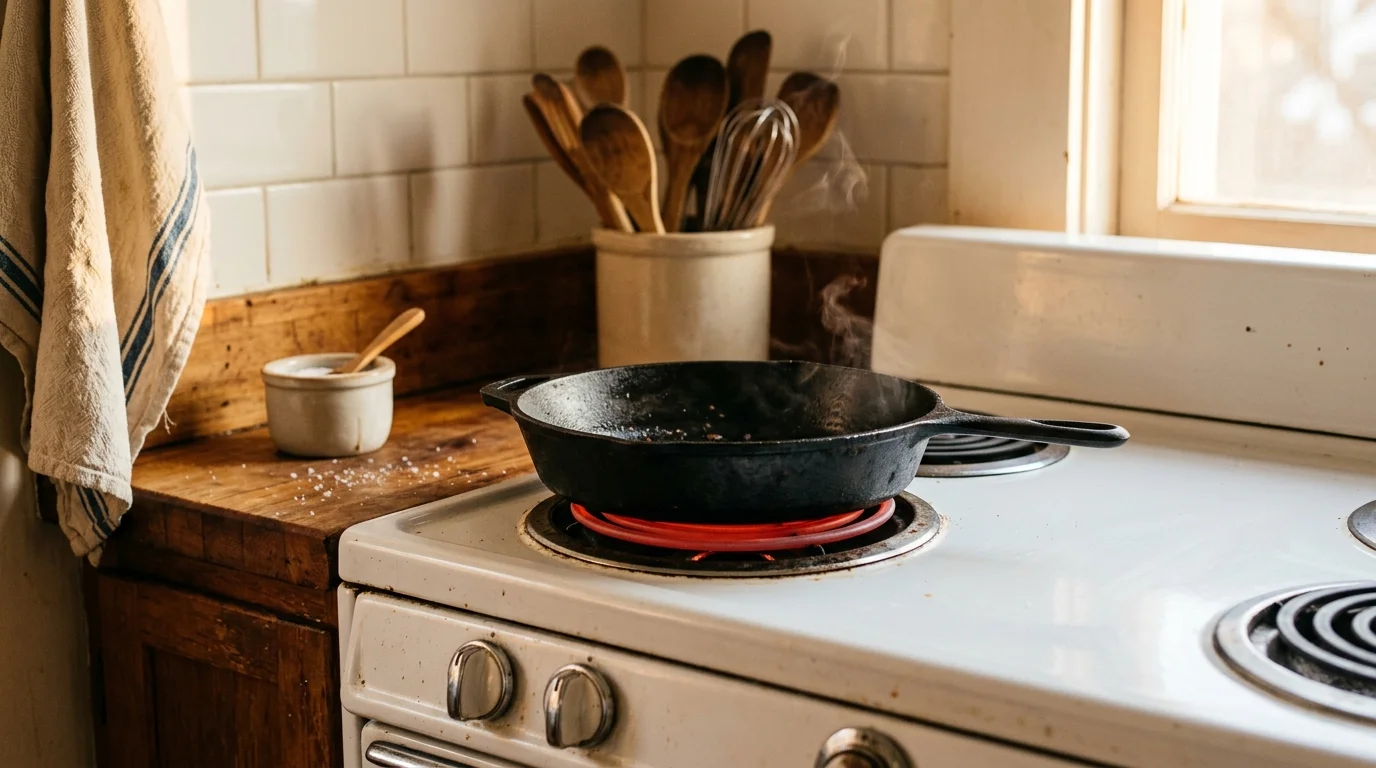
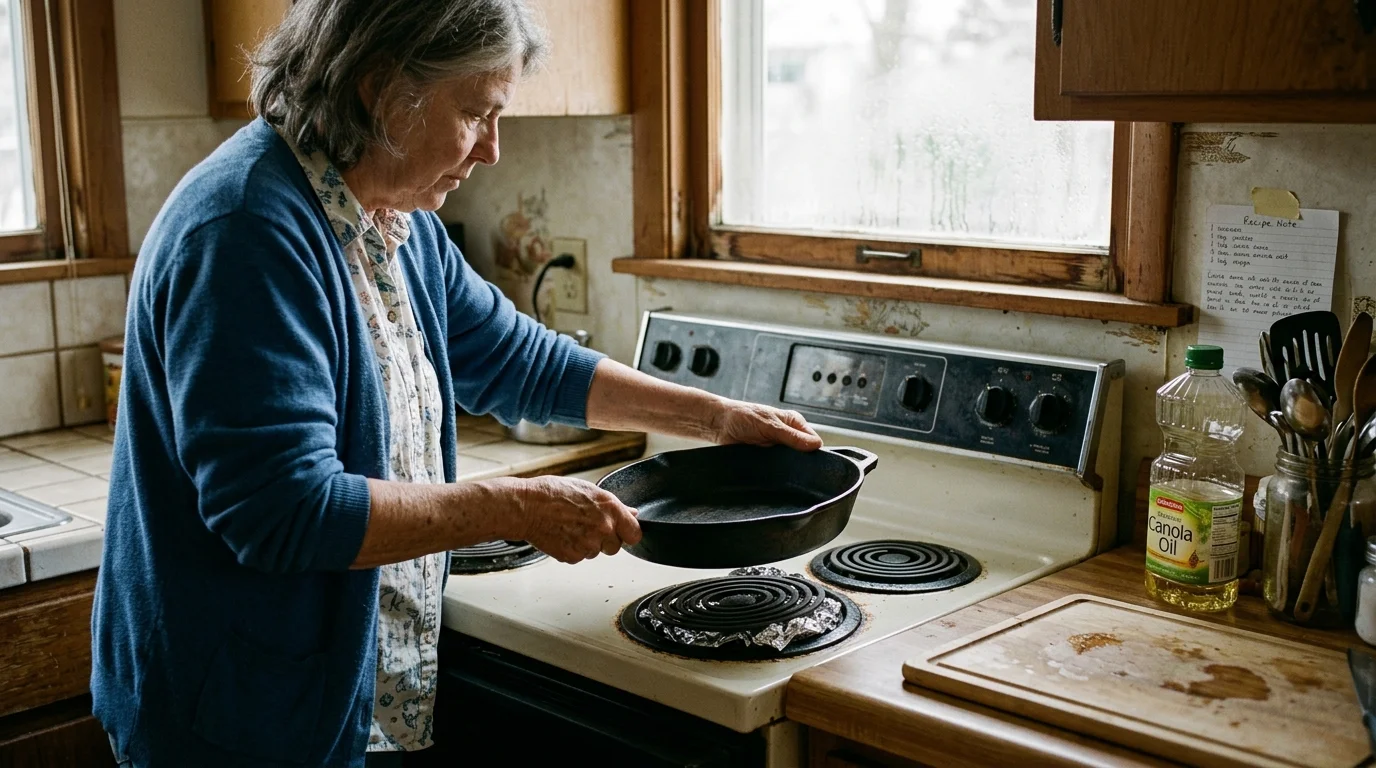
When your electric coil stove tilts at a slight angle, cooking oil pools to one side of pan surfaces. This sloped surface starves half your food of cooking fat while scorching the dry metal.
For home cooks learning how to build a cookware set on a budget, investing in one or two heavy-gauge foundational pans resolves chronic stove leveling issues before buying full sets.
Lightweight cookware amplifies this issue because it lacks the downward mass required to settle loose coil brackets. You end up with uneven searing and frustrating hotspots on basic weeknight meals.
Choosing heavy-base skillets with wide base diameters mechanically forces burner support rings into alignment while distributing thermal energy laterally to eliminate dry hot spots.
The Physics of Tilted Electric Coils and Oil Pooling
Standard electric coil ranges rely on stamped sheet-metal drip pans and three-point support brackets. Over time, heat cycles warp these brackets, causing individual burners to sag at a three-to-five-degree pitch.
This slope is particularly troublesome when using wide griddle pans for breakfast cooking, where runny pancake batter or eggs immediately migrate toward the downward rim.
Unlike smooth glass cooktops where cooks must seek out cookware base finishes that won’t scratch ceramic surfaces, coil elements tolerate heavy textures but present persistent leveling headaches.
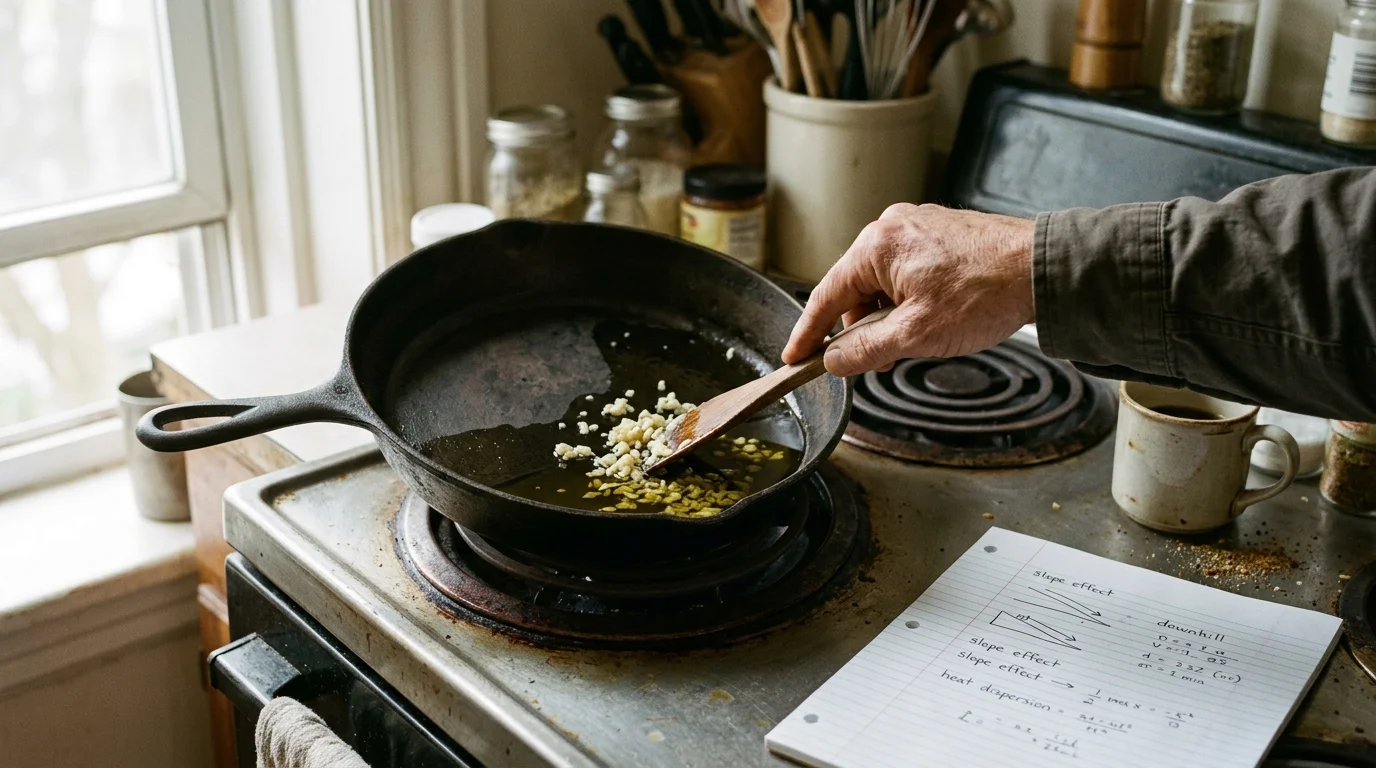
When you pour cooking oil into a heated pan resting on an inclined coil, gravity pulls the liquid to the lowest perimeter. This uneven pooling leaves the uphill cooking surface completely bare.
Without oil to facilitate thermal conduction, food resting on the upper zone cooks via direct, dry metal contact. Meanwhile, the lower zone acts as a shallow fryer, creating wildly inconsistent texture.
Finding the best frying pan for coil burners requires understanding how physical cookware mass interacts with this structural stove flaw. The right pan actively counteracts burner tilt through gravitational force.
Pan Base Diameter and Burner Bracket Mechanics
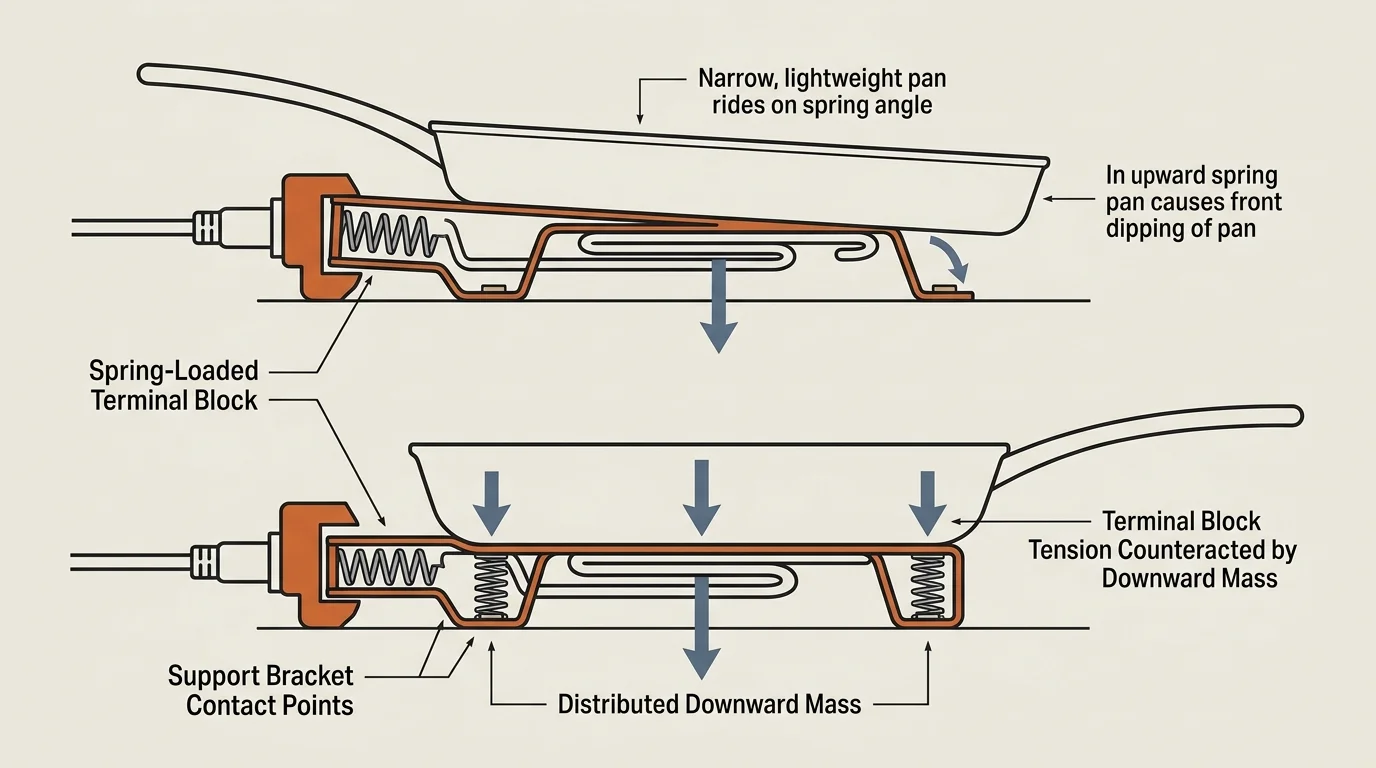
Burner coils plug into a spring-loaded terminal block that naturally pushes the rear element upward. This tension causes the front edge of the element to dip into the burner bowl.
In contrast, narrow vessels like the best saucepans for everyday cooking concentrate their weight across fewer coil rings and require careful centering to avoid tipping.
Similar bracket stability issues occur with curved cookware, making the right wok for electric stoves essential to maintain balanced contact across uneven burner rings.
A lightweight skillet weighing under two pounds cannot overcome this spring tension. The pan simply rides the slope, exaggerating the angle and sending your cooking fats rushing to the rim.
“A heavy pan acts like a mechanical clamp on tilted burner coils; mass provides stability that thin pans cannot match.”
A heavy pan compresses the internal bracket springs, forcing the coil flat against its support points. Heavy cookware for uneven coil stove setups relies on gravity to mechanically stabilize the burner.
Base diameter plays an equally critical role in mechanical stabilization. If your skillet base matches or slightly exceeds the outer coil ring, it bridges the high and low support arms evenly.
Electric coil stove flat pans with wide footprints distribute downward force across all three support points. This balanced weight distribution prevents localized dipping and stabilizes your entire cooking surface.
Material Science: Heat Distribution Across Elevated Zones
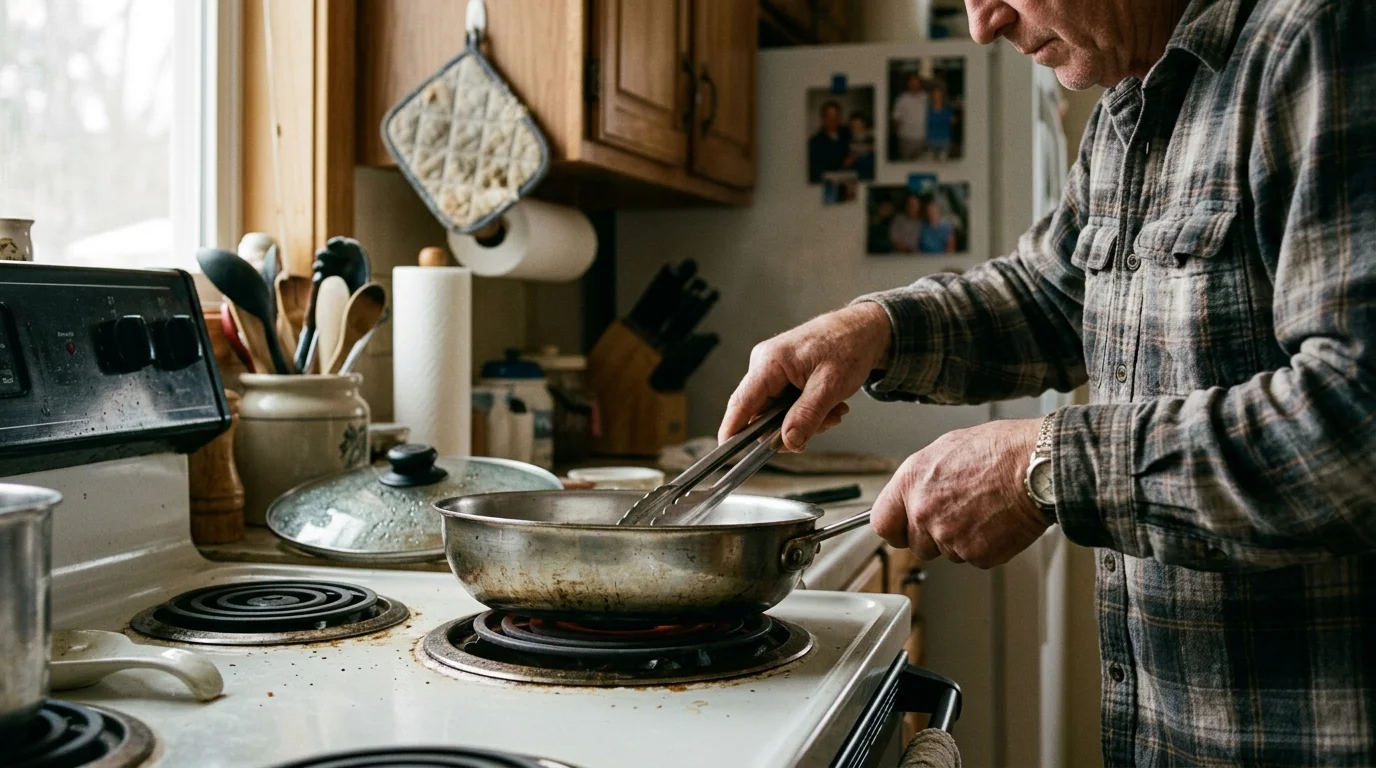
On a tilted burner, air gaps form between the coil element and the elevated side of your pan. These air gaps drastically reduce conductive heat transfer to the raised portion of the base.
The interplay between pan weight and heat retention also influences the tradeoffs between carbon steel and cast iron for apartment burners, where uneven elements demand heavier metal to buffer heat swings.
While many cooks consider carbon steel pans as a cast iron alternative, lighter gauges can lack the rigid downward mass required to settle loose coil brackets.
Cookware performance under these conditions depends directly on heat distribution, which describes how evenly the pan spreads heat across its surface. High thermal conductivity pulls heat laterally across metal.
Aluminum delivers exceptional heat conduction, transferring thermal energy roughly four times faster than cast iron. It pulls heat from the contact zone and spreads it across dry, elevated edges.
Manufacturers often use tri-ply construction, meaning three layers of metal bonded together for better heat distribution. A thick aluminum core sandwiched between stainless steel creates rapid lateral conduction.
Base thickness is measured by gauge, where gauge refers to the thickness of the metal, where lower numbers mean thicker (and usually better) metal. A thick 8-gauge aluminum base resists warping entirely.
According to testing from America’s Test Kitchen, heavy multi-clad bases prevent thermal shock and maintain structural flatness across uneven heating elements.
Cast iron cookware stores massive thermal energy rather than moving it quickly. A skillet that is seasoned, referring to a protective coating built up on cast iron through oil and heat, retains heat steadily.
Once you fully preheat cast iron, its thermal reservoir radiates energy consistently across dry patches. That stored mass ensures food sears properly even where the burner coil fails to make direct contact.
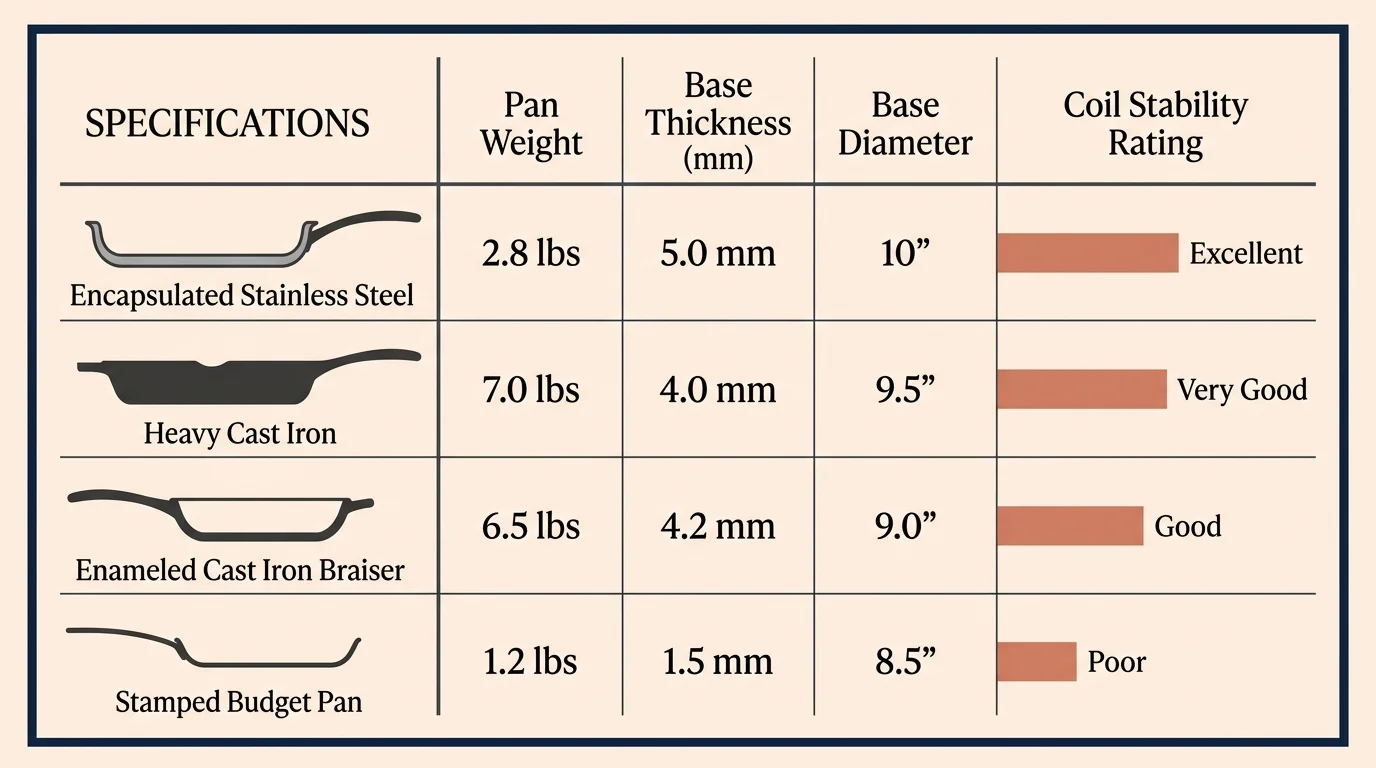
Heavy-Base Skillet Specifications Comparison
Selecting cookware for tilted burners requires evaluating specific mechanical attributes. The following table compares heavy-base models based on weight, base thickness, and thermal properties.
Similar mass principles apply when choosing affordable enameled Dutch ovens, where sufficient base thickness is necessary to disperse concentrated heat from coil elements.
| Skillet Model | Base Construction | Base Thickness / Gauge | Total Weight | Usable Cooking Diameter |
|---|---|---|---|---|
| Lodge 10.25-Inch Cast Iron Skillet | Solid Cast Iron | 4.5 mm (approx. 7-gauge) | 5.4 lbs | 8.25 inches |
| Demeyere Proline 11-Inch Skillet | 7-Ply Fully Clad Stainless | 4.8 mm (commercial heavy) | 5.1 lbs | 8.80 inches |
| All-Clad D3 12-Inch Fry Pan | Tri-Ply Stainless / Aluminum | 2.6 mm (approx. 10-gauge) | 2.8 lbs | 9.50 inches |
| Tramontina Professional 10-Inch | Commercial Stamped Aluminum | 4.0 mm (8-gauge) | 2.2 lbs | 7.75 inches |
| Cuisinart MultiClad Pro 12-Inch | Tri-Ply Stainless / Aluminum | 2.8 mm (approx. 9-gauge) | 3.1 lbs | 9.25 inches |
Heavy models over four pounds provide the downward force needed to level tilted burners. Thinner pans under 2.5 pounds conduct heat well, but they require manual leveling adjustments to prevent oil pooling.
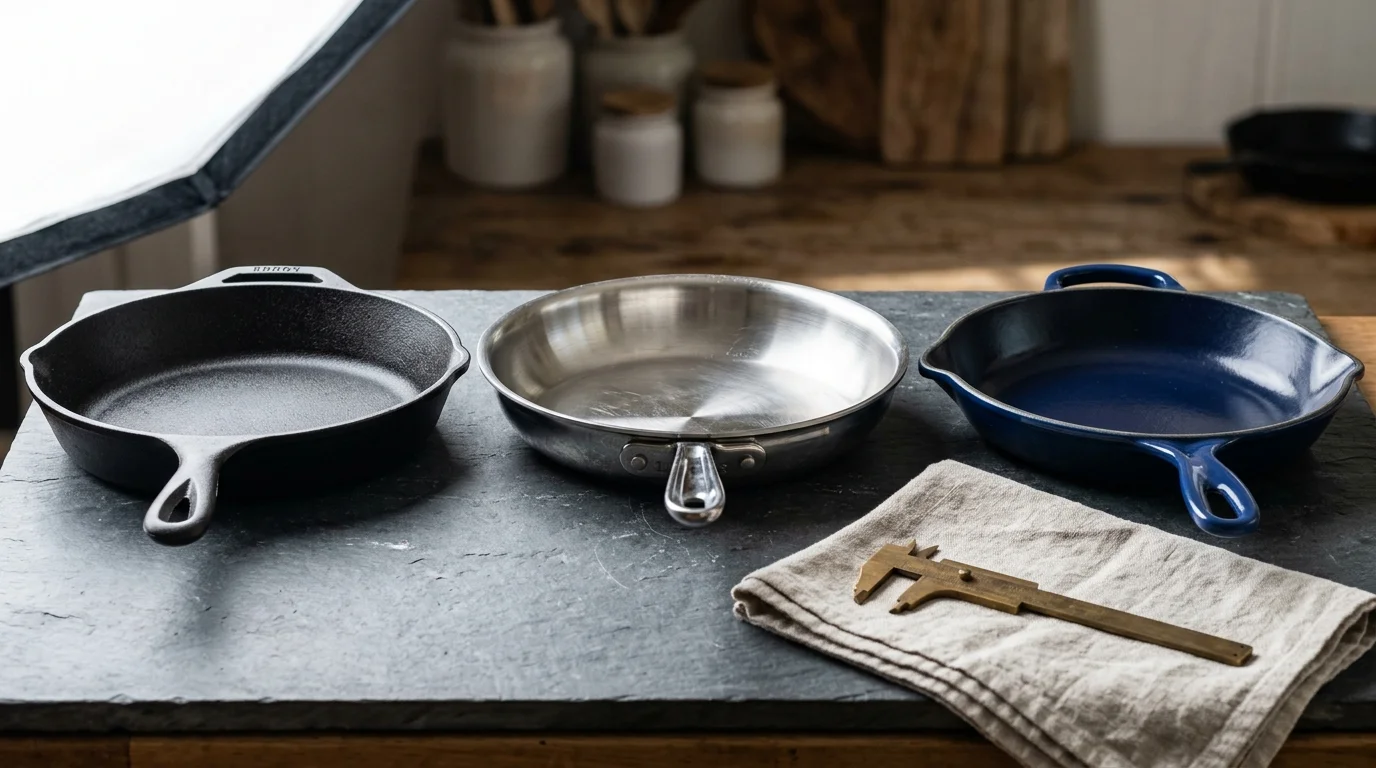
Top Heavy-Base Skillets Engineered for Uneven Coil Burners
The Lodge 10.25-Inch Cast Iron Skillet is our top recommendation for tilted coil stoves. Weighing 5.4 pounds, its substantial mass physically forces misaligned burner rings downward into horizontal alignment.
This pan is oven-safe, meaning it can go from stovetop to oven without damage (check max temperature), handling over 500°F easily. Its dense base eliminates localized cool spots once preheated.
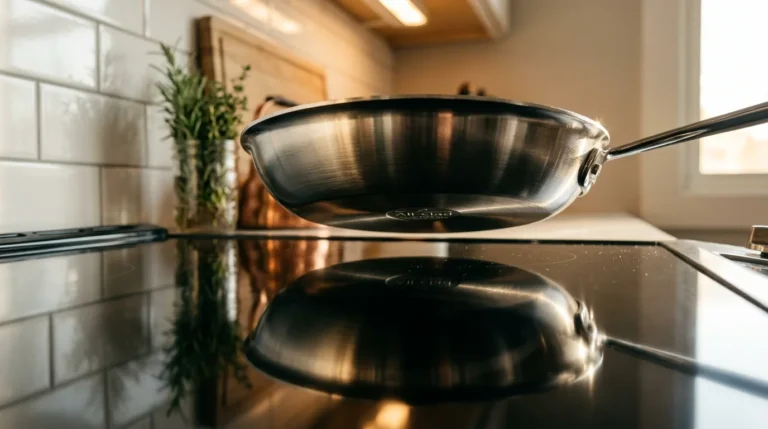
For cooks who prefer stainless steel, the Demeyere Proline 11-Inch 7-Ply Skillet delivers unmatched commercial performance. Its 4.8-millimeter base combines aluminum and alloy layers for instantaneous heat distribution.
The Demeyere pan is also induction compatible, which means it works on induction cooktops (requires magnetic material) if you upgrade later. Its sheer weight levels burner brackets as effectively as cast iron.
If you want everyday responsiveness, consider the All-Clad D3 12-Inch Fry Pan. In extensive evaluations conducted by Wirecutter, tri-ply stainless steel skillets balanced responsive heating with exceptional base flatness.
The D3 model features a wide 9.5-inch cooking surface that spans entire eight-inch coil burners. Its balanced profile prevents hot spots while resisting base curvature over years of high-heat cooking.
For delicate foods like omelets, choose the Tramontina Professional 10-Inch Restaurant Fry Pan. It utilizes PTFE, the chemical name for Teflon-style non-stick coatings, over heavy 8-gauge cold-forged aluminum.
Unlike thin non-stick pans that warp on uneven coils, this commercial vessel stays flat. Its thick aluminum substrate conducts heat laterally, keeping the non-stick surface uniform across slopes.
If you prefer nontoxic minerals, select a pan with a ceramic coating, which is a newer non-stick surface made from silica. Look for heavy hard-anodized bases to maintain necessary burner contact.
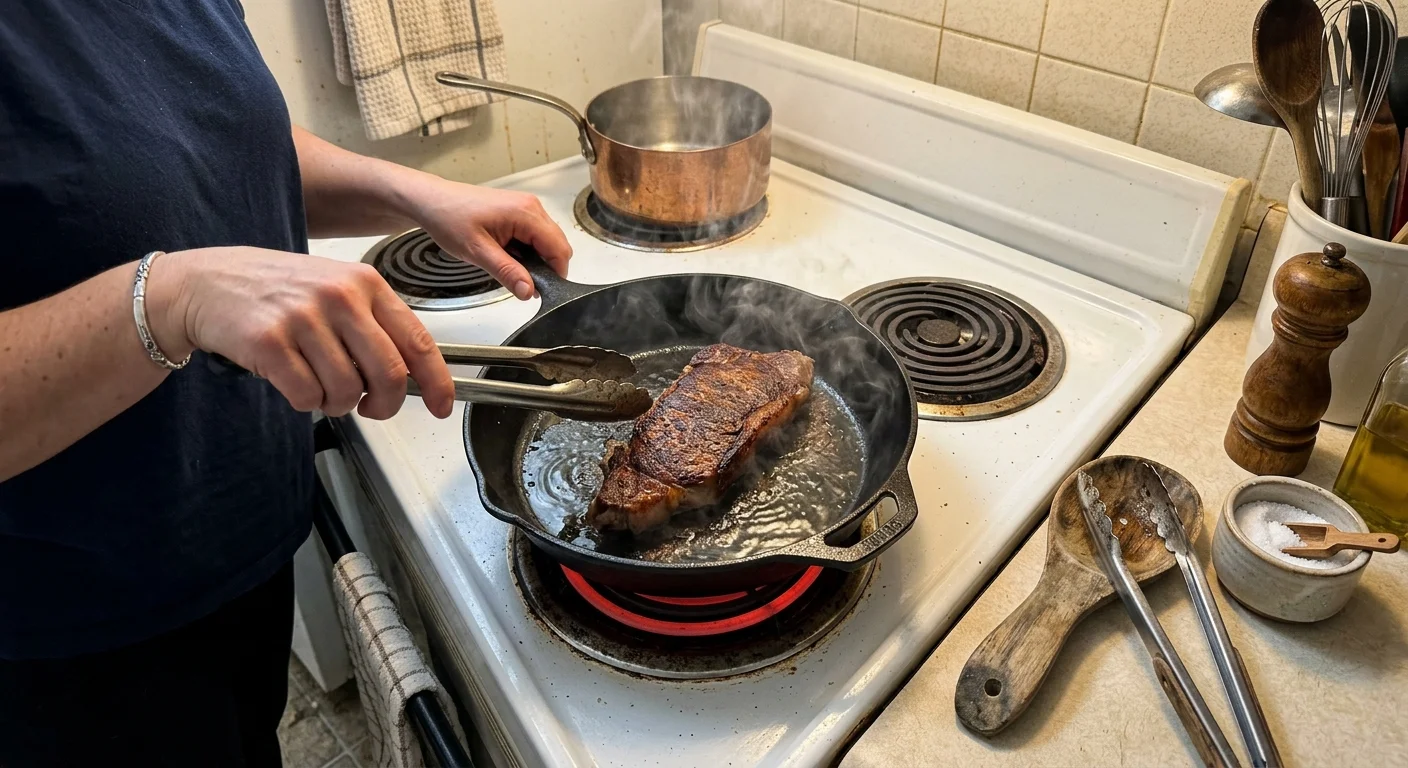
Worked Example: Sealing Heat and Searing Steak on an Incline
Consider a standard apartment kitchen with an eight-inch, 2,100-watt electric coil tilted at a four-degree angle. In this scenario, we sear a 12-ounce New York strip steak measuring 1.25 inches thick.
While raised ridges in grill pans for indoor grilling can keep meats elevated above pooling fats, achieving a uniform flat sear on an inclined burner requires heavy cast-iron contact.
Proper preheating protocols are also critical to prevent food from sticking to stainless steel pans when sloped oil coverage starves upper cooking surfaces.
Using a standard 1.5-pound thin skillet, one tablespoon (15 ml) of avocado oil immediately runs to the bottom edge. When the steak hits the pan, the uphill half sticks to dry metal.
The dry upper surface registers 475°F from unbuffered radiant heat, causing scorch marks. Meanwhile, the pooled lower side drops to 320°F, boiling the meat rather than developing a crisp crust.
“Base thickness dictates whether an inclined pan sears food evenly or chars the dry uphill zone.”
Now consider the same scenario using a 5.4-pound Lodge cast iron skillet. The pan’s downward gravitational force compresses the burner’s rear spring bracket, reducing the tilt angle from four degrees to one degree.
We preheat the skillet on burner dial setting 5 (medium heat) for precisely six minutes. Infrared temperature measurements confirm 425°F on the contact side and 418°F on the elevated side.
Adding one tablespoon of avocado oil forms a stable, uniform film across the entire base. The residual one-degree slope is insufficient to overcome the surface tension of the heated cooking oil.
We lay the $14.50 steak down for 2.5 minutes per side. The uniform thermal distribution yields edge-to-edge Maillard browning across the entire crust, finishing at a perfect 130°F internal temperature.
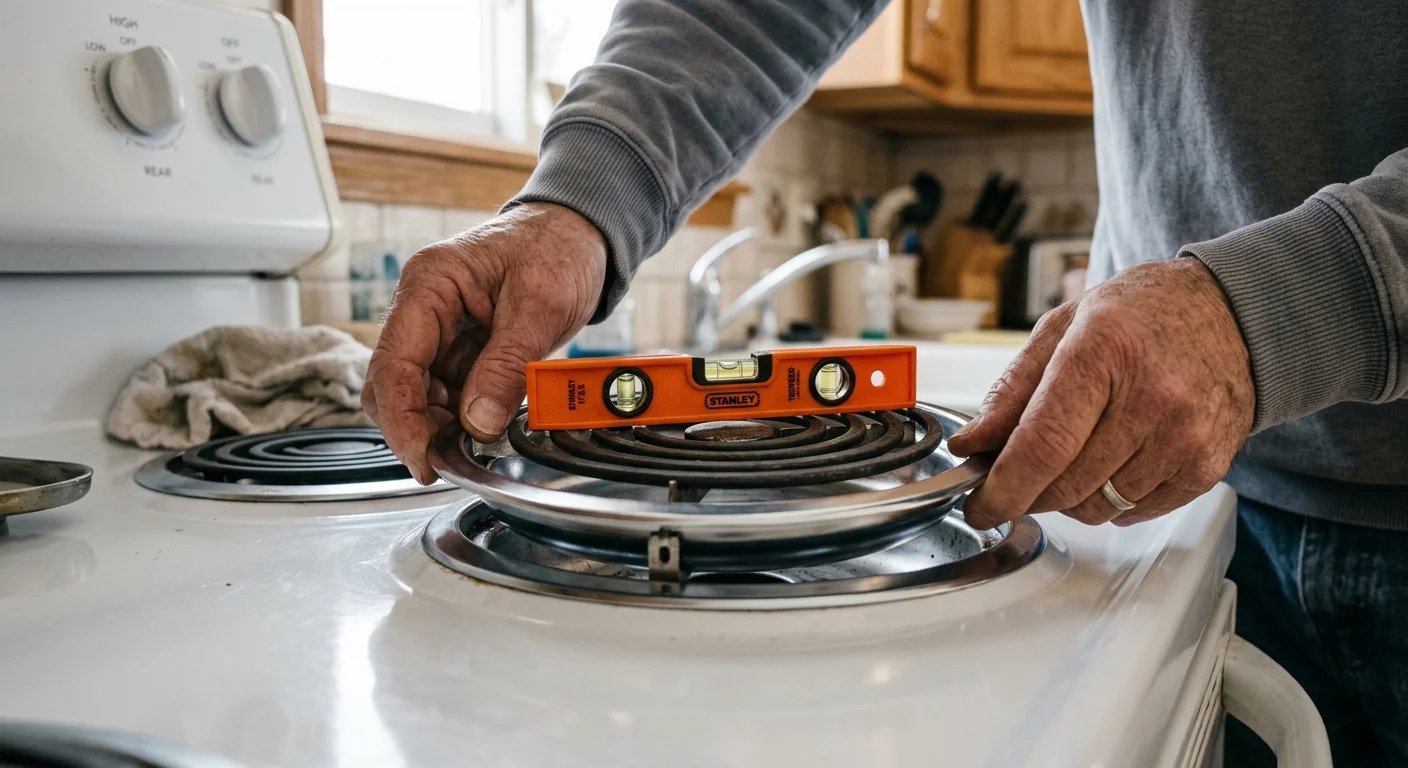
Leveling Coil Burners and Preventing Pan Warping
While heavy pans compress loose burner springs, inspecting your stove hardware improves cooking results. Begin by lifting the cold coil element out of its terminal receptacle.
Examine the chrome or porcelain drip pan beneath the element. These bowls feature specific locator notches designed to seat the three radiating support arms of the coil bracket.
If previous cleaning left the drip pan rotated improperly, the bracket arms ride on the bowl rim. Aligning each support arm inside its designated notch immediately eliminates several degrees of tilt.
Inspect the terminal block bracket beneath your stovetop. If the mounting screws worked loose over time, tightening them with a standard screwdriver levels the plug connection instantly.
Thermal management is equally crucial for preserving flat cookware bases. Never immerse a hot heavy-base skillet into cold sink water; extreme temperature shifts cause instant thermal shock.
According to assessments from Consumer Reports, warped pan bases remain the primary cause of uneven browning and irregular oil pooling on electric ranges.
Common Cookware Myths on Electric Coil Ranges
Many cooks assume cast iron heats completely evenly across any heat source. In reality, cast iron is a relatively poor conductor of heat that creates distinct hot spots if heated too quickly.
On an uneven coil, cast iron succeeds not through rapid heat flow, but through massive thermal storage. You must allow at least five to eight minutes of preheating to saturate the metal.
As equipment analyses from Serious Eats demonstrate, thermal mass retains heat significantly better than thin stamped metal during protein contact.
Another persistent myth claims thin non-stick pans save energy on electric coils. Thin pans actually waste energy because their bases warp upward, creating air pockets that block heat flow.
Some cooks believe you can fix a warped pan by hammering the base back to flat. Hammering clad cookware fractures the internal aluminum core and permanently destroys heat transfer capabilities.
Finally, swirling oil continuously will not solve burner tilt. The moment your spatula touches the food, oil drains back to the low side, leaving your protein to stick on the dry metal.
Frequently Asked Questions
Why does cooking oil pool to one side of my frying pan?
Cooking oil pools because electric coil burners tilt when internal support brackets warp or sit improperly inside drip pan notches. Gravity pulls liquid fat to the lowest edge of the tilted cooking surface.
Can heavy cookware damage electric stove coils?
No, standard electric coil burners easily support heavy cast iron and multi-clad skillets. The downward mass compresses loose spring brackets and stabilizes the cooking plane without harming internal heating wires.
How thick should a skillet base be for an electric coil stove?
Choose pans with bases measuring at least 3.0 to 4.8 millimeters thick (8-gauge to 10-gauge). Thick bases resist thermal warping and conduct heat laterally across uneven burner contact points.
Does tri-ply stainless steel work better than cast iron on tilted burners?
Tri-ply stainless steel conducts heat laterally faster than cast iron, spreading warmth across elevated zones. However, cast iron provides greater downward weight to mechanically level loose burner brackets.
Disclaimer: Product prices and availability change frequently. Prices shown were accurate at time of writing but may have changed. We may earn a small commission from purchases made through links on this site, at no extra cost to you. Always verify current pricing on the retailer’s website before purchasing.
1 Comment