
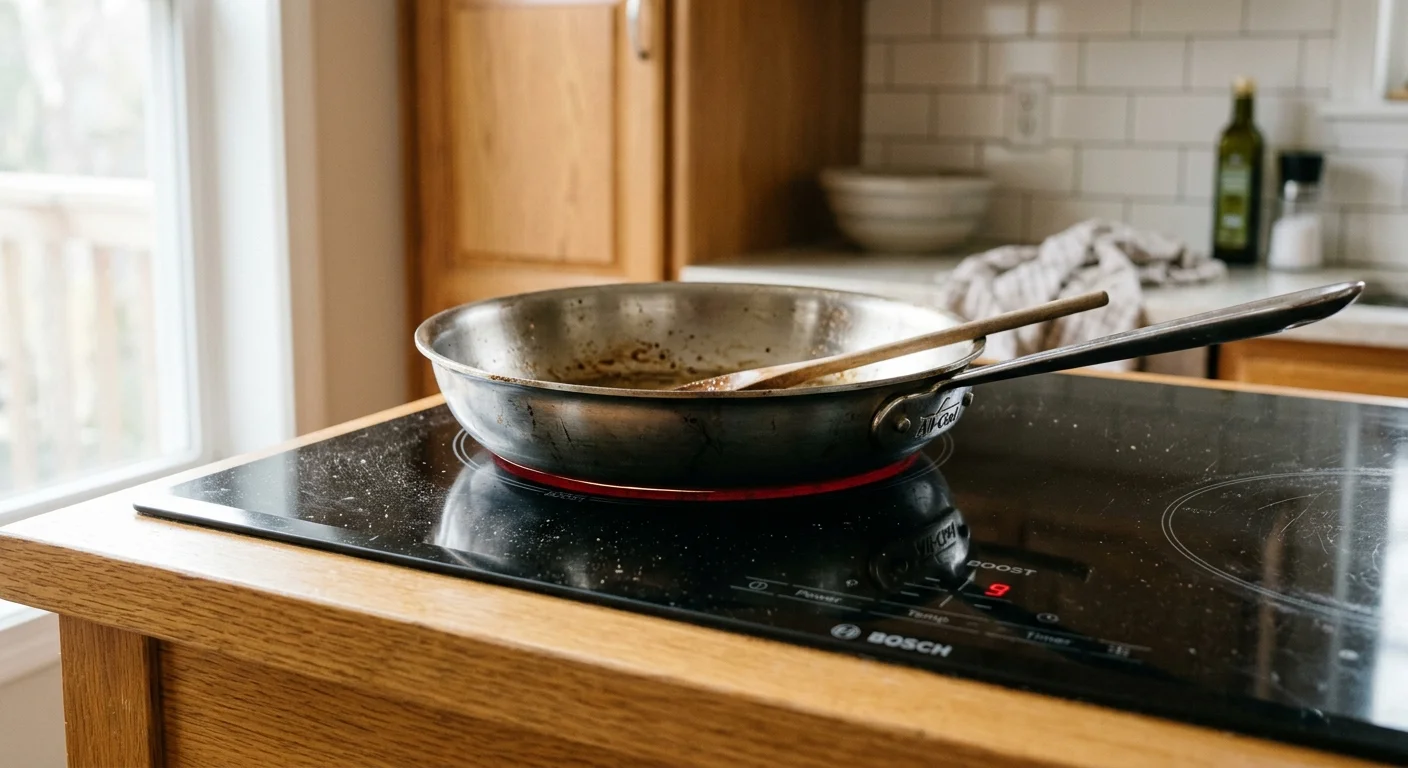
If your portable induction cooktop clicks off mid-sear on your apartment laminate counter, faulty electronics rarely cause the shutdown. Most induction hobs shut off because cookware base deflection exceeding 1.5 millimeters breaks the magnetic coupling loop.
Home cooks troubleshooting burner compatibility should also weigh ceramic cookware benefits and drawbacks to see how coated aluminum pans withstand rapid thermal cycling.
When a pan bottom lifts away from the ceramic glass, the pan-detection sensor detects zero electrical load. The unit rapidly clicks its internal mechanical relay off to prevent the induction coil from overheating.
You can stop this nuisance cycling by auditing cookware base thickness, measuring concave deflection, and stabilizing countertop flex before spending money on replacement pans.
The Physics Behind the Click: Magnetic Coupling and Safety Cutoffs
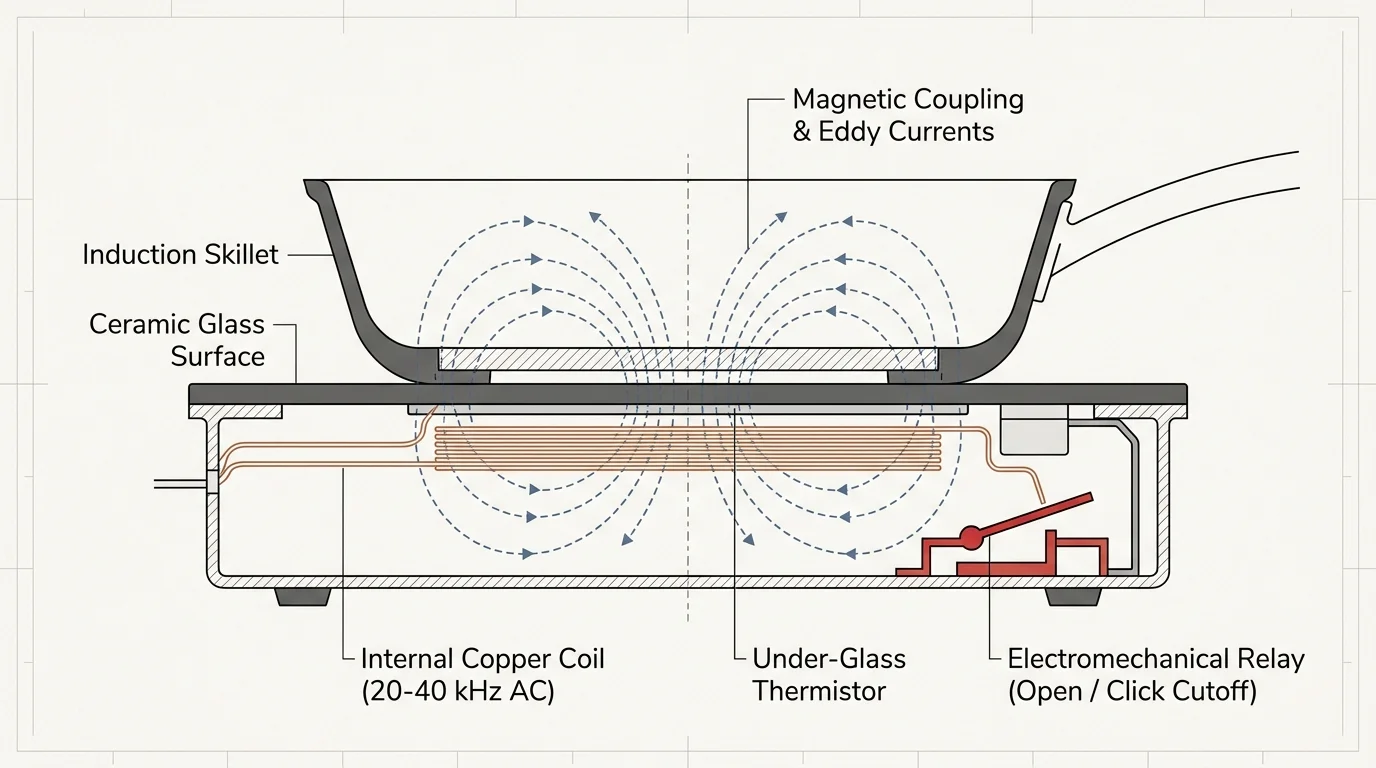
Induction burners rely on high-frequency electromagnetic fields rather than radiant electric coils or gas flames. An internal copper coil sends an alternating current into your cookware base at frequencies between 20 and 40 kilohertz.
If your hob continues shutting down even under flat cookware, learning how to repair common small appliance problems can help you identify blocked cooling fans or faulty internal thermistors.
This oscillation creates eddy currents inside cookware that is induction compatible; this term means the pan contains ferromagnetic metal that reacts directly to magnetic fields. The pan’s electrical resistance converts these currents directly into thermal energy.
The audible clicking you hear comes from a physical electromechanical relay on the burner’s power supply board. Cooktops use this relay to cycle power when the control board senses an abnormal operating condition.
Portable induction units mount a surface temperature thermistor directly against the underside of the ceramic glass surface. If your cookware base lifts off that glass, the burner loses thermal feedback and magnetic resistance.
According to Consumer Reports’ cookware evaluations, rapid heat production stops the instant magnetic contact breaks. The burner’s microcontroller interprets the sudden inductance drop as an absent vessel and trips the relay to protect the internal inverter.
“An induction cooktop does not heat the air. When base warping breaks physical contact, the unit detects open circuit resistance and kills power within seconds.”
The 1.5-Millimeter Rule: Concave Base Deflection Thresholds
Cookware bases do not expand uniformly when exposed to rapid temperature changes. The center of a thin skillet naturally crowns upward or sags downward as thermal expansion stresses the metal crystal lattice.
Vessels with extreme curvature suffer the same coupling dropouts, which is why choosing the best wok for electric stoves requires verifying a wide, flat bottom profile.
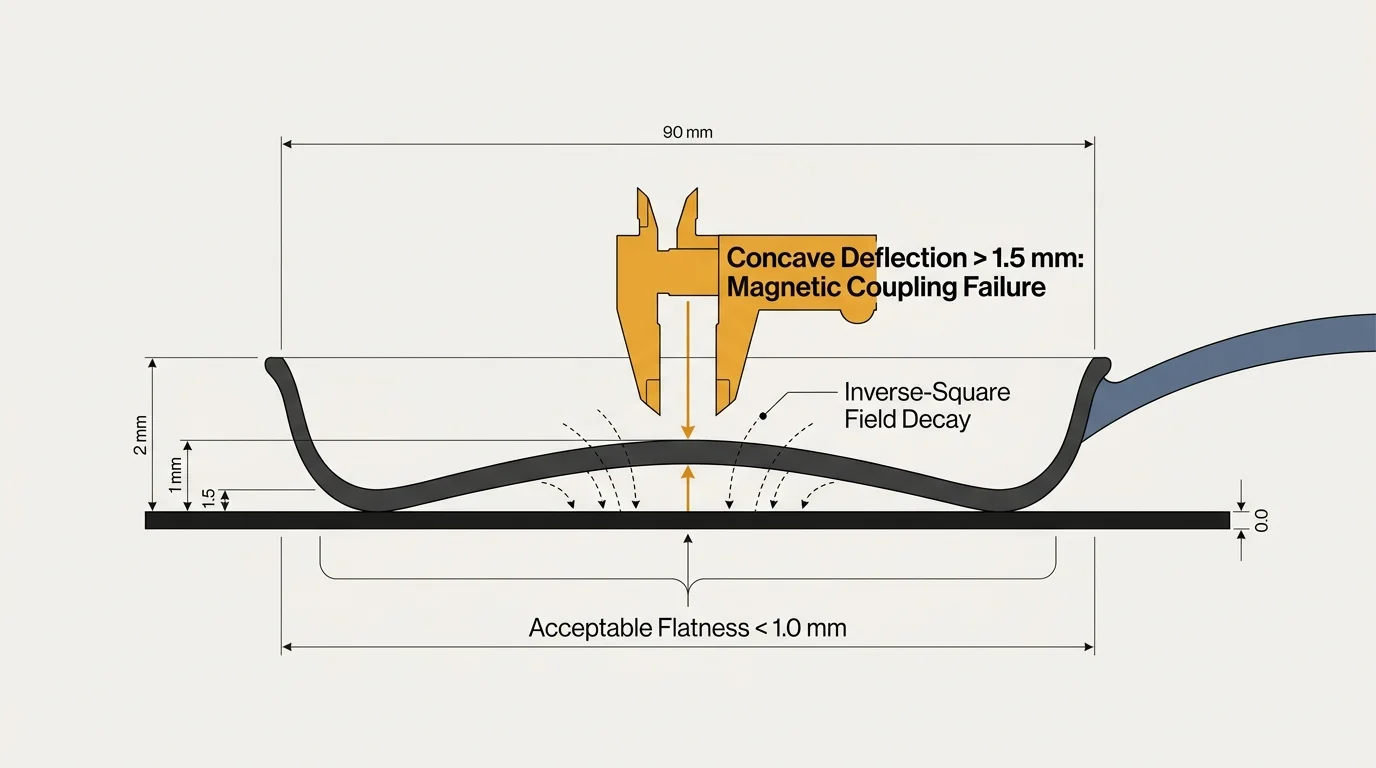
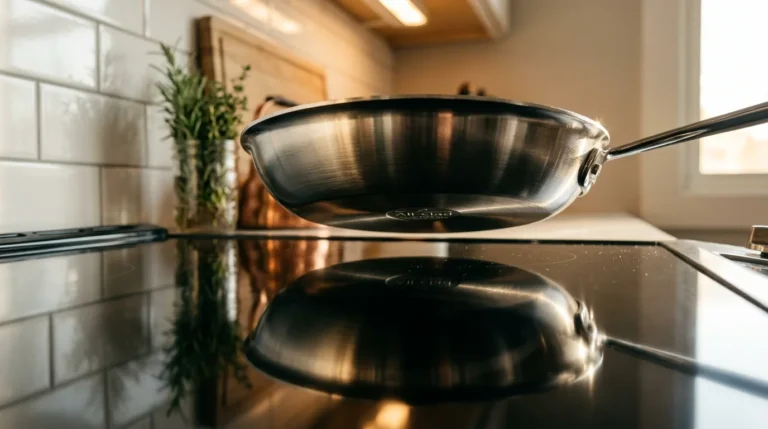
A pan with an induction pan warped base produces a concave air gap in the center of the cooking zone. When this concave deflection exceeds 1.5 millimeters, standard portable induction hobs fail to sustain electromagnetic coupling.
Magnetic field strength decays rapidly as distance increases; it obeys an inverse-square relationship relative to coil distance. Even an air gap of 2 millimeters slashes field strength by more than 50 percent at the pan center.
Without sufficient pan contact induction hob sensors cannot register the minimum eddy current drag required to complete the power circuit. The burner attempts to pulse current into the gap, discovers no magnetic load, and shuts off.
Most manufacturers deliberately engineer a tiny concave bow—usually under 0.5 millimeters—into raw pans during factory stamping. This intentional curve guarantees that the base flattens when thermal expansion pushes the metal downward under heat.
If rapid heating warps that curve beyond 1.5 millimeters upward, the pan edge takes all the weight while the center floats. The peripheral contact points overheat, the center remains cold, and the cooktop clicks off repeatedly.
Laminate Countertop Flex: How Uneven Surfaces Compound Pan Warping
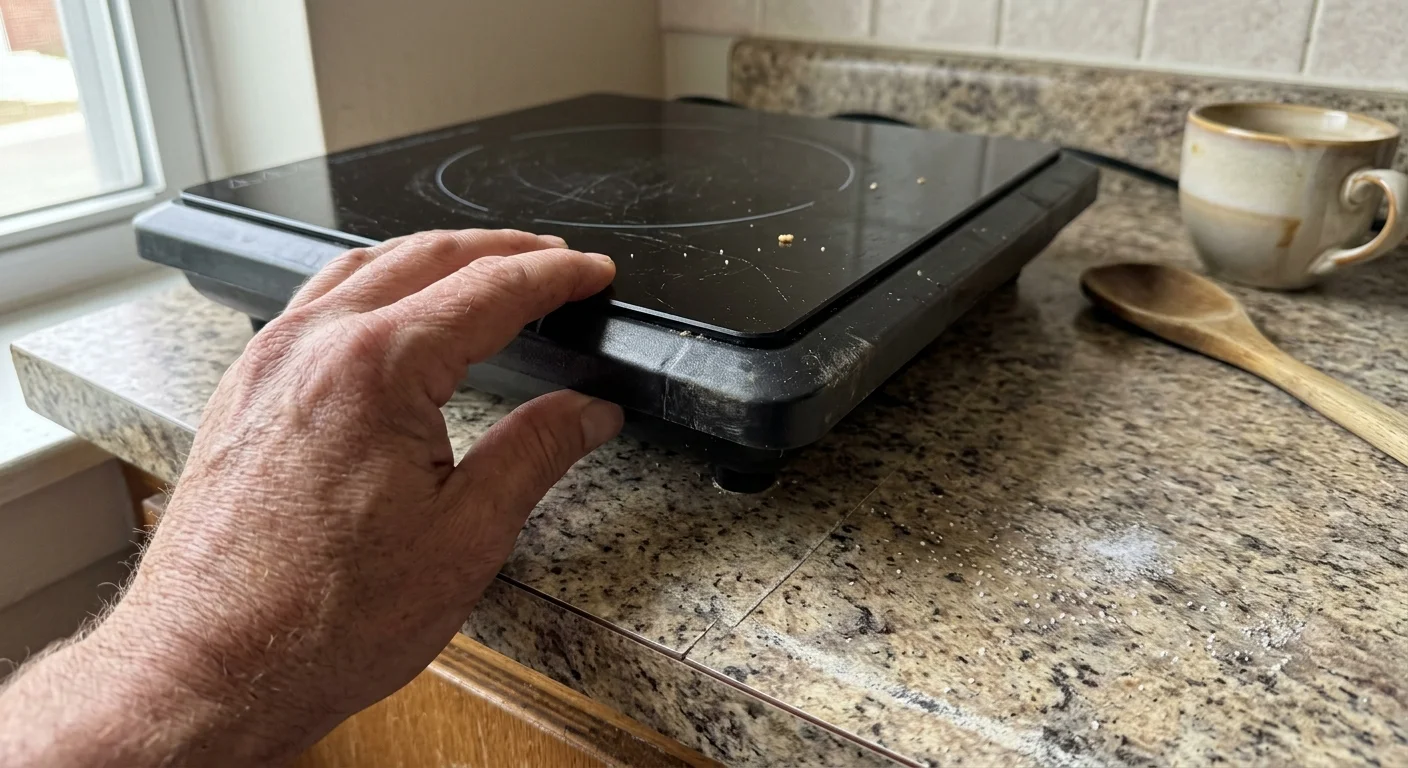
Urban apartment kitchens often feature particle-board laminate counters installed over uneven or settling cabinetry. Humidity, poor structural bracing, and water seepage around drop-in sinks cause these laminate surfaces to sag inward over time.
Evaluating countertop stability and burner clearance is just as critical when comparing electric vs stovetop kettles, griddles, and appliances for small apartments.
Much like using heavy-base skillets on tilted electric coil burners to offset sloping surfaces, choosing structurally rigid pans prevents air gaps caused by flexing counters.
When you place an 8-pound portable burner on a sagging laminate section, the cooktop chassis flexes under the combined load. The burner’s rubber feet settle at mismatched angles, slightly bowing the internal chassis and the top ceramic sheet.
A warped countertop translates directly into a tilted cooking surface. If your pan already carries 1.0 millimeter of upward concave curvature, a 0.5-millimeter chassis sag compounds the physical separation across the burner’s active coil ring.
Portable burners direct cooling airflow underneath their chassis via small high-RPM intake fans. When a flexible countertop blocks or restricts these bottom vent ports, the interior temperatures around the insulated-gate bipolar transistor spike rapidly.
This chassis heat buildup triggers secondary safety relays independently of pan flatness. You can eliminate countertop sag by sliding a rigid half-inch maple cutting board beneath the burner feet to restore an uncompromisingly flat plane.
Base Thickness Metrics: Stamped Aluminum vs. Heavy Tri-Ply
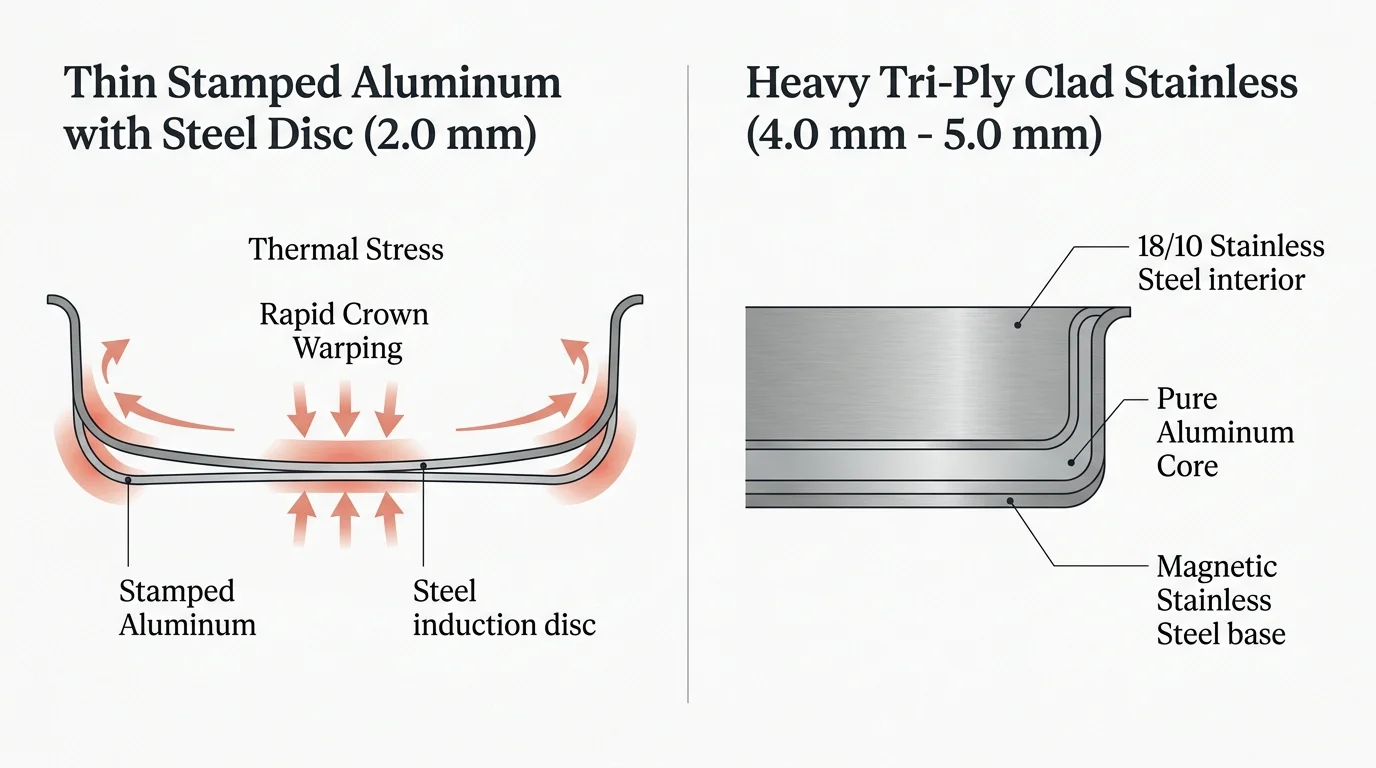
Budget non-stick fry pans generally use stamped aluminum sheets with a thin stamped steel plate attached to the bottom. Aluminum lacks magnetic properties, so manufacturers stamp a 430-grade ferritic stainless steel disc onto the base to ensure magnetic readiness.
Non-magnetic materials require similar engineering workarounds, making base structure a decisive factor when determining whether copper cookware is worth the investment on modern induction hobs.
The overall induction cookware thickness dictates whether that bonded disc stays flat across thermal cycles. Thin stamped aluminum pans measure around 2.0 to 2.5 millimeters in thickness, which equals roughly 12-gauge sheet metal.
Metal gauge describes the thickness of the metal, lower numbers mean thicker (and usually better) structural rigidity. A 10-gauge base measures approximately 3.2 millimeters, while an 8-gauge base provides a rugged 4.1 millimeters of material.
Aluminum expands at 23 micrometers per meter-Kelvin, while stainless steel expands at only 16 micrometers. Because these two metals expand at wildly different rates, intense heat pulls the bonded disc loose and warps the base.
In contrast, tri-ply cookware features three layers of metal bonded together for better heat distribution. The pan sandwiches high-conductivity aluminum between an interior food-grade 304 stainless layer and an exterior magnetic 430 stainless steel floor.
Heat distribution measures how evenly the pan spreads heat across its surface rather than isolating it over burner rings. Fully clad walls prevent the perimeter from staying cold while the center scorches, protecting the base from buckling.
According to Wirecutter’s cookware testing, fully clad multi-ply designs withstand repeated high-heat preheating far better than base-disc bonded alternatives. The bonded sandwich expands as a single structural unit without warping off the glass.
Worked Measurement Scenario: Diagnosing a 1,800-Watt Portable Burner
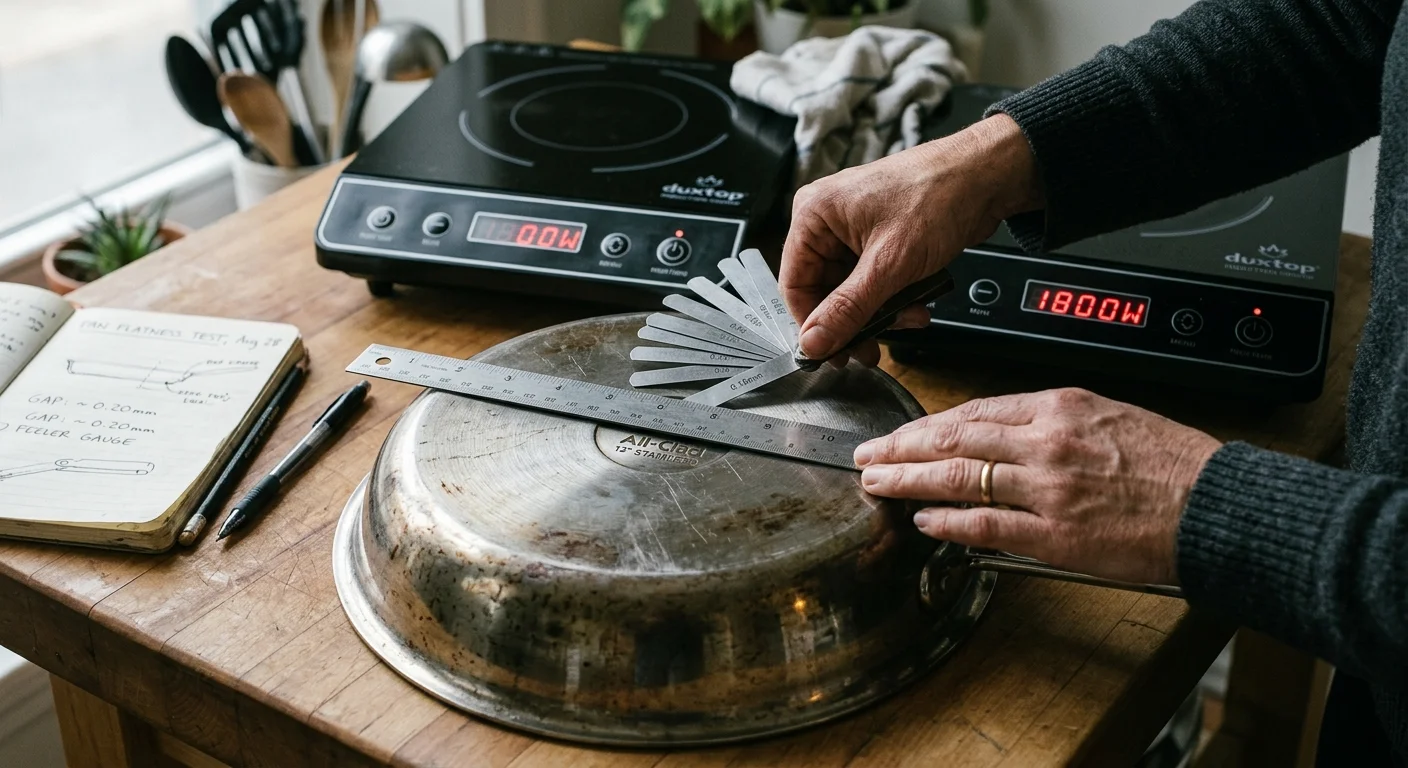
Consider a practical diagnostic scenario in a rental kitchen featuring a 1,800-watt countertop induction burner. The cooktop sits on an unreinforced laminate counter that bows 1.2 millimeters downward across a 24-inch cabinet span.
While switching to thick clad stainless avoids pan base warping, home cooks should practice how to prevent food from sticking to stainless steel pans using proper preheating routines.
You place a 10-inch budget non-stick skillet on the burner to sear a chicken breast. The pan features an aluminum core with a PTFE surface; PTFE is the chemical name for Teflon-style non-stick coatings.
The skillet base measures 2.2 millimeters in total thickness, featuring a stamped 0.5-millimeter magnetic disc on the bottom. You turn the burner to 1,400 watts (medium-high) and let it preheat without cooking oil.
Within 90 seconds, the pan reaches 420 degrees Fahrenheit. The rapid thermal gradient causes the stamped aluminum to push against the rigid steel disc, crowning the pan center upward by 1.8 millimeters.
Add the 0.4-millimeter chassis flex caused by the sagging laminate counter resting beneath the burner’s rubber feet. The central distance between the pan floor and the ceramic glass top now totals 2.2 millimeters.
The cooktop’s induction coil sits recessed 3.5 millimeters below the top surface of the glass plate. The total distance between the copper induction coil and the pan center now reaches 5.7 millimeters.
At 5.7 millimeters of separation, magnetic flux density collapses below the control board’s operational threshold. The burner emits two audible clicks over three seconds, flashes an error code on the LED display, and cuts power.
To verify the mechanical fault, allow the pan to cool to room temperature. Lay an accurate steel machinist straightedge across the center of the pan’s bottom face.
Slide a standard 1.5-millimeter automotive feeler gauge blade under the center of the straightedge. If the blade passes underneath the steel ruler without friction, the pan has permanently deformed past the induction coupling threshold.
Cookware Base Construction Comparison
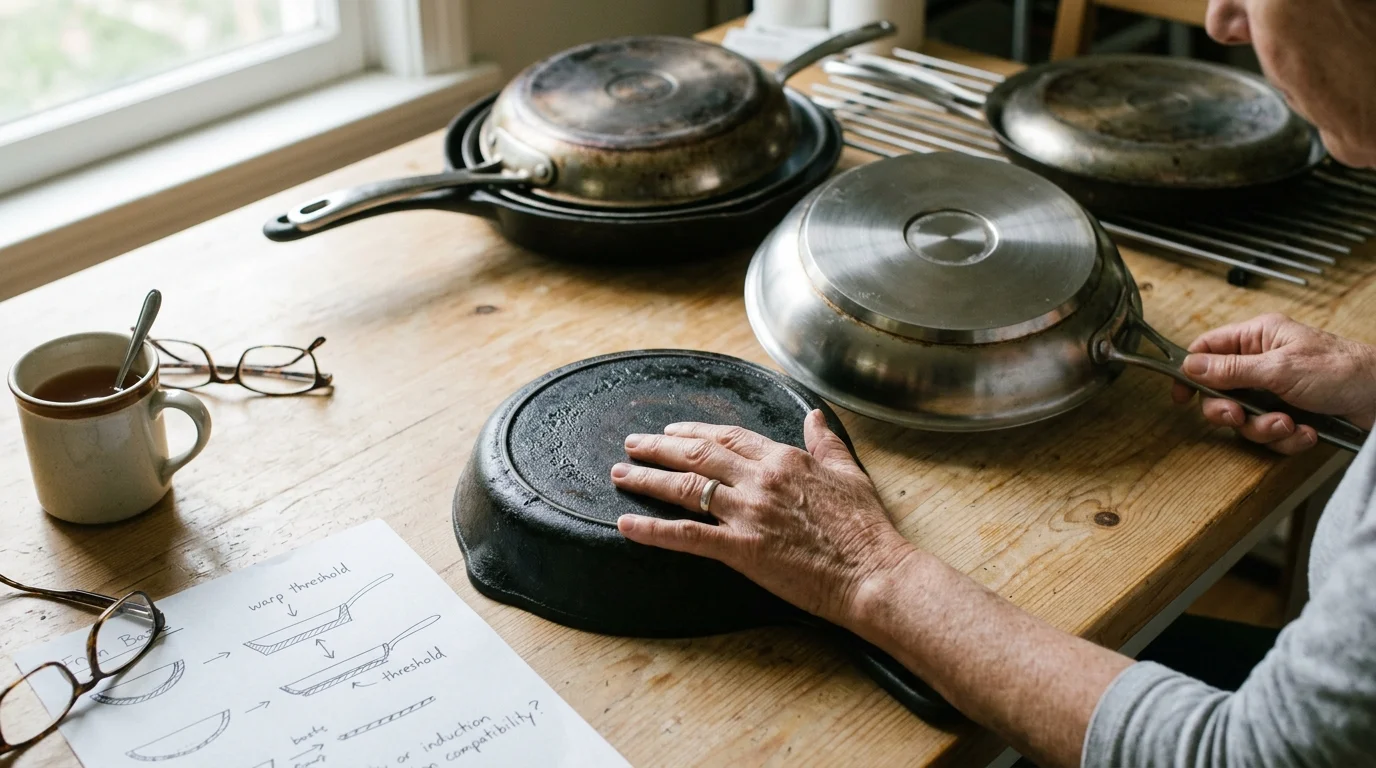
Cookware materials handle induction flux and thermal stress with varying degrees of physical stability. The table below details measured performance attributes across common cookware constructions.
For dependable contact that completely avoids base warping, heavy cast iron vessels such as sub-$80 enameled Dutch ovens maintain a flat magnetic plane under sustained heat.
For home cooks seeking dense, heat-retaining metals without excessive heft, carbon steel pans provide a cast iron alternative that delivers solid magnetic coupling.
| Construction Type | Base Thickness | Coupling Deflection Limit | Thermal Expansion Rate | Induction Coupling Efficiency |
|---|---|---|---|---|
| Stamped Aluminum with Bonded Disc | 2.0 mm – 2.5 mm | 1.2 mm | High (Bimetal shear stress) | 72% – 78% |
| Heavy Cast Aluminum with Ceramic | 4.0 mm – 5.5 mm | 1.8 mm | Moderate (Thick plate stability) | 78% – 82% |
| Tri-Ply Clad Stainless Steel | 2.6 mm – 3.0 mm | 1.5 mm | Low (Uniform expansion) | 84% – 89% |
| 5-Ply Clad Stainless Steel | 3.0 mm – 3.5 mm | 1.6 mm | Very Low (Structural core) | 86% – 91% |
| Heavy Carbon Steel (12-Gauge) | 2.5 mm – 3.0 mm | 1.4 mm | Moderate (Solid ferritic body) | 90% – 94% |
| Enameled Cast Iron | 4.5 mm – 6.0 mm | 2.2 mm | Extremely Low (Dense mass) | 92% – 96% |
As the table demonstrates, heavier constructions offer far greater structural integrity under high heat loads. Thin bonded discs save money on upfront retail prices but fail rapidly once thermal cycling begins.
Recommended Cookware to Prevent Induction Cutouts
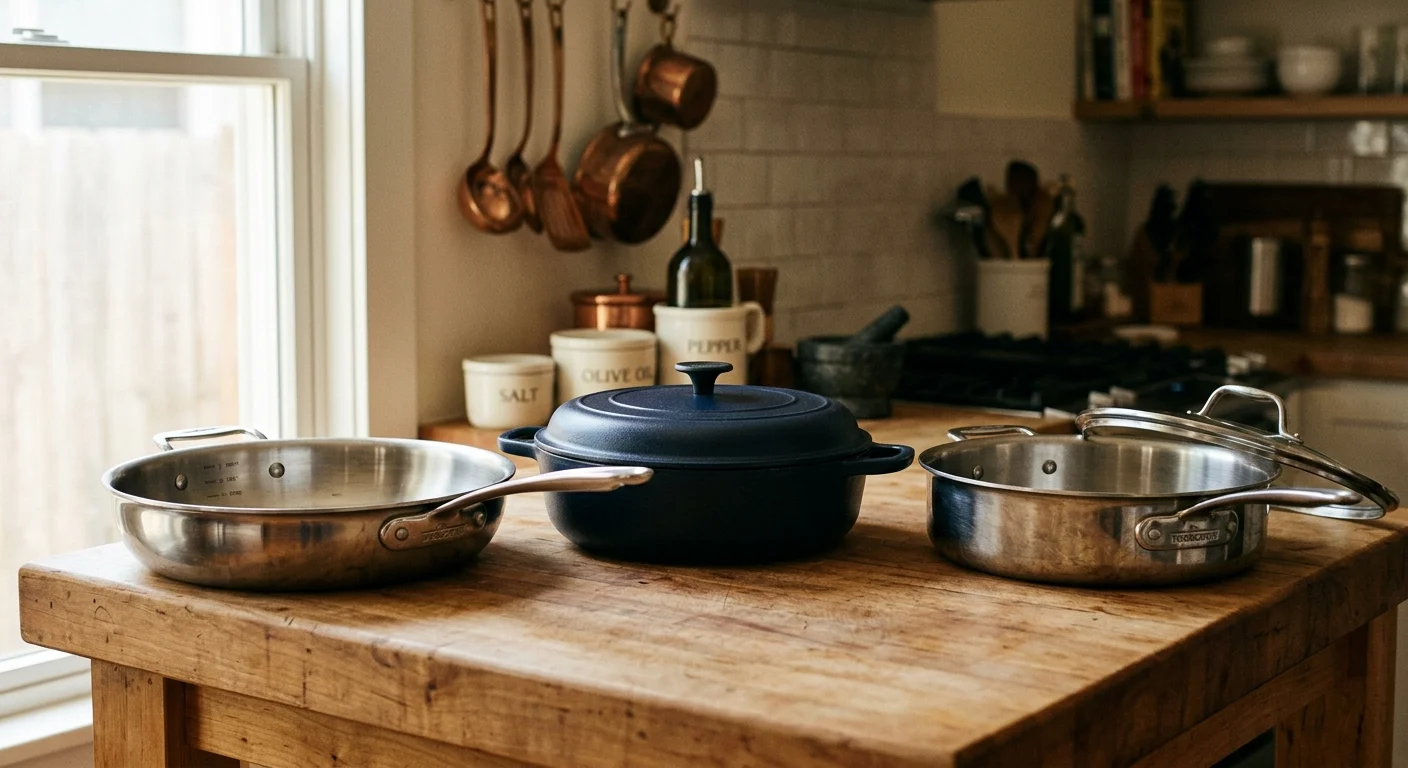
To end continuous burner shutdowns, select pans with robust bases engineered specifically to resist thermal deformation. Here are the three most reliable cookware options for temperamental induction hobs.
Best Everyday Skillet: Cuisinart MultiClad Pro 10-Inch Skillet
The Cuisinart MultiClad Pro features true tri-ply clad construction across the entire body, measuring 2.6 millimeters thick. Its solid magnetic stainless exterior wraps around a pure aluminum core to eliminate disc separation.
This pan stays flat under rapid heat transitions and maintains steady coupling on compact 1,800-watt burners. It is oven-safe up to 500 degrees Fahrenheit, meaning you can transfer it from burner to oven without risk.
Best for High-Heat Searing: Lodge 10.25-Inch Cast Iron Skillet
According to equipment tests from Serious Eats, cast iron provides unmatched thermal retention for searing proteins. The Lodge skillet measures over 4.5 millimeters of pure, dense cast iron across its base.
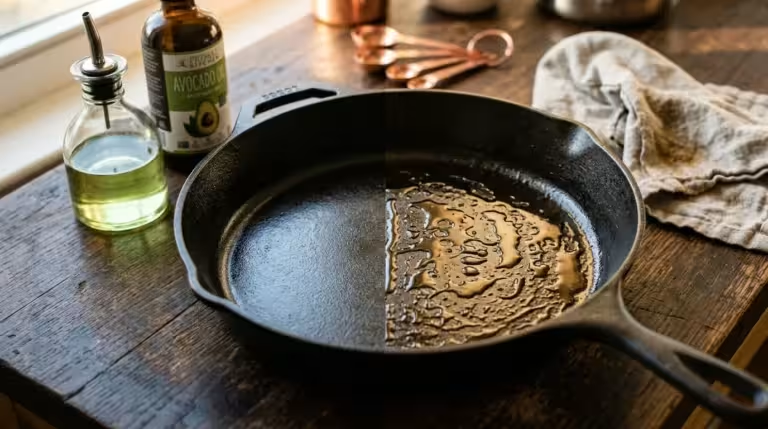
Cast iron comes seasoned; this term describes a protective, non-stick cooking coating built up through polymerized oil and heat. Its sheer weight crushes minor countertop flex and guarantees zero concave thermal deflection during rapid cooking.
Best Value Clad Cookware: Tramontina 10-Inch Tri-Ply Clad Frying Pan
Tramontina offers commercial-grade durability with an impact-bonded or fully clad base that measures 2.8 millimeters thick. It provides identical heat distribution to premium competitors at half the price.
The heavy ferritic base plate resists upward crowning even when subjected to sudden power changes on portable burners. The skillet handles everyday sauté tasks without breaking the burner’s electromagnetic loop.
If you prefer synthetic non-stick releases, select a skillet featuring a ceramic coating; this describes a non-stick cooking surface derived from silica rather than fluoropolymer chemicals. Just ensure the underlying aluminum base measures at least 4.0 millimeters thick.
“Thick pan bases function like thermal flywheels on induction glass. They absorb energy surges from the coil without buckling the cooking surface.”

Preventing Base Distortion: Heat Management and Maintenance
Even premium cookware warps if you treat it with careless thermal habits on an induction cooktop. Induction elements deliver energy instantly, creating violent temperature differentials across the base within seconds of activation.
Never preheat an empty pan using the maximum or boost power settings on your portable cooktop. High wattage concentrates intense heat inside the pan bottom before the sidewalls can absorb and balance the thermal load.
Start your burner at 50 percent power for sixty seconds before stepping up to searing temperatures. This brief warmup window allows the aluminum and steel layers to expand gradually at identical rates.
Match the physical diameter of the pan base to the cooktop’s active coil circle. If you place a 12-inch skillet over a 6-inch induction coil, the center expands while the outer rim remains cold.
This extreme temperature delta forces the center upward, permanently stretching the metal into a concave dome. The resulting deformation ruins the pan for induction use permanently.
Never submerge a screaming-hot pan directly into a sink of cold tap water. Thermal shock instantly locks severe warping into the base metal, rendering the pan unusable on glass cooktops.
Allow all cookware to cool down to room temperature naturally before washing with warm water and soap. Gentle cleaning habits protect your cookware investment and stop the dreaded induction clicking cycle for good.
Frequently Asked Questions
Why does my induction burner click without heating the pan?
The clicking noise indicates the cooktop’s internal mechanical relay is opening and closing repeatedly. The burner attempts to establish an inductive link, detects insufficient magnetic material or excessive air gap distance, and cancels current output.
How do I test if my pan is too warped for an induction stove?
Place a metal straightedge flat across the exterior base of the pan. If you can slide a 1.5-millimeter feeler gauge between the ruler and the pan center, the concave warp exceeds normal sensor thresholds.
Can I use an induction interface converter disc to stop the clicking?
Interface discs bridge the magnetic gap, but they conduct heat very inefficiently through conduction rather than induction. They dramatically slow cooking times and often overheat the glass cooktop, triggering automatic high-temperature shutoffs.
Does countertop material affect portable induction burner performance?
Yes. Flexible laminate countertops bow under burner and pan weight, creating tilted air gaps and restricting bottom ventilation ports. Placing your burner on a rigid, level surface ensures flat physical contact and adequate airflow.
Disclaimer: Product prices and availability change frequently. Prices shown were accurate at time of writing but may have changed. We may earn a small commission from purchases made through links on this site, at no extra cost to you. Always verify current pricing on the retailer’s website before purchasing.


1 Comment