
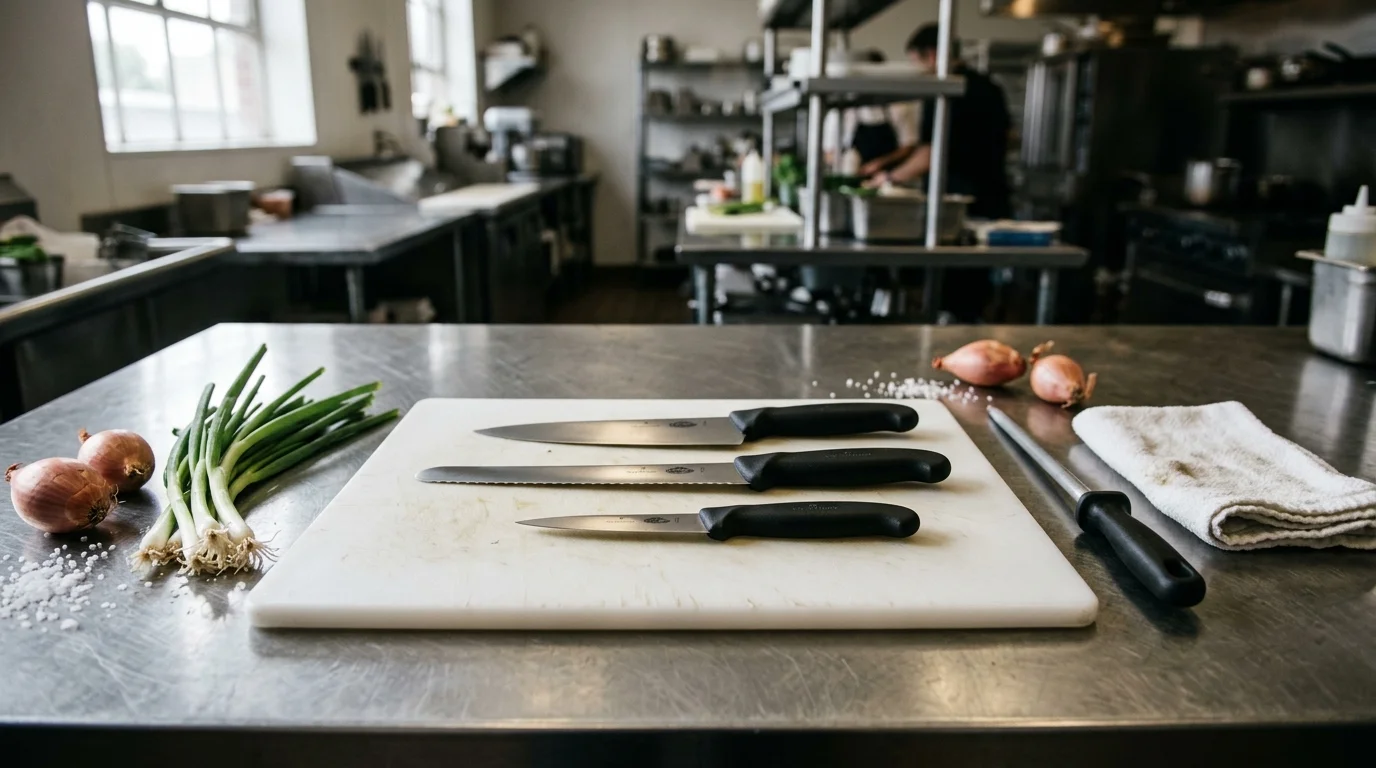
Moving into your first apartment for culinary school forces hard financial choices on a strict $150 prep budget. Spending that entire fund on an entry-level 15-piece knife block wastes cash on redundant, low-grade steel.
When outfitting a starter kitchen with first kitchen essentials, curating standalone items always delivers far better value than pre-packaged sets.
Buying three standalone commercial blades delivers superior edge retention and leaves fifty dollars of surplus cash for an NSF-certified board and honing rod. A targeted budget kitchen knife setup outperforms every bloated consumer block set on the market.
You will chop faster, sharpen less, and protect your practical exam grades by choosing tools engineered for commercial line prep. Here is how to build your kit dollar for dollar.
The 15-Piece Knife Block Illusion: What You Actually Pay For
Retail knife blocks look impressive on a kitchen counter, but their piece counts deceive buyers. Manufacturers inflate those numbers to make entry-level sets look like massive bargains.
Evaluating different knife storage options reveals how much counter space traditional countertop blocks actually waste.
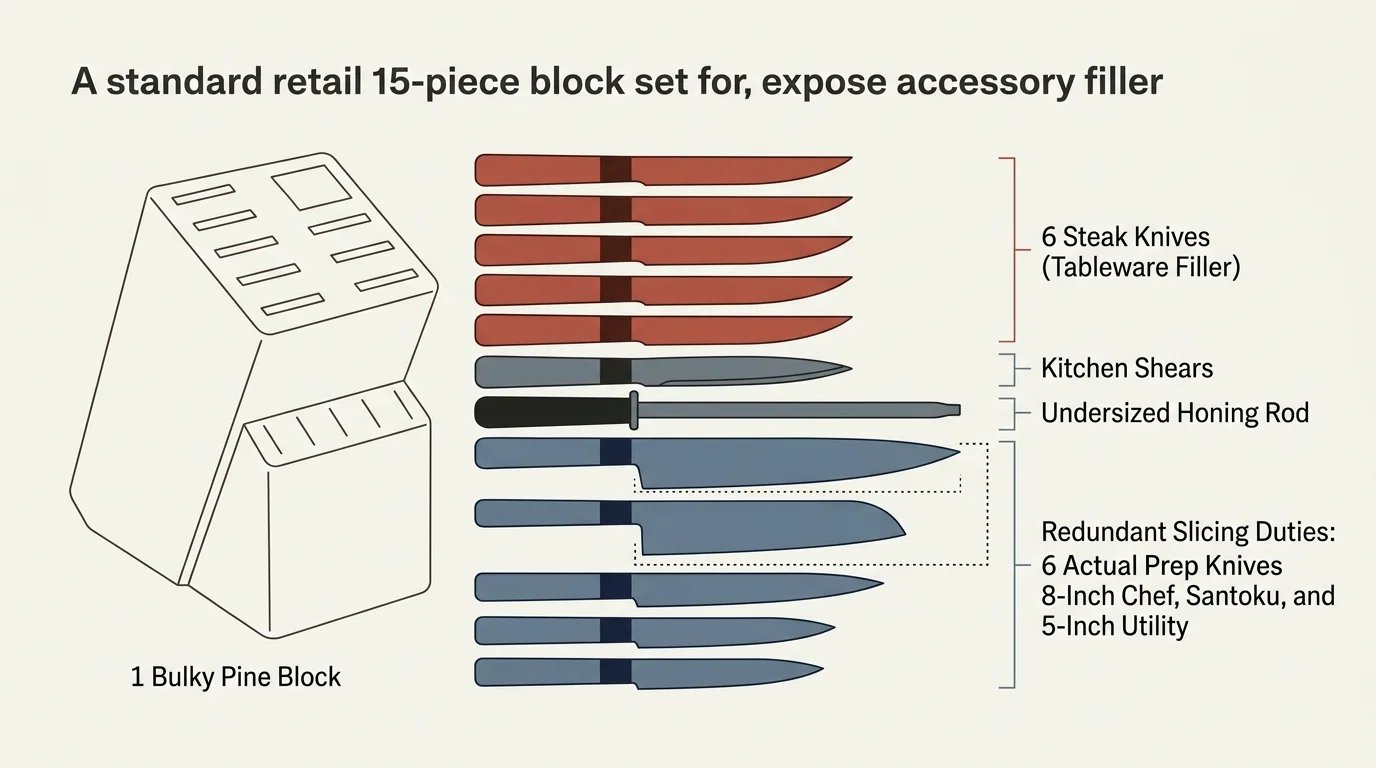
A standard 15-piece set typically includes six steak knives, kitchen shears, an undersized honing rod, and a bulky pine storage block. That leaves just six actual food preparation knives in the collection.
Of those six remaining blades, three duplicate identical slicing duties. You receive a santoku, a chef’s knife, and an awkward five-inch utility knife that rarely touches a cutting board.
The heavy wooden block also consumes massive footprint; footprint means how much counter or storage space something takes up. In a cramped starter apartment, that counter real estate is precious.
Worst of all, manufacturers spread your $150 across fifteen cheap items. You end up paying for filler accessories rather than durable, high-performance cutting steel.
When you skip the knife block set, every dollar targets the actual blades you use daily in culinary coursework.
The Professional Triad: The Three Knives That Cover 95% of Prep
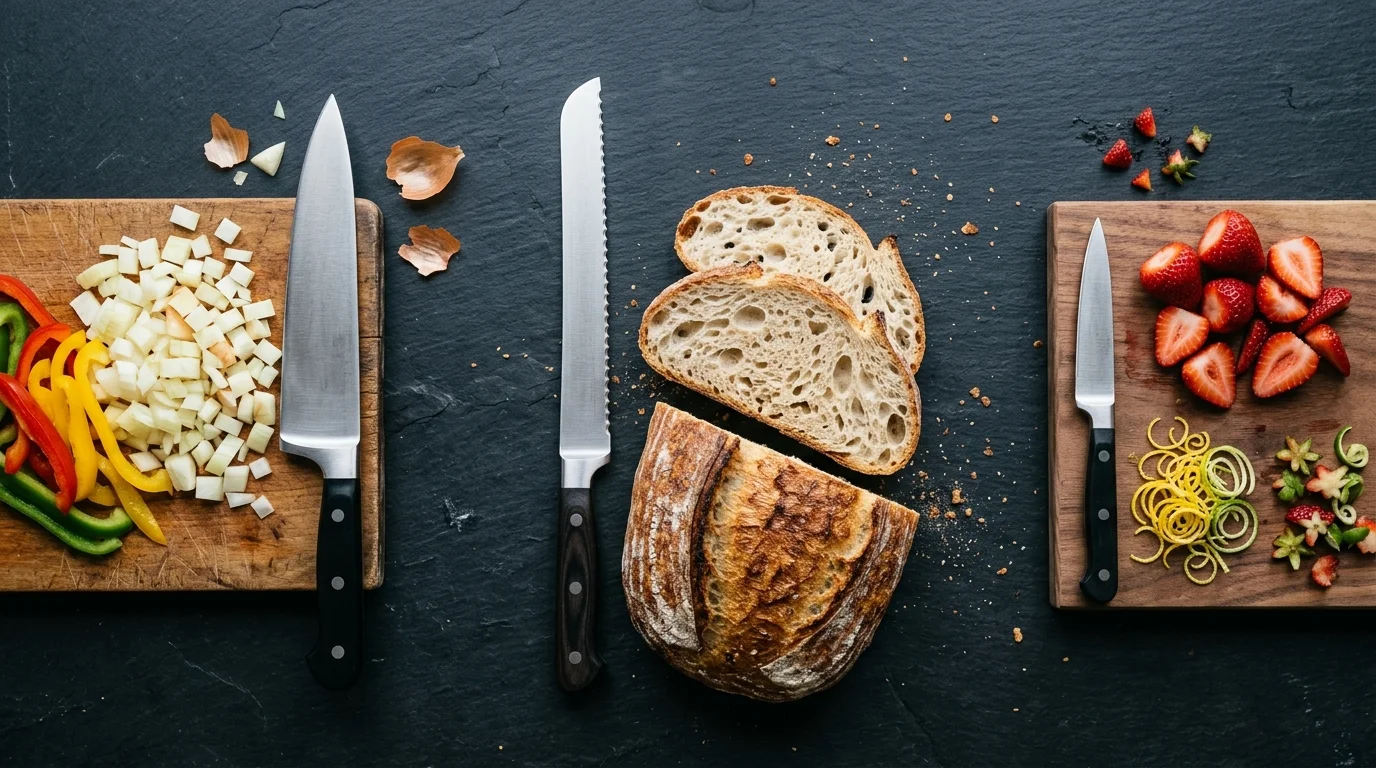
Professional culinary school curricula focus almost entirely on three cutting profiles. These three foundational blades easily execute 90% to 95% of all classical kitchen prep tasks.
Mastering this trio gives you the same streamlined speed prioritized in the best kitchen tools for meal prep, letting you power through high-volume slicing.
Your primary blade is an eight-inch chef’s knife. It handles high-volume dicing, mincing, julienning, and protein butchery on your prep station.
Your secondary tool is a ten-inch serrated bread knife with an offset or wide blade profile. This knife effortlessly cuts crusty artisan baguettes, soft brioche, and delicate heirloom tomatoes without crushing interior flesh.
Your final core blade is a 3.5-to-4-inch paring knife. You need it for off-board hand work, such as trimming artichokes, coring strawberries, and peeling citrus pith.
“A cook who masters an eight-inch chef’s knife, an offset serrated blade, and a paring knife can execute any classical prep station in professional dining.”
Specialty blades like boning knives or cleavers serve isolated culinary tasks. You can borrow those from campus tool cribs until you have post-graduation income.
Focusing your limited funds on this culinary student home knife kit guarantees professional-grade cutting performance from your first day of class.
Dollar-for-Dollar Breakdown: Block Set vs. Tailored Student Kit
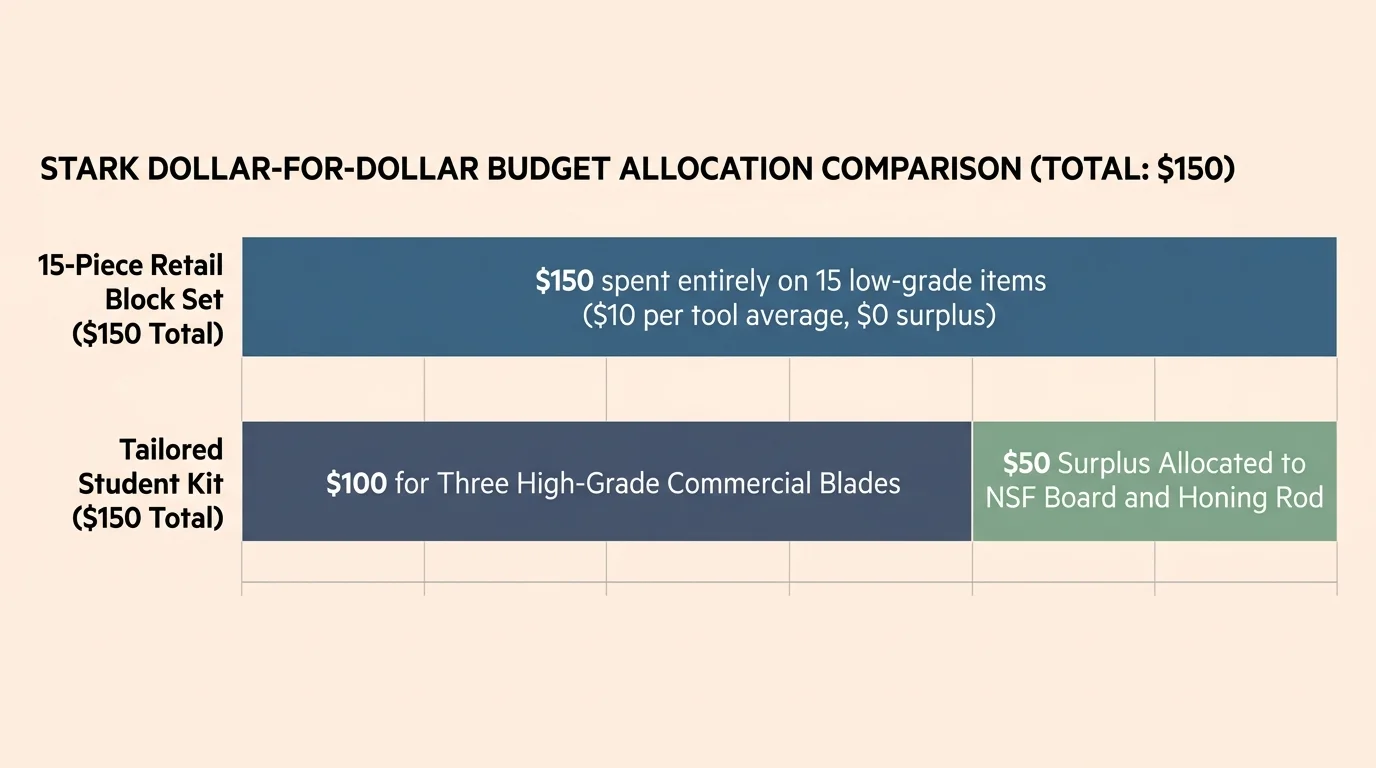
Let us look at a concrete financial scenario comparing an entry-level department store block set to an itemized prep kit. Both options target an identical $150 student equipment budget.
Deciding where to spend and save on culinary equipment ensures your dollars fund high-impact cutlery rather than unused filler.
A typical consumer block set retails for $139.99 before local sales tax. For that price, you receive soft stamped blades, no usable prep cutting surface, and zero budget for blade protection.
Building your kit from standalone commercial restaurant supply items completely changes the math. You get better metal and full cutting board coverage while staying under your spending cap.
| Item Category | Standard 15-Piece Block Set | Tailored Culinary Student Kit |
|---|---|---|
| Primary Chef’s Knife | 8-inch Stamped (51 HRC) | Victorinox Fibrox Pro 8-inch (56 HRC) |
| Serrated Bread Knife | 8-inch Narrow Blade (51 HRC) | Mercer Millennia 10-inch Wide (56 HRC) |
| Detail Paring Knife | 3-inch Utility/Paring (50 HRC) | Kuhn Rikon 4-inch Colori (56 HRC) |
| Included Prep Surface | None (Requires Separate Purchase) | OXO 14.5×21-inch Prep Board |
| Honing Steel Included | 8-inch Narrow Rod | Mercer 10-inch Grooved Rod |
| Edge Sheaths / Storage | Bulky Counter Wood Block | Polypropylene Edge Guards (3-Pack) |
| Total Investment Cost | $139.99 | $141.95 |
Notice the massive difference in usable prep utility. The individual breakdown allocates $80.50 toward superior blades and $61.45 toward board acreage and tool maintenance.
According to Serious Eats equipment reviews, commercial line knives consistently match the slicing performance of luxury cutlery sets costing four times as much.
By buying individually, you establish the best essentials food prep under 150 without sacrificing cutting mechanics or basic prep hygiene.
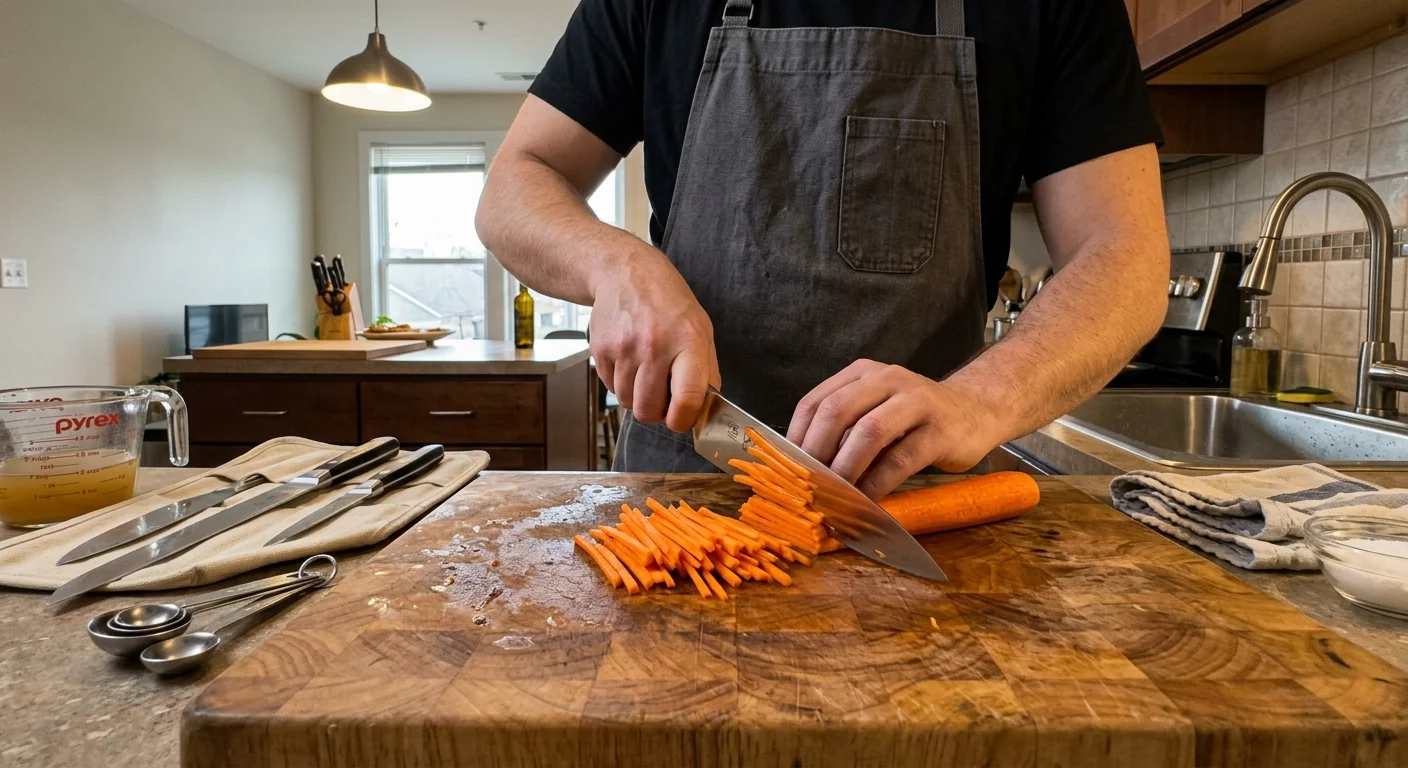
The Three Core Knives: Concrete Specs and Category Picks
Evaluating tools requires examining concrete specs; specs mean specifications, the technical details of a product. We will review each tool category alongside realistic upgrade paths.
Every knife selected here carries a manufacturer warranty; a warranty is a manufacturer’s promise to repair or replace defective products within a designated timeframe.
1. The Primary Workhorse: Victorinox Fibrox Pro 8-Inch Chef’s Knife
The Victorinox Fibrox Pro 8-Inch Chef’s Knife serves as our value pick; a value pick offers the best balance of quality and price for most people. It retails between $45.00 and $49.95.
Its blade uses Swiss stamped high-carbon stainless steel heat-treated to 56 HRC. The thermoplastic elastomer (TPE) handle remains slip-resistant even when working with wet chicken breast or greasy emulsions.
If you need a budget pick—defined as good quality at the lowest price point—the Mercer Millennia 8-Inch Chef’s Knife costs just $22.00.
For an upgrade pick (a premium option for those willing to spend more), consider the fully forged Mercer Renaissance 8-Inch Chef’s Knife at $55.00.
Enthusiasts looking for a splurge—a top-tier option for heavy users—often target the Wüsthof Classic 8-Inch Chef’s Knife at $170.00. That single blade, however, exceeds your entire starting budget.
Skip the Victorinox Fibrox if you strongly prefer the heavy heft and thick metal bolster of a traditional forged German blade.
Bottom Line: The Victorinox Fibrox Pro delivers unmatched cutting geometry, forgiving maintenance, and reliable commercial balance for under $50.
2. The Slicing Specialist: Mercer Culinary Millennia 10-Inch Wide Bread Knife
The Mercer Culinary Millennia 10-Inch Wide Bread Knife retails between $18.00 and $24.00. It is the gold standard bread knife across American culinary programs.
Unlike short eight-inch block set knives, this ten-inch blade lets you slice wide sourdough boules in a single clean pull stroke. The wide profile keeps your slicing plane perfectly vertical.
The serrated teeth cut cleanly through roasted pork crackling and delicate tomato skins without tearing tender interior layers. The Santoprene and polypropylene handle provides tactile grip during repetitive high-volume work.
Skip this knife if your kitchen drawers measure under 16 inches deep, as its overall profile requires adequate lengthwise storage.
Bottom Line: The Mercer Millennia 10-Inch provides professional length and aggressive scalloped teeth at an unbeatable entry-level price point.
3. The In-Hand Detail Tool: Kuhn Rikon Colori 4-Inch Paring Knife
The Kuhn Rikon Colori 4-Inch Paring Knife retails between $10.00 and $13.00. It features Japanese high-carbon steel with a non-stick coating and includes a rigid plastic travel sheath.
As Wirecutter’s kitchen testing shows, inexpensive paring knives perform just as well as luxury forged paring knives on detail prep tasks.
Paring blades experience rough handling in line kitchens, from opening bags to scraping vanilla beans. Spending more than $15 on an intricate paring blade drains money better spent on your chef’s knife.
Skip the Kuhn Rikon if you dislike bright synthetic blade coatings and prefer raw, polished stainless steel.
Bottom Line: The Kuhn Rikon Colori offers pinpoint tip control, high initial sharpness, and an included safety sheath for pocket change.
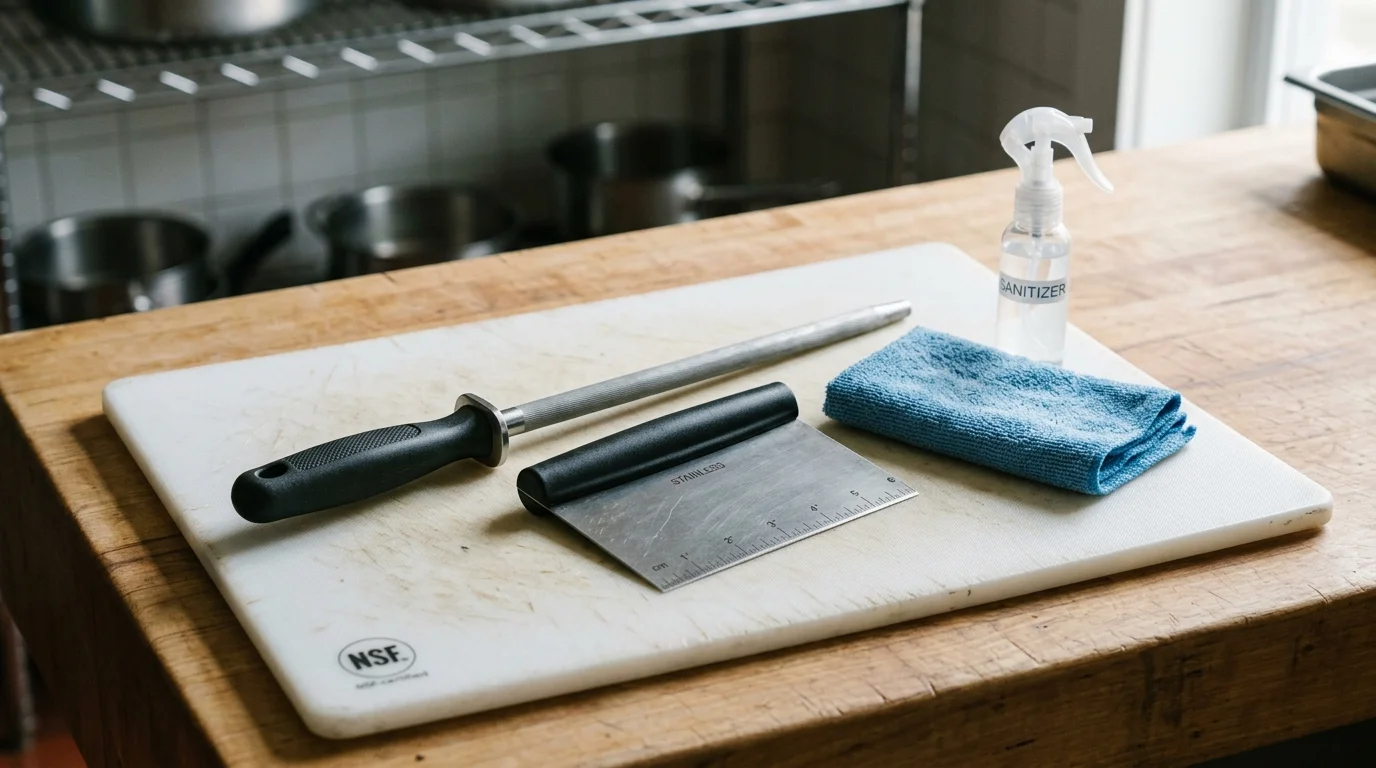
Allocating the Surplus: Essential Prep Gear Under the $150 Cap
Buying your blades individually leaves approximately $68 of unspent cash from your $150 starting allocation. A 15-piece block set leaves you with zero surplus funds.
Budgeting for maintenance tools early lays the groundwork for mastering essential knife sharpening methods as your edges undergo heavy daily use.
You cannot prep food on bare rental laminate counters. You must dedicate your surplus budget to a proper cutting board and a full-length honing rod.
First, purchase the OXO Good Grips 14.5×21-Inch Utility Cutting Board for $29.95. This board provides massive capacity; capacity means how much a product can hold or process at once.
Tiny cutting boards crowd your knife stroke and cause diced ingredients to tumble onto the floor. This NSF-certified polypropylene board accommodates large mounds of celery, carrots, and onions simultaneously.
Second, pick up the Mercer Culinary 10-Inch Honing Steel for $18.25. The eight-inch steels included in block sets are dangerously short for an eight-inch chef’s knife.
A ten-inch steel rod ensures your entire blade edge passes across the steel ridges without striking the safety guard. That protects both your knuckles and your blade heel.
Finally, purchase a three-pack of Mercer edge guards for $12.50. These protective sleeves let you safely stash your trio inside a dorm drawer without dulling edges or slicing fingers.

Steel Hardness and Edge Retention: The 50 HRC Trap
The Rockwell Hardness Scale (HRC) measures how well a metal resists permanent deformation. Understanding steel hardness explains why cheap 15-piece sets fail under culinary school workloads.
Mass-market block sets use cheap, unstamped steel alloys typically heat-treated to just 50 to 52 HRC. This metal is extremely soft.
Soft steel deforms rapidly when striking a cutting board. After julienning two large onions, a 50 HRC edge folds over, forcing you to mash vegetables rather than slice them.
Commercial-grade kitchen cutlery uses German X50CrMoV15 or equivalent alloys hardened to 55 through 58 HRC. Both Victorinox and Mercer blades hit this critical sweet spot.
At 56 HRC, the edge holds its geometry through hours of rigorous classical knife cuts. Yet the steel remains tough enough that it will not chip when striking chicken bones.
Research published by America’s Test Kitchen highlights that blade geometry and appropriate steel hardness matter far more than heavy forged construction.
Choosing 56 HRC commercial steel means your prep kit requires realigning on a honing rod only once per prep session.

Common Food Prep Buying Traps for Culinary Students
First-year culinary students frequently waste equipment stipends on appealing but functionally useless prep items. Avoiding these four purchasing traps protects your wallet.
- Buying for Steak Knives: Department store sets include six serrated steak knives simply to inflate their piece count. You cannot use steak knives for classical kitchen prep drills.
- Purchasing Glass or Marble Boards: Hard mineral surfaces destroy fine knife edges within minutes. Always prep on commercial polypropylene or end-grain wood boards.
- Selecting Short Bread Knives: Consumer sets supply puny eight-inch bread knives. You need ten inches of blade length to cleanly slice round artisan loaves.
- Overpaying for Forged Bolsters: Full metal bolsters run all the way to the blade heel. They prevent full-length sharpening and add unnecessary fatigue during long prep shifts.
Focusing strictly on performance specs guarantees every single cent of your $150 budget works toward refining your culinary technique.
Frequently Asked Questions
Why do culinary schools ban cheap 15-piece knife sets?
Instructors reject low-end consumer block sets because their soft steel rolls over quickly during high-volume prep drills. They also lack the sanitary NSF certifications required in commercial educational kitchens.
Can I safely debone chicken using an eight-inch chef’s knife?
Yes, an eight-inch chef’s knife easily executes poultry fabrication by using the sharp, agile tip. A dedicated flexible boning knife is convenient, but not strictly necessary for basic butcher drills.
How often should I hone my three prep knives?
Hone your chef’s knife and paring knife lightly before every prep session using five alternating passes on each side. Never hone your serrated bread knife, as the teeth require specialized ceramic stones.
Do I need a wooden knife block to store these three blades?
No, a heavy wooden countertop block collects internal grease, dust, and bacteria while hogging workspace. Hard plastic blade guards protect your edges inside drawers and knife rolls at a fraction of the cost.
Disclaimer: Product prices, features, and availability change frequently. Prices shown were accurate at time of writing but may have changed. We may earn a small commission from purchases made through links on this site, at no extra cost to you. Always verify current pricing and specifications on the retailer’s website before purchasing.





1 Comment