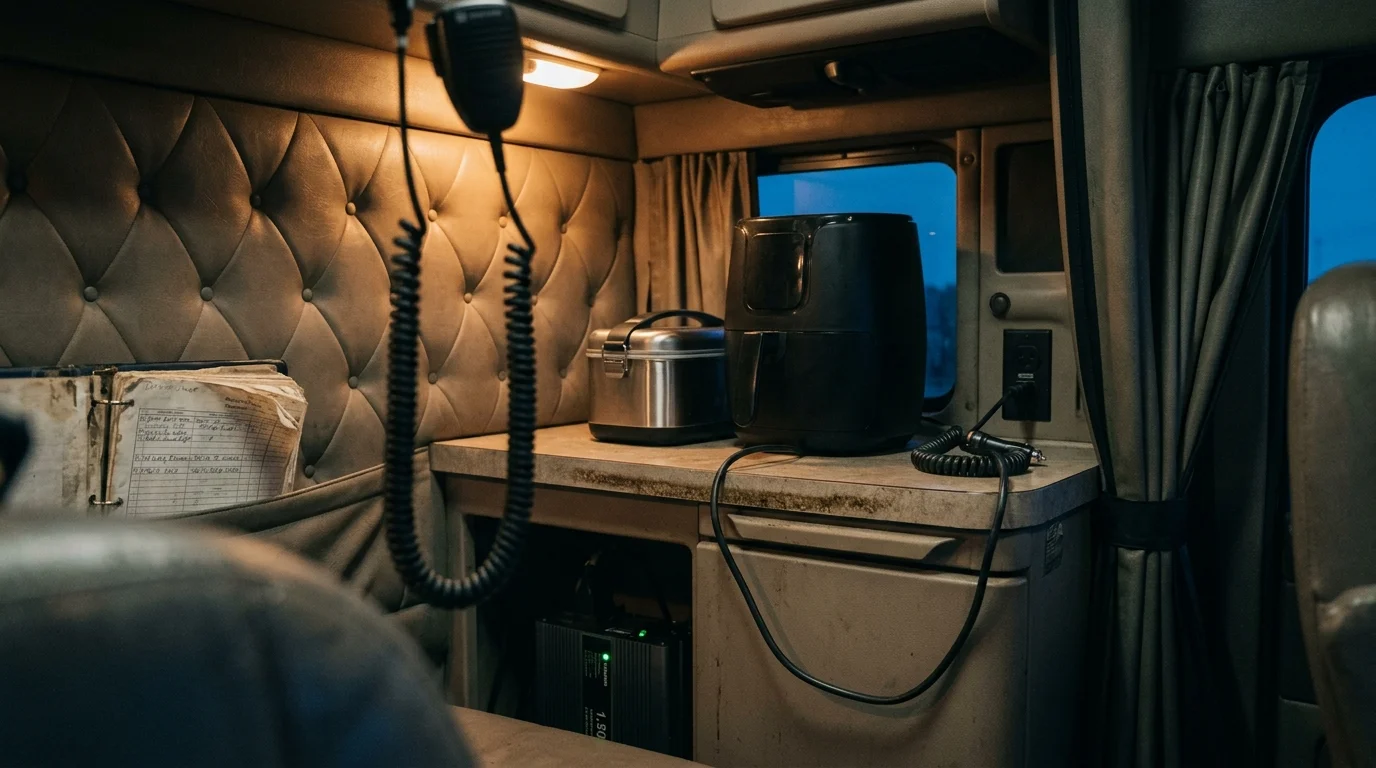
You can run a compact air fryer inside your sleeper berth without tripping your 1,500W truck inverter, but standard reviews ignore how modified sine wave power alters performance. Real cab cooking requires balancing rapid meal prep against voltage sag and inverter thermal stress.
Cooking inside a vehicle poses challenges similar to preparing meals in dorm rooms without stoves, where traditional stovetop ranges are unavailable.
While a heated lunchbox plugs directly into native 12V auxiliary ports, an alternating-current air fryer slashes meal preparation times from forty-five minutes down to eight. However, that speed demands massive, short-burst current from your house battery bank.
Standard household reviews assume a clean 120V pure sine wall outlet; this guide calculates actual voltage sags, internal fan motor overheating risks, and cycle delays when cooking under heavy truck inverter loads.
Inverter Mechanics: Modified Sine Waves and Direct 12V Loads
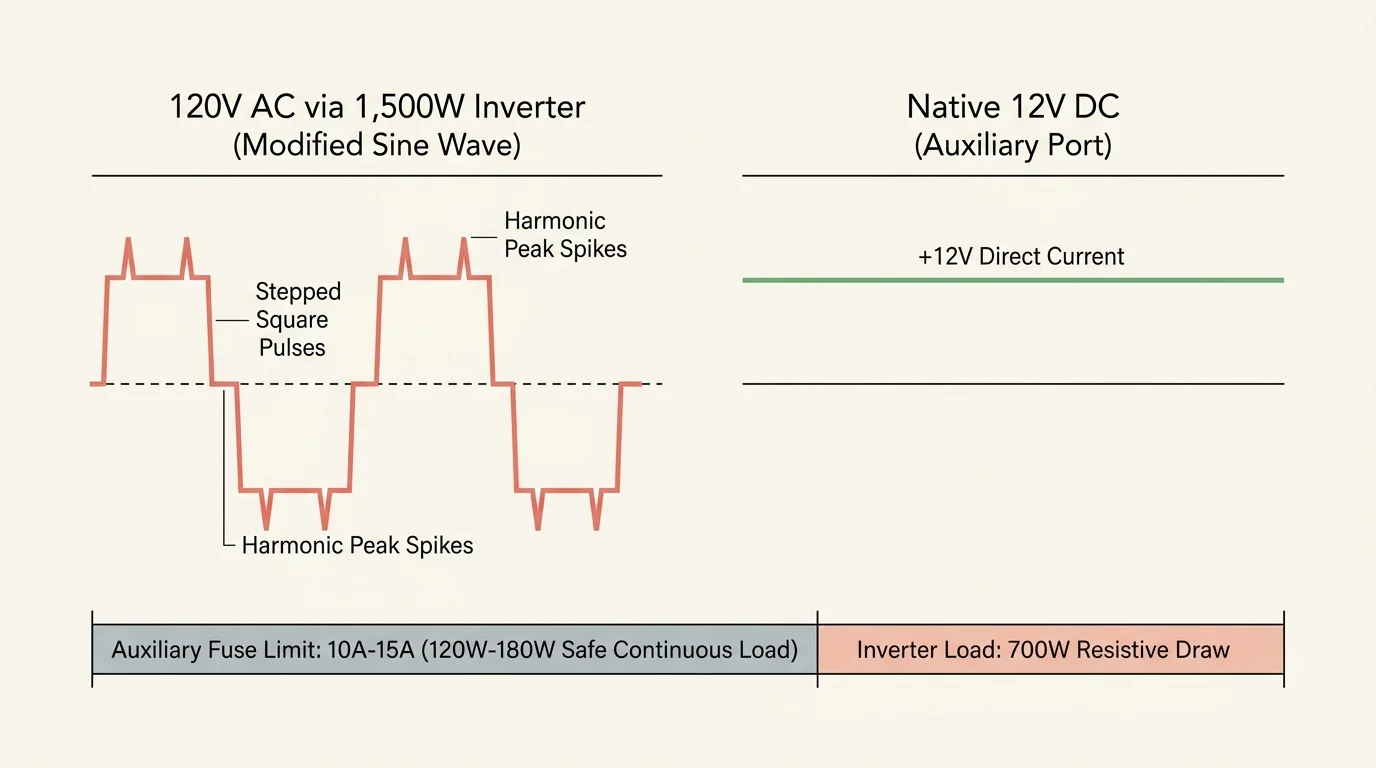
Most commercial tractor sleepers come equipped with factory-installed 1,500W modified sine wave inverters. Unlike smooth utility-grid pure sine alternating current, modified sine wave power delivers choppy, stepped square-wave electricity.
Weighing DC-powered lunchboxes against AC air fryers presents similar power and convenience trade-offs to choosing between electric vs stovetop small appliances.
Managing strict power caps on mobile circuits follows the same load-balancing strategies used for low-wattage appliances on 15-amp circuits.
Wattage measures how much electrical power an appliance uses; higher wattage usually means faster cooking and higher thermal output. When choosing an appliance, your power delivery method dictates your daily cooking limits.
Dedicated 12v cooking appliances bypass your inverter entirely. These units draw direct current straight from the cab cigarette lighter receptacle, avoiding conversion losses completely.
Vehicle 12V dashboard and sleeper ports use fuses rated strictly between 10A and 15A. This fuse limit restricts safe continuous electrical loads to roughly 120W to 180W.
Exceeding 180W on a 12V auxiliary port quickly blows the vehicle fuse or melts the plastic socket casing. Portable 12V lunchboxes safely avoid this danger by operating at a modest 45W to 100W draw.
Conversely, a 700W air fryer requires 120V household alternating current, forcing you to run it through an inverter. While the pure resistive heating coil tolerates stepped wave output, digital electronics and motors struggle.
“An inverter is not an infinite wall outlet; running high-draw appliances over modified sine waves demands constant monitoring of DC voltage drop.” — Truck Electrical Specialist
According to Consumer Reports, compact cooking units demand careful electrical monitoring in small spaces. Overloading an inverter circuit can disrupt other essential cab systems like your sleeper refrigerator.
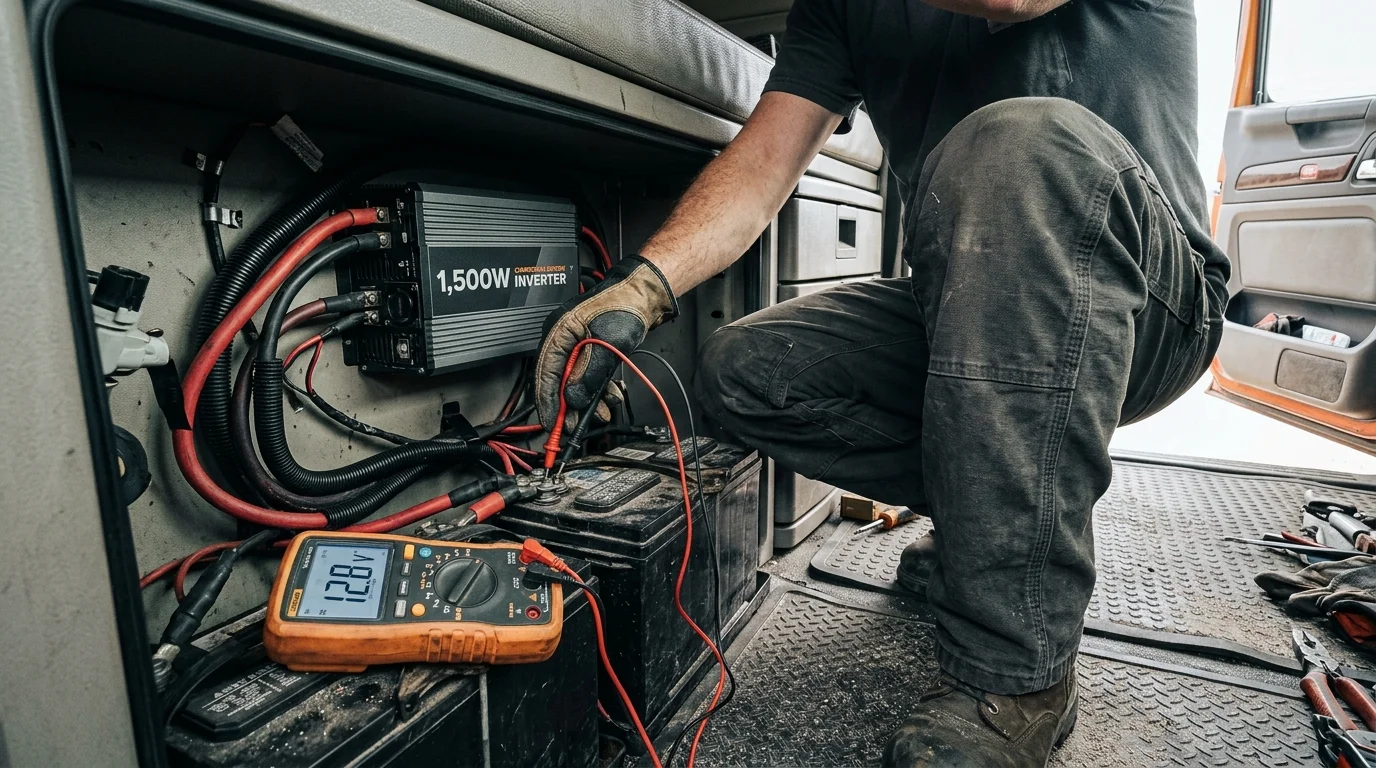
Electrical Load Calculations: Real-World Amp Draw and Voltage Sag
Operating an air fryer for semi truck setups requires understanding DC-to-AC conversion losses. Inverters run at approximately 85% to 90% operating efficiency under moderate loads.
Much like operating sub-600W electric kettles in camper vans, keeping continuous electrical draws low protects auxiliary batteries from rapid depletion and inverter cutoffs.
Delivering 700W of AC power to an air fryer actually draws between 780W and 825W from your 12V truck batteries. That significant conversion loss manifests as heat inside the inverter housing.
Under a resting battery state of 12.6V, an 825W DC load pulls approximately 65.5A of continuous current. If your battery drops to 12.0V under load, current draw climbs to nearly 69A.
This massive continuous draw causes immediate voltage sag across your auxiliary battery bank. If your cabling is undersized or connections are corroded, supply voltage can plummet below your inverter’s low-voltage cut-off limit.
A low watt air fryer inverter installation must use 2 AWG or 4 AWG copper cabling wired straight to the battery box. You must protect this direct run with an inline 80A to 100A ANL or MEGA fuse.
In contrast, a 60W heated lunchbox draws roughly 5.0A at 12.0V DC. This light load produces zero noticeable voltage sag on a commercial truck’s dual- or quad-battery bank.
You can safely run a heated lunchbox while resting without worrying about triggering low-voltage disconnect warnings. The light current draw lets you cook food silently while preserving battery reserves for your bunk heater.
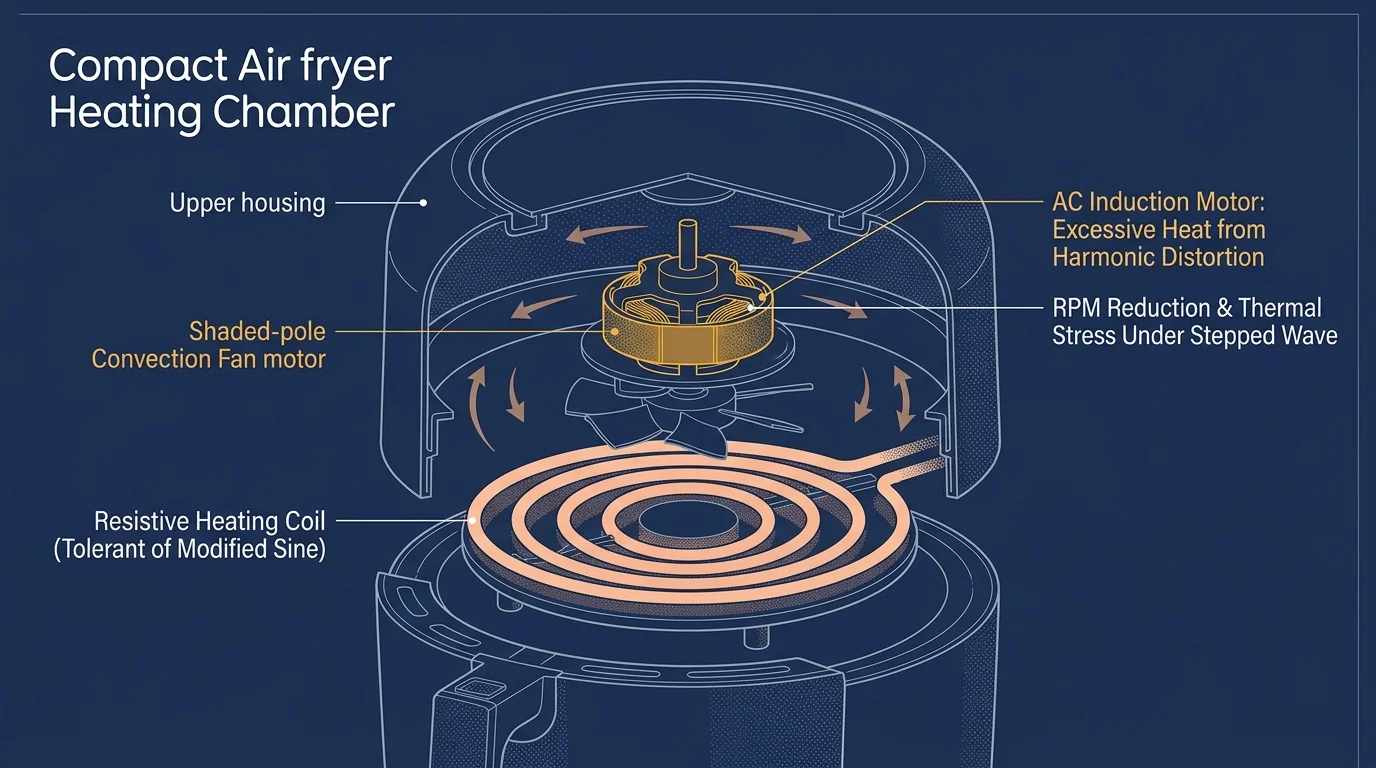
Convection Fan Stress and Modified Sine Wave Overheating Risks
Air fryers rely on convection to function properly. Convection uses an internal fan to circulate hot air rapidly around the food basket for crisp, even cooking.
That convection blower relies on a small alternating-current motor. When you feed that motor a modified sine wave, the square electrical edges introduce harmonic distortion.
This electrical distortion causes the motor windings to dissipate wasted energy as excess physical heat. You will often hear an audible electrical buzz or humming sound emanating from the appliance housing.
Over extended cooking sessions, this excessive winding heat can degrade internal bearing lubricants and damage delicate plastic fan impellers. In severe situations, the fan motor can stall completely.
If the convection fan stalls while the 700W heating coil remains active, thermal safety fuses inside the air fryer will blow. Once that thermal cutoff triggers, the appliance becomes permanently unusable.
As tests by Wirecutter demonstrate, miniature convection fans require steady current to circulate air evenly. Choppy power delivery causes the internal fan to spin at lower RPMs, extending cooking times.
Heated lunchboxes contain zero moving mechanical parts or electric fans. They rely strictly on basic conductive or gentle radiant heating plates that remain unaffected by electrical wave shapes.
Because lunchboxes contain no motors or complex microprocessors, they boast superior long-term reliability inside rough truck cabs. They handle voltage fluctuations and modified electrical signals without mechanical complaint.
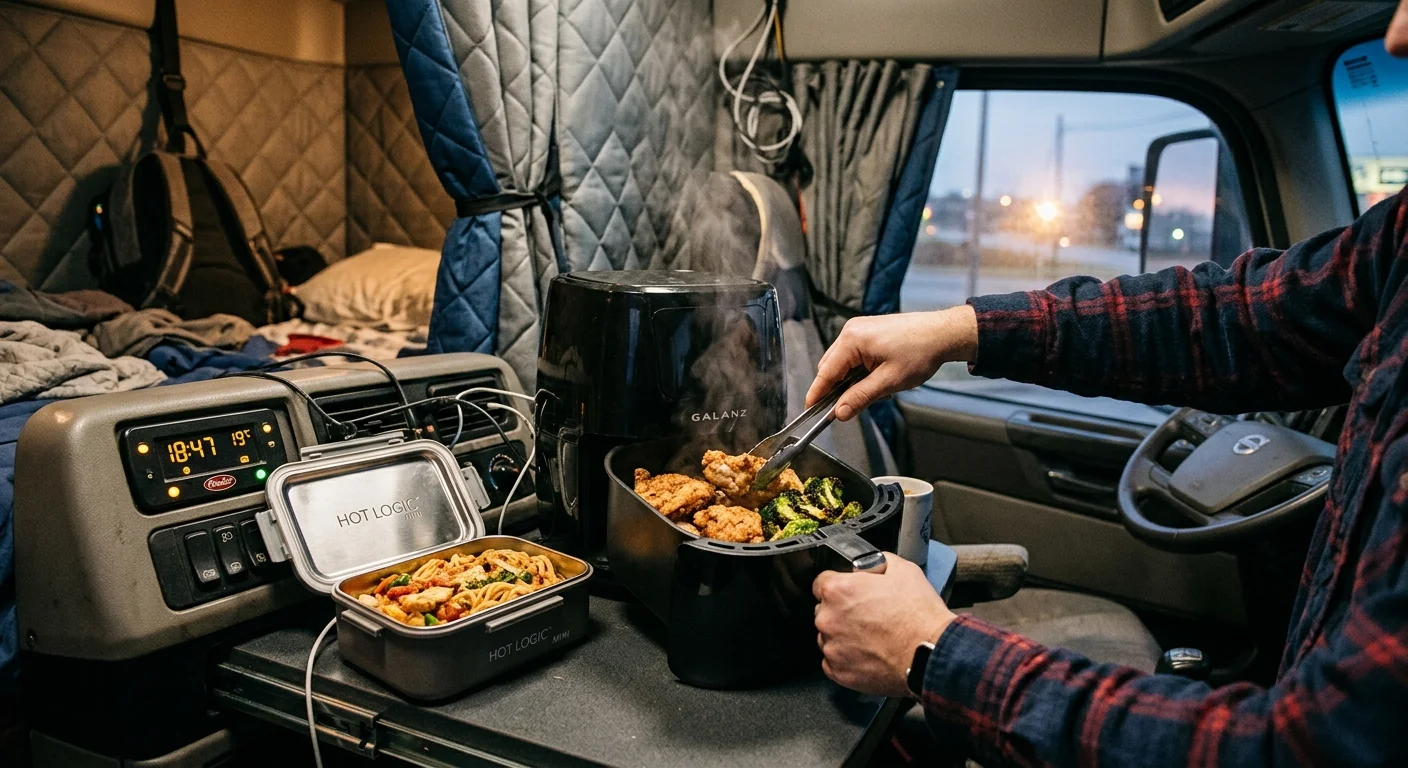
Cooking Cycle Benchmarks: Reheating and Raw Prep Times
Cooking speed represents the single largest operational divergence between these two sleeper berth appliances. An air fryer produces intense, dry heat, whereas a heated lunchbox acts like a low-power conduction steamer.
Equipping your setup with the best air fryer accessories, such as silicone baskets and liners, helps keep food juices contained and speeds up clean-up inside the cab.
A 700W air fryer reheats pre-cooked foods like pizza, roasted potatoes, or grilled chicken in four to eight minutes at 350°F. The rapid air movement restores crispy crusts without making the food soggy.
A 12V heated lunchbox requires twenty-five to forty-five minutes to reheat refrigerated leftovers to safe serving temperatures. If you insert dense, frozen meal containers, total heating time extends to an hour.
According to federal safety guidelines, reheated leftover meats must reach an internal core temperature of 165°F. Furthermore, food held warm for later consumption must stay above the 140°F safety floor.
Many heated lunchboxes feature a keep warm setting. A keep warm function maintains food safely at serving temperature after cooking concludes, preventing bacterial growth during long driving shifts.
Cooking raw food highlights an even greater contrast. An air fryer cooks raw chicken breast or pork chops in twelve to twenty minutes at 375°F.
A 12V lunchbox operates like a slow cooker when preparing raw ingredients. Stewing raw diced poultry and chopped root vegetables inside a lunchbox takes between two and three hours to reach safe internal temperatures.
If you need quick hot food during a short thirty-minute DOT break, an air fryer is unbeatable. A 12V lunchbox requires advance meal planning, demanding you plug it in two hours before your planned stop.
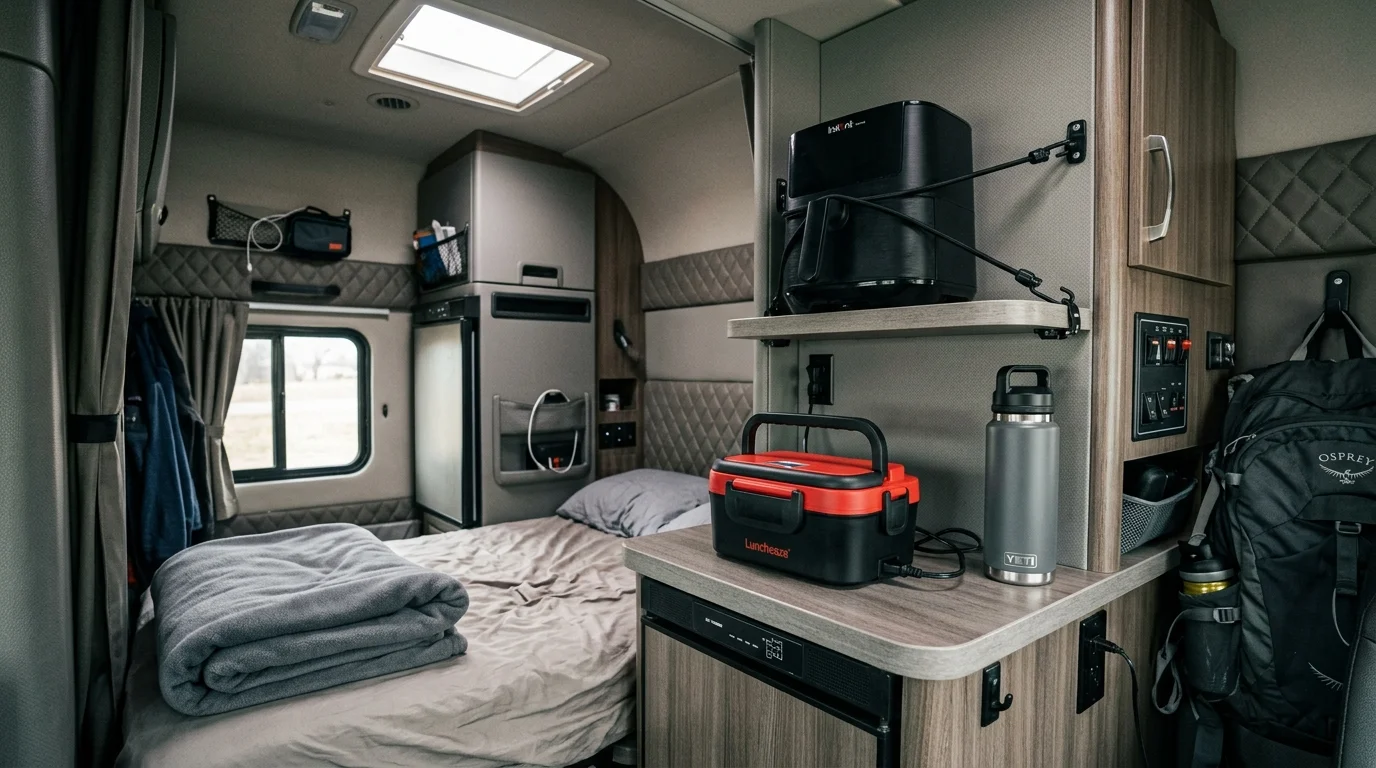
Countertop Footprint and Cab Storage Constraints
Sleeper berth living requires careful management of every square inch of usable interior space. Countertop real estate on cab cabinet tops or pull-out work surfaces is exceptionally limited.
Just as tight mobile spaces benefit from removable-handle cookware sets for RVs, sleeper berths demand appliances that fit into strict dimensional limits.
Much like arranging a studio kitchenette, choosing compact kitchen appliances for small spaces requires balancing usable capacity against severe dimensional boundaries.
Quart capacity indicates how much the appliance holds, where 4 quarts equals roughly 4 liters. Compact 700W air fryers typically offer a modest 1.2-quart to 2.1-quart capacity basket.
A typical 2-quart air fryer measures roughly 8.1 inches wide, 10.2 inches deep, and 11.4 inches tall. It weighs around 5.5 to 6.5 pounds, requiring dedicated cabinet shelving or floor storage when driving.
You cannot safely operate an air fryer on an open bunk mattress. The exterior housing radiates heat, and the rear exhaust vent expels air exceeding 300°F, creating a fire hazard against bedding.
By comparison, a 12V heated lunchbox measures approximately 8.75 inches wide, 6.75 inches deep, and 3.5 inches tall. These units weigh less than two pounds empty and store easily in small side compartments.
Lunchbox exteriors utilize insulated, cool-touch zippered fabric or heat-resistant plastic shells. You can safely place them on the cab passenger floorboard or bunk table while driving without heat damage.
Many heated lunchbox models also feature secure lid latches and silicone perimeter seals. These airtight gaskets prevent oily stews or gravies from sloshing across your cab carpet during hard braking.
Air fryer baskets do not form a liquid-tight seal against the outer chassis. Cooking saucy or liquid-heavy foods inside an air fryer while driving leads to disastrous spills and cab odors.
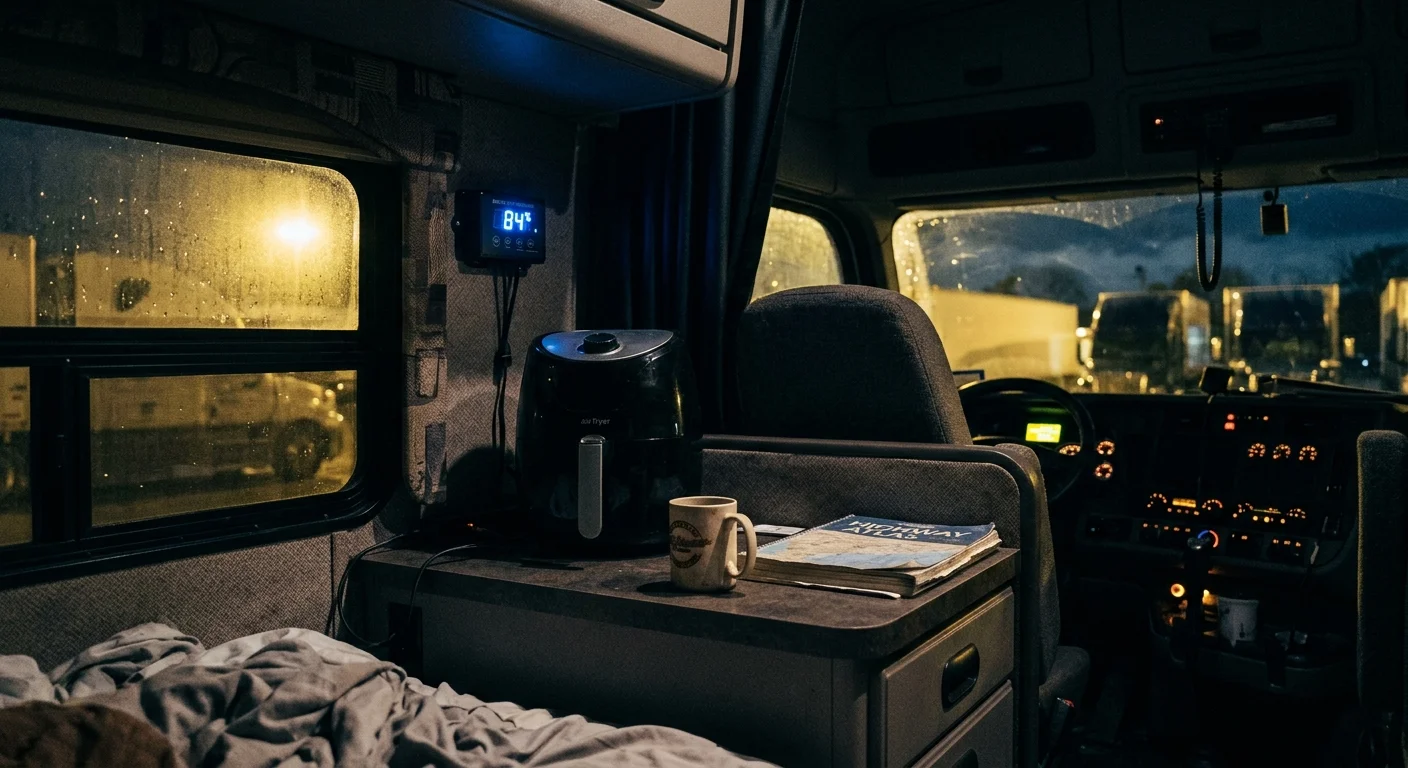
Worked Scenario: Battery Drain Over a 34-Hour Restart
To evaluate real energy consumption, consider a driver spending a 34-hour DOT restart at an unpowered staging lot. Ambient outdoor temperature is mild, and the truck relies on an auxiliary battery pack.
The truck uses a four-battery deep-cycle AGM bank providing 400 Amp-hours (Ah) of total rated capacity. To prevent premature battery failure, you should never deplete the bank beyond 50% depth of discharge (200 Ah usable).
Our driver plans to prepare five hot meals across this layover: dinner, breakfast, lunch, dinner, and a final breakfast. Let us compare the total electrical consumption of both cooking methods.
In Scenario A, the driver uses a 700W compact air fryer running off a 1,500W modified sine wave inverter. Each cooking cycle averages twelve minutes to roast meats and potatoes.
At an inverter operating efficiency of 85%, the 700W AC load draws 824W from the DC system. Over twelve minutes (0.2 hours), the inverter draws approximately 165 Watt-hours of energy per meal.
Dividing 165 Watt-hours by a nominal 12.6V battery level equals 13.1 Ah consumed per meal cycle. Across five meals, the air fryer consumes 65.5 Ah of electrical capacity.
In Scenario B, the driver uses a 60W portable heated lunchbox plugged directly into the sleeper 12V port. Each meal cycle takes fifty minutes (0.833 hours) to heat stews and leftovers thoroughly.
The 60W DC draw operating for 0.833 hours consumes 50 Watt-hours of total energy per meal. At 12.6V, this equates to roughly 3.97 Ah pulled from the battery bank per meal cycle.
Across five layover meals, the 12V heated lunchbox draws a total of 19.85 Ah. That leaves 180.15 Ah of usable battery reserve for bunk lights, CPAP machines, and auxiliary cab fans.
The air fryer uses 45.65 Ah more total battery capacity than the 12V lunchbox over the weekend. However, the air fryer requires only one total hour of run time, versus over four hours for the lunchbox.
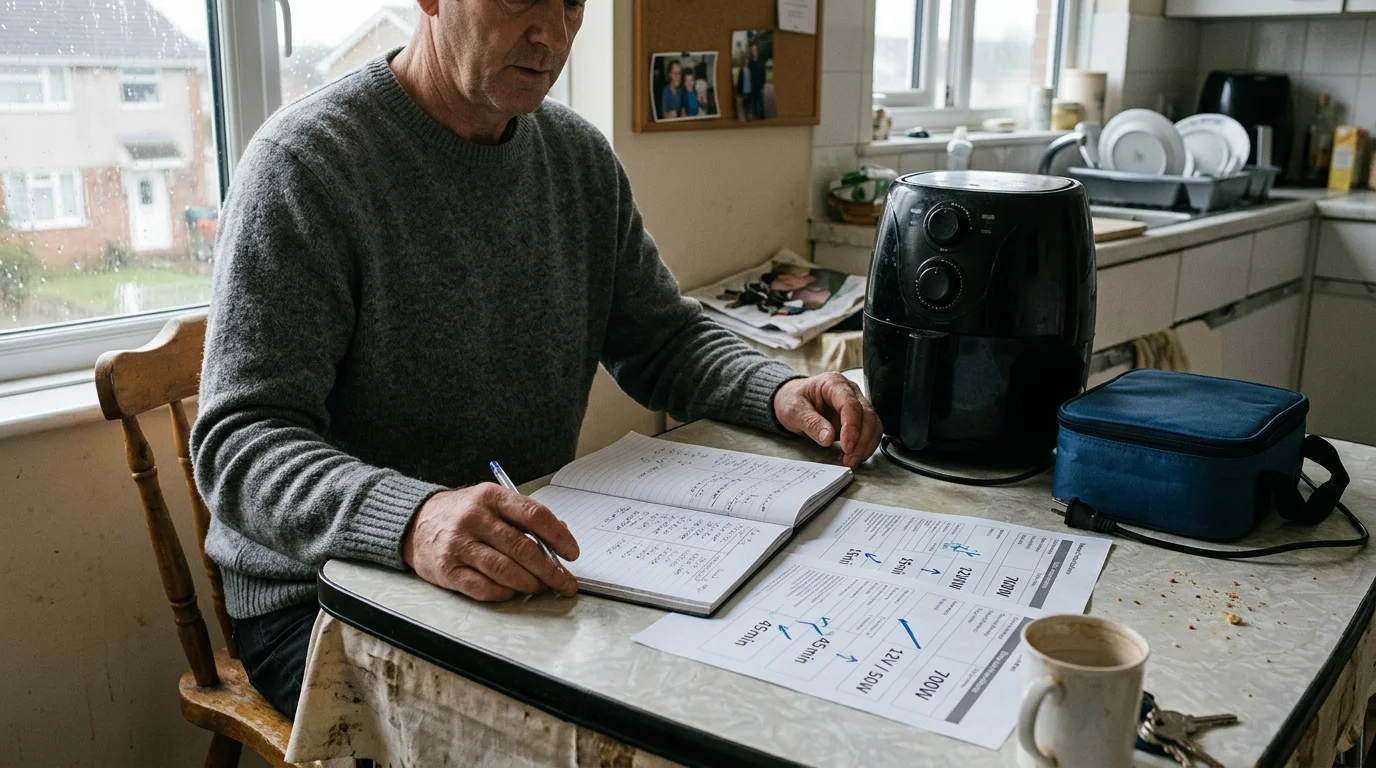
Head-to-Head Specifications Comparison
Selecting the right road appliance requires comparing hard electrical and physical measurements. The table below outlines five common cooking units used in long-haul commercial tractor setups.
| Appliance Model | Rated Wattage | Input Power Type | Quart Capacity | Dimensions (Inches) | Weight | Cook Time (1 Meal) |
|---|---|---|---|---|---|---|
| Dash Compact Air Fryer | 700W | 120V AC (Inverter) | 2.0 Quarts | 10.2 x 8.1 x 11.4 | 5.6 lbs | 8–12 Minutes |
| Elite Gourmet EAF-0201 | 1,000W | 120V AC (Inverter) | 2.1 Quarts | 11.0 x 8.5 x 11.0 | 6.2 lbs | 6–10 Minutes |
| Hot Logic Mini 12V | 45W | 12V DC (Aux Port) | 1.5 Quarts | 8.75 x 6.75 x 3.5 | 1.8 lbs | 45–60 Minutes |
| Buddew 3-in-1 Lunchbox | 80W | 12V DC / 120V AC | 1.8 Quarts | 9.4 x 6.8 x 4.5 | 2.4 lbs | 30–45 Minutes |
| RoadPro RPHB-110FB | 150W | 12V DC (Aux Port) | 1.5 Quarts | 10.0 x 8.0 x 7.8 | 3.1 lbs | 30–50 Minutes |
Notice how the Elite Gourmet unit increases wattage to 1,000W, pushing closer to inverter surge safety limits. That higher wattage reduces cycle times slightly but increases continuous battery drain to 95A DC.
The Buddew lunchbox provides dual-voltage capability, operating on native 12V DC or standard 120V AC household current. This versatility lets you cook from dashboard ports while driving, or switch to inverter power when parked.
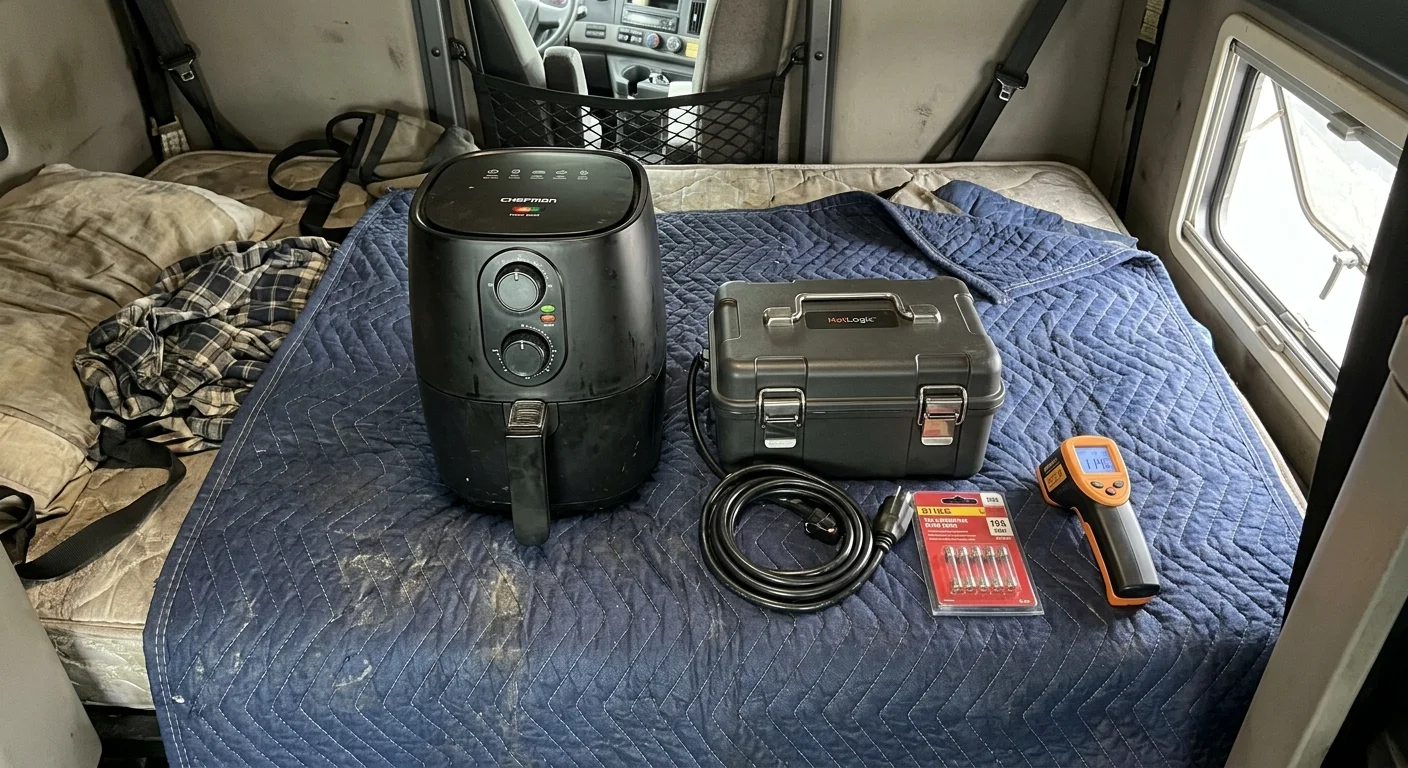
Top Equipment Recommendations for Semi-Truck Cabs
Choosing between these appliances depends on your electrical system, cooking style, and route timing. Below are specific, tested recommendations for three standard over-the-road driver setups.
For drivers with limited battery storage, the Hot Logic Mini 12V remains the best choice for small cabs. Drawing just 45W, it produces zero inverter noise and poses no risk of battery depletion during ten-hour breaks.
If you want fast hot meals and have a well-wired 1,500W inverter, select the Dash Compact 2-Quart Air Fryer. Its low 700W rating leaves plenty of continuous inverter headroom for your cab refrigerator and phone chargers.
Preset programs provide automatic temperature and time settings for common cooking tasks like roasting or reheating. The Dash unit uses simple analog dials rather than digital touchscreens, avoiding microprocessor errors caused by modified sine waves.
For drivers wanting maximum electrical flexibility, the Buddew 80W Heated Lunchbox represents the best value multi-voltage option. It includes a sealed stainless steel insert tray and works across 12V, 24V, and 120V power sources.
Always inspect the power cord during initial runs to ensure connections remain cool to the touch. Warm plug prongs indicate socket contact resistance, which requires immediate terminal cleaning or port replacement.
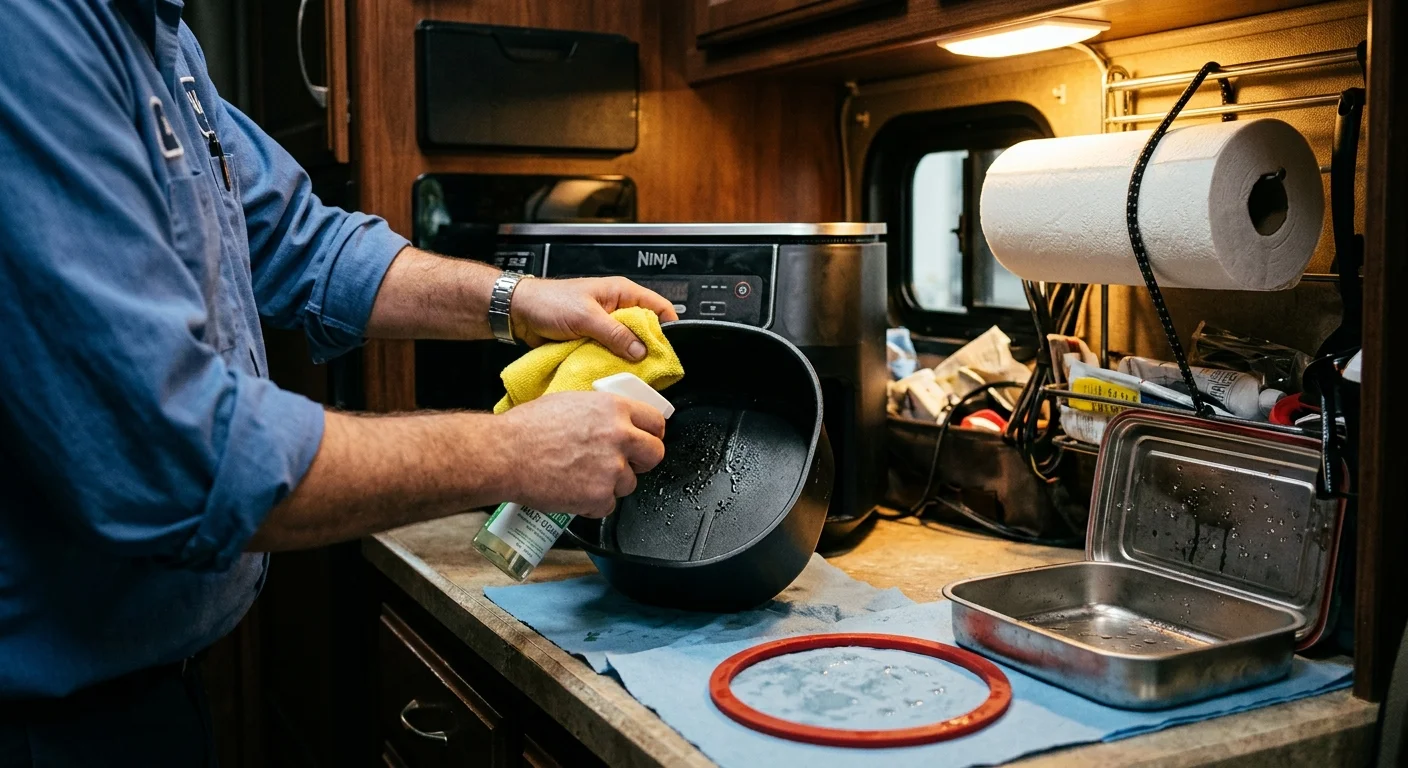
Cleaning, Maintenance, and Road Vibration Durability
Cleaning cooking gear inside a sleeper berth presents unique challenges without a standard kitchen sink. You must rely on gallon jugs of water, truck stop rest areas, or heavy-duty paper towels.
Air fryers require careful interior maintenance to prevent grease build-up. Residual oils from cooking bacon or chicken tenders will smoke heavily during subsequent cycles, filling your cab with irritating haze.
According to equipment evaluations from Serious Eats, nonstick coatings on entry-level baskets degrade rapidly when exposed to abrasive cleaning methods. Use silicone basket liners to catch grease and wipe down the interior using gentle microfiber cloths.
Heated lunchboxes utilize removable stainless steel interior containers that seal with dedicated leak-proof lids. You can easily remove the metal tub, wash it inside a truck stop service sink, or store it in your cab fridge.
Road vibration also affects appliance lifespan significantly over long highway miles. The continuous jarring of tractor suspension will loosen small structural screws and damage delicate electronic circuit boards.
Analog air fryers with mechanical dials handle road vibration far better than digital, touch-panel models. Heated lunchboxes, containing solid aluminum heat plates and zero moving parts, offer exceptional long-term road durability.
Store your cooking equipment inside padded storage crates or wedged firmly between soft items when traveling. Cushioning prevents appliance feet from cracking against cabinet surfaces during rough transit over expansion joints.
Frequently Asked Questions
Can a 700W air fryer damage a 1,500W modified sine wave truck inverter?
No, a 700W air fryer will not immediately overload a 1,500W inverter because the continuous load remains well below the inverter’s maximum threshold. However, the stepped electrical waveform will cause the air fryer’s internal convection fan motor to run warmer than normal.
Can you safely run a 12V heated lunchbox while driving down the highway?
Yes, 12V heated lunchboxes with sealed, latched lids are specifically engineered for safe operation while driving. Place the unit on a flat, heat-resistant surface like a rubber cab floor mat away from your steering controls.
Why does an air fryer cook food so much faster than a heated lunchbox?
Air fryers use 700W or more of power combined with a high-speed convection fan to blast dry heat up to 400°F directly across food surfaces. Heated lunchboxes operate at only 45W to 100W, relying on slow conduction heat that tops out around 165°F to 300°F.
How many Amp-hours does an air fryer pull from truck batteries during a single cook?
A 700W air fryer running for ten minutes draws roughly 11 to 13 Amp-hours from a 12V battery bank through an inverter. Even though its instantaneous amp draw is high, the brief operating time minimizes total battery drain.
Disclaimer: Product prices, features, and availability change frequently. Prices shown were accurate at time of writing but may have changed. We may earn a small commission from purchases made through links on this site, at no extra cost to you. Always verify current pricing and specifications on the retailer’s website before purchasing.