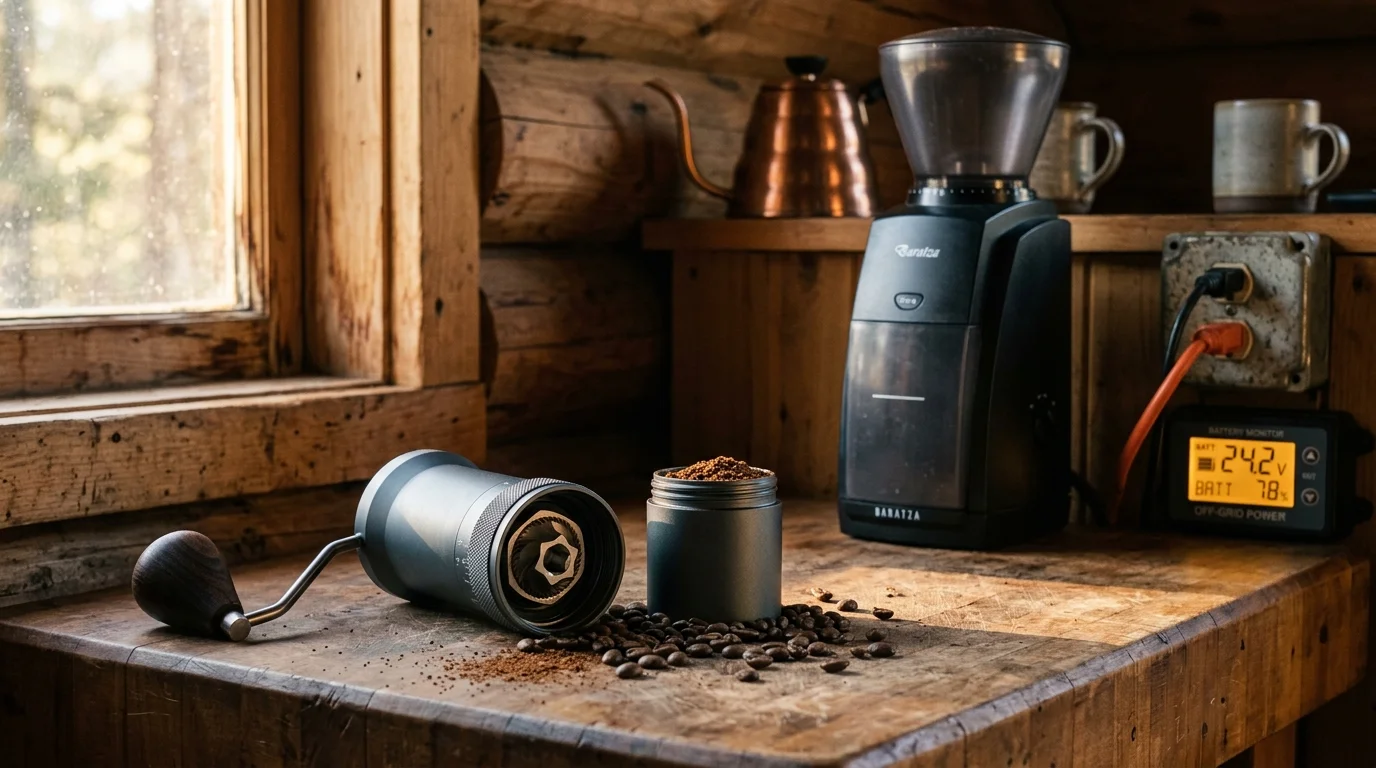
Running an off-grid cabin on a 24V battery bank demands scrutinizing every watt-hour before breakfast. Choosing between a manual hand grinder and a motorized countertop unit involves more than just physical morning effort.
Most coffee reviews focus purely on grind consistency, but off-grid living requires auditing the electrical cost of alternating current. Motor ratings alone rarely reveal true battery consumption.
Inverter tare losses make low-amp electric grinders consume up to 400% more battery power than their labels suggest. Meanwhile, manual 48mm hex-burr grinders deliver identical extraction quality for absolute zero electrical load.
The Off-Grid Electrical Budget: Inverter Tare and Standby Losses
Off-grid electrical systems do not deliver power with the effortless overhead of a municipal grid. When you live from a 24V battery storage bank, every morning appliance must justify its presence.
Most home cooks evaluate an appliance by its stated wattage, which measures how much power an appliance uses during active operation. However, AC electric grinders hide substantial parasitic loads behind that single number.
Plugging an AC grinder into a cabin electrical outlet requires turning on your primary pure sine wave power inverter. That inverter converts direct current from your battery bank into 120V household power.
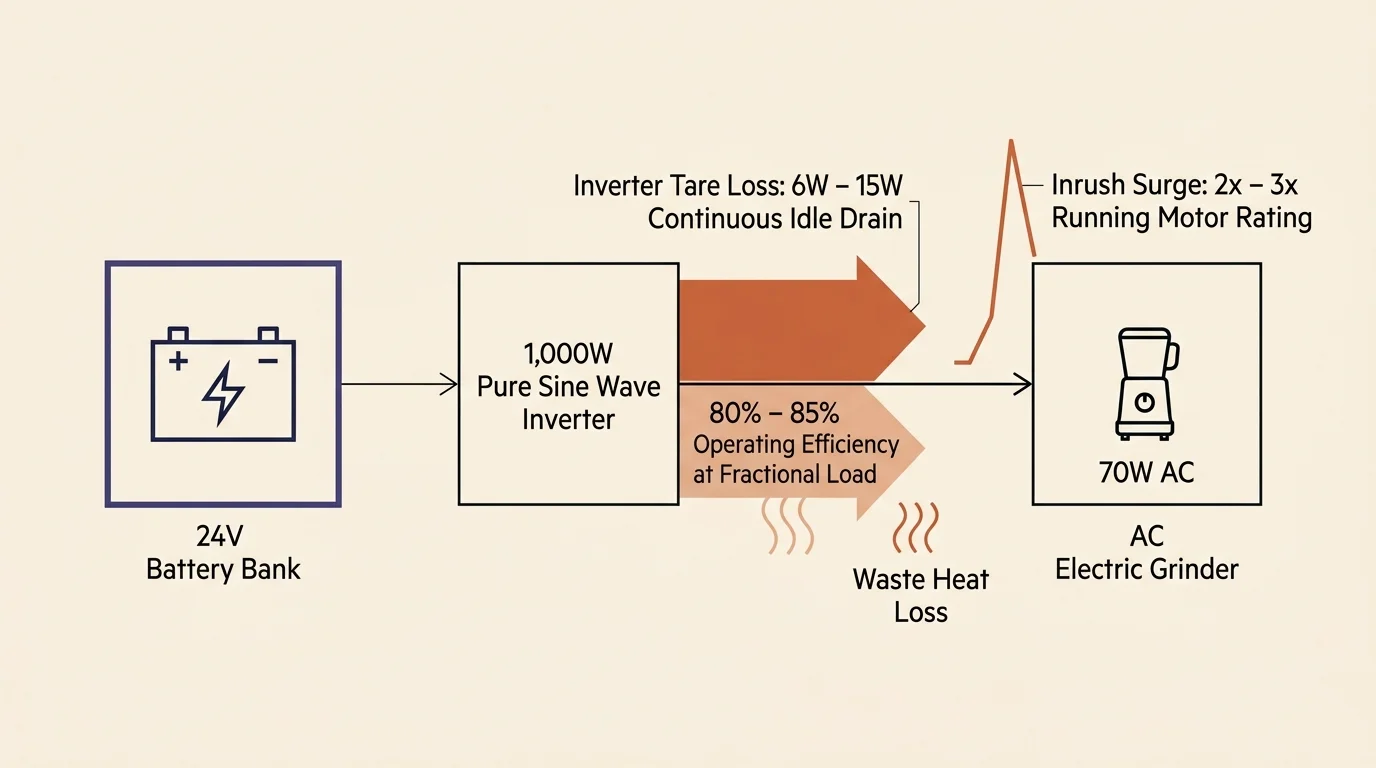
A standard 1,000W inverter consumes between 6W and 15W simply sitting idle with no load attached. Off-grid solar engineers refer to this background drain as the tare loss or parasitic overhead.
If you leave your inverter active for twenty minutes while preparing breakfast, you burn several watt-hours before grinding a bean. That idle draw often exceeds the power needed to crush the coffee itself.
Furthermore, inverters operate inefficiently when handling very small electrical loads. A 1,000W inverter powering a 70W grinder operates at roughly 80% to 85% electrical efficiency, discarding the rest as waste heat.
Motor-driven grinders also create a startup inrush surge when the internal switch closes. This brief current spike can reach two to three times the running motor rating, stressing smaller inverter systems.
“Countertop appliances running on fractional loads force pure sine wave inverters into their least efficient operating curves. Idle draw often wastes more energy than the actual task.” — Off-Grid Systems Designer
These compounded inefficiencies transform an apparently modest kitchen appliance into an energy thief. Understanding these realities is crucial when evaluating an off grid coffee grinder for remote living.
Mechanical Architecture: Why 48mm Hexagonal Burrs Excel Without Power
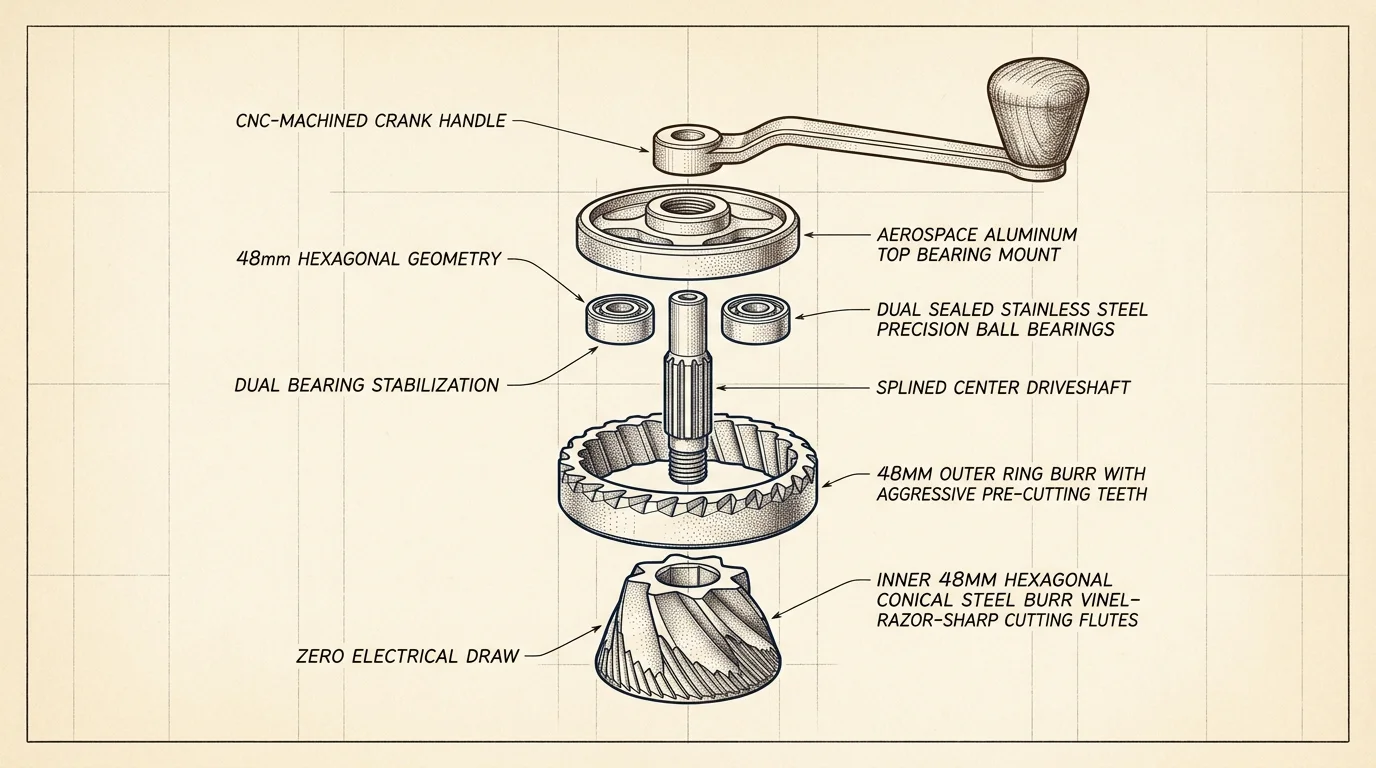
Manual hand grinders have evolved far beyond the squeaky cast-iron pepper mills of the past. Modern hand mills utilize large, precision-machined 48mm stainless steel burr sets cut into aggressive hexagonal or heptagonal geometries.
Burr diameter directly dictates rotational throughput and the physical effort required per turn. Smaller 38mm burrs slip around beans, whereas a 48mm burr set pulls beans down with decisive mechanical bite.
A premium 48mm hex-burr hand mill processes an 18g pour-over dose in 30 to 45 seconds at human cadences. Grinding a finer espresso dose takes roughly 45 to 65 seconds of steady cranking.
The total physical work required to grind an 18g dose equals roughly 25 to 45 joules of human mechanical energy. Converted to electrical units, that equals a minuscule 0.010 watt-hours of manual burr grinder efficiency.
According to Wirecutter’s kitchen equipment reviews, modern high-end hand grinders consistently match the grind consistency of commercial electric units. They accomplish this without touching a battery bank.
Dual ball bearings support the central steel axle to eliminate lateral burr wobble. This rigid alignment produces remarkably uniform coffee grounds without generating excess heat or electrical drain.
Because hand mills rotate between 60 and 100 RPM, they never heat the delicate aromatic oils inside the beans. Low rotational speed protects your cup quality while sparing your renewable battery reserve.
AC Motor Realities: Auditing the Baratza Encore and Fellow Opus
The standard entry point for quality domestic grinding remains the motorized AC conical burr machine. The Baratza Encore and Fellow Opus dominate this category in traditional grid-connected homes across the United States.
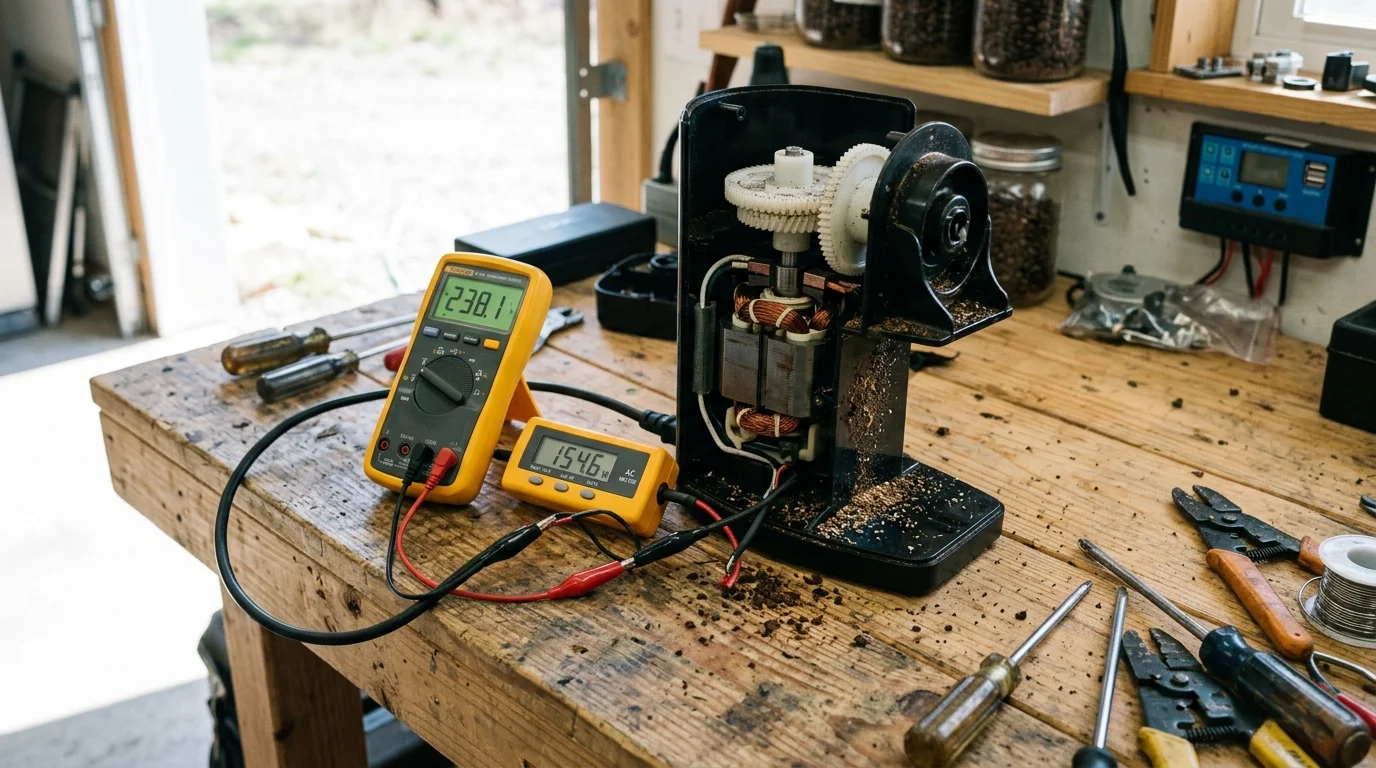
The standard Baratza Encore uses a gear-reduction DC motor powered through an internal AC rectifier circuit. It carries a rated wattage of 70W at 120V AC, drawing roughly 0.8 amps under load.
The Encore grinds whole bean coffee at roughly 0.8 to 1.1 grams per second through 40mm steel conical burrs. Processing a standard 20g coffee dose requires approximately 20 seconds of continuous runtime.
During that 20-second cycle, the Encore draws approximately 0.39 watt-hours of raw electrical energy. On paper, that minimal consumption appears entirely harmless to an off-grid energy budget.
The Fellow Opus takes a different engineering approach, utilizing a larger 140W motor driving 40mm conical burrs. It processes an 18g dose in roughly 20 to 25 seconds, consuming around 0.85 watt-hours.
As reported by Serious Eats in their equipment reviews, low-amp conical grinders deliver excellent grind quality for domestic brewing methods. However, these machines require an uninterrupted AC power line to operate.
When you account for inverter conversion loss, that Fellow Opus cycle draws over 1.05 watt-hours from your batteries. If you accidentally leave the inverter energized for fifteen minutes afterward, total consumption jumps past 5.5 watt-hours.
Counter space represents an additional drawback for these AC machines inside compact cabin kitchens. The Baratza Encore measures 4.7 by 6.3 by 13.8 inches, permanently claiming precious prep room.
The Low-Voltage Middle Ground: Cordless DC Conical Grinders
Rechargeable DC grinders have emerged as a hybrid solution for off-grid kitchens seeking convenience without high AC conversion overhead. The Timemore Grinder Go illustrates this low power coffee grinder design category.
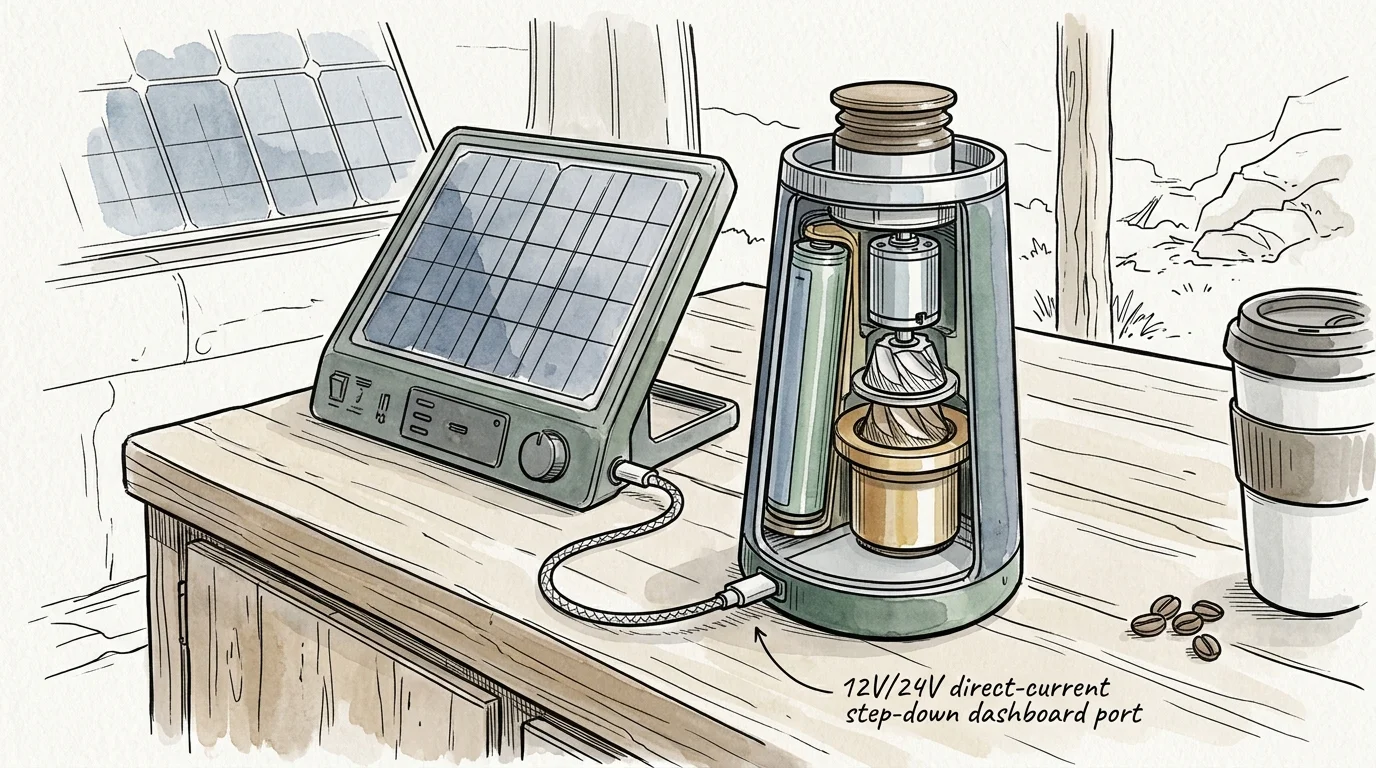
The Grinder Go incorporates a small 20W internal DC motor connected directly to an internal lithium-ion battery pack. Two 3.7V 800 mAh cells wired in series provide 7.4V and 5.92 watt-hours of onboard capacity.
Because the unit recharges via a standard 5V USB-C port, you can charge it directly from a 12V or 24V DC outlet. This connection bypasses your main inverter entirely, avoiding tare loss and AC conversion penalties.
A full battery charge requires roughly two to three hours and provides approximately thirty separate 15g grinding cycles. Each dose consumes roughly 0.20 watt-hours drawn directly from the internal lithium cells.
Throughput is slower than both AC electric units and manual hand grinders, requiring 40 to 60 seconds per dose. The small motor relies on high internal gear reduction to crush hard, light-roast beans without stalling.
These cordless grinders provide effortless motorized grinding for users with limited wrist mobility or joint stiffness. However, internal lithium batteries introduce a distinct failure point in unheated winter cabins.
Freezing temperatures degrade lithium-ion capacity and prevent safe charging below 32 degrees Fahrenheit. In contrast, an all-metal manual hand grinder remains completely unaffected by sub-zero interior cabin temperatures.
Energy and Operational Specification Comparison
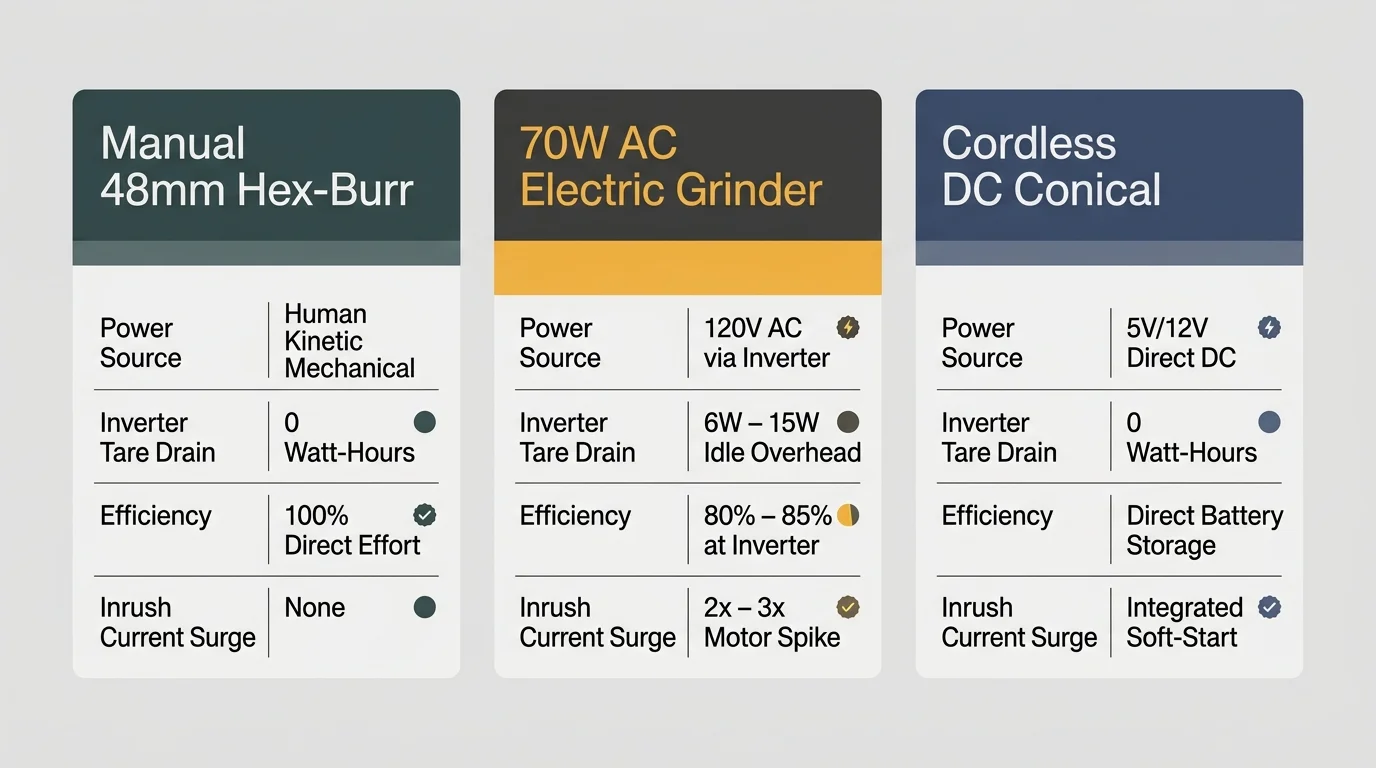
Selecting the right grinder requires balancing power demands, physical dimensions, and throughput speeds. The following table compares standard manual, AC electric, and cordless DC conical grinders.
| Grinder Model | Power Architecture | Rated Motor Wattage | 18g Dose Grind Time | True Battery Draw per Dose | Dimensions (W × D × H) | MSRP |
|---|---|---|---|---|---|---|
| 1Zpresso K-Ultra | Manual Hand Crank | 0W | 35 seconds | 0.00 Wh | 2.4 × 2.4 × 7.7 inches | $259.00 |
| Kingrinder K6 | Manual Hand Crank | 0W | 40 seconds | 0.00 Wh | 2.2 × 2.2 × 7.1 inches | $99.00 |
| Timemore Grinder Go | Internal 7.4V DC Battery | 20W | 50 seconds | 0.24 Wh (USB charge) | 3.4 × 3.4 × 8.7 inches | $89.00 |
| Baratza Encore ESP | 120V AC (Inverter) | 70W | 22 seconds | 3.45 Wh (incl. tare) | 4.7 × 6.3 × 13.8 inches | $199.95 |
| Fellow Opus | 120V AC (Inverter) | 140W | 22 seconds | 4.10 Wh (incl. tare) | 4.3 × 8.3 × 11.0 inches | $195.00 |
The numbers demonstrate an unmistakable pattern regarding energy consumption. While AC grinders grind quickly, their system-level energy tax remains disproportionately high due to necessary inverter runtimes.
Counter footprint differences are equally stark for remote dwellers with limited kitchen counters. A manual hand grinder occupies less than six square inches of shelf space, fitting neatly inside a drawer.
Worked 24V Cabin Scenario: Calculating Winter Battery Depletion
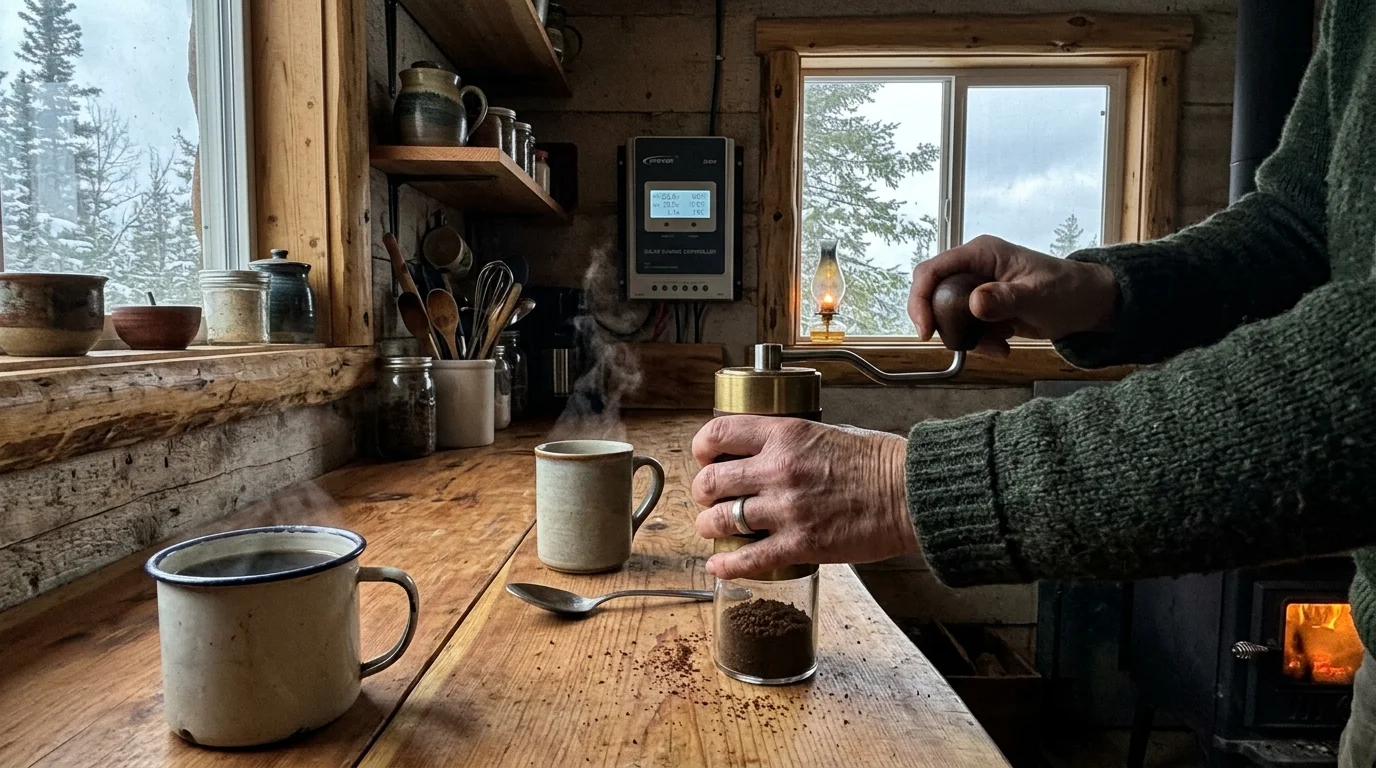
To understand the practical impact of grinder selection, consider a realistic off-grid cabin scenario. Our cabin operates in northern Minnesota during mid-December, using a 24V LiFePO4 battery bank.
The battery bank stores 100 ampere-hours at 24V, providing a nominal storage capacity of 2,400 watt-hours. To protect battery lifespan, the owner limits depth of discharge to 80%, leaving 1,920 usable watt-hours.
Persistent cloud cover and low solar angles restrict energy generation severely. A 400W rooftop solar array produces an average of only 320 watt-hours per day during dark winter weeks.
The household prepares four 18g pour-over coffees each day, totaling 72g of freshly ground coffee. Let us compare the electrical impact of running a Fellow Opus versus using a manual 48mm grinder.
For the Fellow Opus, the owner switches on a 1,000W pure sine wave inverter displaying a modest 10W standby draw. Morning coffee prep, water heating, and grinding keep the inverter energized for fifteen minutes daily.
Fifteen minutes of inverter tare loss consumes 2.50 watt-hours of battery storage every morning. The four grinding cycles run the 140W Opus motor for a combined total of 88 seconds.
At an 82% inverter conversion efficiency, the Opus draws 170.7W from the battery bank during active grinding. Eighty-eight seconds of grinding runtime consumes an additional 4.17 watt-hours of electrical energy.
Total daily energy consumption for the electric grinder equals 6.67 watt-hours. Over a month with no sun, coffee grinding burns 200.1 watt-hours—over 10% of the entire usable battery reserve.
Switching to a 1Zpresso K-Ultra or Kingrinder K6 reduces that daily electrical burden to exactly 0.00 watt-hours. The saved energy keeps cabin LED lighting and water pump pressure active for days.
Extraction Quality: Particle Distribution Versus Human Energy Output
Many home baristas tolerate the energy drain of motorized grinders because they fear hand grinding yields inferior coffee. Rigorous testing of particle size distribution reveals this fear is completely unfounded.
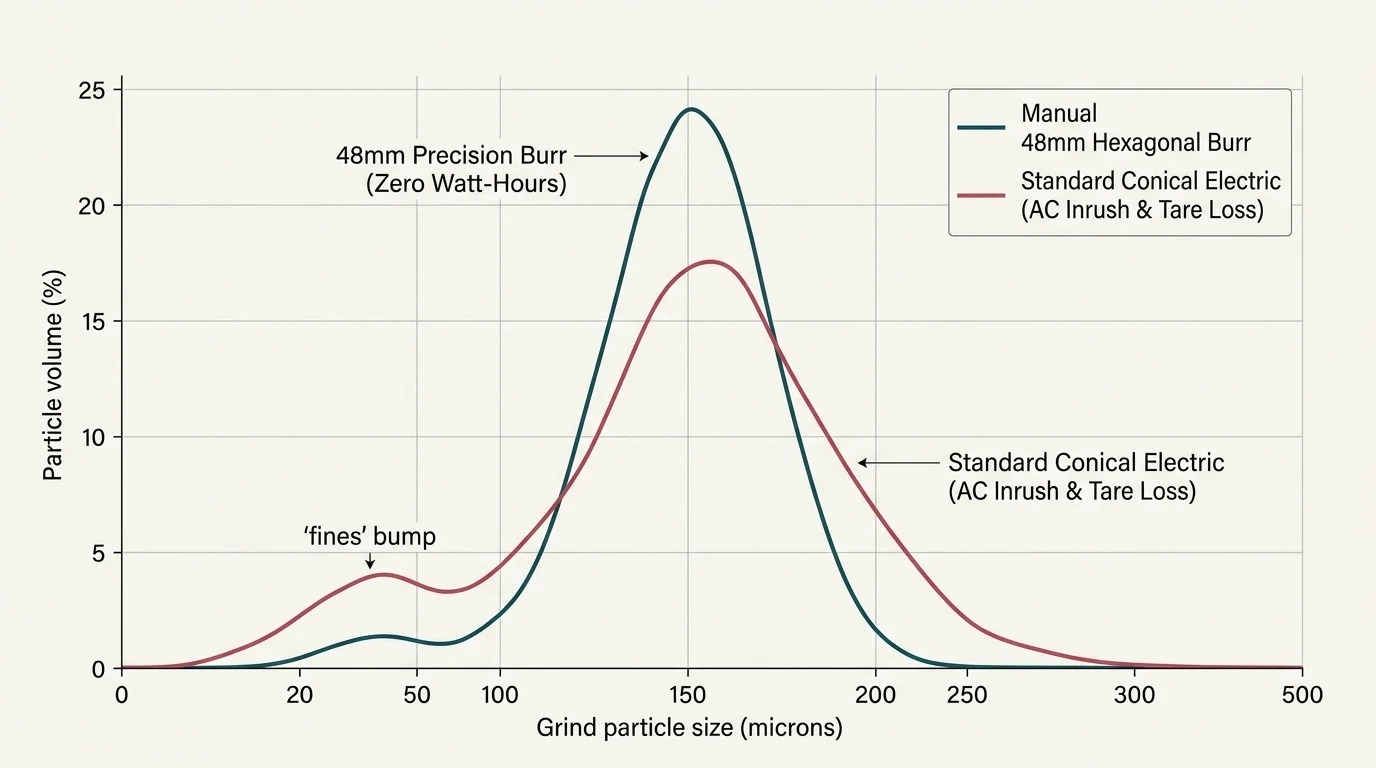
Coffee extraction quality depends on minimizing microscopic coffee dust, known to coffee professionals as fines. Excessive fines clog paper filters and cause over-extraction, creating harsh, bitter notes in the cup.
As testing by America’s Test Kitchen demonstrates, uniform grind size directly prevents bitter over-extraction in pour-over and immersion brewing. Consistent grind size ensures clean, sweet coffee flavors.
High-speed AC grinders spin their burrs at roughly 450 to 550 RPM under load. That high rotational velocity causes bean shattering on impact, generating a higher percentage of unwanted fines.
In contrast, manual 48mm heptagonal burrs operate between 60 and 90 RPM under human power. The slow, controlled cutting action slices coffee beans cleanly along their natural cellular grain.
Laser diffraction particle analyzers show that modern 48mm manual burrs produce narrower particle distributions than entry-level AC grinders. You achieve cleaner cups and clearer tasting notes without burning electricity.
The only trade-off is the physical effort required to operate the manual crank. Grinding light-roast Ethiopian beans requires firm hand strength, though darker roasts crush with minimal resistance.
Off-Grid Grinder Recommendations by Cabin Setup
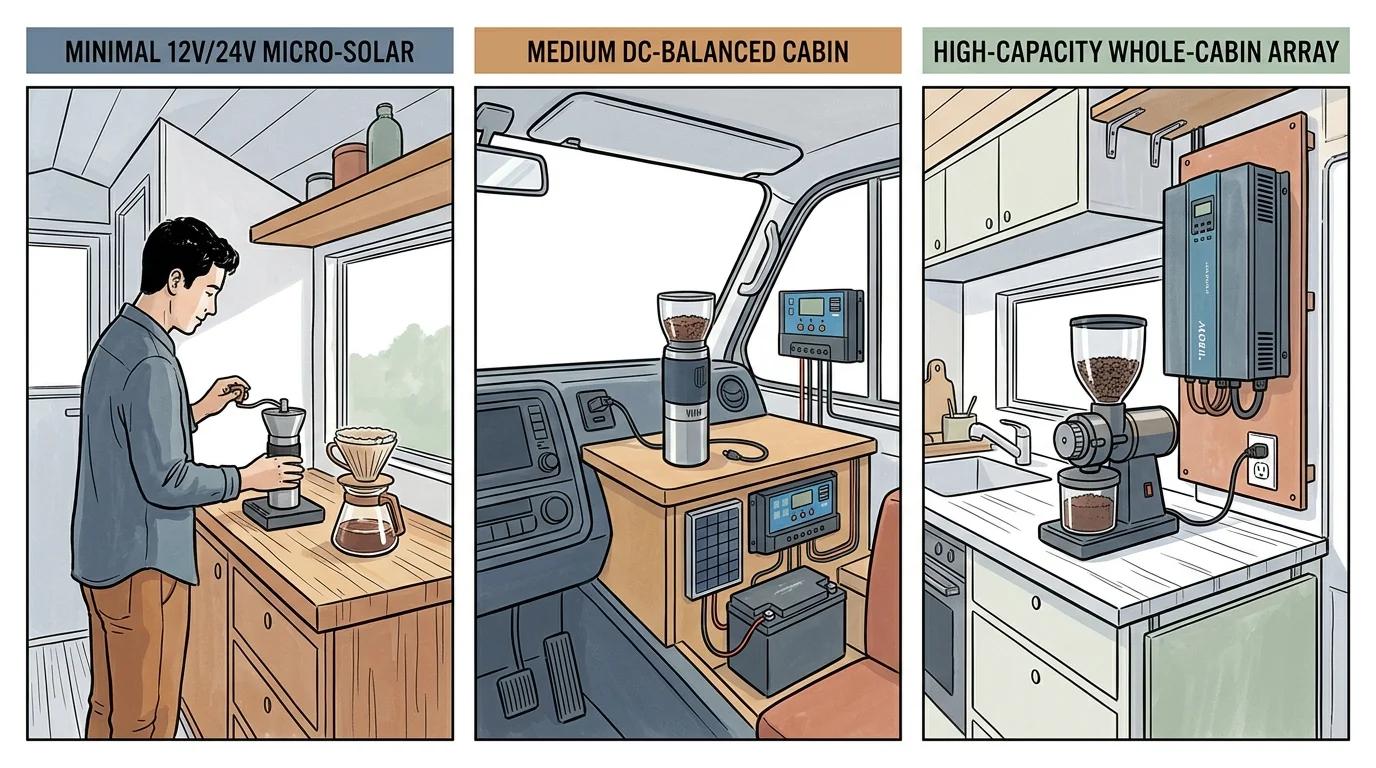
Every remote homestead maintains different priorities regarding physical effort, counter space, and electrical availability. Here are specific recommendations matched to distinct living situations.
For the strict energy minimalist, the Kingrinder K6 represents the best value manual hand grinder on the market. Retailing between $99 and $130, it features 48mm heptagonal burrs and external click adjustment.
The Kingrinder K6 handles everything from fine espresso to coarse French press with outstanding particle consistency. Its aluminum unibody construction endures rugged outdoor handling and sub-zero temperatures effortlessly.
For those seeking the highest build quality, the 1Zpresso K-Ultra at $259 represents the gold standard. Its foldable handle simplifies storage, while its external adjustment dial allows rapid adjustments between brew methods.
If arthritis or joint pain makes hand cranking impossible, choose the Timemore Grinder Go at roughly $89. You can recharge its internal battery pack directly from a 12V USB socket without engaging your inverter.
If you possess an oversized 48V solar array with ample excess power, the Baratza Encore ESP at $199.95 remains viable. Its upgraded 40mm M2 burr set delivers reliable grind uniformity across espresso and drip settings.
Maintenance and Cleaning in Water-Constrained Environments
Water conservation is just as critical as power management when living off municipal utilities. Countertop appliances that require extensive wet washing create unnecessary burdens on hauled water supplies.
Electric grinders retain stale grounds inside internal chutes and around the motor drive housing. Clearing that trapped coffee often requires dedicated vacuum attachments, disassembly tools, or sacrificial cleaning tablets.
Manual 48mm grinders feature direct, vertical drop paths that eliminate ground retention almost entirely. Coffee drops cleanly from the burrs straight into an aluminum catch cup beneath.
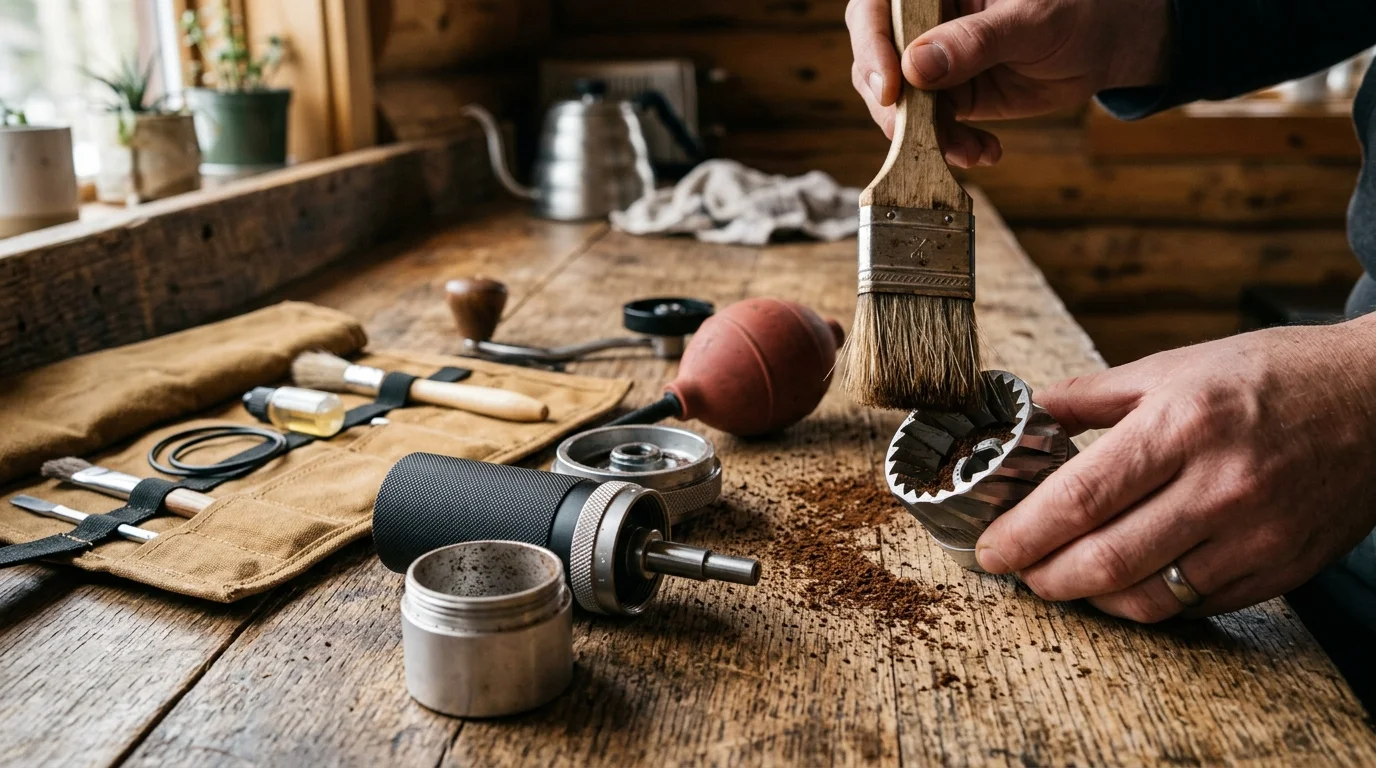
Cleaning a manual grinder requires zero water. A simple dry bristle brush and rubber air blower clear lingering chaff and dust from the burr flutes in thirty seconds.
Never wash manual steel burr assemblies with water or dish detergent. Water trapped inside internal miniature ball bearings causes rust and destroys smooth rotational action permanently.
Keep a soft horsehair brush near your coffee station to sweep the burr set weekly. This dry maintenance routine keeps grounds fresh and preserves your equipment indefinitely without consuming a drop of water.
Frequently Asked Questions
Can a modified sine wave inverter safely power an AC coffee grinder?
No, you should avoid powering AC grinders with modified sine wave inverters. The chopped electrical waveform causes electric motors to run hot, vibrate excessively, and risk premature motor winding burnout.
How long does an 18g dose take to grind manually with 48mm burrs?
A standard 18g medium-coarse pour-over dose takes between 30 and 45 seconds of steady cranking. A finer espresso grind requires greater physical effort and takes roughly 45 to 65 seconds.
Does a cordless USB grinder use less energy than an AC electric grinder?
Yes, cordless USB grinders use substantially less energy overall. Charging via native 12V or 24V USB ports bypasses your power inverter entirely, eliminating standby tare loss and AC conversion penalties.
Do manual hand grinders produce worse particle consistency than electric units?
No, premium 48mm manual grinders actually produce superior particle uniformity compared to budget electric grinders. Slow rotational speeds cut beans cleanly, generating significantly fewer dust-like fines that cause bitterness.
Disclaimer: Product prices, features, and availability change frequently. Prices shown were accurate at time of writing but may have changed. We may earn a small commission from purchases made through links on this site, at no extra cost to you. Always verify current pricing and specifications on the retailer’s website before purchasing.