Freezer meal prepping sixteen waffles every Sunday morning demands rapid heat recovery, not just first-batch crispness. If your waffle iron cannot rebound quickly between pours on a standard 15-amp circuit, your third batch will turn pale, limp, and soggy.
Most appliance reviews evaluate crispness on a single pour, ignoring how back-to-back batter dumps sap internal plate heat. Without sufficient thermal recovery, latent heat loss compounds across successive cycles, causing batter to cling to nonstick grids.
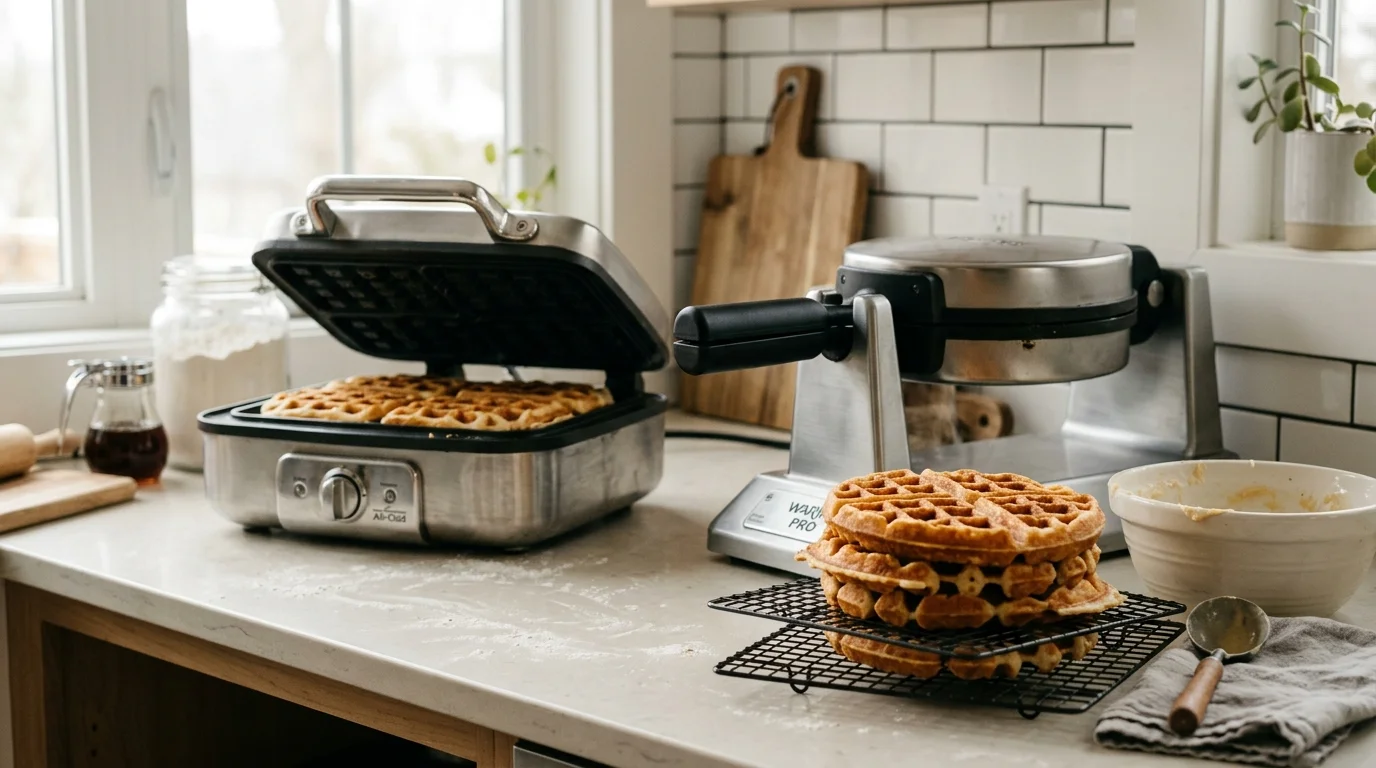
Choosing between stationary dual-plate machines and rotary flip irons determines whether your Sunday meal prep takes twenty minutes or an hour. Here is how continuous thermal recovery dictates your real-world cooking speed.
The Physics of Thermal Recovery in High-Volume Waffle Prep
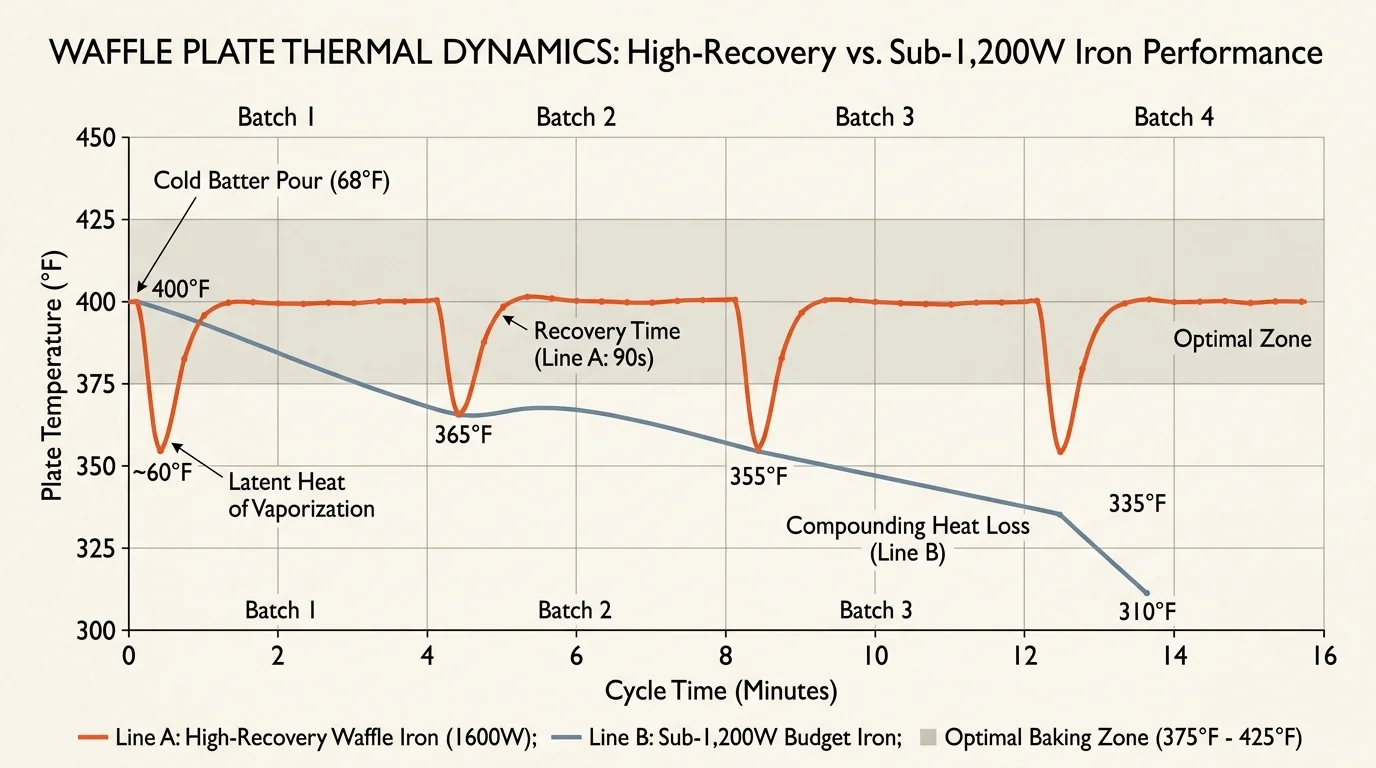
Waffle irons cook best when plates maintain a steady surface temperature between 375°F and 425°F (190°C to 220°C). This intense heat instantly vaporizes moisture on the batter surface, creating a rigid, golden outer crust.
When you pour half a cup of batter at 68°F into the iron, plate temperature plunges by 50°F to 100°F. If you use chilled buttermilk batter straight from the refrigerator at 40°F, the initial temperature drop is even steeper.
This sharp decline occurs because water requires immense energy to transition into steam. Appliance engineers call this energy drain the latent heat of vaporization.
Thermal recovery refers to the time an appliance needs to return to its target baking temperature after you remove a cooked waffle. In batch cooking, this recovery interval determines whether your next waffle crisps immediately or stews in trapped moisture.
“When a cold liquid hits a hot grid, the metal surface starves for heat. If the heating element cannot replenish that lost energy immediately, moisture pools instead of venting as steam.”
According to culinary equipment testing from Serious Eats, rapid heat delivery directly controls how effectively steam escapes the waffle core. Trapped steam softens the crust and accelerates plate sticking.
When you rush back-to-back batches without pausing, sub-1,200W irons experience compounding thermal deficits. Each successive pour starts at a lower baseline temperature, dragging batch four into a pale, soggy failure.
Electrical Realities: 15-Amp Kitchen Circuits and Wattage Limits
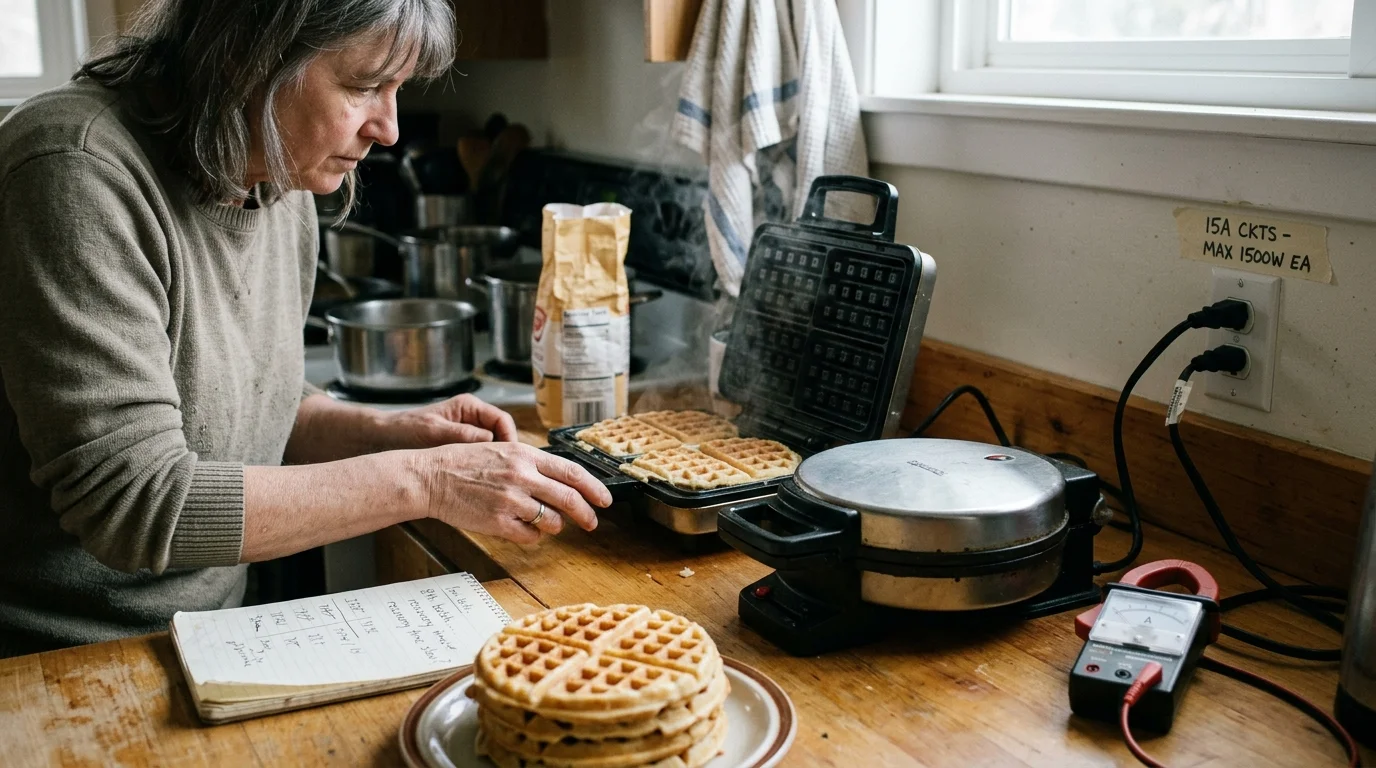
To understand thermal recovery, you must evaluate wattage (how much power an appliance uses, higher usually means faster cooking). Your standard North American kitchen outlet supplies 120 volts along a 15-amp branch circuit breaker.
Basic electrical formulas dictate that 120 volts multiplied by 15 amps yields a absolute maximum capacity of 1,800 watts. Running an appliance at this upper ceiling demands the entire electrical circuit.
High-end stationary batch irons draw a full 1,800 watts to feed heavy heating coils embedded directly beneath cast-aluminum plates. This raw power enables these units to reheat cold grids in under thirty seconds.
By contrast, double-sided rotary flip irons typically draw around 1,400 watts. That total wattage must split across two separate cooking chambers, leaving each waffle cavity with roughly 700 watts of heating power.
Single rotary flip irons generally operate between 1,000 and 1,100 watts. While adequate for a single breakfast serving, 1,100 watts struggles to replenish heat during repetitive, back-to-back baking cycles.
If you run a 1,800-watt waffle maker alongside a two-slice toaster or an electric kettle on the same circuit, you will trip the breaker. You must dedicate an isolated circuit outlet to high-wattage batch appliances on Sunday mornings.
Stationary Dual-Plate vs. Rotary Flip Mechanics: Heat Transfer Dynamics
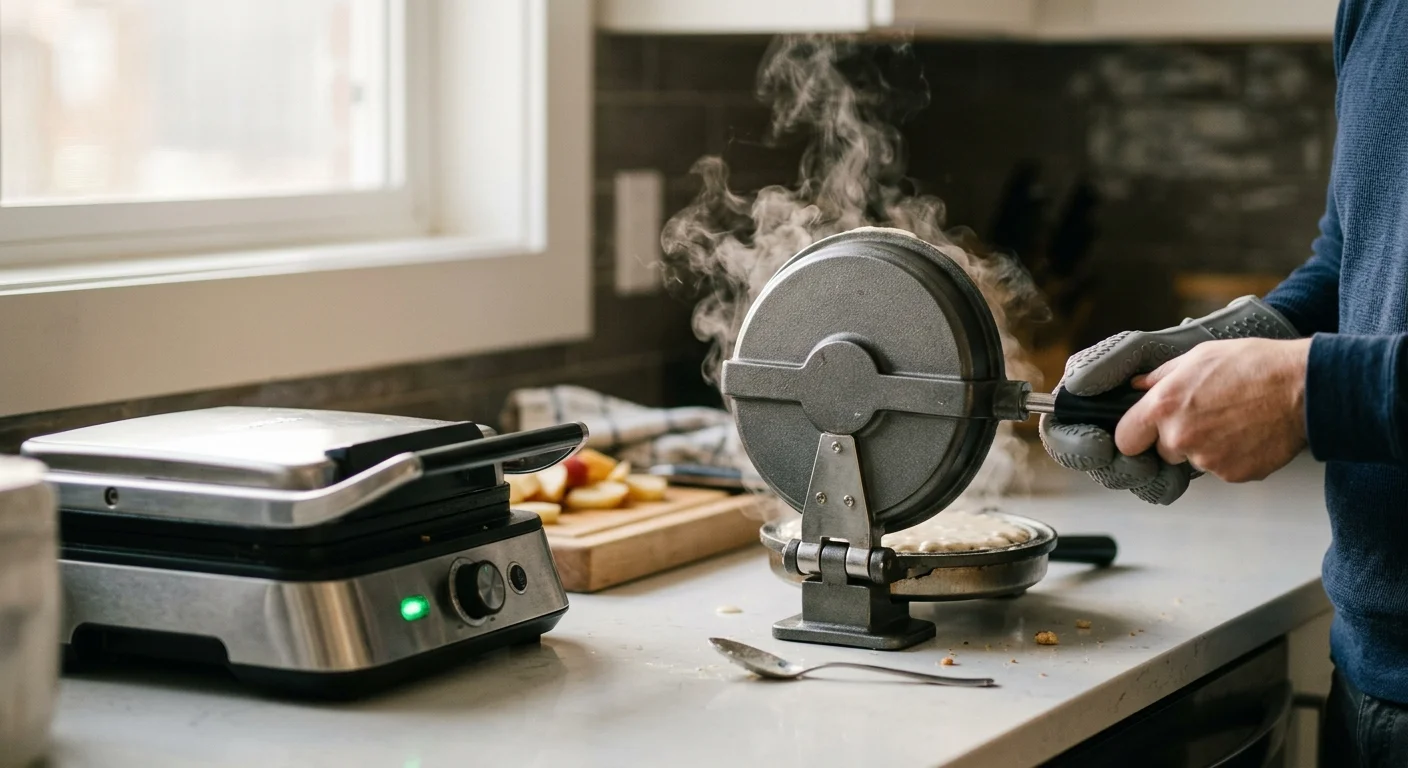
Stationary dual-plate waffle irons keep both cooking grids horizontally fixed throughout the baking cycle. These units depend entirely on batter expansion to establish solid contact with the upper grid.
As the bottom plate heats the batter, chemical leaveners like baking powder release carbon dioxide gas. This expanding gas pushes the wet batter upward into the cavities of the top plate.
If the stationary upper plate drops below 320°F due to repeated pours, that leavening lift slows down. The top of your waffle never develops an even, dark crust because physical surface contact remains weak.
Rotary flip irons resolve surface contact through gravity rather than thermal leavening lift. After pouring your batter onto the lower grid, you close the iron and rotate the entire assembly 180 degrees.
This inversion forces wet batter to coat the top plate while the iron is still hot. Gravitational distribution guarantees uniform waffle thickness, even when heating elements lack high-wattage recovery speeds.
As equipment analyses by America’s Test Kitchen demonstrate, flipping irons create superior batter distribution in Belgian-style pockets. However, mechanical rotation does not eliminate the physical requirement for thermal recovery between batches.
While the rotary design ensures even shape, low-wattage rotary plates still bleed heat during successive runs. Flipping wet batter against an unrecovered 300°F plate produces a limp waffle with a rubbery texture.
16-Waffle Sunday Scenario: A Quantitative Time and Heat Comparison
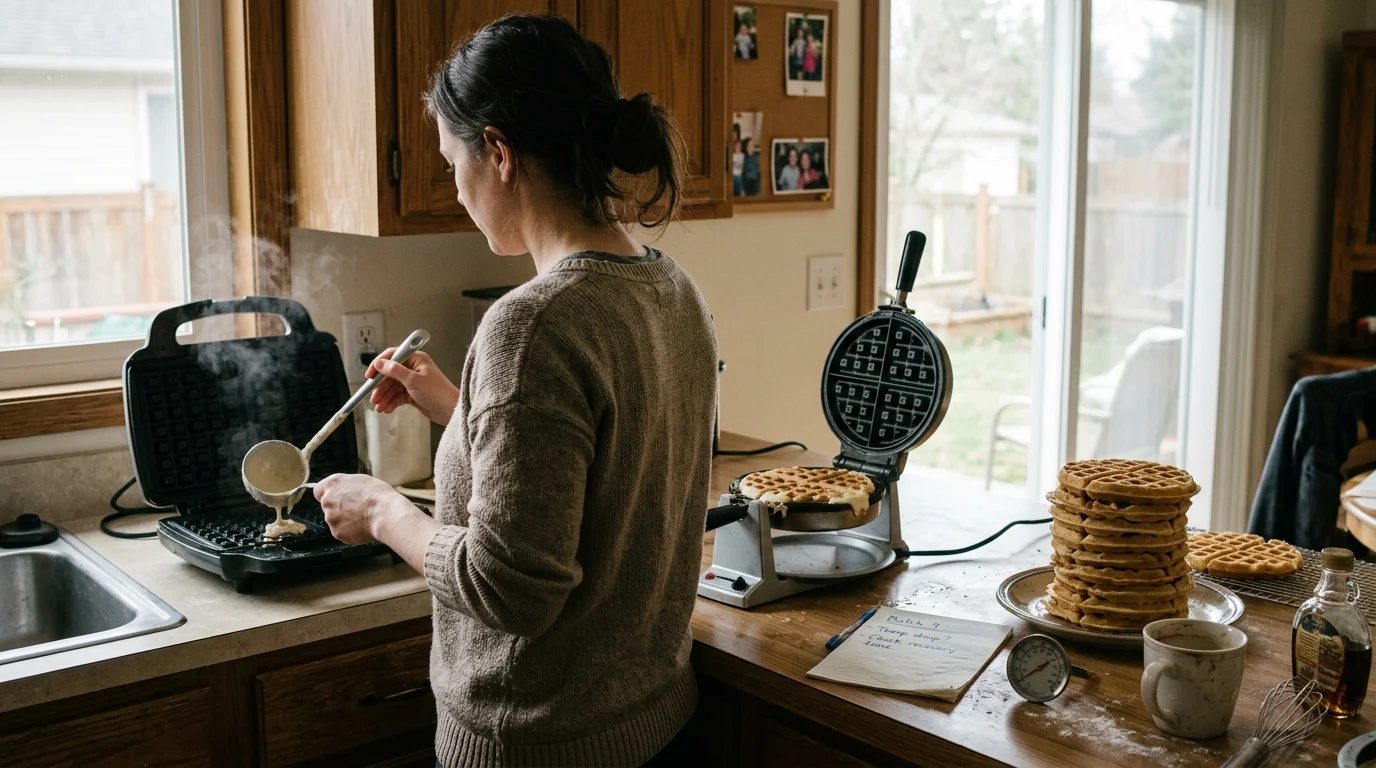
Consider a parent meal-prepping sixteen Belgian waffles every Sunday morning to freeze for weekday school breakfasts. This real-world scenario uses a standard batter recipe requiring half a cup of batter per waffle section.
The first setup utilizes a 1,800-watt stationary four-slice iron like the Breville Smart Waffle Pro. Baking four waffles simultaneously requires four complete cycles to yield the target sixteen waffles.
The Breville bakes a four-slice batch in four minutes and rebounds to full operating temperature in twenty seconds. Total active baking time spans sixteen minutes, with recovery pauses totaling just over one minute.
Factoring in forty seconds per batch to remove cooked waffles and pour fresh batter, the entire session finishes in nineteen minutes. The thick cast-aluminum plates retain heat so effectively that batch four browns identically to batch one.
The second setup uses a 1,400-watt dual rotary iron like the Cuisinart WAF-F20 Double Belgian. This design cooks two waffles at once across two opposing chambers, requiring eight consecutive baking cycles.
Each dual cycle takes three minutes and forty-five seconds to bake, but the lower wattage per cavity slows thermal recovery. The iron requires a sixty-second idle recovery between cycles to maintain crisping temperatures.
Eight cycles at 3.75 minutes of baking, plus seven recovery minutes and staggered pour times, pushes total prep time to thirty-eight minutes. If you skip those sixty-second recovery pauses, batches five through eight turn pale and stick.
The third setup uses a standard 1,100-watt single rotary iron like the Presto FlipSide. Producing sixteen waffles on a single-cavity iron requires sixteen distinct cooking cycles.
Each single waffle bakes in three minutes and thirty seconds, but the lightweight plate loses significant heat on every pour. Without ninety seconds of empty, closed-lid reheating between pours, bake times stretch past five minutes.
At sixteen individual cycles, this single iron demands fifty-six minutes of pure baking time alone. Adding recovery intervals and batter handling balloons your Sunday morning prep session to seventy-six minutes.
Detailed Specifications and Thermal Metrics Across Leading Models
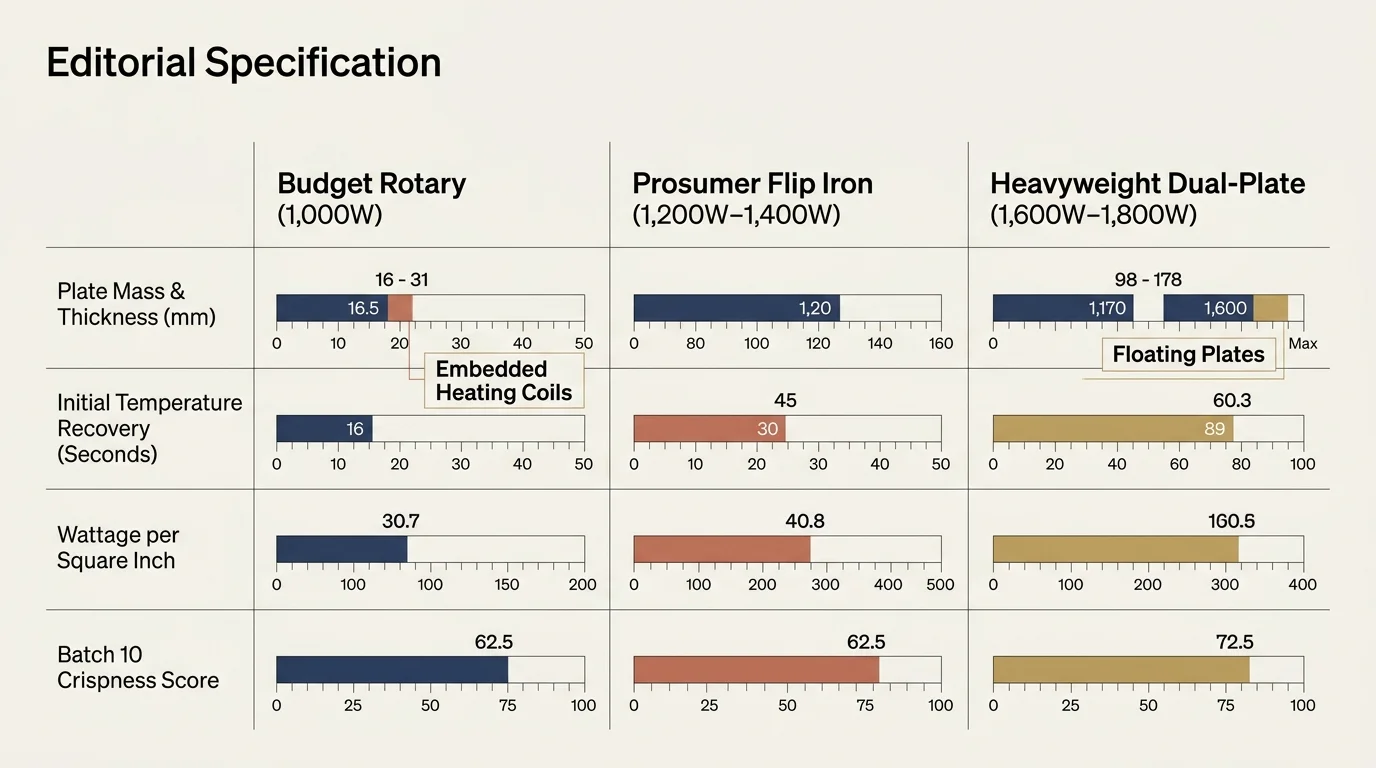
Evaluating continuous batch performance requires looking beyond brand marketing claims to examine real engineering specifications. Plate thickness, heating element placement, and wattage directly control your meal prep efficiency.
The table below compares four market-leading waffle makers across measurable thermal attributes, physical capacity, and recovery benchmarks.
| Appliance Model | Plate Configuration | Wattage Draw | Waffle Capacity | Thermal Recovery Time | Dimensions (Inches) | Weight (lbs) |
|---|---|---|---|---|---|---|
| Breville Smart Waffle Pro 4-Slice | Stationary Dual-Plate | 1,800 W | 4 square slices | 15–25 seconds | 15.7 x 18.5 x 5.8 | 18.2 lbs |
| Cuisinart WAF-F20 Double Belgian | Rotary Dual-Chamber | 1,400 W | 2 round waffles | 60–75 seconds | 10.5 x 15.1 x 9.3 | 11.5 lbs |
| All-Clad 4-Slice Digital Waffle Maker | Stationary Dual-Plate | 1,800 W | 4 square slices | 20–30 seconds | 13.5 x 18.0 x 6.5 | 16.0 lbs |
| Presto 03518 FlipSide Belgian | Rotary Single-Chamber | 1,100 W | 1 round waffle | 90–120 seconds | 12.0 x 14.8 x 4.0 | 6.2 lbs |
Notice the inverse relationship between waffle capacity, wattage draw, and recovery delay across these models. High-wattage stationary units recover three to four times faster than lower-wattage rotary models.
According to appliance evaluations by Wirecutter, high-wattage heating grids distribute thermal energy far more evenly across wide surface areas. That uniform heat distribution prevents cool spots around plate edges.
Units pulling 1,800 watts incorporate thick, die-cast aluminum plates designed to act as thermal heat sinks. That physical mass stores thermal energy, cushioning the temperature drop when cold batter touches the metal.
Lighter irons use thin stamped plates that shed heat rapidly upon contact with wet ingredients. Those thin plates must rely entirely on their heating elements to claw back up to temperature.
Countertop Footprint, Storage, and Sunday Workflow Practicalities
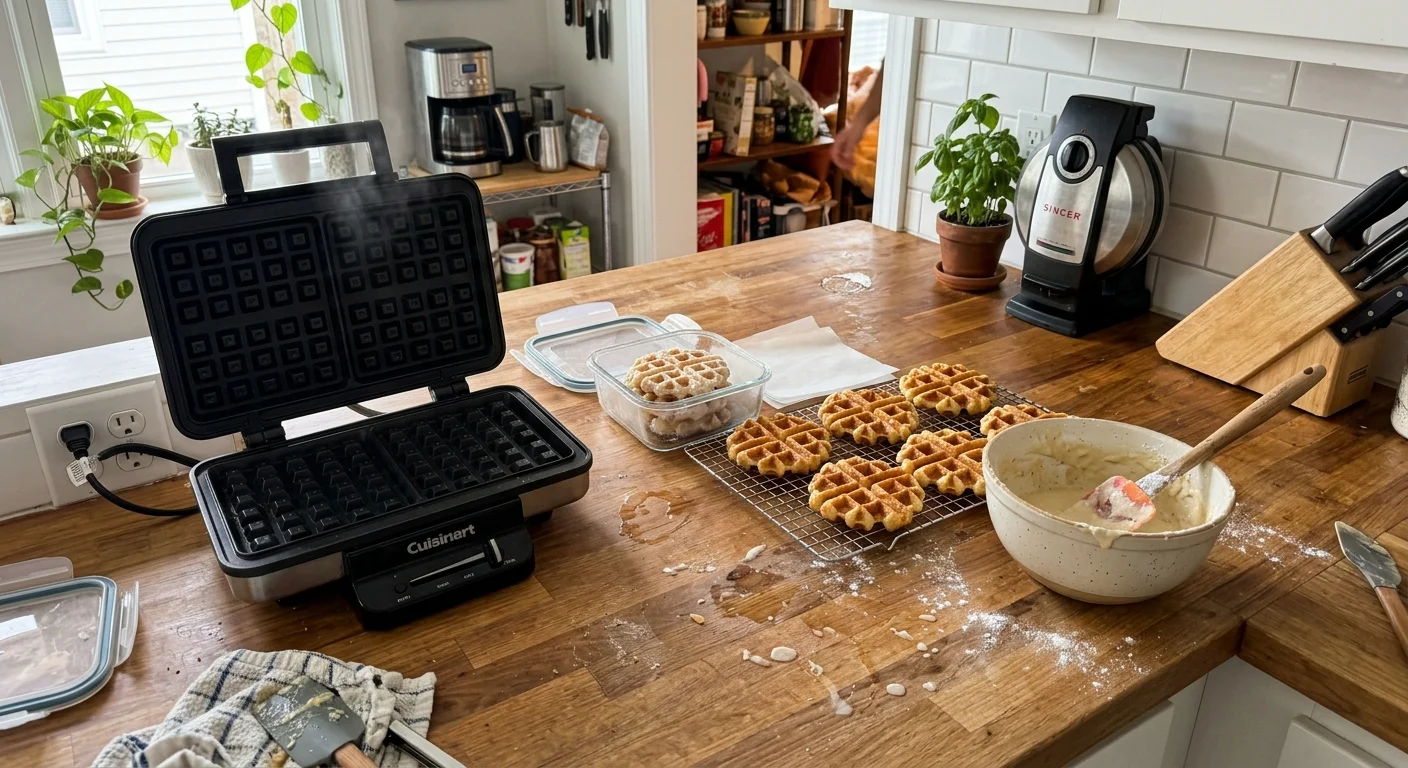
While heavy stationary irons offer unmatched recovery speeds, they command substantial countertop real estate. A four-slice stationary iron measures nearly sixteen inches wide and nineteen inches deep when open.
Weighing eighteen pounds, the Breville Smart Waffle Pro is an appliance you must lift with two hands. Storing this unit inside a standard kitchen base cabinet requires clearing an entire shelf compartment.
If your kitchen features limited counter space, rotary flip irons provide distinct vertical advantages during storage. Many rotary units store upright on their end, occupying a minimal footprint inside narrow pantry cabinets.
The Presto FlipSide features an ingenious base lock that pivots the iron into an upright standing position. This lock reduces its storage footprint to just three inches of cabinet shelf depth.
However, operating a rotary flip iron during active meal prep requires vertical and front-to-back clearance. You need at least fifteen inches of open overhead space to rotate dual-chamber models without striking upper cabinets.
Rotary models also demand careful attention to batter run-off. When flipped, excess batter can seep through the hinge seam and coat your kitchen counter if you overfill the cavities.
Stationary four-slice irons typically incorporate wide overflow moats surrounding the entire perimeter of the lower plate. These wide moats catch escaping batter and bake it into crisp strips that peel away cleanly.
Long-Term Durability, Plate Coatings, and Cleaning Realities
Batch cooking sixteen waffles every Sunday subjects nonstick coatings and internal wiring to intense thermal stress. Continuous heat cycling causes cheap nonstick coatings to degrade and blister over months of repetitive use.
Traditional nonstick surfaces rely on PTFE coatings applied over cast aluminum grids. When operated continuously for an hour, budget irons often overheat localized spots, weakening the chemical bond of the coating.
Ceramic coatings present a safer alternative but can lose their natural release properties after repeated high-temperature exposure. Once a nonstick coating fails during meal prep, sticking batter ruins entire batches and slows down recovery.
Stationary units often feature permanently fixed cooking plates rather than removable grids. While fixed plates seem harder to clean, they provide direct metal-to-element contact for superior thermal efficiency.
Removable plates introduce an air gap between the heating coil and the cooking surface. That microscopic air buffer insulates the grid, slowing heat transfer and extending thermal recovery times significantly.
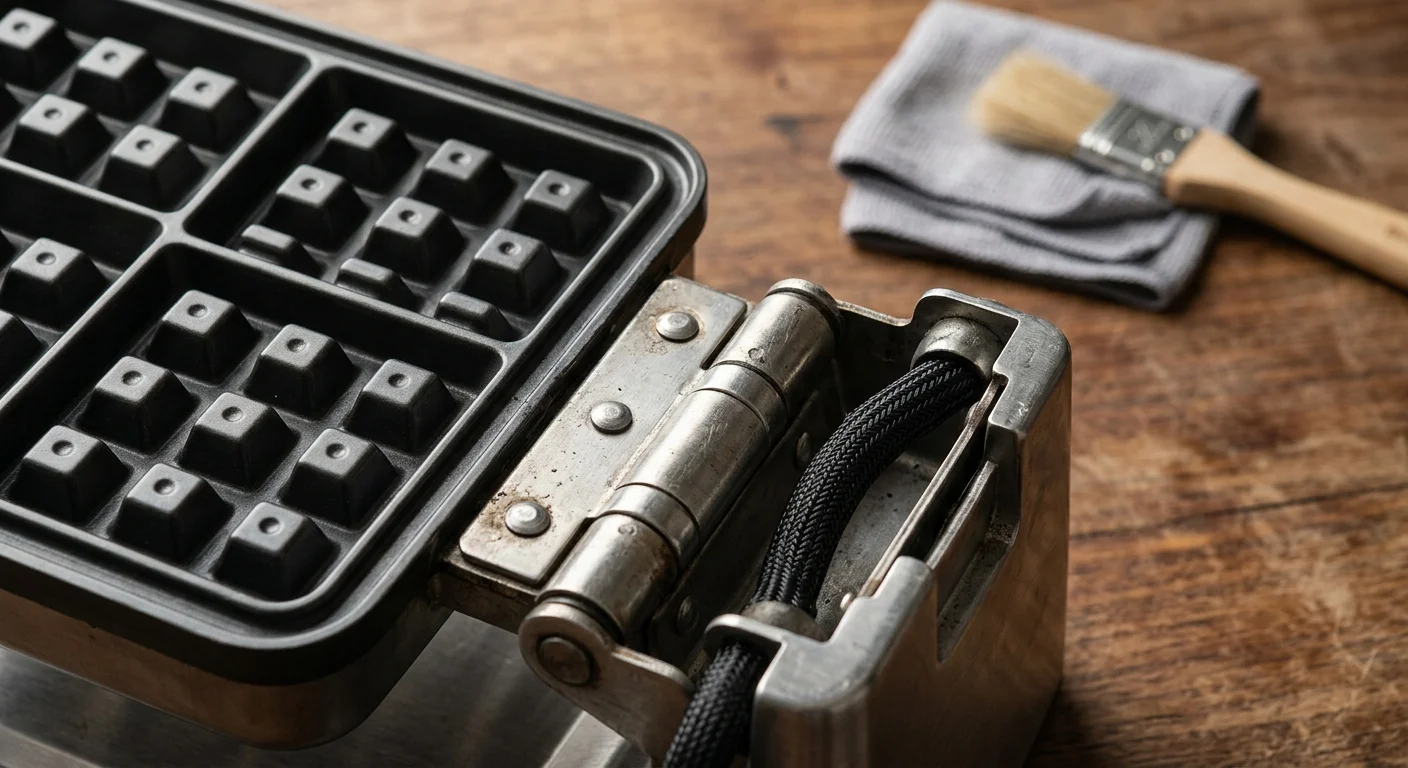
Mechanical wear also differs dramatically between stationary and rotary designs over years of ownership. Rotary irons house their high-voltage power wires inside hollow pivot hinges that rotate 180 degrees every batch.
Rotating that hinge dozens of times every Sunday eventually strains internal wiring harnesses. Stationary dual-plate irons utilize rigid, heavy-duty rear spring hinges that experience far less mechanical fatigue over time.
Top Appliance Recommendations for Sunday Batch Cooking
If your primary goal is meal-prepping dozens of waffles in minimum time, select the Breville Smart Waffle Pro 4-Slice. Its 1,800-watt heating system and massive cast-aluminum plates eliminate thermal lag across unlimited batches.
The Breville features intuitive preset programs (automatic settings for common tasks like Belgian, classic, chocolate, or buttermilk waffles). Its internal thermal sensors adjust baking times dynamically if plate temperatures drop slightly between cycles.
For budget-conscious cooks who still want dual-waffle capacity, the Cuisinart WAF-F20 Double Belgian represents the best value. It costs half the price of premium stationary irons while producing two thick Belgian waffles per cycle.
To succeed with the Cuisinart during bulk prep, you must practice patience. Wait sixty seconds after removing batch two before pouring batch three to allow its 1,400-watt heating elements to recover.
If you prep in a tiny apartment kitchen with strict storage limitations, choose the Presto 03518 FlipSide Belgian Waffle Maker. Its 1,100-watt element cannot match the speed of commercial-grade units, but its compact vertical storage is unmatched.
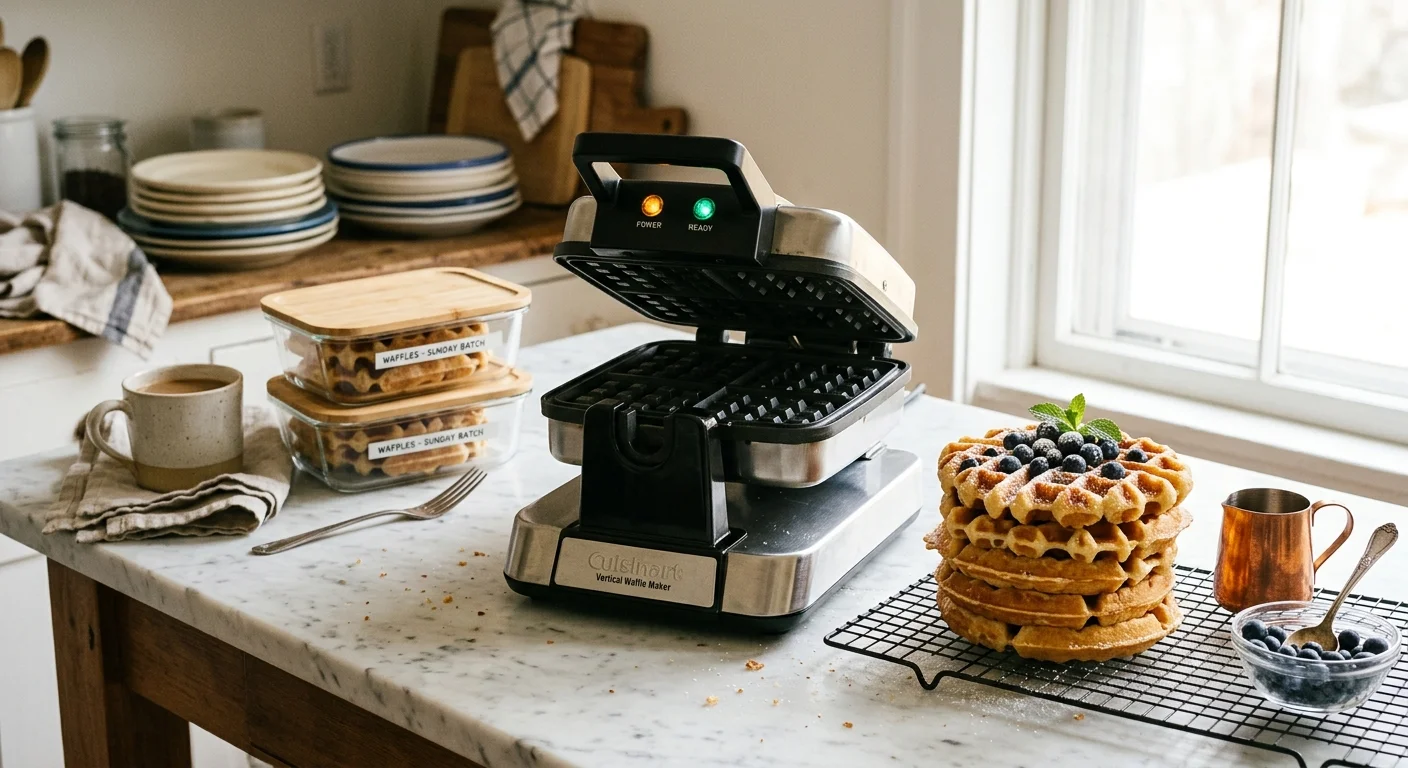
When cooking sixteen waffles on the Presto, place your cooked waffles on a wire cooling rack inside a 200°F oven. This keep warm technique (maintains food at serving temperature after cooking) preserves crispness while you finish the long batch session.
Once cooled, freeze your waffles in a single layer on parchment-lined sheet pans before packing them into airtight bags. This flash-freezing method prevents individual waffles from fusing together during storage.
Frequently Asked Questions
Why do my waffles get soggy after the second or third batch?
Your waffles turn soggy because the iron has not fully recovered its initial baking temperature. Pouring cold batter into an unrecovered grid causes plate temperatures to drop below 320°F, preventing moisture from venting as steam.
How long should I wait between waffle batches to let the iron recover?
Heavy 1,800-watt stationary irons recover within 15 to 30 seconds of closing the lid. Lower-wattage rotary flip irons pulling 1,100 to 1,400 watts require 60 to 90 seconds of empty reheating between batches.
Are rotary flip waffle makers better than stationary waffle makers?
Rotary flip irons excel at distributing batter evenly through gravity, producing uniform Belgian waffles with lighter leavening. However, stationary 1,800-watt irons offer superior thermal mass and heat recovery for high-volume batch cooking.
Can I run an 1,800-watt waffle maker on any kitchen outlet?
You can run an 1,800-watt waffle maker on standard 15-amp, 120-volt household outlets. However, the iron consumes the maximum circuit capacity, meaning you cannot run other heating appliances on the same circuit simultaneously.
Do removable plates affect waffle maker cooking speed?
Yes, removable plates transfer heat less efficiently than fixed plates due to small air gaps between the heating element and grid. Fixed plates heat faster, recover quicker between batches, and deliver more consistent browning.
Disclaimer: Product prices, features, and availability change frequently. Prices shown were accurate at time of writing but may have changed. We may earn a small commission from purchases made through links on this site, at no extra cost to you. Always verify current pricing and specifications on the retailer’s website before purchasing.