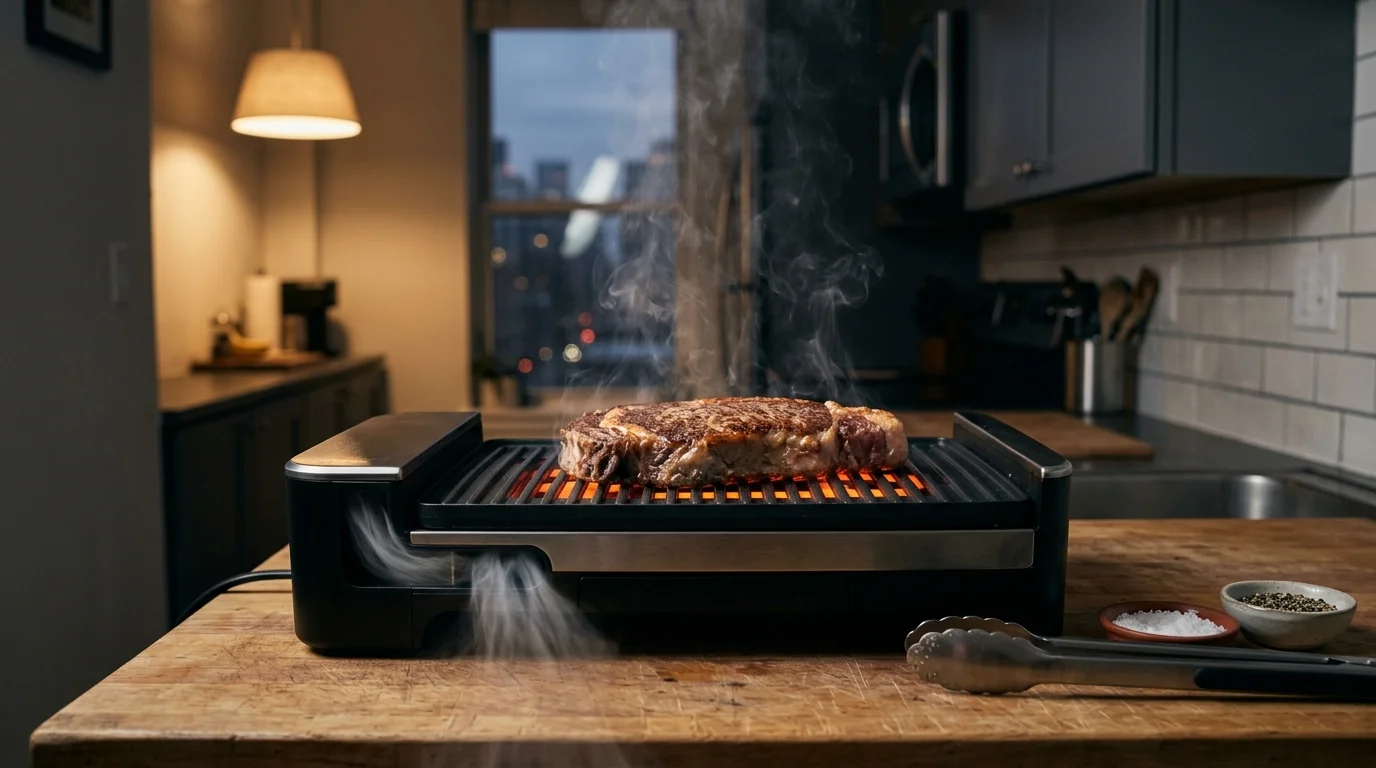
Searing a marbled steak in a compact apartment often ends with a shrieking smoke detector. Choosing the right electric grill sensitive smoke alarm solution requires understanding how sizzling grease becomes airborne haze.
Standard manufacturer marketing claims that passive water pans eliminate up to 87 percent of smoke. However, these promotional ratings only measure element flare-ups, ignoring hot surface oil vaporization entirely.
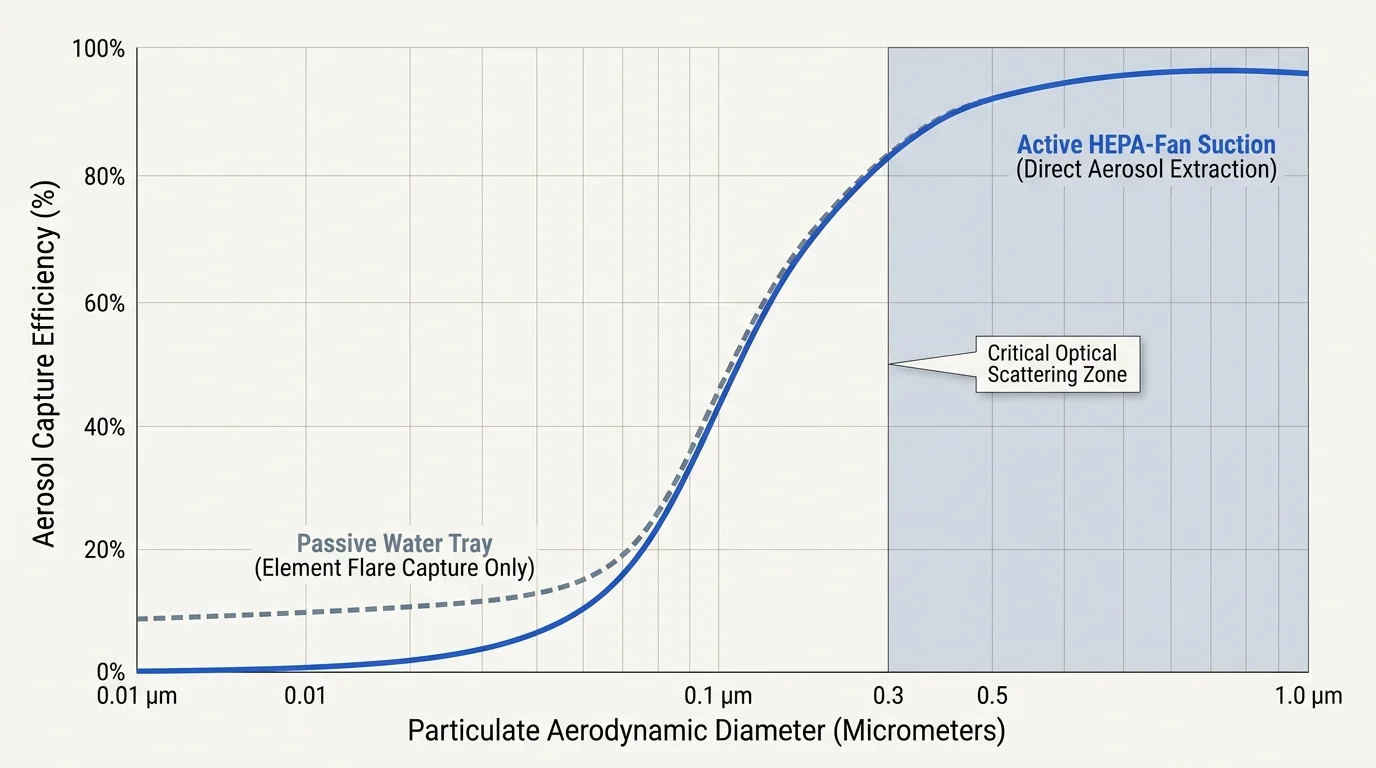
Passive water trays merely catch falling grease droplets, whereas active HEPA-fan systems actively capture sub-micron liquid aerosols before they can drift toward your sensitive optical sensors.

Smoke Physics: Why Photoelectric Alarms Trigger Indoors
Cooking oil fumes consist of fine particulate matter measuring between 0.01 and 1.0 micrometers in aerodynamic diameter. When you heat animal fat past its smoke point, it volatilizes into a dense suspension of microscopic liquid droplets.
Apartment buildings in the United States primarily utilize photoelectric smoke detectors rather than older ionization alarms. These optical sensors house a light-emitting diode and a photosensitive receiver positioned at an angle.
When airborne particles enter the detection chamber, they scatter the infrared light beam toward the light sensor. Particles sized between 0.3 and 1.0 micrometers match infrared light wavelengths perfectly, scattering rays with maximum efficiency.
Standard building regulations compound this kitchen detection issue in smaller multifamily dwellings. Most residential architects position kitchen alarms inside cramped circulation paths.
Under Section 29.11.3.4 of the National Fire Protection Association (NFPA) 72 code, smoke alarms must sit at least 10 feet away from stationary cooking appliances. This statutory clearance prevents nuisance alarms from normal culinary vapors.
In a 500-square-foot urban layout, your countertop often sits only 6 to 8 feet from the nearest ceiling detector. That proximity violates the standard clearance threshold and creates an ongoing nuisance during high-heat searing.
Because optical alarms respond aggressively to light-scattering grease droplets, uncontained cooking mist triggers false alarms within minutes. Stopping these alarms requires controlling the physical escape of 0.3-to-1.0-micrometer aerosol particles.
How Passive Water-Tray Grills Extinguish Grease Flare-Ups
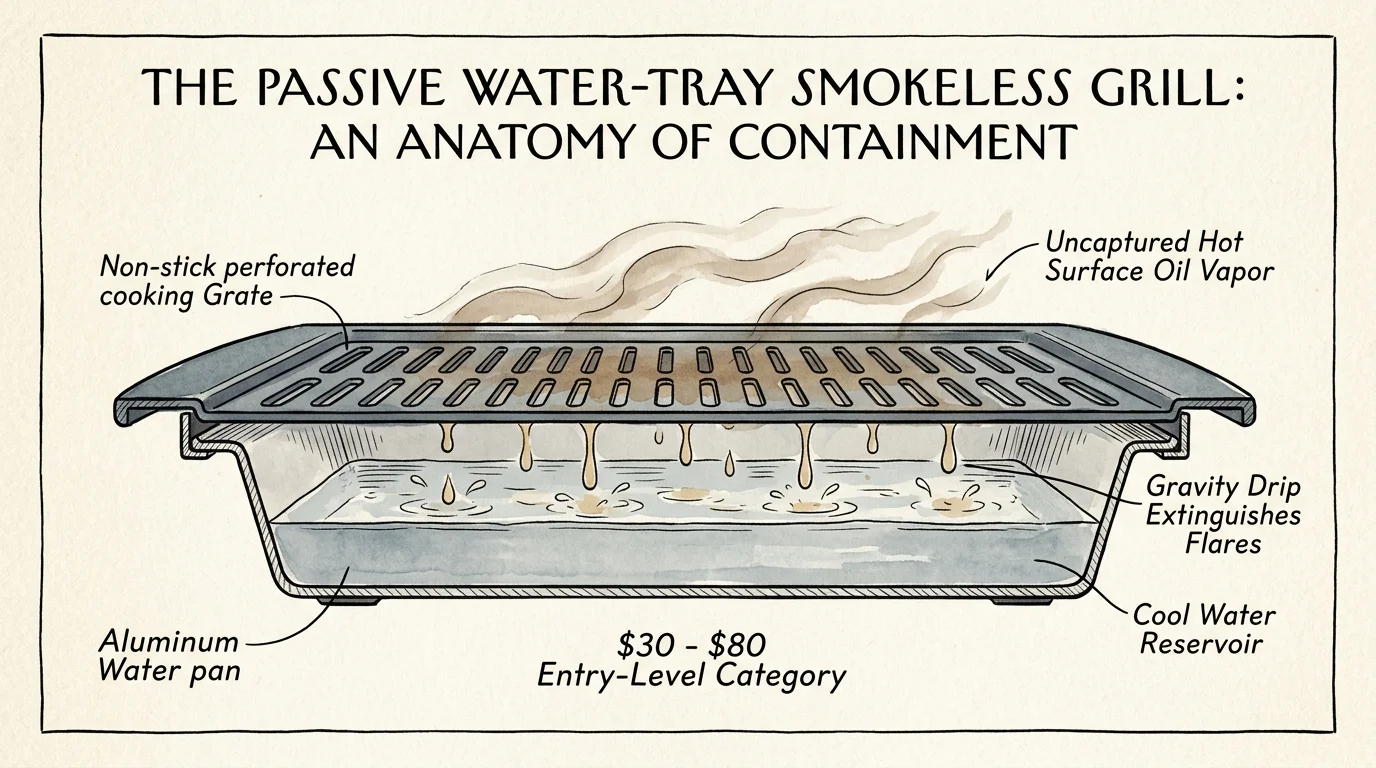
Passive smokeless grills use a perforated metal plate suspended directly above an open water reservoir. Brands like Chefman and Elite Gourmet manufacture these appliances for budget-conscious consumers.
These units retail between $30 and $80, offering an accessible entry point for indoor grilling. Their mechanical operation relies entirely on basic gravity and thermal conduction.
As fat renders out of meat, it drips through the slotted grate bars toward the electric heating element below. Deflector channels guide the liquid fat past the element and into the lower basin.
The lower tray contains standard tap water, which maintains a maximum liquid temperature of 212 degrees Fahrenheit. When rendering fat falls into the reservoir, the cool liquid quenches it instantly.
By keeping rendered drippings below their typical 375-to-450-degree smoke points, the water bath prevents flare-ups. This quenching mechanism supports manufacturer claims of an 80 to 87 percent smoke reduction.
However, this grease-quenching design features a major engineering blind spot during high-heat searing. The water pan only treats drippings that successfully leave the cooking surface.
The heavy aluminum cooking grate itself must reach 400 to 450 degrees Fahrenheit to brown meat effectively. When marbled beef contacts those hot metal ridges, surface fat vaporizes immediately at the sear point.
Because passive water-pan grills lack suction fans, thermal buoyancy carries that surface-generated oil aerosol straight upward. The vapor drifts across your ceiling directly into nearby optical sensors.

Active Fan and HEPA Filtration Mechanics Explained
Active smokeless grills resolve aerosol escape by pairing sealed hoods or perimeter suction vents with internal extraction fans. Leading manufacturers like Ninja and PowerXL engineer these high-performance systems.
These advanced appliances retail between $100 and $280 due to their integrated motors, ductwork, and replaceable filtration assemblies. They consume considerable countertop space but control airflow mechanically.
You should evaluate their wattage—which measures how much electrical power an appliance consumes, where higher values usually yield faster cooking recovery. Quality extraction grills draw between 1,500 and 1,760 watts.
These units utilize convection—the use of an integrated fan to circulate hot air—alongside high-velocity perimeter extraction. Cross-draft blowers generate an intake stream pulling between 25 and 45 cubic feet of air per minute.
“Countertop extraction fans prevent false alarms only when their capture velocity exceeds the natural thermal plume rising off the searing meat.” — Ventilation Engineer
The suction creates negative air pressure across the cooking surface, pulling smoke downward into internal baffles. Heavy oil droplets collide with an initial aluminum mesh filter, condensing into a removable collection channel.
The remaining vapor passes through a dense filtration medium before venting back into your room. Premium designs deploy true HEPA or dense activated-carbon composite filter pads.
Under United States Department of Energy standards, certified True HEPA filtration captures at least 99.97 percent of airborne particles measuring 0.3 micrometers. This efficiency directly targets the most sensitive detection spectrum of photoelectric alarms.
Activated carbon layers absorb volatile organic compounds and gaseous odor molecules that pass through standard mechanical screens. The filtered exhaust returns to your living space without carrying concentrated grease aerosols.
Aerosol Fat Capture: Laboratory Data and Particle Dynamics
Aerosol collection studies reveal clear performance differences between passive water quenching and mechanical extraction. The differences center on particle size distribution rather than overall grease weight.
When cooking high-fat beef on a passive water-tray grill, total particulate matter generation drops significantly compared to an open charcoal grate. Heavy char particles measuring over 10 micrometers fall into the water.
However, fine particle concentrations measuring between 0.1 and 1.0 micrometers remain high. Optical particle counters confirm that passive water designs disperse millions of fine droplets per cubic foot.
According to appliance evaluations by Consumer Reports, unvented indoor heating appliances allow ultrafine particulate matter to linger in indoor air for hours.
Active HEPA-fan units interrupt this dispersion process at the grate boundary. The high-velocity suction captures oil droplets while they remain concentrated within the appliance housing.
Laboratory aerosol impactor tests demonstrate that multi-stage mechanical filters capture up to 96 percent of sub-micron grease droplets. The mesh stage traps large droplets, while the carbon-HEPA stage arrests smaller airborne particulates.
By capturing the 0.3-to-1.0-micrometer optical scattering zone, active fans prevent the localized particulate accumulation required to trigger alarm photocells. The ambient air retains safe baseline clarity.
Passive water trays merely cool discarded liquid fat at the base of the machine. Active HEPA-fan systems extract the airborne aerosol mist, protecting both indoor air quality and your peace of mind.

Specification Comparison: Top Water-Tray and Active-Fan Models
Choosing an appliance requires balancing physical dimensions, motor wattage, and filtration mechanics against your available kitchen counter space. The following table compares prominent water-tray and active-fan models across key performance metrics.
| Model | Technology Type | Wattage | Cooking Surface | Dimensions (W x D x H) | Filtration Method | Retail Price |
|---|---|---|---|---|---|---|
| Chefman Smokeless Electric Grill (RJ23-SG) | Passive Water Tray | 1,500 W | 150 sq. in. | 20.5 x 10.0 x 3.5 in. | Water Quench (None) | $49.99 |
| Ninja Foodi Smart XL 6-in-1 (FG551) | Active Fan & Hood | 1,760 W | 100 sq. in. | 15.7 x 16.5 x 11.1 in. | Mesh & Cyclonic Airflow | $259.99 |
| PowerXL Smokeless Grill Pro (PG-1500FDR) | Active Fan / Downdraft | 1,500 W | 137 sq. in. | 19.7 x 11.4 x 5.1 in. | Water Tray & Carbon Filter | $129.99 |
| Elite Gourmet Maxi-Matic (EMG-980B) | Passive Water Tray | 1,400 W | 180 sq. in. | 17.0 x 13.0 x 3.8 in. | Water Quench (None) | $39.99 |
Reviewing these specifications highlights critical engineering trade-offs for urban cooks. The passive Chefman and Elite Gourmet units offer expansive cooking areas alongside exceptionally low vertical profiles.
Their shallow 3.5-inch heights slide easily into standard apartment cabinetry. However, their lower wattages and unassisted airflow leave aerosol dispersion completely unchecked across that wide surface.
The Ninja FG551 features a 4-quart capacity equivalent cooking basket and draws 1,760 watts—representing how much power an appliance uses for rapid heat recovery. Its cyclonic airflow pulls vapors through a dense splatter shield.
The PowerXL unit bridges both approaches by integrating an active cross-draft fan above a water reservoir. It pulls smoke over the water surface before exhausting it through an internal carbon filter.
Worked Scenario: Searing a New York Strip in an Urban Kitchen
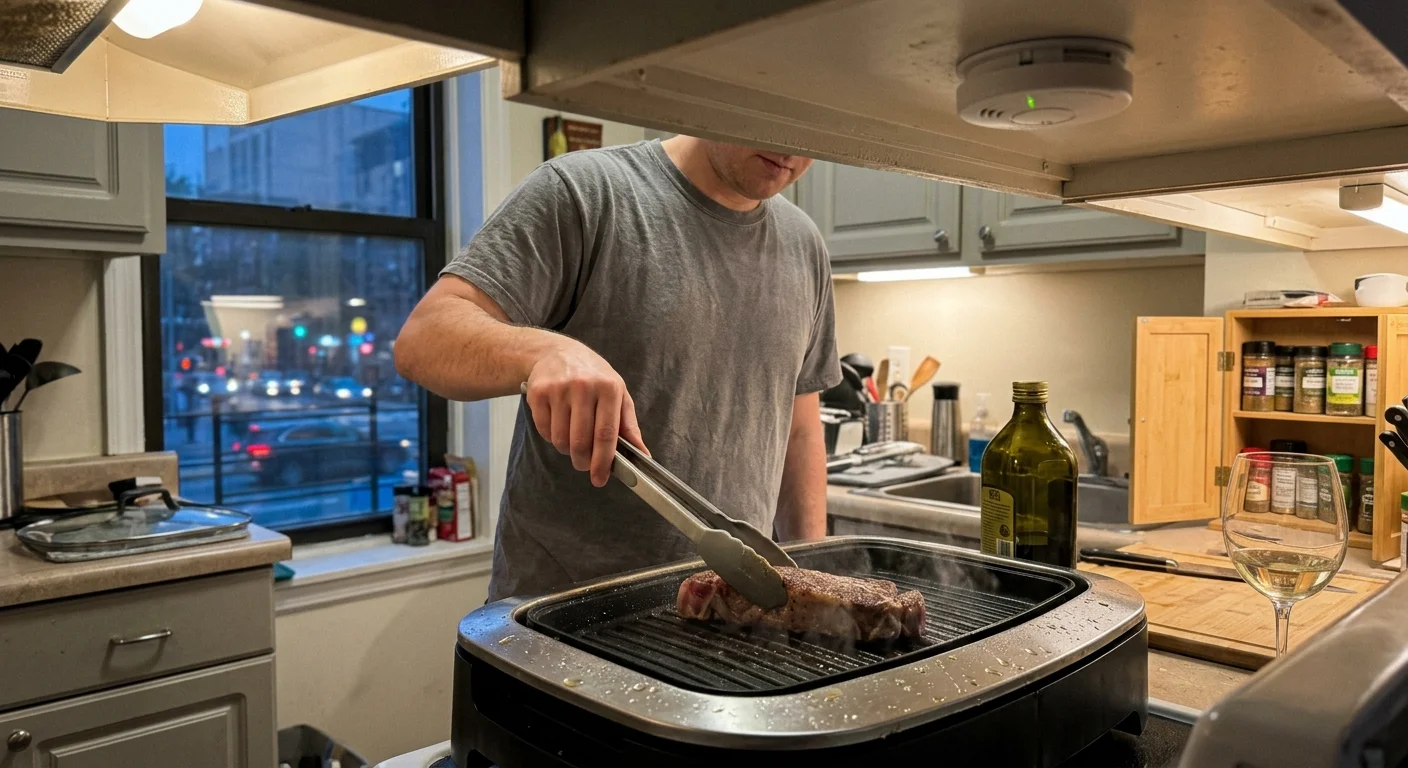
Consider a practical searing scenario in a 450-square-foot studio apartment. The ceiling houses a modern photoelectric smoke alarm mounted 7.5 feet from the primary kitchen counter, violating the 10-foot NFPA guideline.
The cook prepares a 12-ounce USDA Choice New York strip steak measuring 1.25 inches thick. This cut contains roughly 18 percent intramuscular fat by weight, guaranteeing heavy grease vaporization at high temperatures.
In the first trial, the cook preheats the passive water-tray grill to its maximum dial setting of 450 degrees Fahrenheit. The lower tray holds 1.5 cups of cool tap water per manufacturer instructions.
The steak hits the preheated grate at minute 0:00, sizzling violently. Rendered fat drips steadily through the grate slots into the water below, extinguishing flare-ups as designed.
However, contact between the steak surface and the 450-degree metal grates vaporizes surface fats instantly. A visible blue-gray haze rises unchecked from the open cooking surface.
By minute 3:15, thermal lift carries the fine oil aerosol across the ceiling. At minute 5:30, during the flip, the photoelectric detector registers light scattering above its threshold and sounds a shrieking 85-decibel alarm.
In the second trial, the cook sears an identical strip steak in the active-fan grill set to 500 degrees Fahrenheit. The cook engages the internal suction fan before placing the meat inside.
As fat hits the grate, the 35 CFM fan pulls the rising aerosol sideways into the intake vents. The cyclonic airflow forces the mist through the fine mesh splatter screen, trapping suspended liquid fat.
After 8 minutes of total searing, the steak achieves a deep mahogany crust. The ambient air 7 feet away remains clear, and the photoelectric ceiling alarm never triggers.

Noise Levels, Footprint, and Cleaning Realities
Performance involves more than capturing smoke; day-to-day usability dictates whether an appliance stays on your counter or gets abandoned. Noise levels represent the most immediate operational difference.
Passive water-pan grills generate zero operational noise. You hear only the sizzle of rendering fat against hot aluminum, making them completely unobtrusive in quiet living spaces.
Active HEPA-fan units function like miniature range hoods, operating between 54 and 65 decibels. That sound level resembles an active dishwasher or a standard countertop microwave.
Countertop storage requirements also diverge sharply between the two styles. Passive models feature flat profiles requiring only 4 inches of vertical clearance, sliding easily into standard 12-inch pantry gaps.
Active-fan units stand 11 to 14 inches tall, requiring significant overhead clearance. You cannot safely operate high-velocity exhaust grills directly beneath low-hanging laminate wall cabinets without causing moisture condensation.
Cleaning presents another major practical hurdle. While passive water grills lack mechanical ductwork, cleaning their grease trays requires careful, prompt handling.
The bottom basin fills with a lukewarm mixture of water and congealed animal tallow. Pouring this greasy slurry down an apartment sink risks severe plumbing clogs, requiring you to skim the fat first.
Active grills feature nonstick, dishwasher-safe grates and removable splatter screens. However, their internal fan chambers and duct walls require regular wipe-downs to prevent rancid oil build-up.
“If you pour water-tray grease directly down your sink, you trade a false smoke alarm for an expensive visit from the building plumber.” — Master Plumber
Active models frequently include convenient preset programs and a keep warm setting—maintaining food at safe serving temperature after cooking finishes. These digital conveniences offset the added cleaning requirements.

Best Appliance Picks for Your Apartment Layout
Your ideal smokeless indoor grill apartment selection depends primarily on your ceiling detector placement and ventilation access. Room geometry dictates mechanical requirements.
For studio apartments where smoke alarms sit within 10 feet of your counter, choose the Ninja Foodi Smart XL 6-in-1 (FG551). Its enclosed lid and powerful cyclonic air extraction prevent aerosol leakage completely.
Independent equipment evaluations at Serious Eats highlight that enclosed countertop grills achieve superior high-heat browning while maintaining complete grease containment. The Ninja model reaches a true 500 degrees Fahrenheit, ensuring restaurant-grade crusts.
If you live in a larger layout with a dedicated kitchen and an exterior-venting range hood, choose the Chefman Smokeless Electric Grill (RJ23-SG). It provides an expansive 150-square-inch cooking surface for under $50.
For open-concept apartments requiring wide cooking grates without hood enclosures, the PowerXL Smokeless Grill Pro offers the best balance. Its perimeter downdraft suction pulls vapor across its carbon filter efficiently.
Comprehensive reviews published by Wirecutter confirm that active extraction fans reliably reduce airborne grease residues on nearby walls and cabinetry. The PowerXL handles delicate fish, burgers, and vegetables without clouding your living area.
When selecting your unit, match the appliance depth to your counters. Ensure at least 6 inches of clearance around active fan exhausts to allow clean air dispersal.
Frequently Asked Questions
Why did my water-tray smokeless grill still set off my apartment smoke alarm?
Water trays only prevent drippings from burning against lower heating elements. The upper grate surface remains hot enough to vaporize oil directly off your meat. Without an exhaust fan, that sub-micron grease aerosol rises freely and triggers sensitive photoelectric alarms.
Do active fan grills completely eliminate lingering cooking odors?
No countertop grill eliminates 100 percent of cooking odors. Active grills trap liquid oil droplets and aerosolized grease in mesh screens and carbon filters, but gaseous volatile organic compounds still escape into room air. Running your kitchen exhaust fan helps dissipate these residual smells.
Can I use olive oil or butter on a smokeless indoor grill?
You should avoid extra-virgin olive oil and unclarified butter on all indoor smokeless grills. These fats possess low smoke points between 325 and 375 degrees Fahrenheit, causing rapid surface vaporization. Use high-smoke-point oils like avocado, refined canola, or grapeseed oil instead.
How often do active grill filters need replacement?
Permanent aluminum grease screens do not require replacement if you clean them regularly in warm soapy water. Disposable activated-carbon filter pads generally require replacement every 30 to 60 days, depending on your cooking frequency and the fat content of your meals.
Disclaimer: Product prices, features, and availability change frequently. Prices shown were accurate at time of writing but may have changed. We may earn a small commission from purchases made through links on this site, at no extra cost to you. Always verify current pricing and specifications on the retailer’s website before purchasing.