
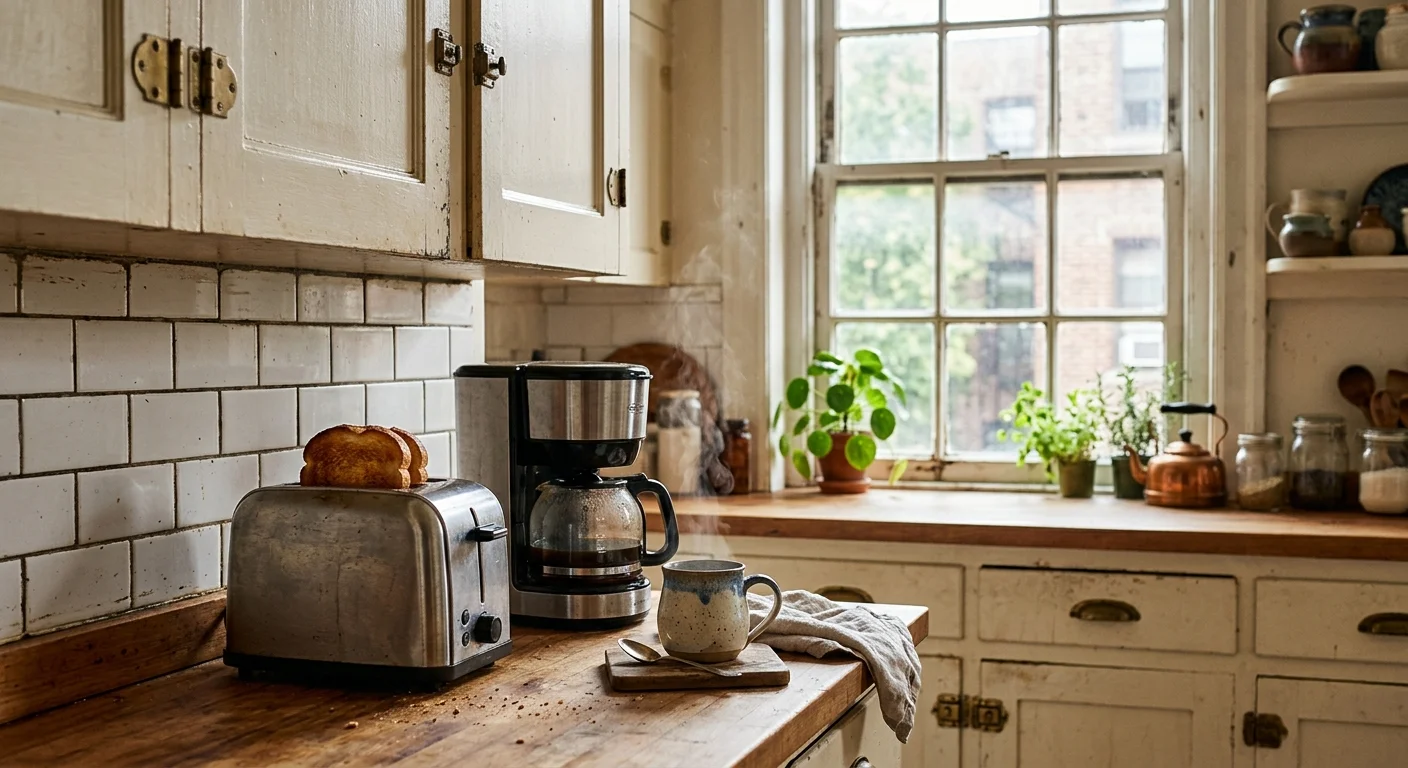
If you live in a pre-war apartment, your morning routine risks blacking out your entire kitchen. Running a standard toaster and capsule coffee brewer simultaneously pulls over 2,200 watts, instantly tripping an ancient 15-amp kitchen breaker.
While generic guides recommend power-hungry kitchen gear, this guide calculates the exact combined electrical draw of low-draw appliances. You can prepare hot toast and fresh coffee concurrently without exceeding your building’s wiring limits.
By swapping standard countertop units for curated small apartment kitchen appliances pulling under 750 watts each, you can cook breakfast safely on vintage electrical infrastructure.
The 15-Amp Circuit Math: Understanding Your Wiring Limits
Old residential buildings constructed before 1959 rarely include dedicated 20-amp kitchen circuits. Instead, landlords often wired the entire kitchen—and occasionally adjacent hallway outlets—to a single general-purpose 15 amp kitchen breaker.
Before choosing breakfast hardware, you must understand wattage—how much power an appliance uses, higher usually means faster cooking. Basic electrical physics dictates that total watts equal volts multiplied by amps.
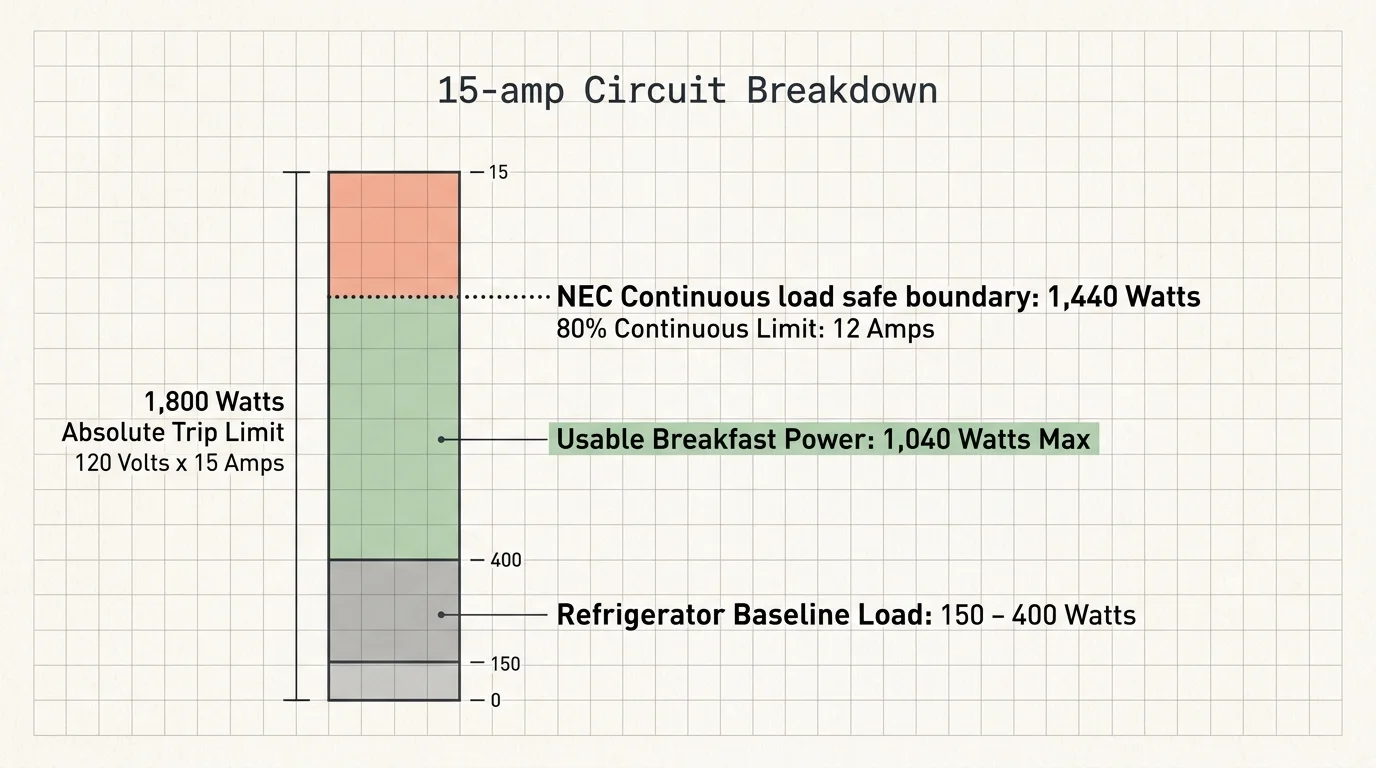
In North America, standard wall outlets supply 120 volts of electricity. Multiplying 120 volts by a 15-amp breaker yields an absolute ceiling of 1,800 watts before the breaker trips.
However, the National Electrical Code enforces the 80% continuous load rule under Article 210. This standard limits continuous branch circuit loads to 12 amps, or 1,440 watts.
Your refrigerator compressor draws between 150 and 400 watts when running. That baseline draw leaves you with barely 1,040 usable watts for all other morning appliances combined.
“In pre-1959 apartments, the kitchen circuit rarely exists in isolation. Turning on a high-draw kettle often starves the refrigerator sharing that same line.” — Master Electrician Review
Safety evaluations from Consumer Reports — Small Appliances emphasize that older electrical panels degrade faster when loaded near their thermal trip limit. Managing your morning wattage avoids costly service calls.
Low-Wattage Toasters: Crispy Bread Under 750 Watts
Standard two-slice toasters draw between 850 and 1,200 watts to scorch bread quickly. Four-slice models demand 1,400 to 1,800 watts, monopolizing your entire circuit instantly.
If you need more versatility than a standard slot unit, consider low-profile 2-slice toaster ovens designed to operate safely beneath low kitchen cabinets.
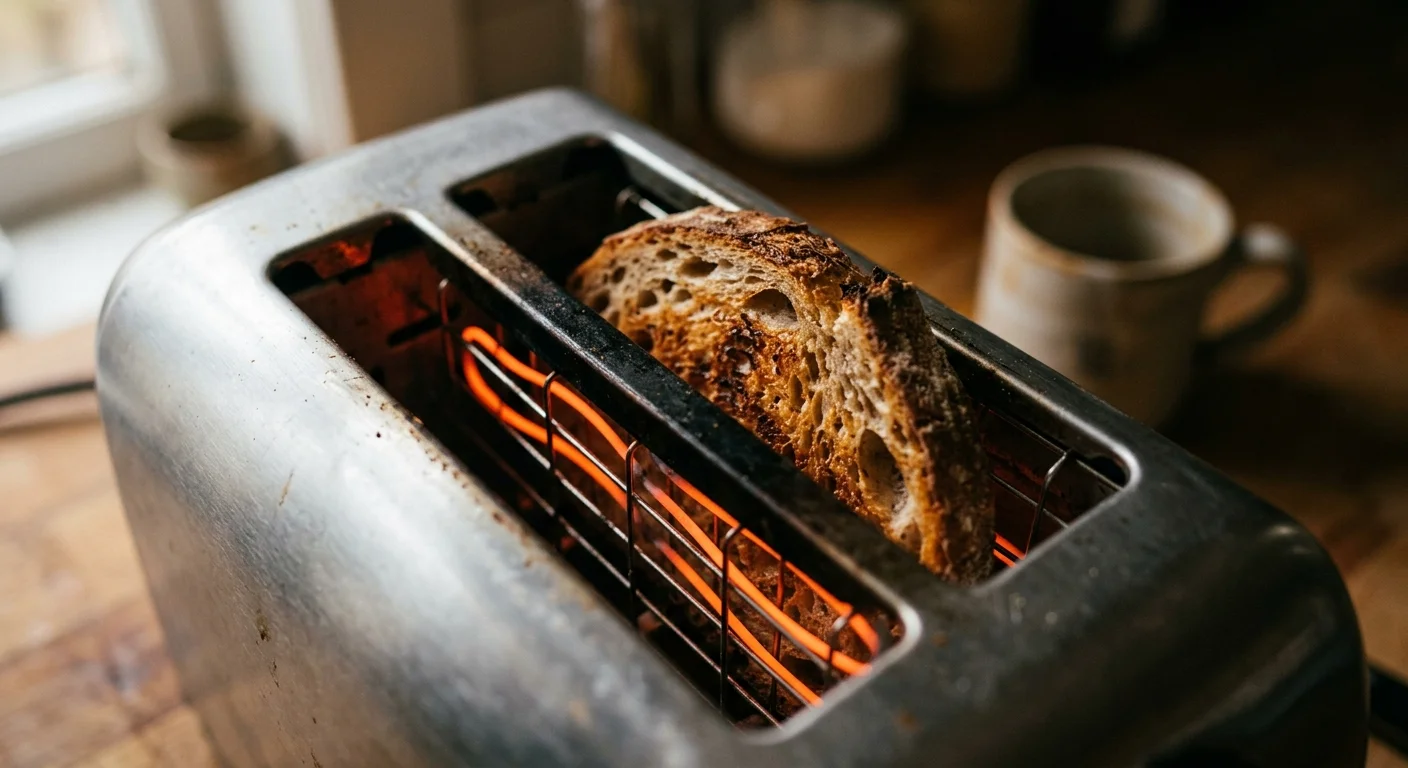
A dedicated low wattage toaster operates between 650 and 750 watts. This reduced draw drops current demand down to roughly 5.4 to 6.25 amps.
Low-draw toasters achieve thorough browning by narrowing the bread carriage slots. Positioned closer to the nichrome heating wires, your bread browns evenly without requiring extreme wattage spikes.
Some compact units include preset programs—automatic settings for common tasks like “rice” or “pressure cook”—though on toasters they automate bagel and defrost cycles. These electronic boards consume negligible standby power.
Because the heating elements run at lower surface temperatures, browning takes roughly 45 to 60 seconds longer than commercial-grade units. This slight delay preserves your electrical stability.
When selecting a unit, look for models measuring under 6 inches in width. Compact footprints save counter real estate while pulling minimal current through vintage copper wires.
Low-Amp Coffee Makers: Brewing Without Voltage Drops
Single-serve capsule brewers use rapid flash heaters that spike power draw to 1,500 watts. Running a capsule machine while your refrigerator cycles will trip your breaker every time.
For tea drinkers needing hot water without risking an electrical surge, sub-600W electric kettles provide a reliable, low-draw boiling alternative.
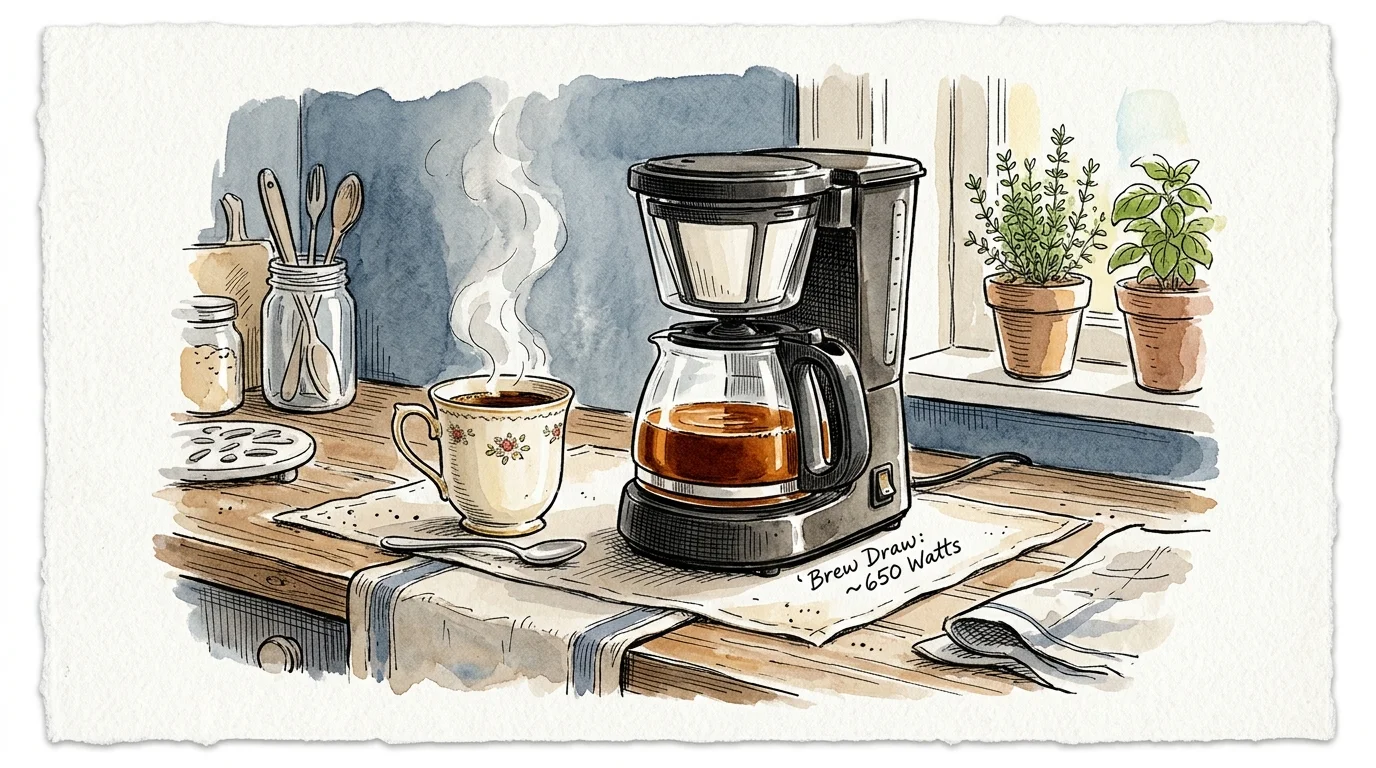
A low amp coffee maker solves this dilemma by employing an enclosed 600- to 650-watt aluminum boiler. These compact 4-cup to 5-cup drip brewers pull only 5.0 to 5.4 amps.
According to equipment guides from Wirecutter — Kitchen, compact brewers draw significantly lower peak power than single-serve capsule machines. They maintain steady water temperatures without overloading vintage branch circuits.
Look for machines offering a reliable keep warm—maintains food at serving temperature after cooking—hot plate. Low-draw hot plates utilize low-resistance heating coils drawing just 50 watts post-brew.
Avoid units featuring rapid boil—heats water faster than standard models—features, as rapid boiling necessitates high-current heating elements. Instead, choose brewers with delayed start—program the appliance to start cooking later—capabilities.
A delayed start timer allows your coffee to finish brewing before you wake up. This staggered schedule clears the electrical circuit entirely before you power up your toaster.
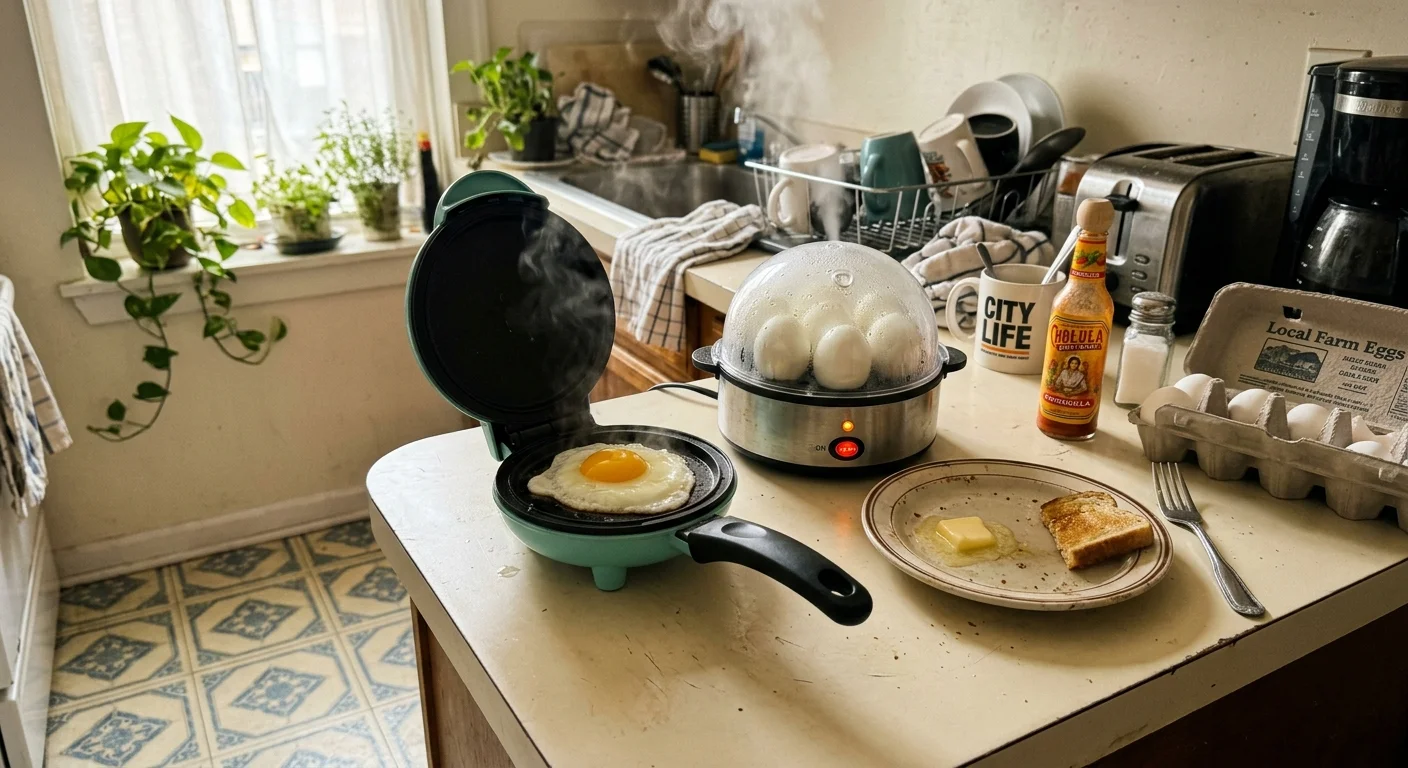
Compact Egg Cookers and Mini Griddles: High Efficiency Cooking
Electric frying pans and countertop induction burners frequently consume 1,500 to 1,800 watts. In contrast, specialized mini breakfast appliances offer exceptional thermal efficiency at minimal power levels.
Rapid egg cookers operate using sealed steam plates drawing merely 350 to 360 watts. That translates to an electrical load of only 3.0 amps at 120 volts.
These devices boil, poach, or scramble eggs in under nine minutes using two tablespoons of water. Steam heat transfers energy faster than radiant heat, maximizing every watt drawn.
Mini waffle makers and compact countertop griddles similarly run on 350-watt internal heating loops. Their dual-sided aluminum die-cast plates lock in heat with minimal ambient dissipation.
As rigorous evaluations from Serious Eats — Equipment Reviews demonstrate, smaller heating elements maintain consistent thermal output without requiring power-hungry spikes. You gain precise cooking performance inside tight spatial boundaries.
If you prefer hot cereals, consider an appliance with miniature quart capacity—how much the appliance holds (4 quarts = about 4 liters). A 1.5-quart slow cooker draws only 120 watts on low heat.
Similarly, mini multicookers maintain pressure at low amperage, unlike full-sized 1,200-watt pressure cookers that operate at 15 PSI—pounds per square inch, measures pressure in pressure cookers. You preserve functional breakfast variety without threatening your electrical panel.
For baked items, avoid heavy ovens unless they feature true convection—uses a fan to circulate hot air for more even cooking. Convection air currents allow lower thermal wattage to achieve identical baking speeds.
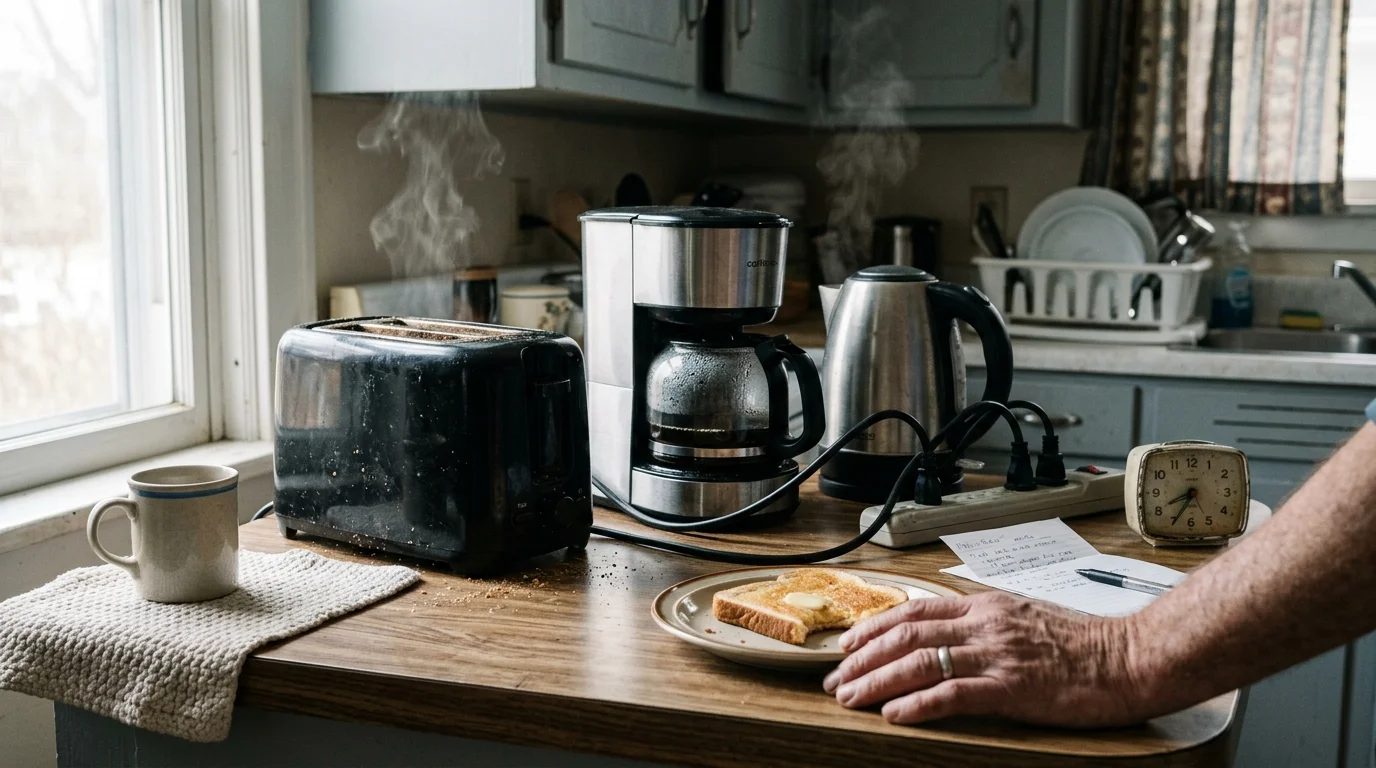
Worked Electrical Load Scenario: A 1,050-Watt Morning
Consider a practical morning scenario in an unrenovated 1928 brick apartment building in Chicago. The kitchen operates on a single 15-amp fuse block shared with the apartment’s entry light.
On Tuesday morning at 7:15 AM, the apartment refrigerator runs its cooling cycle. The compressor draws a continuous baseline load of 180 watts (1.5 amps).
At 7:16 AM, you turn on a Zojirushi ZUTTO 5-cup drip coffee maker (priced around $85, measuring 9 x 6 inches). The coffee maker draws 650 watts (5.41 amps) for a 7-minute brew cycle.
At 7:18 AM, you place two slices of sourdough into a Dash Clear View toaster (priced at $39.99, measuring 15.7 x 4 x 7.8 inches). You set the browning control to level 3, pulling 700 watts (5.83 amps) for 2.5 minutes.
During those overlapping 2.5 minutes, your total peak power draw reaches exactly 1,530 watts (180W + 650W + 700W). Converted to electrical current, this equals 12.75 amps total.
Because 12.75 amps sits below your 15-amp breaker threshold (1,800 watts), the circuit remains fully operational. The breaker does not trip, and the hallway lights do not flicker.
Conversely, standard appliances would draw 1,450 watts for a pod brewer and 1,200 watts for a standard toaster. Adding the 180-watt refrigerator yields 2,830 watts (23.58 amps), blowing the 15-amp fuse within 10 seconds.
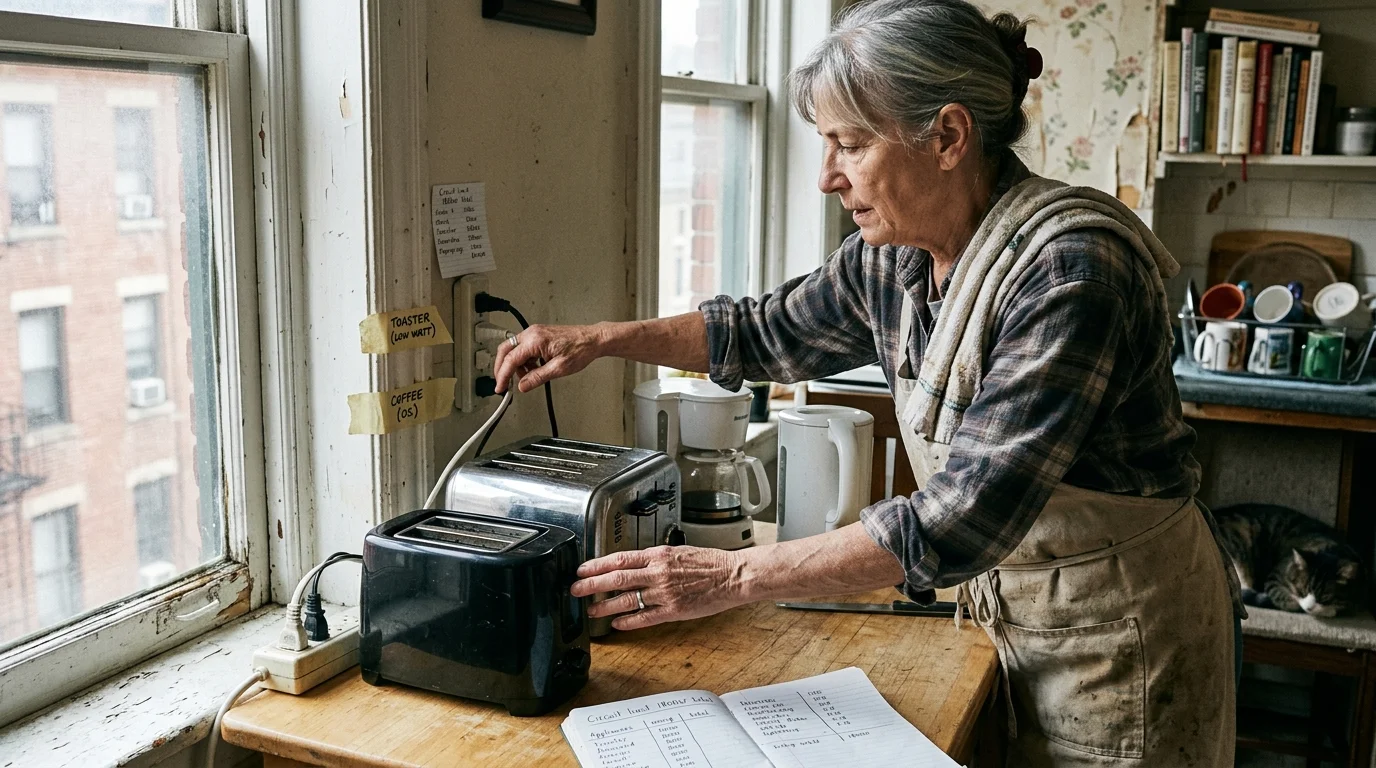
Breakfast Appliance Power and Dimension Comparison
Choosing the correct combination of countertop equipment requires balancing rated power, physical footprint, and functional output. The table below lists tested specifications for low-draw breakfast gear.
| Appliance Model | Rated Wattage | Current Draw (120V) | Dimensions (W x D x H) | Capacity / Output |
|---|---|---|---|---|
| Zojirushi EC-DAC50 ZUTTO | 650 W | 5.41 Amps | 8.8 x 6.0 x 10.8 in | 5 Cups (21.6 oz liquid) |
| Dash Clear View DVTS501 | 700 W | 5.83 Amps | 15.7 x 4.0 x 7.8 in | 2 Extra-Long Slices |
| Dash Rapid Egg Cooker DEC005 | 360 W | 3.00 Amps | 5.5 x 6.0 x 8.0 in | 6 Large Eggs |
| Bodum Bistro 11452 Kettle | 700 W | 5.83 Amps | 6.8 x 4.5 x 7.9 in | 17 oz (0.5 Liter) |
| Elite Gourmet ECT-3100 Toaster | 650 W | 5.41 Amps | 9.5 x 5.0 x 6.0 in | 2 Standard Slices |
| Dash Mini Griddle DMS001 | 350 W | 2.91 Amps | 5.0 x 6.4 x 2.8 in | 4-inch Cooking Surface |
Every option in this table draws under 6.0 amps during peak heating. This low threshold guarantees continuous headroom on delicate residential branch circuits.
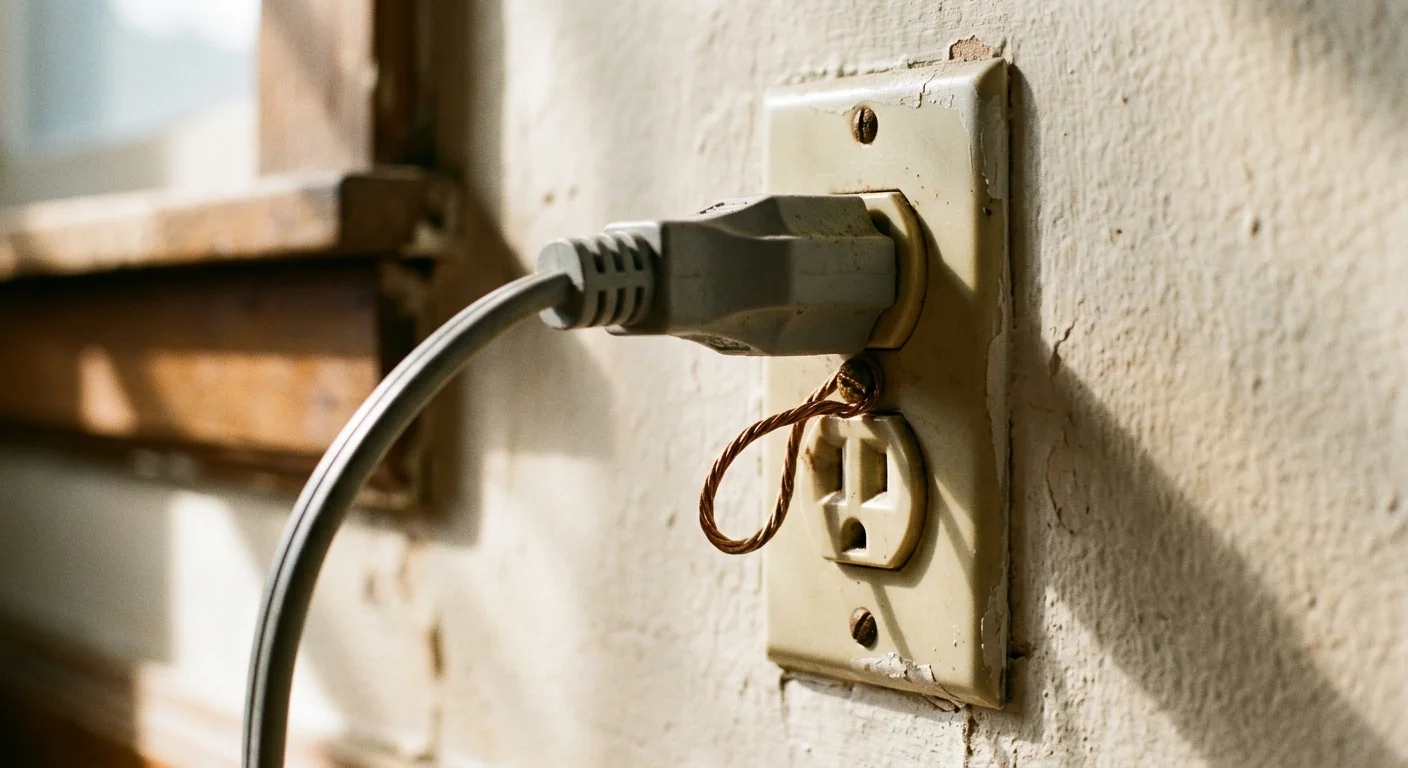
Ungrounded Two-Prong Outlets and Kitchen Adapter Safety
Many pre-war rental properties retain original ungrounded two-prong NEMA 1-15R receptacles. Modern heating appliances typically ship with three-prong grounding NEMA 5-15P plugs to prevent electrical shock.
Never snap off the third grounding pin to force a three-prong plug into a two-prong outlet. Removing that grounding pin destroys the appliance’s safety path and creates severe fire hazards.
Avoid cheap “cheater” three-to-two prong gray adapters unless you properly ground the brass pigtail tab. That metal tab must screw into a center faceplate screw connected to a verified metallic armored cable.
If your outlet boxes lack grounded conduit, ask your landlord to install GFCI (Ground Fault Circuit Interrupter) receptacles. The National Electrical Code explicitly permits GFCI outlets on ungrounded circuits to protect against personal shock.
Inspect older two-prong outlets for internal spring tension before plugging in heating equipment. Loose socket blades increase electrical resistance, causing wall outlets to run hot during prolonged 600-watt breakfast operations.
Top Curated Appliance Picks for Vintage Apartments
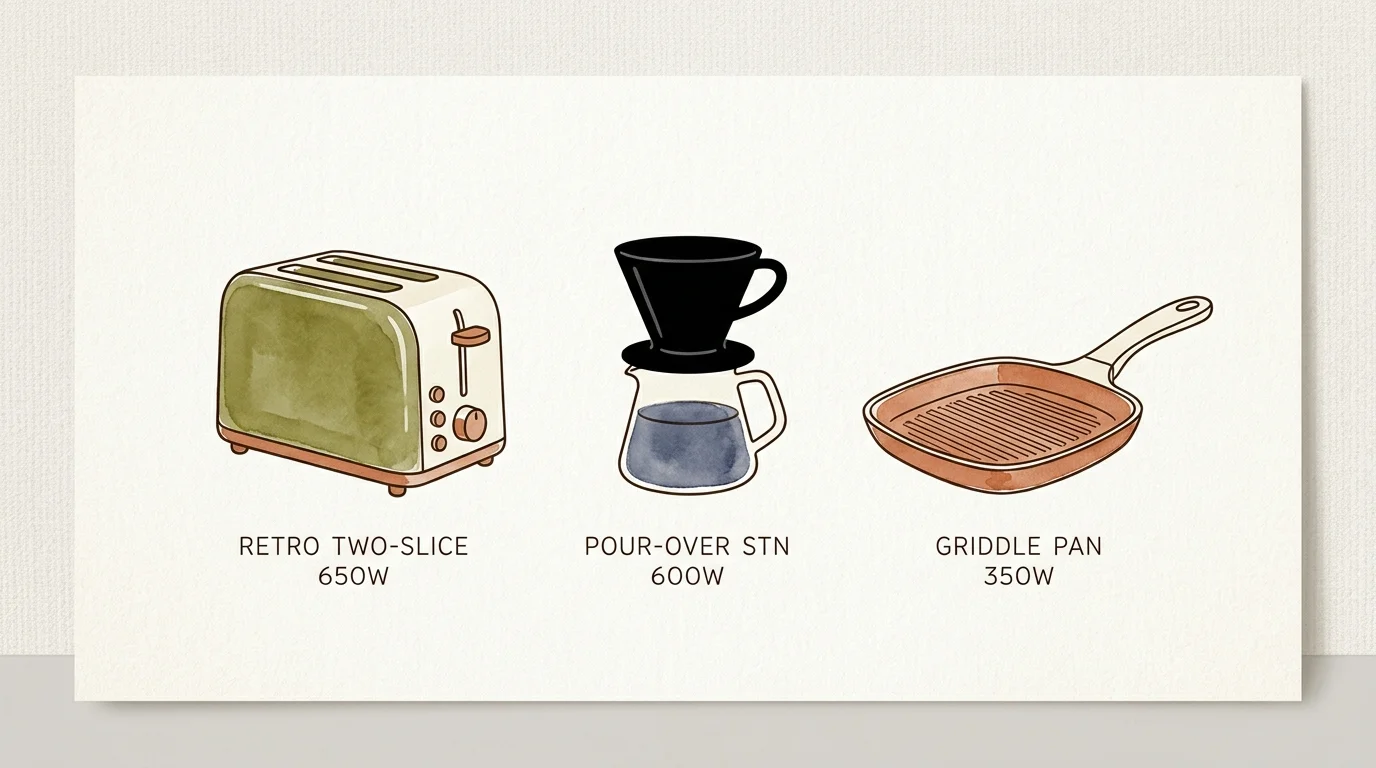
We evaluated dozens of compact breakfast devices against stringent wattage draw limits, counter footprint dimensions, and reliability standards. These three specific models deliver maximum morning utility without tripping delicate breakers.
Best for Small Kitchens: Dash Clear View 2-Slice Toaster (700 Watts)
The Dash Clear View DVTS501 draws exactly 700 watts (5.83 amps) and measures just 4.0 inches wide by 15.7 inches long. Its long-slot profile slips against your backsplash, consuming minimal depth on shallow vintage laminate counters.
The glass observation window lets you monitor toast color manually, eliminating repeated high-draw heating cycles. Cleaning requires sliding out the bottom tray; the glass panel removes easily for hand washing.
Best Value: Zojirushi EC-DAC50 ZUTTO 5-Cup Drip Brewer (650 Watts)
Drawing 650 watts (5.41 amps), the Zojirushi ZUTTO brews 21.6 ounces of drip coffee in under eight minutes. Its compact footprint spans 8.8 by 6.0 inches, taking up less countertop area than a standard dinner plate.
The water reservoir detaches completely for direct sink filling, preventing messy counter spills. Its low-wattage hot plate keeps coffee hot for two hours without burning the carafe base.
Best for Families: Dash Rapid Egg Cooker DEC005 (360 Watts)
The Dash DEC005 cooks six whole eggs simultaneously while consuming a negligible 360 watts (3.00 amps). Measuring 5.5 by 6.0 by 8.0 inches and weighing 1.1 pounds, it stores effortlessly in narrow kitchen drawers.
The unit features dishwasher-safe accessories including a poaching tray, omelet bowl, and boiling rack. An auto-shutoff buzzer prevents water dry-out, eliminating fire risk during rushed family mornings.
Frequently Asked Questions
Can I run a low-wattage toaster and coffee maker at the exact same time?
Yes, provided their combined draw does not exceed 1,440 watts. A 700-watt toaster combined with a 650-watt brewer draws 1,350 watts (11.25 amps), fitting safely within a standard 15-amp circuit.
Why does my apartment breaker trip even when using only one appliance?
In older apartments, a single 15-amp kitchen circuit frequently shares wiring with hallway lights, living room outlets, or your refrigerator. Existing loads from other rooms reduce the remaining wattage headroom in your kitchen.
Are travel electric kettles safe for everyday apartment kitchen use?
Yes, compact kettles rated at 600 to 700 watts work safely for daily boiling tasks. They take roughly five minutes to boil 0.5 liters of water, protecting vintage lines from the 1,500-watt spikes of full-sized kettles.
Can I plug low-wattage breakfast appliances into a power strip?
You should avoid standard office power strips for heating appliances. If an extension is mandatory, use an appliance-rated 14-gauge heavy-duty cord rated for a full 15 amps and 1,800 watts.
Disclaimer: Product prices, features, and availability change frequently. Prices shown were accurate at time of writing but may have changed. We may earn a small commission from purchases made through links on this site, at no extra cost to you. Always verify current pricing and specifications on the retailer’s website before purchasing.
1 Comment