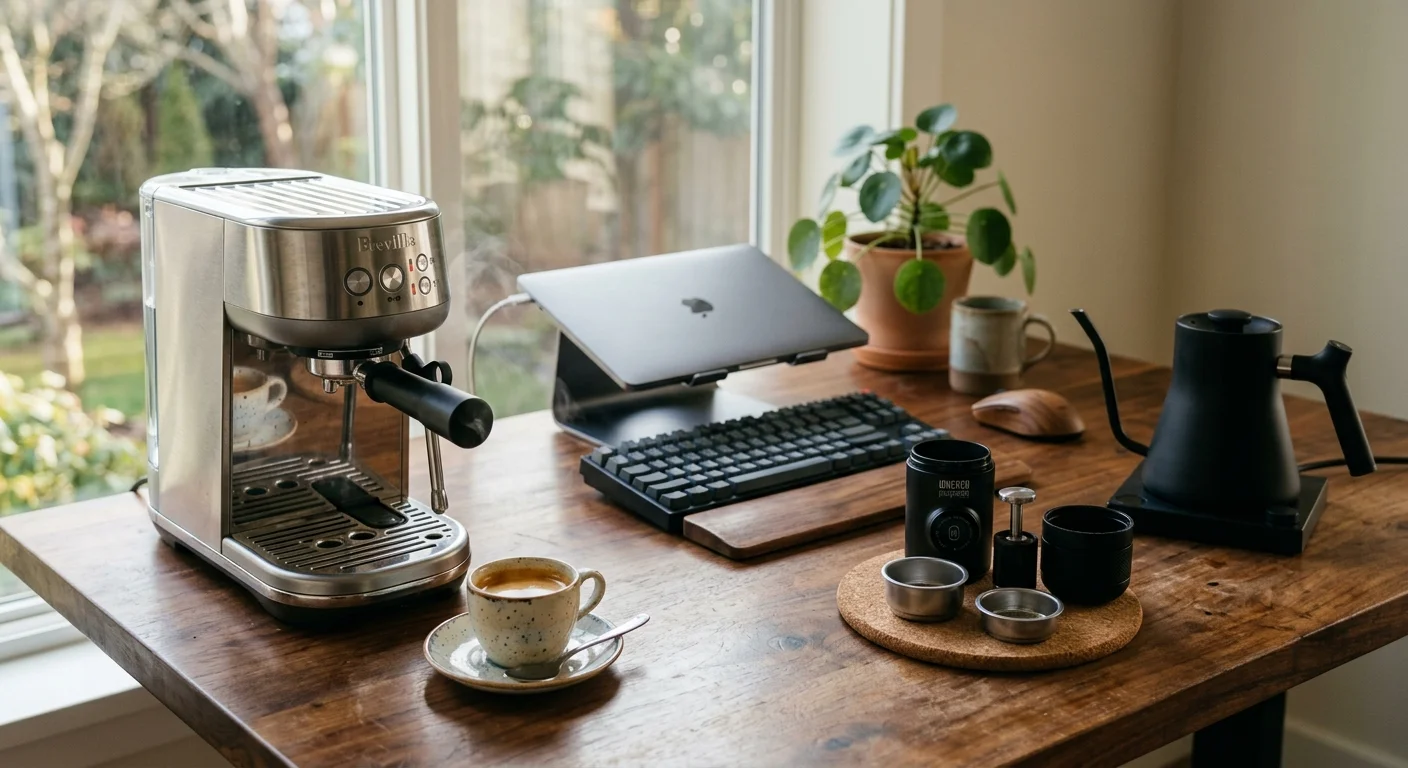
You need a quick midday espresso at your desk without losing precious workspace or waiting 15 minutes for a commercial boiler to heat up. A compact espresso machine for small kitchen setups seems ideal, but manual handheld brewers promise espresso with zero electrical footprint.
While a manual portable espresso maker eliminates countertop clutter, it requires roughly 400% more cleanup wastewater per shot than a compact thermoblock unit. Choosing the right desk setup comes down to balancing your available workspace against your proximity to a sink.
This guide breaks down extraction yields, power draw, and real-world desk logistics to help you pick the best tool for your remote workspace.
Counter Footprint and Desk Clearance
Setting up an espresso station beside your computer monitors requires strict spatial discipline. An oversized appliance crowds out your mouse pad and paperwork, creating visual chaos in your home office.
Managing overhead clearance is essential in tight home offices, much like evaluating clearance and heat safety for compact countertop appliances tucked under low shelving.
Applying smart principles for creating an organized coffee station can keep beans, tamps, and mugs contained even on a crowded desk.
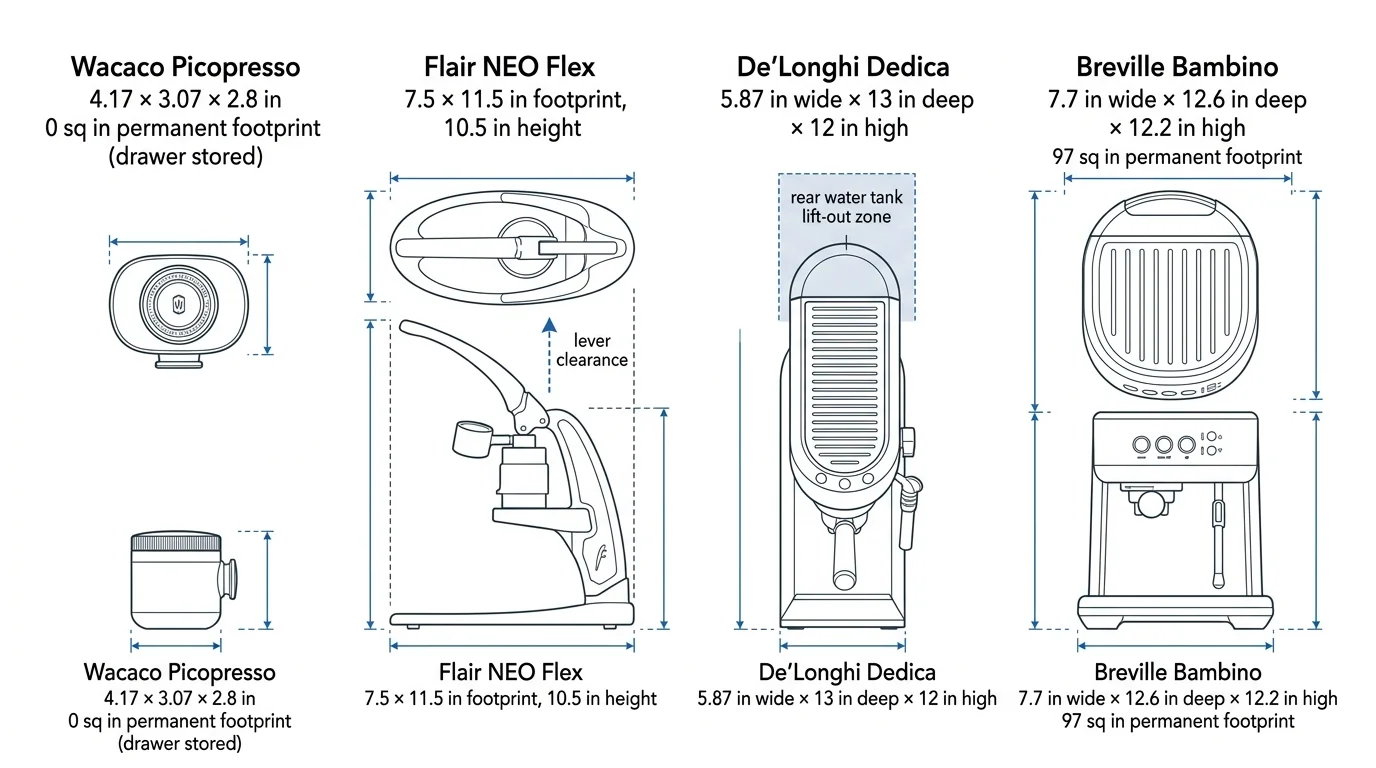
Manual handheld brewers deliver extreme space savings. The Wacaco Picopresso measures just 4.17 × 3.07 × 2.8 inches and weighs a mere 12.35 ounces.
When you finish your extraction, the Picopresso tucks neatly into a shallow desk drawer. It leaves zero permanent footprint on your desktop surface between brew sessions.
Manual lever devices demand a bit more clearance. The Flair NEO Flex occupies a surface footprint of 7.5 × 11.5 inches and stands 10.5 inches tall.
You also need vertical headroom to operate the lever through its downward arc. Placing it under low hutch shelves can obstruct your leverage during extraction.
Compact thermoblock machines require a permanent countertop reservation. The De’Longhi Dedica holds the benchmark for narrow electric machines at only 5.87 inches wide.
However, the Dedica measures 13 inches deep and 12 inches high. You must also preserve overhead clearance to lift out its rear water container.
The Breville Bambino is slightly broader, measuring 7.7 inches wide, 12.6 inches deep, and 12.2 inches high. It claims 97 square inches of permanent surface area.
“Counter space is premium real estate in a compact workspace. Before choosing a machine, verify whether your workflow allows drawer storage or demands a fixed countertop station.”
Electrical Draw and Circuit Limits
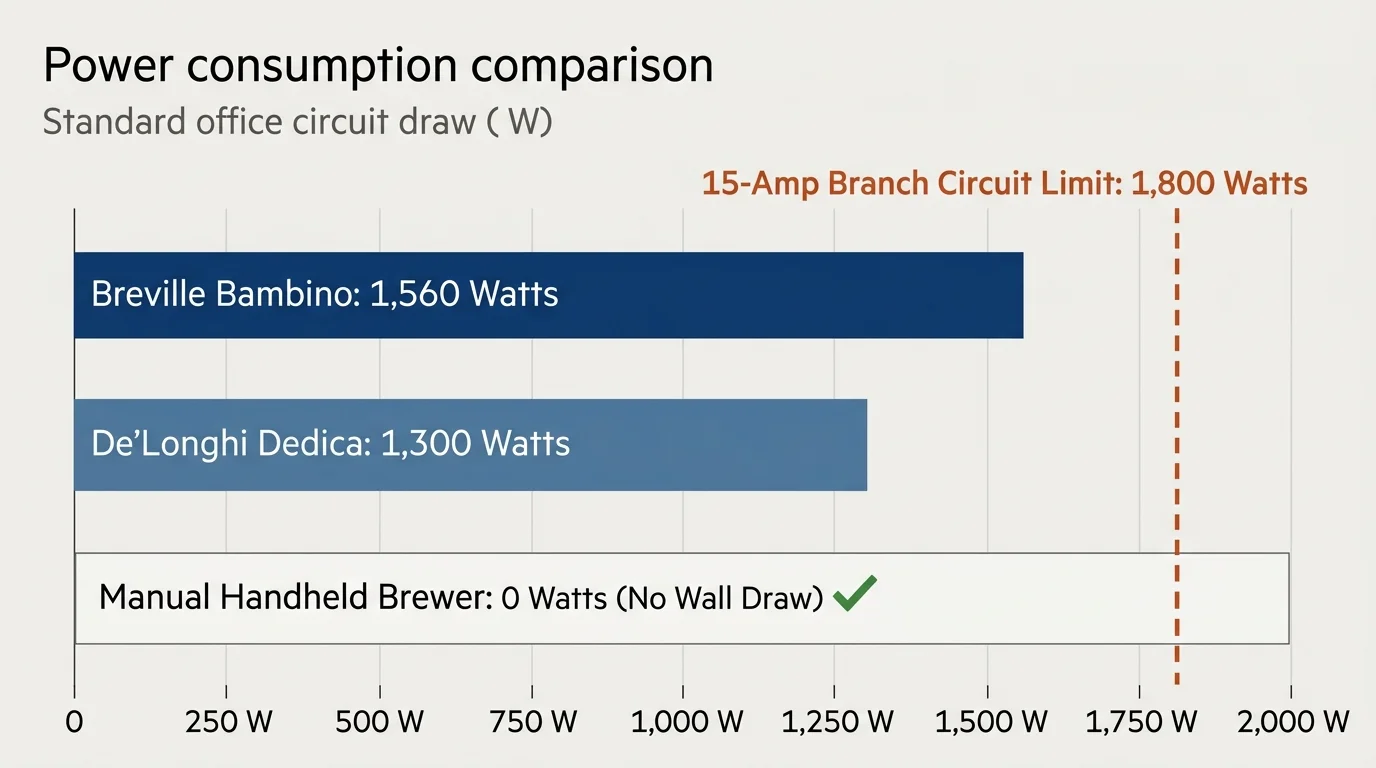
Home office desk kitchenettes frequently share a single 15-amp branch circuit with computers, printers, and monitors. High-draw heating elements can instantly overload shared surge protectors.
If your office electrical capacity is already strained, pairing a manual brewer with a sub-600W low-draw electric kettle prevents sudden circuit trips.
You must evaluate wattage before plugging any heating appliance into a desk power strip. Wattage indicates how much power an appliance uses; higher wattage usually means faster cooking and heating.
The De’Longhi Dedica draws 1,300 watts from your electrical wall outlet. The Breville Bambino pulls up to 1,560 watts during its active heating cycles.
Most basic office power strips carry ratings between 1,500 and 1,800 watts total. Running a thermoblock machine while charging a high-performance laptop can trip your power strip’s internal breaker.
Manual handheld brewers consume exactly zero watts of electrical energy at your desk. They produce no electrical noise, eliminate trailing power cords, and cannot trip circuit breakers.
However, manual brewers still demand water heated to 200°F. You must walk to a separate kitchen kettle or keep a compact rapid-boil kettle nearby.
An electric kettle with rapid boil heats water faster than standard models. Yet, adding a kettle reintroduces an 800-to-1,200-watt load to your office circuit.
According to appliance evaluations by Wirecutter’s kitchen testing, matching electrical draw to your available outlet capacity is essential for preventing nuisance circuit trips in micro-kitchen setups.
Thermal Stability and Warm-Up Speed
Brew temperature directly dictates espresso flavor balance. Pulling shots with water below 195°F causes sour, thin under-extraction, while temperatures above 205°F scorch delicate aromatic compounds.
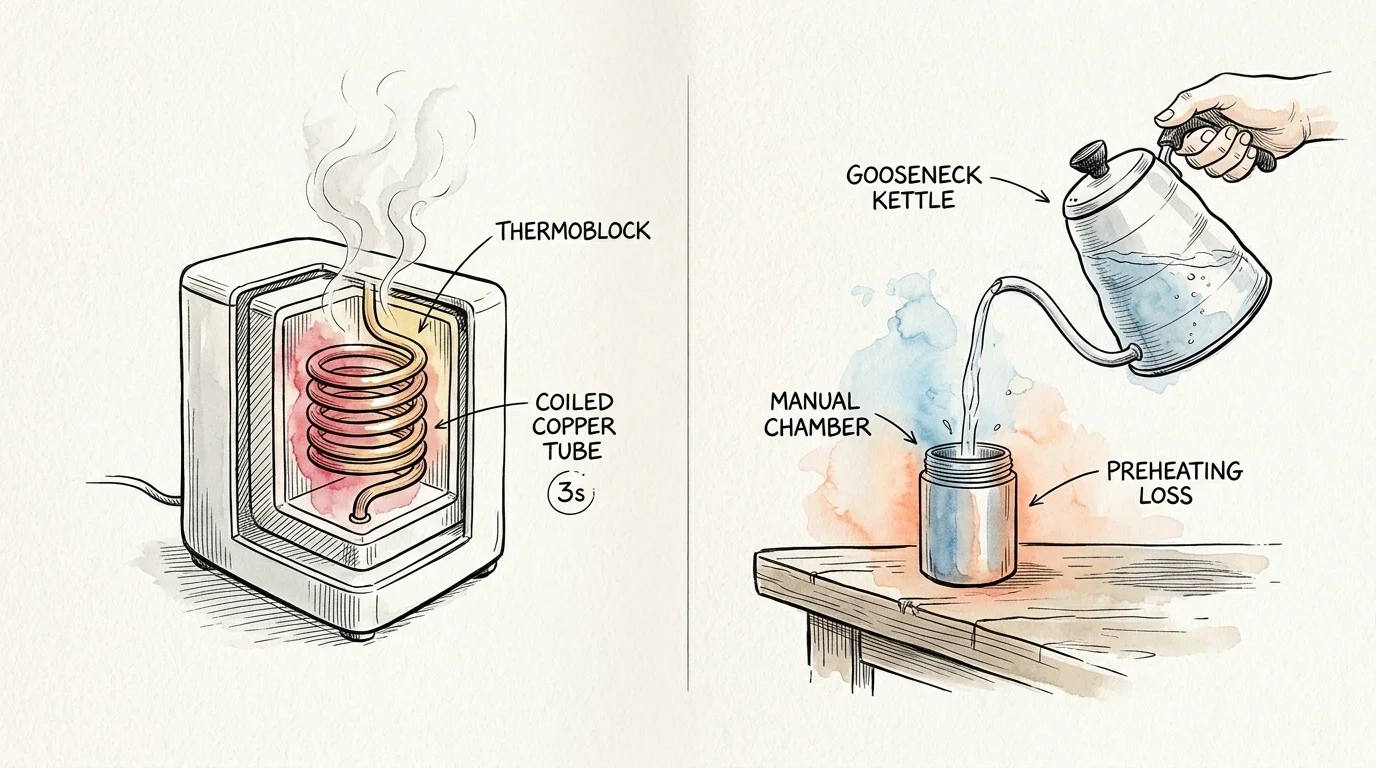
When heating kettle water for preheating manual chambers, using gooseneck spout mesh catchers or mineral absorber balls keeps hard-water mineral flakes out of your espresso extraction.
Understanding the differences in heat transfer when comparing electric versus stovetop appliances highlights why internal electric heating elements maintain more consistent temperatures than passive vessels.
Thermoblock machines heat cold water flash-style by driving it through a spiraled heating channel. This eliminates the sluggish 15-minute warmup times required by heavy brass boiler machines.
The Breville Bambino uses a ThermoJet heating coil that reaches brewing temperature in three seconds. You can power the machine on and pull an espresso shot almost instantly.
The De’Longhi Dedica employs a traditional cast-aluminum thermoblock. It requires approximately 30 to 40 seconds to reach operating temperature from a dead stop.
Both electric units maintain consistent brewing temperatures automatically. Internal sensors modulate the heating pulse to ensure stable hot water delivery across the shot.
Manual handheld makers lack active heating elements and suffer from thermal bleed. Cold metal chambers rapidly sap thermal energy from incoming brew water.
To pull balanced espresso with the Picopresso, you must preheat the chamber with boiling water for 60 seconds. You must pump that water out before dosing your coffee.
Skipping this preheat step causes extraction temperatures to drop below 180°F. The resulting espresso will taste overwhelmingly sour and astringent.
Extraction Mechanics and Pressure Delivery
True espresso demands roughly 9 bars of brewing pressure. That force equals approximately 130 PSI (pounds per square inch, measures pressure in pressure vessels and fluid lines).
For home workers who enjoy pouring fresh shots over ice for afternoon drinks, having one of the best countertop ice makers nearby provides cold drinks without a walk to the main freezer.
If you enjoy milk-based drinks alongside straight espresso, pairing a manual brewer with one of the best milk frothers lets you make lattes without adding a bulky steam wand.
Thermoblock machines generate mechanical pressure via integrated 15-bar vibration pumps. These pumps deliver consistent hydraulic force at the press of a button.
The Breville Bambino includes an over-pressure valve that limits peak extraction pressure to 9 bars. It also applies low-pressure pre-infusion to saturate the coffee bed evenly.
The Bambino also features preset programs, which are automatic settings for common tasks like single and double shot volumes. You press a button and step back.
Conversely, the De’Longhi Dedica applies an unmodulated 15 bars of pressure through dual-wall pressurized baskets. The restricted basket creates artificial crema, but masks subtle single-origin tasting notes.
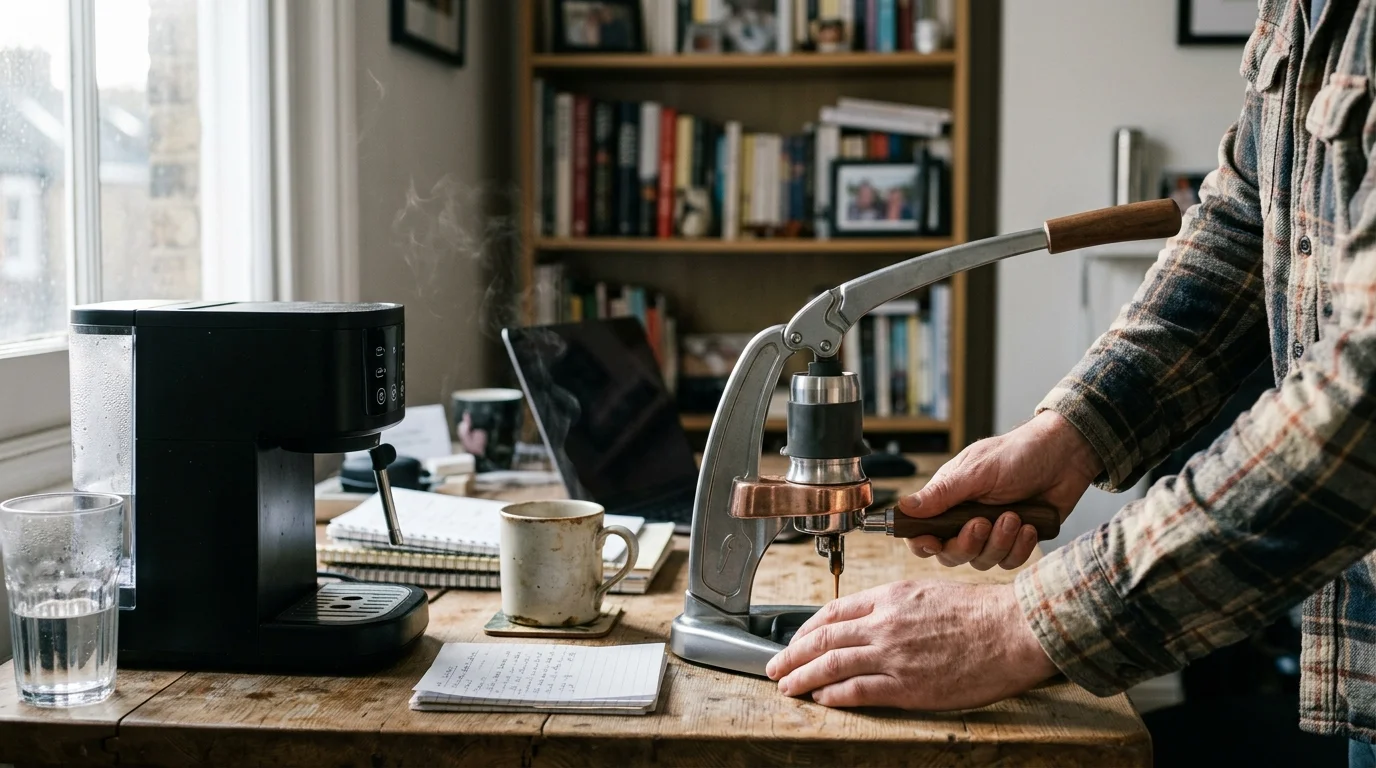
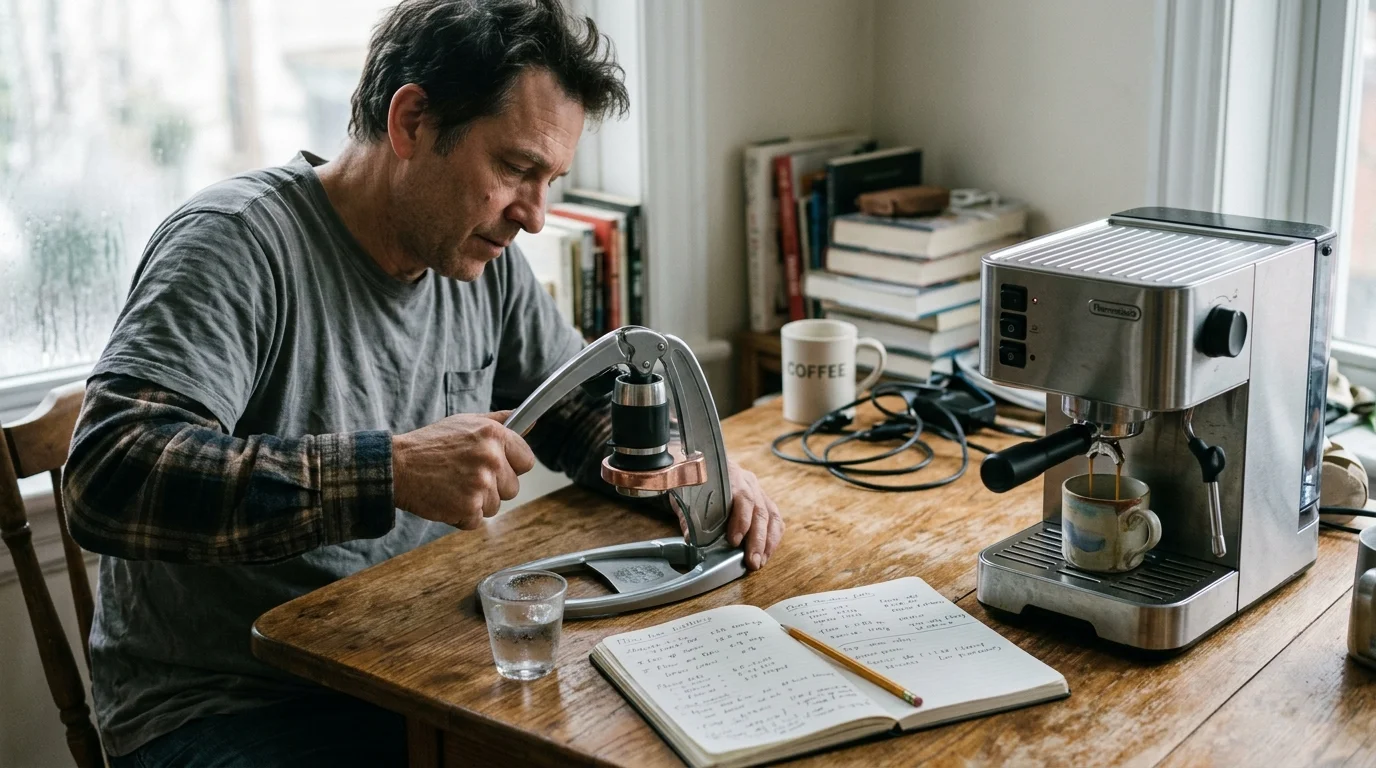
Manual espresso units place extraction mechanics entirely under your physical control. The Flair NEO Flex utilizes an articulated lever that allows direct manual pressure profiling.
As documented in Serious Eats’ equipment reviews, manual lever brewers give you precise control over extraction flow rates that cheap electric pumps cannot match.
The Wacaco Picopresso uses a thumb-actuated piston pump capable of reaching 18 bars. It pairs with an unpressurized 52 mm commercial basket designed for fine espresso grinds.
In a direct flare vs picopresso desk comparison, the Picopresso requires two-handed pumping directly over your cup. The Flair rests firmly on your desk during downward lever strokes.
Cleanup Wastewater and Sink Logistics
Wastewater management represents the biggest friction point for desk kitchenettes. Remote workspaces rarely feature plumbed drainage sinks within convenient walking distance.
Thermoblocks are particularly vulnerable to internal mineral accumulation, making fast, odor-free descaling methods essential for routine maintenance in small spaces.
Thermoblock machines handle internal wastewater management exceptionally well. Three-way solenoid valves direct post-extraction slurry pressure straight down into an internal drip tray.
A standard double espresso on a Breville Bambino generates about 35 to 45 milliliters of wastewater. The sealed drip tray holds up to 500 milliliters before filling.
You can pull up to eight espresso shots before carrying the tray to a sink. Unlike drip brewers with a keep warm feature (which maintains liquid temperature on a hotplate), thermoblocks brew fresh without leaving stagnant carafes.
A single serve manual espresso maker flips this wastewater equation entirely upside down. Manual tools lack integrated catch basins and demand multi-step rinsing procedures.
Preheating a manual cylinder requires 80 milliliters of boiling water that you must discard. Clearing residual head space water after brewing produces another 40 milliliters of murky discharge.
Rinsing the portafilter basket, shower screen, and silicone seals requires at least 120 milliliters of clean water. You must perform this cleaning cycle immediately to prevent coffee oils from baking onto metal.
Pulling one shot on a manual press generates roughly 240 milliliters of desk wastewater. You must keep a dedicated slop bowl on your desk or make a sink trip after every single cup.
“An espresso brewer that produces excellent coffee but generates cups of dirty wastewater becomes an abandoned novelty if you work ten steps away from a drain.”
Head-to-Head Specifications Comparison
Choosing between manual and thermoblock designs requires comparing physical dimensions, electrical ratings, and operational capacities. The table below details key specifications for leading desk options.
Regardless of which brewing style fits your desk, understanding the impact of water softeners on kitchen appliances will help prolong the lifespan of your machine’s heating components.
For those not strictly tied to espresso, exploring coffee makers for every brewing style reveals simpler pour-over and immersion options that might better suit quiet desk environments.
The Bambino features a 1.4-liter tank, avoiding the bulk of large multi-quart capacity reservoirs (quart capacity indicates how much the appliance holds, where 4 quarts equals about 4 liters).
| Brewer Model | Counter Dimensions | Power Draw | Water Capacity | Extraction System | Wastewater Per Shot | MSRP |
|---|---|---|---|---|---|---|
| Wacaco Picopresso | 4.2 × 3.1 × 2.8 in | 0 Watts | 80 ml (2.7 oz) | Manual Piston (Up to 18 bar) | ~240 ml | $129.90 |
| Flair NEO Flex | 7.5 × 11.5 × 10.5 in | 0 Watts | 60 ml (2.0 oz) | Manual Lever (6 to 9 bar) | ~220 ml | $99.00 |
| De’Longhi Dedica EC685 | 5.9 × 13.0 × 12.0 in | 1,300 Watts | 1.1 L (37 oz) | 15-Bar Vibration Pump | ~45 ml | $249.95 |
| Breville Bambino | 7.7 × 12.6 × 12.2 in | 1,560 Watts | 1.4 L (47 oz) | 9-Bar Regulated ThermoJet | ~35 ml | $299.95 |
Manual units require zero countertop footprint after cleanup, making them ideal for ultra-minimalist desks. However, their total time investment per shot remains substantially higher.
Compact thermoblocks demand continuous desk space, but deliver unmatched workflow efficiency. Their integrated drip trays cleanly isolate dirty discharge water from your office environment.
Worked Example: The 9 AM Desk Brew Scenario
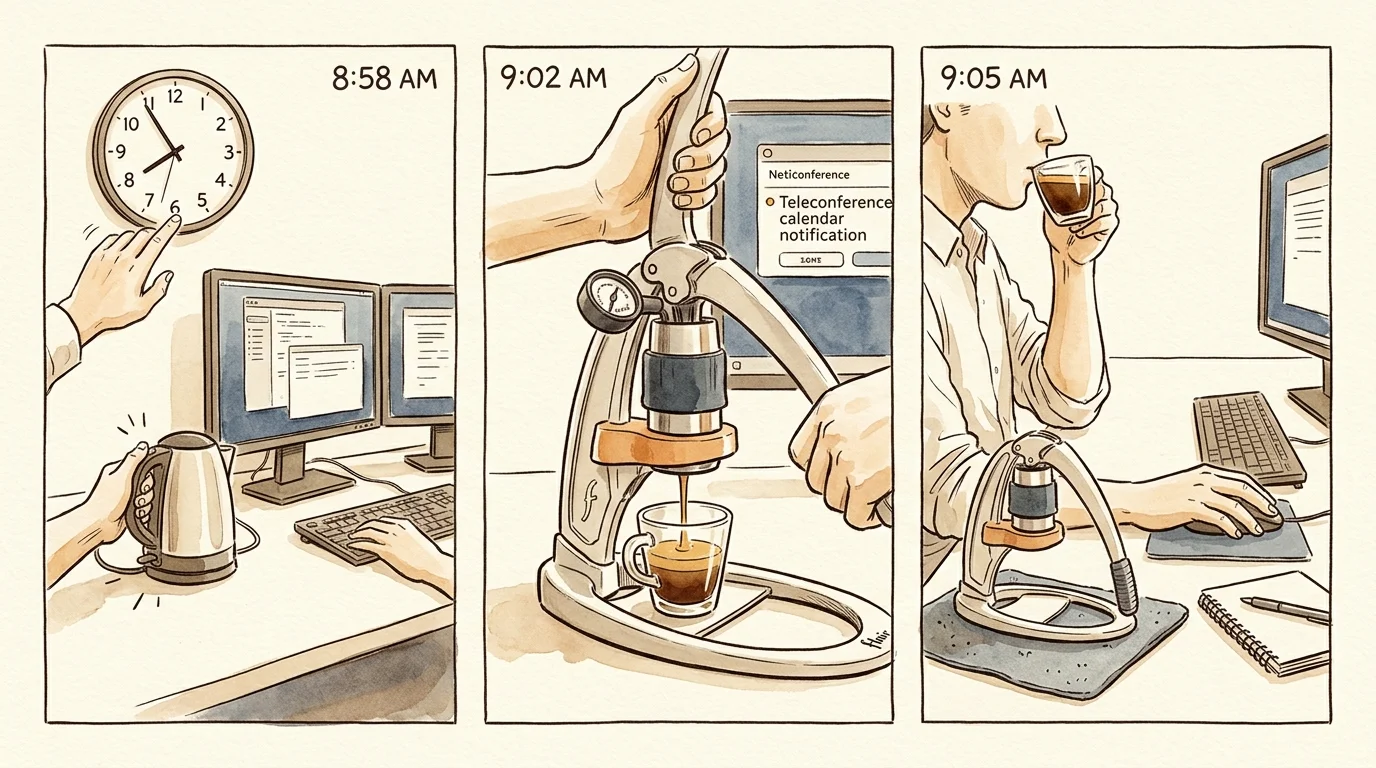
To see how these machines perform in practice, consider a remote software developer preparing a double espresso at 9:00 AM before a 9:15 AM team standup. The office features a 48 × 24-inch desk located 30 feet from the nearest sink.
Using the Breville Bambino, the developer powers the machine on at 9:00:00 AM. The ThermoJet coil reaches operating temperature by 9:00:03 AM.
The worker doses 18.0 grams of espresso-ground coffee into the 54 mm portafilter and tamps. Locking the portafilter in place, they press the double-shot preset button at 9:00:30 AM.
The machine dispenses 36.5 grams of liquid espresso in 27 seconds, shutting off automatically. Solenoid valves route 35 milliliters of backpressure water into the drip tray.
The developer knocks the spent puck into a small countertop box and wipes the basket clean. Total elapsed time: 2 minutes and 15 seconds. Countertop mess: zero drops.
Now consider the Wacaco Picopresso under identical desk constraints. The developer begins by filling a separate kettle with 300 milliliters of water and pressing boil at 9:00:00 AM.
The kettle boils in 2 minutes and 15 seconds. At 9:02:15 AM, the worker pours 80 milliliters of boiling water into the Picopresso chamber to preheat the cylinder.
While the metal warms, the worker grinds 18.0 grams of coffee, doses the 52 mm basket, and uses a distribution needle. At 9:03:30 AM, they pump the preheat water out into a desktop waste bowl.
The developer fills the chamber with fresh boiling water, locks the basket, and pumps 12 times to pre-infuse. After an eight-second pause, they pump steadily for 32 seconds to extract a 36.0-gram shot.
At 9:04:50 AM, the espresso is ready, but the device holds hot, pressurized slurry. The worker pumps residual water (45 milliliters) into the dump bowl, disassembles the hot parts, and rinses them using 120 milliliters of kettle water.
Total elapsed time: 6 minutes and 40 seconds. Total dirty wastewater accumulated in the desktop bowl: 245 milliliters. The developer must carry this liquid bowl to the sink before logging into their call.
Best Picks for Desk Kitchenette Setups
Selecting your ideal setup depends entirely on whether desk space or sink access represents your tighter bottleneck. Here are our specific model recommendations.
Best for Zero-Counterprint Kitchenettes: Wacaco Picopresso ($129.90)
If you refuse to sacrifice permanent desk surface, the Picopresso stands uncontested. It delivers cafe-quality 9-bar espresso using a true unpressurized 18-gram commercial basket.
You can store the entire kit inside a standard desk organizer drawer. Buy this if you already have an electric kettle nearby and do not mind managing a desktop dump cup.
Best Value Lever Brewer: Flair NEO Flex ($99.00)
The NEO Flex uses a lightweight polymer frame and an integrated pressure gauge to deliver authentic manual lever extraction. Its Flow-Control portafilter accommodates less consistent grinders while letting you experiment with pressure profiling.
Keep in mind that its 10.5-inch operating height requires clear vertical clearance. It suits home offices with deep desks and open overhead space.
Best Plug-and-Play Electric Performer: Breville Bambino ($299.95)
The Bambino represents the ultimate efficiency benchmark for remote desk kitchenettes. Its three-second warmup and 9-bar regulated extraction produce consistent espresso with zero preheating routines.
The sealed internal drip tray contains all post-shot waste, making it the cleanest choice for carpeted offices. As confirmed by Consumer Reports’ small appliance evaluations, its combination of rapid readiness and compact width provides unmatched convenience for micro-kitchens.
Best Ultra-Narrow Budget Thermoblock: De’Longhi Dedica EC685 ($249.95)
At just 5.87 inches wide, the Dedica squeezes into narrow gaps between computer towers and bookshelves. It heats in 40 seconds and offers reliable automated shot volumes.
Its stock pressurized baskets limit extraction clarity compared to the Bambino. However, it provides a mess-free drip tray at a lower price point for budget-minded workers.
Frequently Asked Questions
Can I pull real espresso with crema using a manual handheld maker?
Yes. Handheld brewers like the Wacaco Picopresso produce genuine espresso with thick crema. They reach commercial extraction pressures between 9 and 12 bars over unpressurized coffee beds.
Will running a 1,560-watt thermoblock trip my home office power strip?
It can trip your breaker if you share the power strip with desktop PCs or space heaters. Plug high-wattage thermoblocks directly into wall outlets or heavy-duty 15-amp surge protectors.
How do I manage wastewater from a manual espresso maker without an office sink?
You must keep a dedicated ceramic or stainless steel dump vessel on your desk. Empty this waste bowl into a breakroom drain or kitchen sink once or twice per day.
Is a pressurized portafilter better than an unpressurized basket for desk brewing?
Pressurized baskets are forgiving if you use pre-ground coffee from grocery stores. Unpressurized baskets produce superior espresso flavor, but require a high-end burr grinder calibrated for espresso.
Disclaimer: Product prices, features, and availability change frequently. Prices shown were accurate at time of writing but may have changed. We may earn a small commission from purchases made through links on this site, at no extra cost to you. Always verify current pricing and specifications on the retailer’s website before purchasing.