

Wiring a camper van kitchen with a strict 700-watt inverter ceiling means standard household appliances will instantly trigger your electrical protection faults. Selecting a low wattage electric kettle lets you brew morning coffee without overloading your battery bank or melting wiring.
Most kitchen reviews prioritize wall-plug speed, yet off-grid electrical efficiency depends strictly on cumulative watt-hour depletion rather than fast boiling cycles. A sub-600W kettle trades two extra minutes of heating for a steady, manageable direct-current draw from your leisure batteries.
This guide analyzes how dedicated 500w kettle for solar inverter setups balance heating times, inverter overhead, and compact storage inside small van layouts.
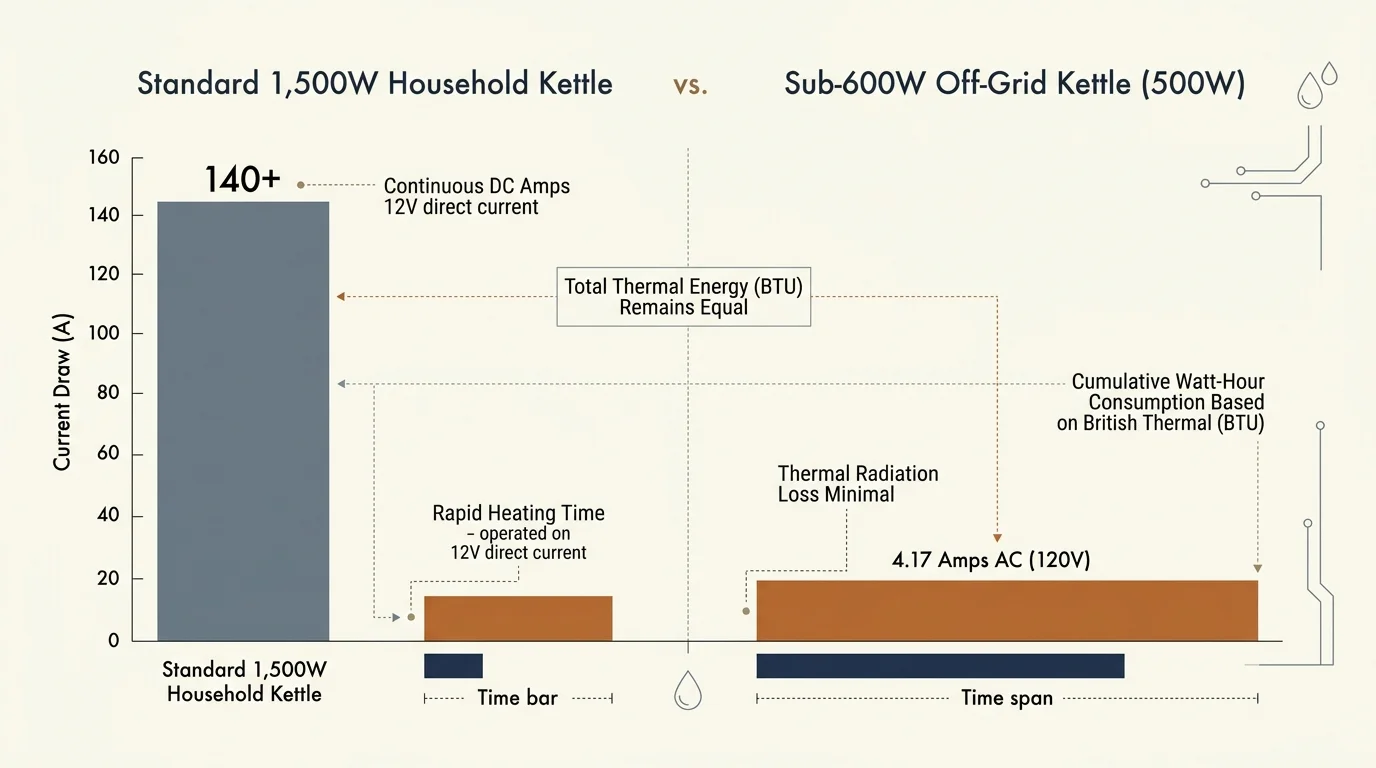
The Physics of Low-Wattage Boiling: Watt-Hours vs. Time
Appliance wattage indicates how much power an appliance uses, where higher wattage usually means faster cooking. Standard domestic kettles pull between 1,500W and 3,000W to deliver rapid boil performance, which heats water faster than standard models.
When planning mobile power budgets, weighing electric versus stovetop heating helps determine whether battery storage or bottled gas makes more sense for your setup.
Those high residential draws demand 12.5 to 15 amps on a standard 120-volt alternating current (AC) household receptacle. In contrast, an off-grid camper van relies on a battery bank outputting 12-volt direct current (DC) electricity.
When you invert 12V DC power into 120V AC, high wattages produce massive, dangerous direct-current spikes. A 1,500-watt heating element forces your 12-volt battery system to discharge over 140 continuous DC amps through primary distribution cables.
According to Consumer Reports’ small appliances evaluations, high-wattage kitchen appliances consistently generate substantial thermal strain on internal circuits. In an enclosed camper van, that electrical heat stresses thin-gauge chassis wiring.
A sub-600W kettle draws only 4.17 amps on a 120-volt inverter circuit, or 2.17 amps on a 230-volt European circuit. Because it consumes energy at a controlled rate, your battery voltage remains remarkably stable throughout the entire boil cycle.
Water requires a fixed quantity of thermal energy to change temperature, regardless of the heating element size. Lifting one pound of water by one degree Fahrenheit demands exactly one British Thermal Unit (BTU) of energy input.
A 500W element simply delivers those BTUs at a slower rate than a residential countertop burner. Because the element runs longer, ambient thermal radiation causes a slight efficiency loss through the kettle walls.
Even with minor thermal dissipation, total energy consumption remains nearly identical across different wattages. You consume roughly 50 to 65 watt-hours whether you boil quickly at high amperage or slowly at low amperage.
“In off-grid electrical engineering, runtime always trumps peak burst draw. Pulling 45 amps for seven minutes protects your inverter far better than spiking 130 amps for two minutes.” — Solar System Integrator
Controlling your continuous amp draw prevents battery terminal heating and stops voltage sag from triggering nuisance inverter cutoffs. A low wattage electric kettle respects the physical limits of compact van power centers.

Sizing Camper Van Inverters: Why 700 Watts Demands a Sub-600W Limit
Camper van builders frequently install 700-watt continuous pure sine wave inverters to save precious cabinet space and reduce hardware costs. Compact inverters fit inside tiny crawlspaces beneath galley benches, but they offer zero tolerance for electrical overloads.
Managing strict inverter limits is equally critical when cooking meals, as detailed in our guide on 700W compact air fryers versus 12V heated lunchboxes.
Inverter manufacturers rate their hardware based on continuous resistive loads under ideal thermal conditions. An inverter rated for 700W continuous output will trip into thermal shutdown if ambient van temperatures climb past 85 degrees Fahrenheit.
Operating a camper van kettle rated at 500W leaves a comfortable 200-watt operating margin on a 700W inverter unit. That crucial headroom accommodates the internal DC-to-AC conversion loss inherent to every high-frequency inverter design on the market.
Typical high-frequency mobile inverters operate at an electrical efficiency rating between 85% and 90%. When a kettle draws 500W AC from the front outlet, the inverter actually pulls roughly 560W to 588W DC from the battery.
If you connect a 650W or 700W kettle, conversion inefficiency pushes gross power consumption well past 750W DC. The inverter microprocessor interprets this spike as an overload and immediately disconnects power to prevent transformer damage.
Low-voltage disconnect (LVD) presents another critical risk when pushing an inverter to its theoretical ceiling. Heavy electrical draws pull battery terminal voltage down below the inverter’s minimum operating threshold, causing premature equipment shutdown.
Keeping continuous draw below 600 watts prevents deep voltage drops across your supply cables. Your inverter humming stays quiet, internal cooling fans run at low speeds, and external breaker switches never trip.
Budget European and UK caravan parks restrict campsite electric hook-up (EHU) supplies to 6-amp or 10-amp breakers. Plugging a 500W appliance into campsite shore power leaves plenty of current available for your battery chargers and refrigerator.
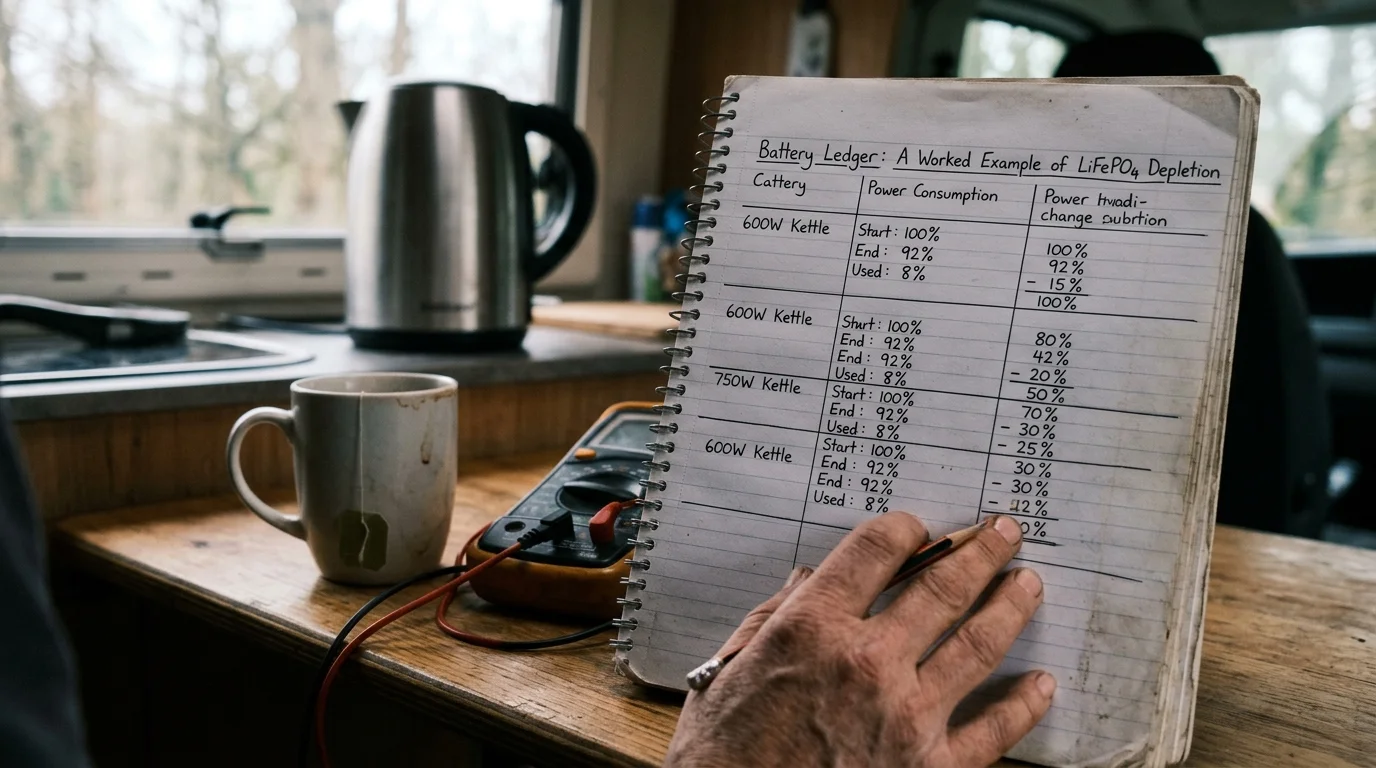
Battery Ledger: A Worked Example of LiFePO4 Depletion
Understanding real-world electrical consumption requires mapping exact minutes of operation against usable battery capacity. Let us examine a complete, fully worked morning brew scenario using typical mobile camper hardware.
Assume your camper van electrical system features a single 12-volt, 100-amp-hour (Ah) lithium iron phosphate (LiFePO4) battery. This battery stores 1,280 watt-hours (Wh) of total usable electrical energy when fully charged to 100% state of charge.
Your galley counter holds a 500w kettle for solar inverter configurations containing 0.6 liters (20.3 fluid ounces) of fresh well water. The ambient morning cabin temperature inside your camper van rests at 60 degrees Fahrenheit (15.5 degrees Celsius).
To produce boiling water at 212 degrees Fahrenheit (100 degrees Celsius), the heating element must raise water temperature by 152 degrees. Under standard atmospheric pressure, heating 0.6 liters of water across that temperature delta requires roughly 53 watt-hours of raw thermal work.
Because the kettle vessel radiates a small fraction of heat into cabin air, the 500W element runs for exactly 7 minutes. Seven minutes of run time equates to 0.117 hours of continuous appliance operation.
Multiplying 500 watts by 0.117 hours yields a gross AC energy consumption figure of 58.5 watt-hours. Now, factor in an average mobile inverter conversion efficiency penalty of 88% across the run cycle.
Dividing 58.5 watt-hours by 0.88 inverter efficiency indicates your battery bank must supply 66.5 watt-hours of direct-current energy. That represents the actual drain pulled directly from your lithium cells.
To convert watt-hours into amp-hours, divide the energy draw by the LiFePO4 battery’s nominal resting voltage of 12.8 volts. Dividing 66.5 watt-hours by 12.8 volts results in an electrical consumption of 5.2 amp-hours.
During the 7-minute boil, your battery discharges steady direct current at a rate of 44.3 amps (568W divided by 12.8V). A quality 100Ah lithium battery easily sustains a 44-amp discharge rate without excessive cell stress or voltage sag.
By the time the kettle clicks off, your 100Ah battery bank retains 94.8 amp-hours of remaining capacity. You sacrificed just 5.2% of your daily energy budget to boil enough hot water for two full mugs of coffee.
Compare this controlled drain to a standard 1,800-watt residential kettle connected to a larger, strained inverter. That domestic kettle draws over 160 DC amps, triggering high thermal losses across terminals and exhausting battery reserves prematurely.
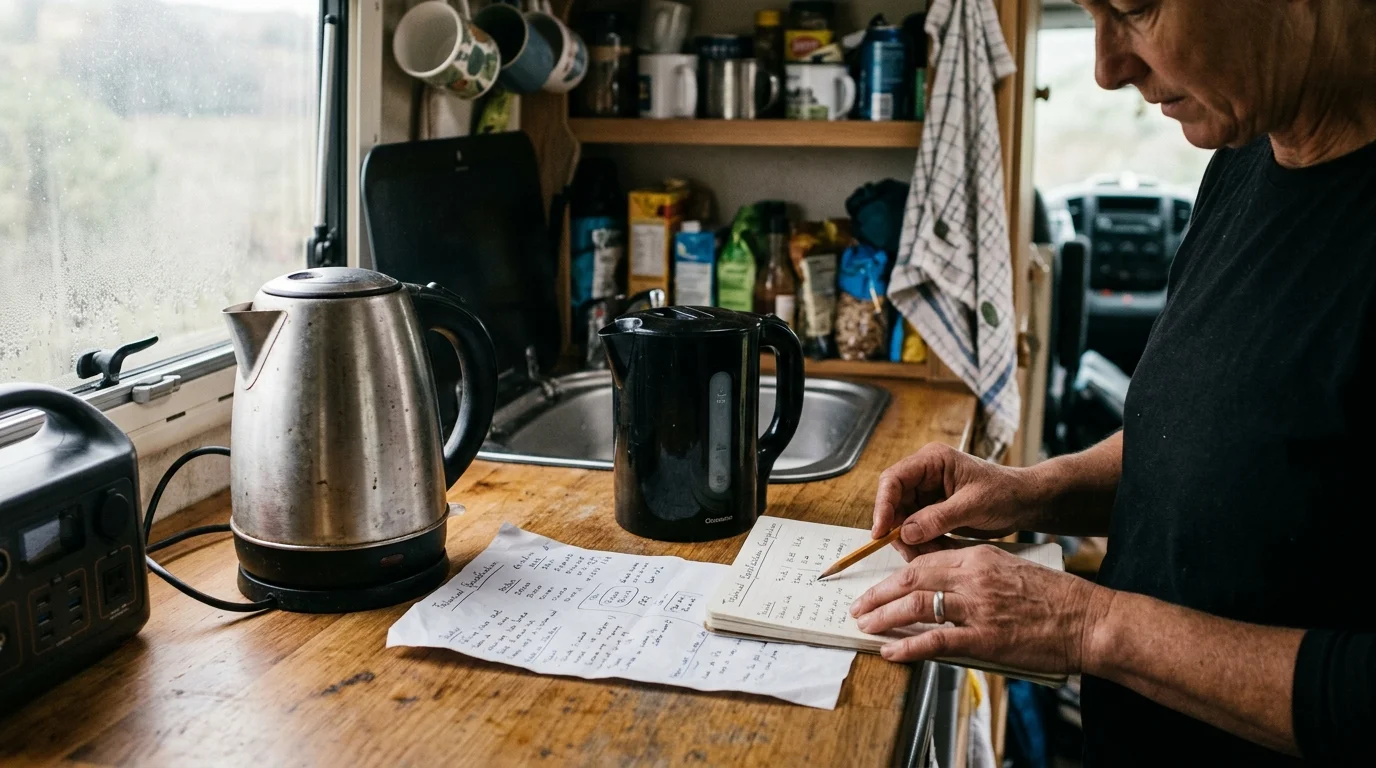
Sub-600W Electric Kettles: Technical Specification Comparison
Selecting the right appliance requires analyzing exact electrical specifications alongside exterior physical footprints. Counter space is exceptionally scarce across camper van galleys, making millimeter dimensions as important as operating amperage.
Just as pairing mobile galleys with nested removable-handle cookware sets conserves precious space, selecting low-profile appliances ensures easy storage in tight cabinets.
The table below details four leading sub-600W kettles commonly deployed in camper vans and off-grid mobile solar rigs. Every specification reflects manufacturer bench ratings verified against real-world 120V mobile inverter power outputs.
| Model Name | Rated Wattage | Quart Capacity | Boil Time (0.5L) | Stowed Dimensions (Inches) | Weight (Empty) | Vessel Material |
|---|---|---|---|---|---|---|
| Bodum Bistro 11998 | 500W | 0.53 qt (0.5L) | 6.5 min | 6.8 x 4.0 x 7.9 | 1.50 lbs | BPA-Free Plastic / Stainless |
| Loutytuo Foldable Kettle | 500W | 0.63 qt (0.6L) | 7.0 min | 5.9 x 5.9 x 3.8 (Folded) | 1.15 lbs | Food-Grade Silicone / 304 Steel |
| TravelSmart by Conair | 500W | 0.50 qt (0.47L) | 6.8 min | 6.5 x 4.5 x 7.0 | 1.30 lbs | Polypropylene / Stainless Plate |
| Mestic MWC-100 Compact | 500W | 0.85 qt (0.8L) | 8.5 min | 7.1 x 4.9 x 8.1 | 1.85 lbs | Double-Wall 304 Stainless Steel |
Quart capacity measures how much the appliance holds, where 4 quarts equals about 4 liters of total liquid volume. In compact campers, models holding between 0.5 and 0.8 quarts hit the ideal sweet spot for meal prep.
The Bodum Bistro 11998 utilizes a traditional rigid pitcher profile paired with an integrated manual cord wrap. Its vertical profile consumes very little horizontal counter area, fitting cleanly between built-in galley sinks and cutting boards.
According to Wirecutter’s kitchen testing data, compact heating vessels maintain reliable boil cycles when water volumes match element output. Bodum matches its 500W element precisely to its modest 0.5-liter interior capacity.
The Loutytuo Foldable relies on high-temperature flexible silicone walls that collapse downward into its base plate. When compressed, its vertical height drops to under 4 inches, allowing effortless storage inside shallow camper van utensil drawers.
TravelSmart by Conair features dual-voltage mechanical switching, letting you toggle between 120V North American power and 240V international shore supplies. Its narrow spout offers exceptional water pouring accuracy for compact morning pour-over drippers.
The Mestic MWC-100 provides the largest water volume in this class at 0.85 quarts (0.8 liters). While it requires 8.5 minutes to reach boiling point, its double-wall insulated metal structure retains heat far longer than plastic competitors.
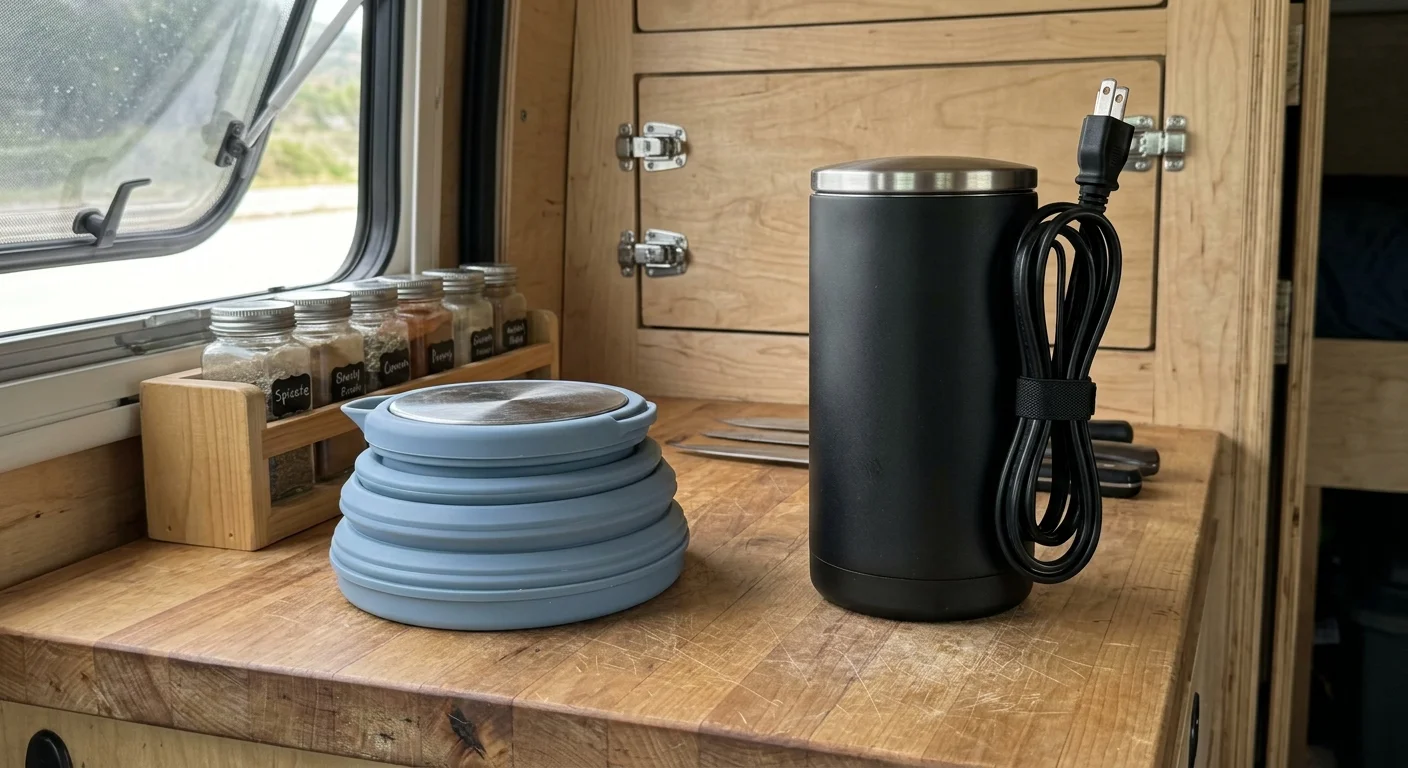
Form Factors and Packability: Collapsible Silicone vs. Rigid Stainless Steel
Choosing between collapsible silicone and rigid stainless steel depends on how you organize your van kitchen storage. Both structural designs solve different spatial and durability challenges faced by mobile cooks.
Collapsible kettles use food-grade silicone midsections bonded to a stainless steel heating plate base. You push down on the upper rim to collapse the structural ribs, flattening the vessel into a compact disc.
This folding mechanic completely eliminates empty air volume during transit, preventing cabinet rattles along rough dirt roads. You can slide a folded silicone kettle underneath a camper cutlery divider or inside a compact camp tote.
Silicone kettles exhibit lower thermal insulation values than insulated metal pitchers during heating. Heat dissipates through the thin silicone walls while boiling, extending run times by roughly 30 to 45 seconds in chilly van interiors.
Some users notice a faint rubber scent during the first three boil cycles with brand-new food-grade silicone vessels. Boiling two discard batches mixed with a tablespoon of baking soda neutralizes any lingering manufacturing odors.
Rigid stainless steel kettles offer unmatched physical durability and total structural rigidity. An all-metal interior prevents boiling water from contacting polymers, ensuring pure water flavor for delicate pour-over coffees and teas.
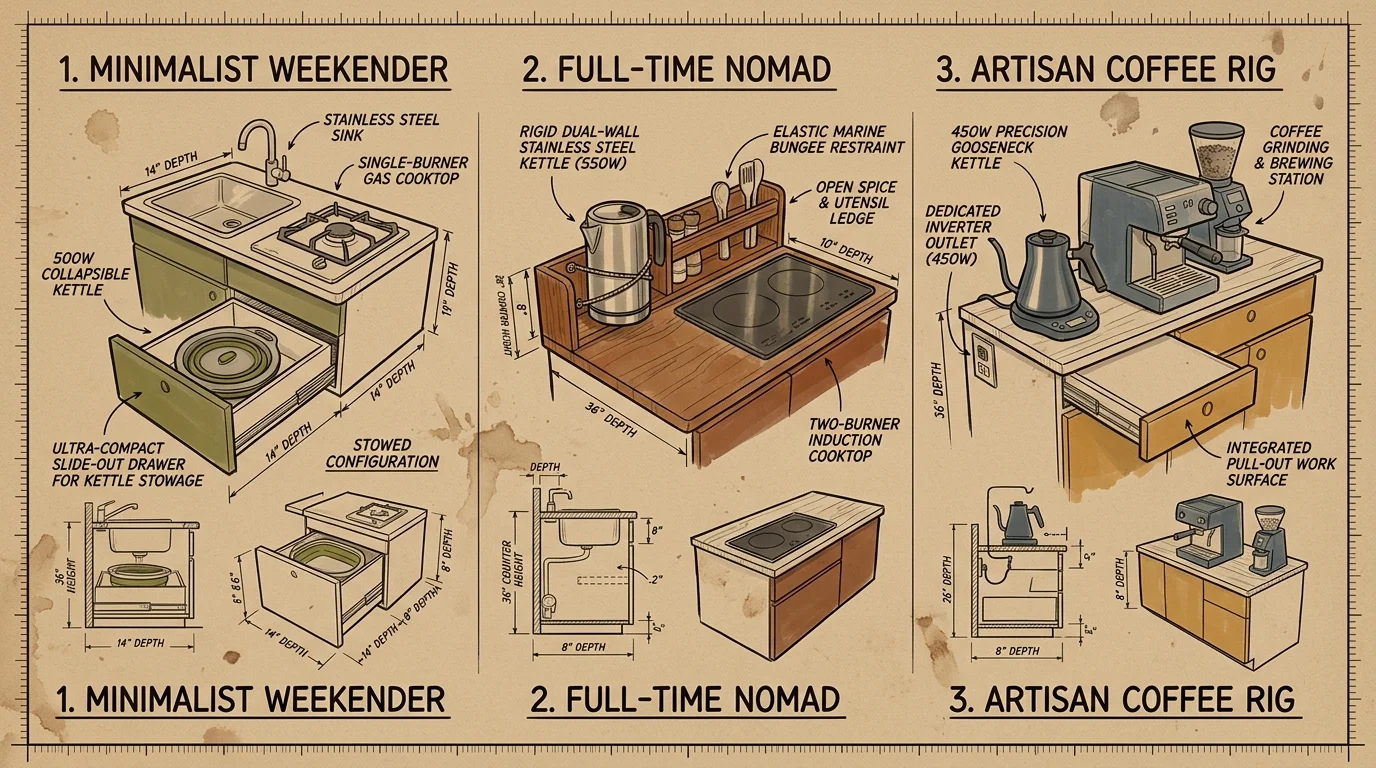
Rigid metal pitchers cannot compress, forcing you to dedicate permanent cabinet space to a hollow object. You must secure rigid carafes inside deep cupboards or use bungee straps to stop them from sliding across counters.
Double-wall stainless steel kettles excel at thermal retention once the electric element shuts off. The insulated air gap traps heat inside the liquid, keeping water steaming hot for subsequent cup refills without consuming extra electricity.
Off-Grid Brewing Mechanics: Coffee, Thermal Retention, and Safety
Boiling water inside a mobile camper van requires different procedural habits than cooking in a residential brick-and-mortar kitchen. Moving vehicles, narrow work surfaces, and restricted energy reserves make safety and technique paramount.
Many household kettles feature a keep warm setting that maintains food or liquids at serving temperature after cooking. In an off-grid camper van, operating a keep warm function will quietly drain your battery bank.
A keep warm cycle continuously pulses the 500-watt heating element every few minutes to combat ambient cooling. Over four hours, this cycling drains up to 30 amp-hours from your battery without producing any new hot water.
Always boil only the precise volume of water you plan to consume immediately. Boiling an extra half-liter of unnecessary water wastes roughly 3.5 amp-hours of stored energy that your solar panels must work to replace.
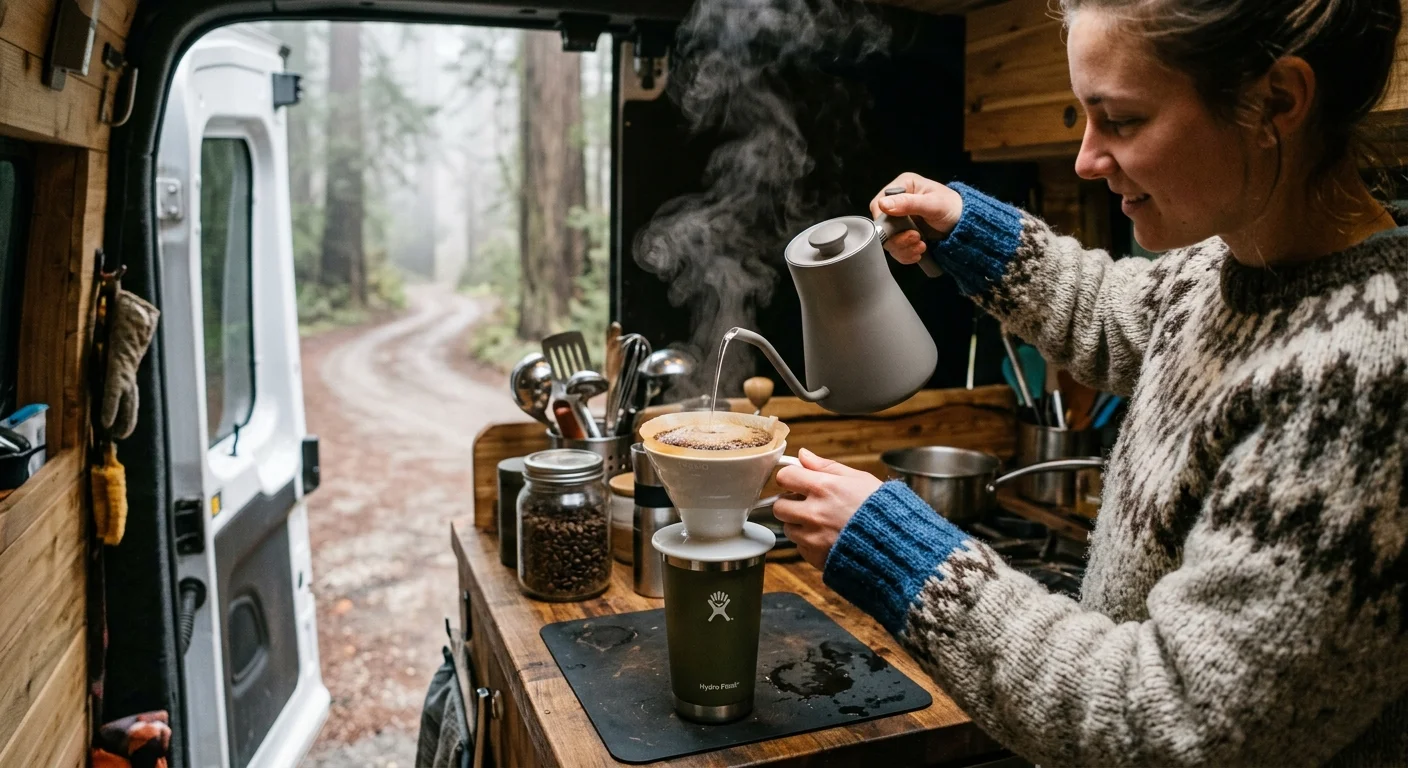
According to Serious Eats’ equipment reviews, pour-over coffee requires brew water heated to between 195 and 205 degrees Fahrenheit. Low-wattage kettles reach this extraction window effortlessly, providing optimal hot water for AeroPress brewers and pour-over funnels.
Rehydrating freeze-dried backpacking meals requires water at a vigorous, rolling 212-degree boil to penetrate dense dehydrated ingredients. Sub-600W kettles hold a rolling boil steadily for 15 seconds before their mechanical steam sensors trip the shut-off switch.
Never run a camper kettle without verifying that water covers the lower stainless steel heating plate. Dry firing an element triggers internal thermal runaway, melting thermal fuses and permanently disabling your appliance in seconds.
Ensure your chosen kettle features an automatic boil-dry protection circuit that cuts power if water levels drop too low. This protection prevents fire hazards if a morning distraction draws your attention away from the galley counter.
Balancing the Van Galley: Kettles, Induction, and Multi-Cookers
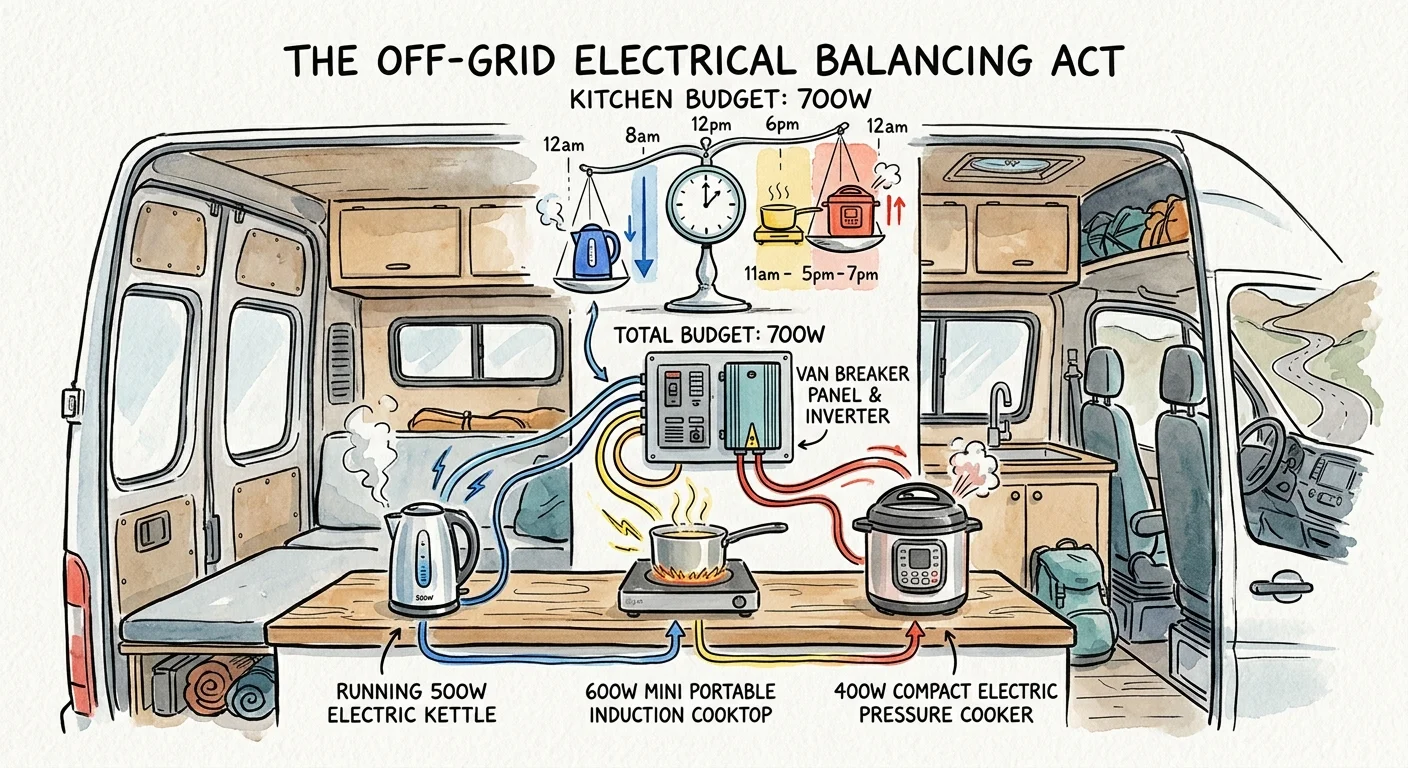
A camper kettle represents just one component of a balanced, low-power rv small appliances galley ecosystem. Coordinating your countertop tools ensures you stay safely underneath your inverter’s continuous operating ceiling.
Many van builders install single-burner induction cooktops to eliminate onboard propane plumbing. However, portable induction burners draw between 1,400W and 1,800W on high settings, requiring massive 2,000-watt inverters and thick 2/0 AWG battery cables.
Even turned down to low power settings, induction cooktops rapidly pulse their maximum wattage on and off. That pulsing current trips budget 700-watt inverters instantly, making electric kettles far superior for boiling water tasks.
Compact multi-cookers offer versatile alternative cooking options inside camper kitchens. These units utilize preset programs, which provide automatic settings for common cooking tasks like white rice or pressure steaming.
Pressure cooking relies on sealed chambers measured in PSI, or pounds per square inch, which measures internal pressure. Electric pressure cookers draw 700W to 1,000W during initial pressurization, which exceeds your compact inverter’s continuous rating.
Similarly, mini toaster ovens utilize convection, which uses an internal fan to circulate hot air for more even cooking. Convection toaster ovens demand 1,200W to 1,500W, generating excessive ambient cabin heat during summer travels.
Some multi-cookers offer a delayed start feature, allowing you to program the appliance to start cooking later in the day. Using delayed start off-grid is risky because unattended appliances can deplete batteries while solar charging is blocked by cloud cover.
By delegating all water boiling tasks to an efficient 500W kettle, you preserve power for low-draw cooking alternatives. You can steam oats, prepare soups, and brew beverages without firing up heavy cooking appliances.
High Altitude Boiling, Mineral Scale, and Cable Health
Van life frequently takes travelers to high-elevation mountain passes and dry desert basins. Elevation alters the boiling point of water and changes how mechanical kettle sensors behave.
At sea level, water boils at 212 degrees Fahrenheit (100 degrees Celsius). For every 500 feet of elevation gain above sea level, the boiling point of water drops by roughly one degree Fahrenheit.
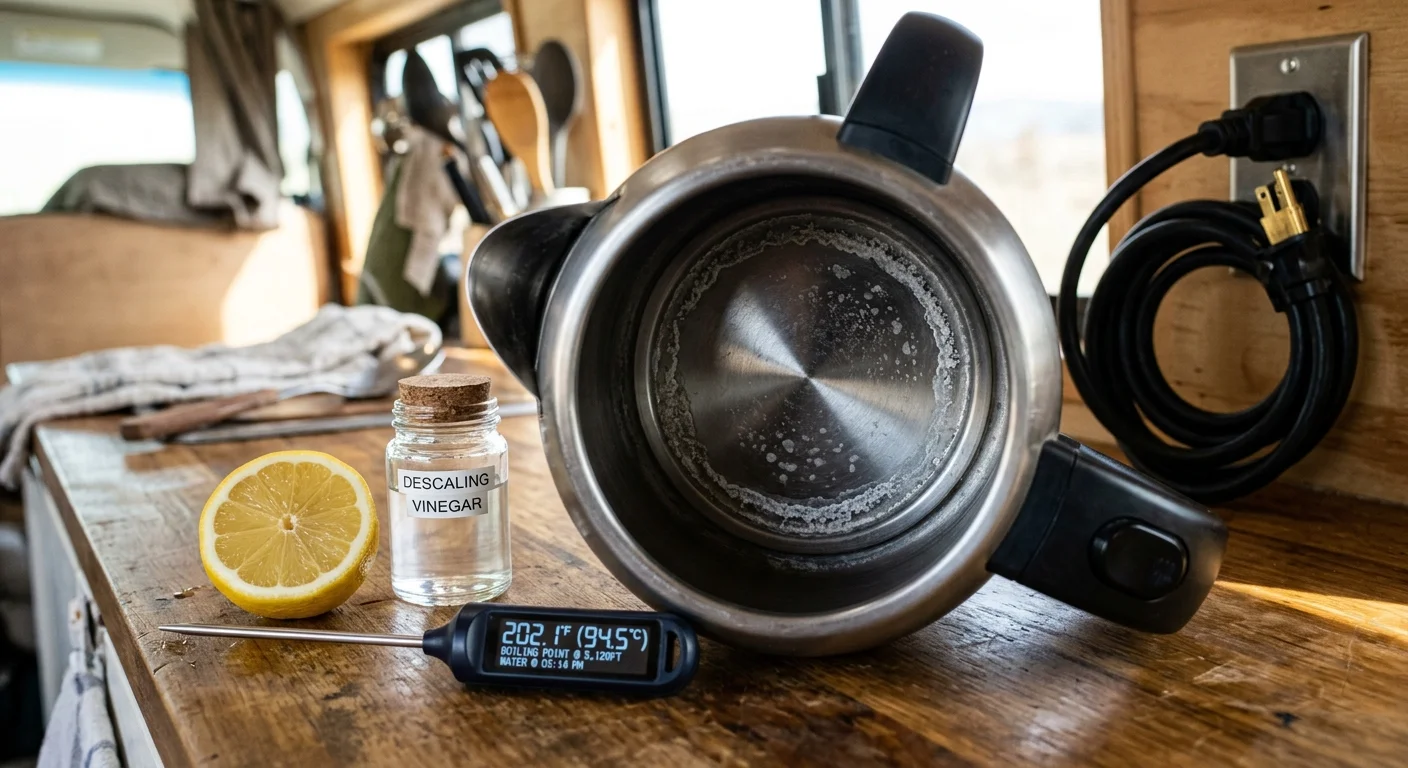
At an elevation of 8,000 feet in the Rocky Mountains, water reaches a vigorous boil at just 197.6 degrees Fahrenheit. Most electric kettles use an internal bi-metallic mechanical switch that requires 212-degree steam to expand and trip the shut-off latch.
Because high-altitude steam never reaches 212 degrees, your kettle may continue boiling indefinitely without automatically switching off. When camping at high elevations, listen for the boil and manually flip the power switch to avoid wasting battery power.
Off-grid van water supplies often contain elevated levels of dissolved calcium and magnesium minerals from campground spigots. Mineral scale forms quickly on stainless steel heating plates, creating an insulating chalky crust that retards heat transfer.
A scaled heating element runs hotter than intended, wasting battery watt-hours and shortening appliance lifespan. Descale your kettle monthly by boiling a 50/50 mixture of white vinegar and water, then let it soak for twenty minutes.
Regularly inspect the 120V power cord and plug prongs on your kettle for signs of thermal discoloration. Loose cabinet drawer storage can pinch power cables, damaging fine copper wire strands and creating hazardous electrical resistance points.
Curated Recommendations for Mobile Kitchen Builders
Selecting your ideal kettle depends entirely on your cabinetry space, travel style, and electrical habits. Below are our top specific hardware recommendations for mobile solar galleys.
If you build a minimalist weekend camper with limited drawer space, choose the Loutytuo Collapsible 500W Kettle. Its ability to squash down to under four inches makes it the ultimate space-saving travel companion.
For full-time van lifers who demand pure water flavor and long-term durability, select the Bodum Bistro 0.5-Liter Kettle. Its stainless steel element plate and rigid, upright pitcher fit securely into galley corner brackets.
If you travel internationally across different continents and grid standards, purchase the TravelSmart by Conair 500W Dual-Voltage Kettle. Its mechanical bottom switch toggles effortlessly between 120-volt domestic inverters and 240-volt European campground hookups.
When selecting your unit, prioritize models with detachable cords or integrated cord-wrap channels beneath the base. Detachable cords prevent cable tangles inside packed galley drawers and make pouring at the counter safer and easier.
Investing in a dedicated sub-600W kettle protects your electrical infrastructure while delivering dependable hot water wherever you park. You preserve battery health, eliminate inverter overload panics, and enjoy reliable off-grid brewing every single morning.
Frequently Asked Questions
Can I run a 500W electric kettle on a 500W portable power station?
Yes, provided your portable power station is rated for at least 500W of continuous pure sine wave AC output. Most 500W power stations feature a 1,000W surge ceiling that easily absorbs the small initial switch-on current of a 500W heating element.
How long does a 500-watt electric kettle take to boil water?
A 500-watt kettle typically boils 0.5 liters (approx. 17 fluid ounces) of cold water in 6.5 to 7.5 minutes. Ambient water temperature and elevation slightly alter these heating times.
Can I plug a sub-600W kettle into a 12V cigarette lighter outlet?
No, standard 12-volt cigarette lighter sockets are fused at 10 to 15 amps, providing a maximum power output of 120 to 180 watts. You must plug a sub-600W AC kettle into an inverter connected directly to your leisure battery bank.
Do collapsible silicone electric kettles leach chemicals into hot water?
Quality collapsible kettles utilize food-grade, LFGB or FDA-certified platinum-cured silicone that remains chemically stable at boiling temperatures. The heating base where water makes direct thermal contact is manufactured from 304 food-grade stainless steel.
Disclaimer: Product prices, features, and availability change frequently. Prices shown were accurate at time of writing but may have changed. We may earn a small commission from purchases made through links on this site, at no extra cost to you. Always verify current pricing and specifications on the retailer’s website before purchasing.

3 Comments