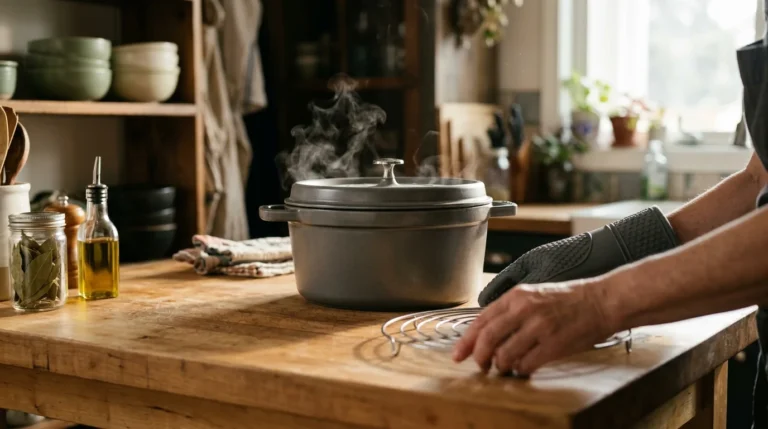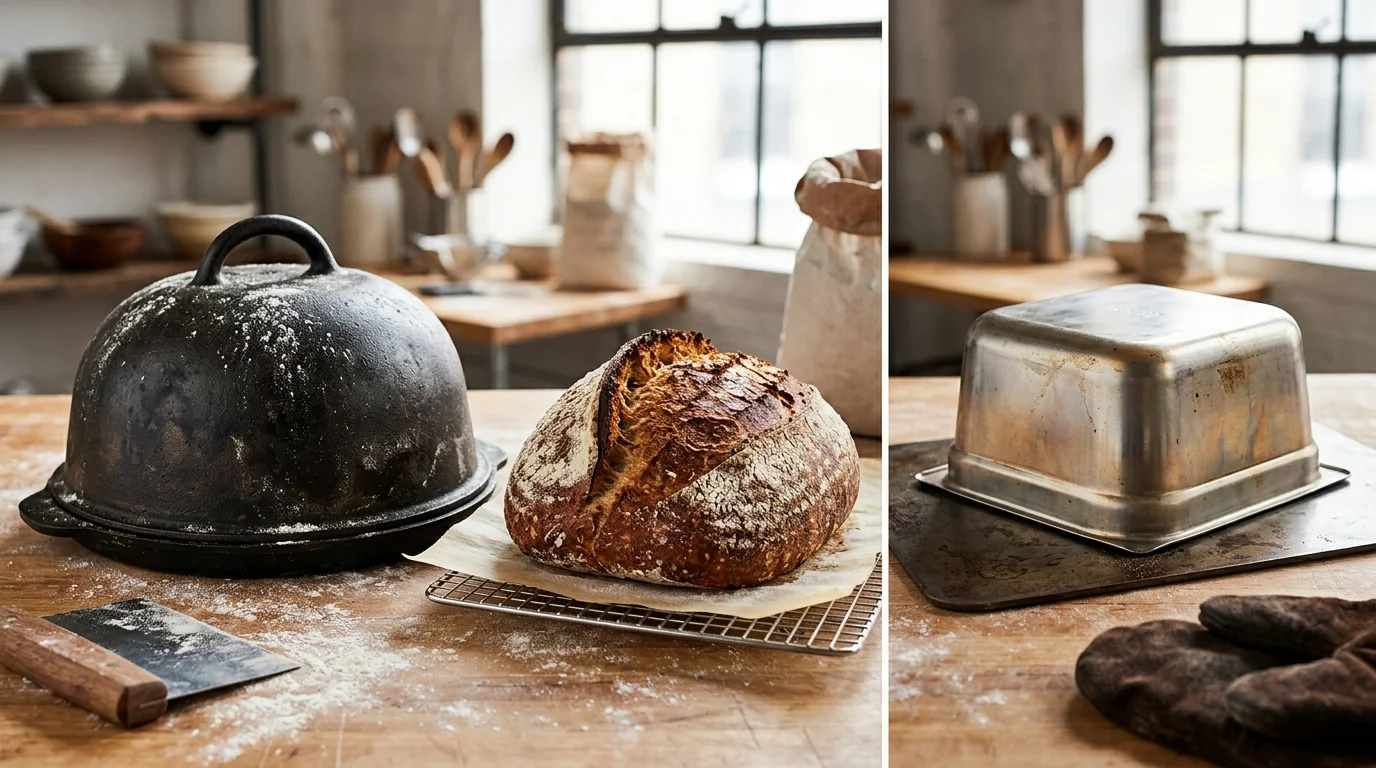
You do not need an expensive cloche to bake blistered sourdough batards with towering ears. An inverted commercial stainless steel hotel pan traps dough steam just as effectively as heavy cast iron while cutting oven weight by eighteen pounds.
While traditional loaf pans for sandwich bread rely on ambient oven dry heat, baking hearth loaves requires trapping local humidity to achieve an open crumb.
Bakers often assume that cast iron’s massive thermal bulk creates superior crust gelatinization. However, internal relative humidity—not the dome’s metal thickness—dictates oven spring when baking over a preheated baking steel.
Swapping heavy cast iron for a lightweight 22-gauge stainless pan also solves vertical clearance issues in standard residential ovens. This guide compares steam retention physics, rack spacing, and handling ergonomics to upgrade your artisan bread setup.
The Physics of Sourdough Steam: Latent Heat vs. Enclosure Volume
When moist dough hits a 450-degree Fahrenheit surface, dry oven heat hardens the exterior skin within minutes. Saturated steam acts as a thermal buffer by condensing directly onto the cooler exterior of the loaf.
Maximizing oven spring starts before baking, as consistent dough development often relies on fermentation boxes or seedling heat mats to maintain predictable proofing temperatures.
This condensation transfers latent heat rapidly while keeping surface starches pliable for maximum oven spring. It also dissolves surface starches into a glossy gel that bakes into a blistered, crisp crust.
To produce an open crumb, you need a high-efficiency steam trap sourdough environment maintaining at least 90 percent relative humidity during early baking. Both cast iron cloches and inverted metal pans achieve this by capturing evaporated dough water.
A standard 850-gram batard contains roughly 320 grams of water, releasing 35 to 45 grams as steam during the opening ten minutes. That moisture expands into hundreds of liters of water vapor at baking temperatures.
An inverted half-size commercial hotel pan creates an internal volume of roughly 9.5 liters. The expanding dough moisture saturates this compact air pocket with water vapor in less than two minutes.
Heavy cast iron cloches like the Challenger pan enclose approximately 7.5 liters of interior space. While slightly smaller, the relative humidity difference between the two vessels during active baking is functionally undetectable.
As equipment evaluations from Serious Eats demonstrate, sealing local ambient moisture around the dough matters far more than the specific metal enclosing the loaf.
“Trapping pure moisture around the loaf during the first twenty minutes is the single factor that unlocks professional crust blisters. The metal dome is merely an umbrella.” — Artisan Bread Specialist
Material Science: Stainless Steel Heat Conduction vs. Cast Iron Thermal Mass
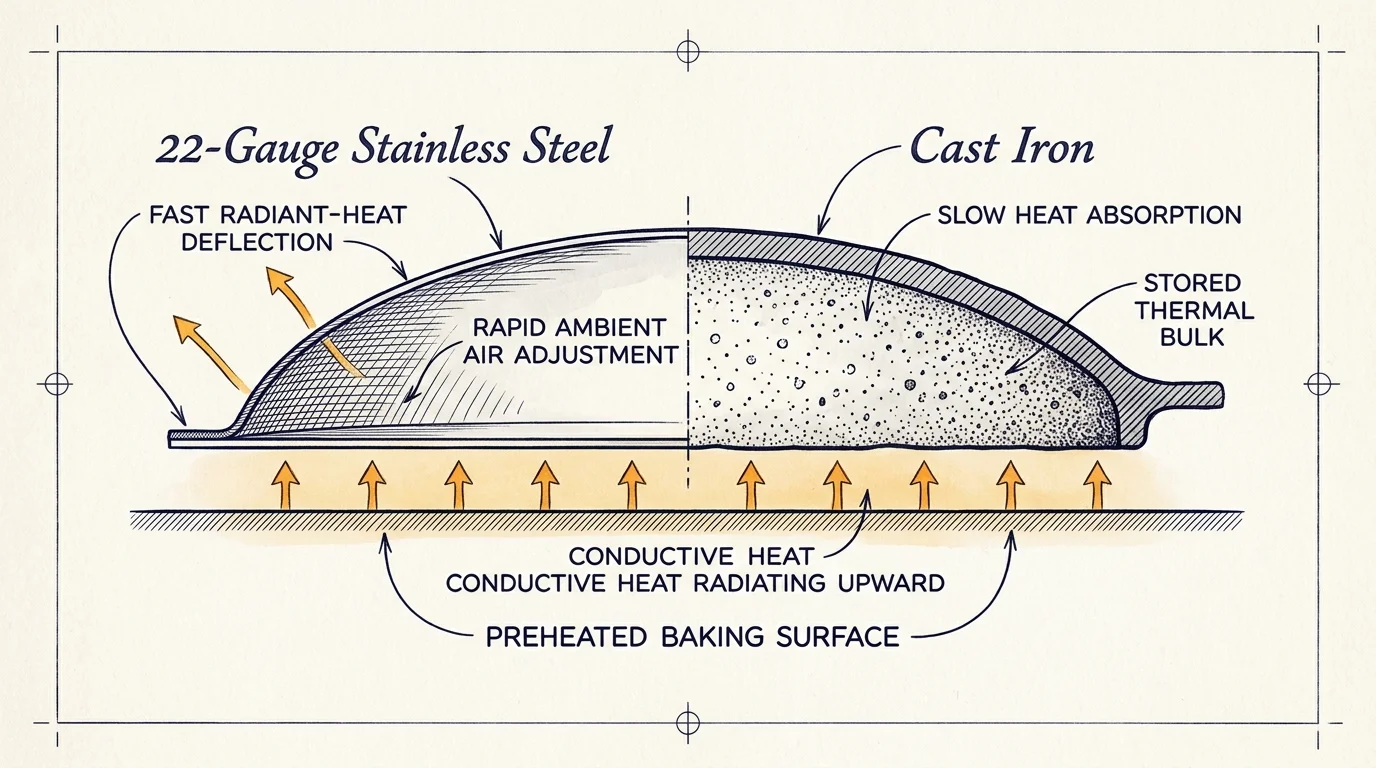
Cookware marketers frequently advertise cast iron as the premier material for bread domes due to its immense heat retention. Cast iron possesses high volumetric heat capacity, storing energy within its thick walls.
However, a bread dome does not need to store thermal energy; it only needs to contain vapor. The hot base beneath your loaf supplies conductive heat, while the upper dome merely blocks dry convective oven currents.
Commercial pans are graded by gauge, which measures the thickness of the metal where lower numbers mean thicker steel. Standard restaurant pans feature 22-gauge or 24-gauge food-grade 304 stainless steel.
While heat distribution—the measure of how evenly a pan spreads thermal energy across its surface—matters for searing meats, it is secondary for a steam dome. A stainless pan reaches ambient oven temperature almost immediately.
Unlike cast iron that requires a seasoned surface, which is a protective coating built up through polymerized oil and heat, stainless steel resists moisture natively. Steam will rust raw cast iron, whereas stainless steel never corrodes.
A commercial steam table pan is completely oven-safe, meaning it can withstand high oven temperatures without warping or releasing toxic fumes. Food-grade 304 stainless pans tolerate temperatures exceeding 750 degrees Fahrenheit without structural failure.
You must avoid non-stick bakeware coated with PTFE, the chemical name for Teflon-style non-stick coatings. Baking sourdough at 450 to 500 degrees Fahrenheit causes PTFE coatings to decompose and emit harmful fumes.
Similarly, bakeware with a ceramic coating—a newer non-stick surface made from silica—often degrades and crazes when exposed to dry 500-degree preheats. Plain, uncoated stainless steel remains chemically inert under extreme heat.
You also do not need expensive tri-ply cladding, which bonds three layers of metal together for better heat distribution. An unclad, stamped stainless pan traps steam just as effectively at a fraction of the cost.
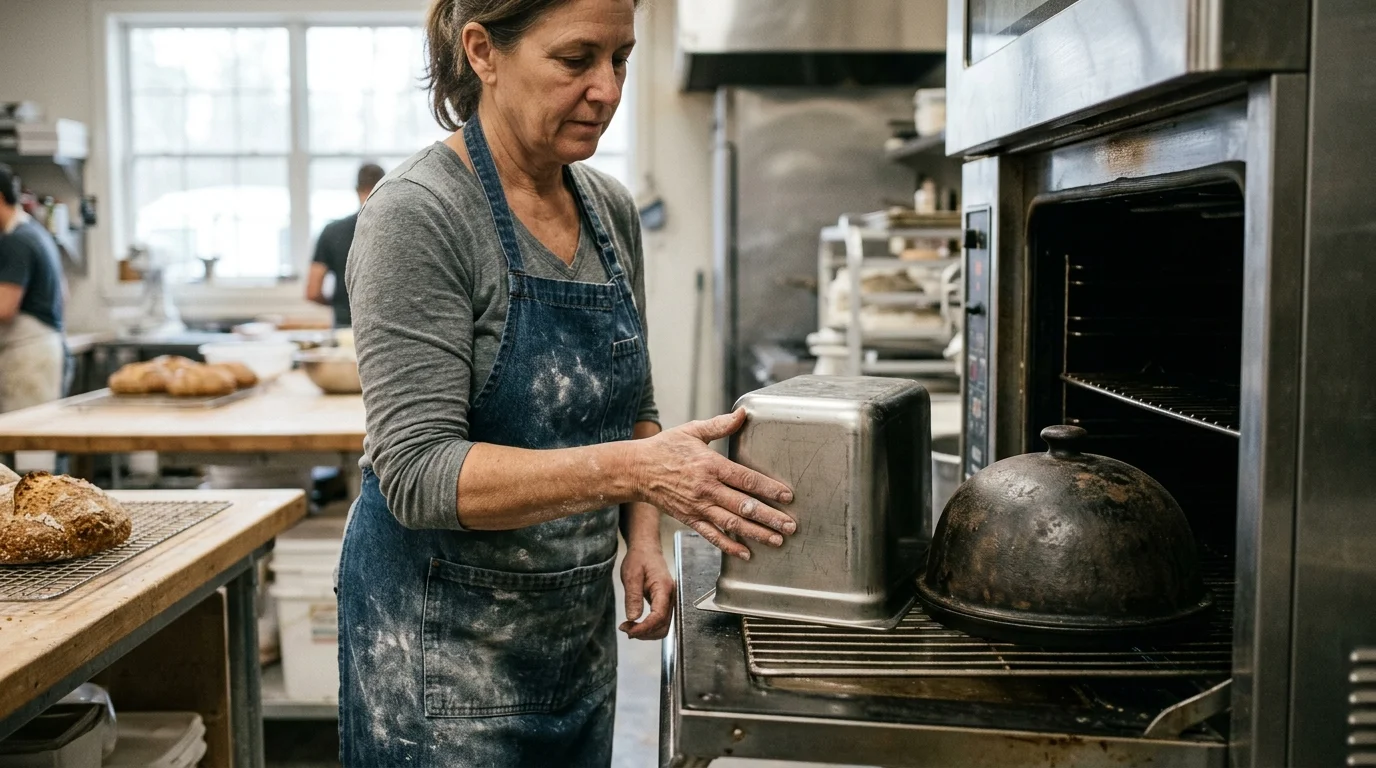
Dimensional Analysis: 6-Inch Hotel Pans vs. Dedicated Cast Iron Cloches
Dedicated cast iron cloches and commercial pans differ drastically in footprint, internal height, and price. Selecting the wrong vessel limits the loaf shapes you can bake without scorching dough against metal walls.
Much like Pullman loaf pans trap internal steam to shape uniform crusts, an inverted commercial pan provides an airtight chamber giving batards plenty of headroom.
The half-size hotel pan for bread baking has become an industry favorite because its dimensions accommodate long European batards. Measuring 12.75 inches long by 10.38 inches wide, it comfortably shields standard 10-inch to 12-inch loaves.
More importantly, the 6-inch depth provides vertical clearance for dramatic sourdough expansion. Loaves rise freely without sticking to the ceiling or singing their upper crusts before you vent the steam.
The table below compares standard restaurant supply pans against leading cast iron bread cloches across critical functional dimensions.
| Vessel Model | Material & Wall Gauge | Exterior Footprint (L × W × H) | Internal Vertical Clearance | Lid / Cover Lift Weight | Retail Price (USD) |
|---|---|---|---|---|---|
| Half-Size Deep Hotel Pan | 22-Gauge 304 Stainless Steel | 12.75″ × 10.38″ × 6.00″ | 5.85 inches | 1.8 lbs (0.8 kg) | $18.50 |
| Challenger Bread Pan | Pre-seasoned Cast Iron | 15.40″ × 10.20″ × 5.40″ | 5.00 inches | 11.3 lbs (lid only) | $299.00 |
| Lodge 3.2-Qt Combo Cooker (LCC3) | Pre-seasoned Cast Iron | 16.56″ × 10.50″ × 4.56″ | 4.25 inches | 6.5 lbs (shallow base used as lid) | $64.95 |
| Standard 4-Inch Half Pan | 24-Gauge 304 Stainless Steel | 12.75″ × 10.38″ × 4.00″ | 3.85 inches | 1.4 lbs (0.6 kg) | $14.00 |
As the data shows, the 6-inch hotel pan delivers greater internal height than either dedicated cast iron cloche. That vertical headroom prevents tall, blistered ears from burning against scorching top metal.
While the Challenger pan offers a sturdy cast base, its $299 price tag deters many home bakers. An $18 stainless pan serves as a cheap bread cloche alternative without sacrificing crust blistering or ear development.
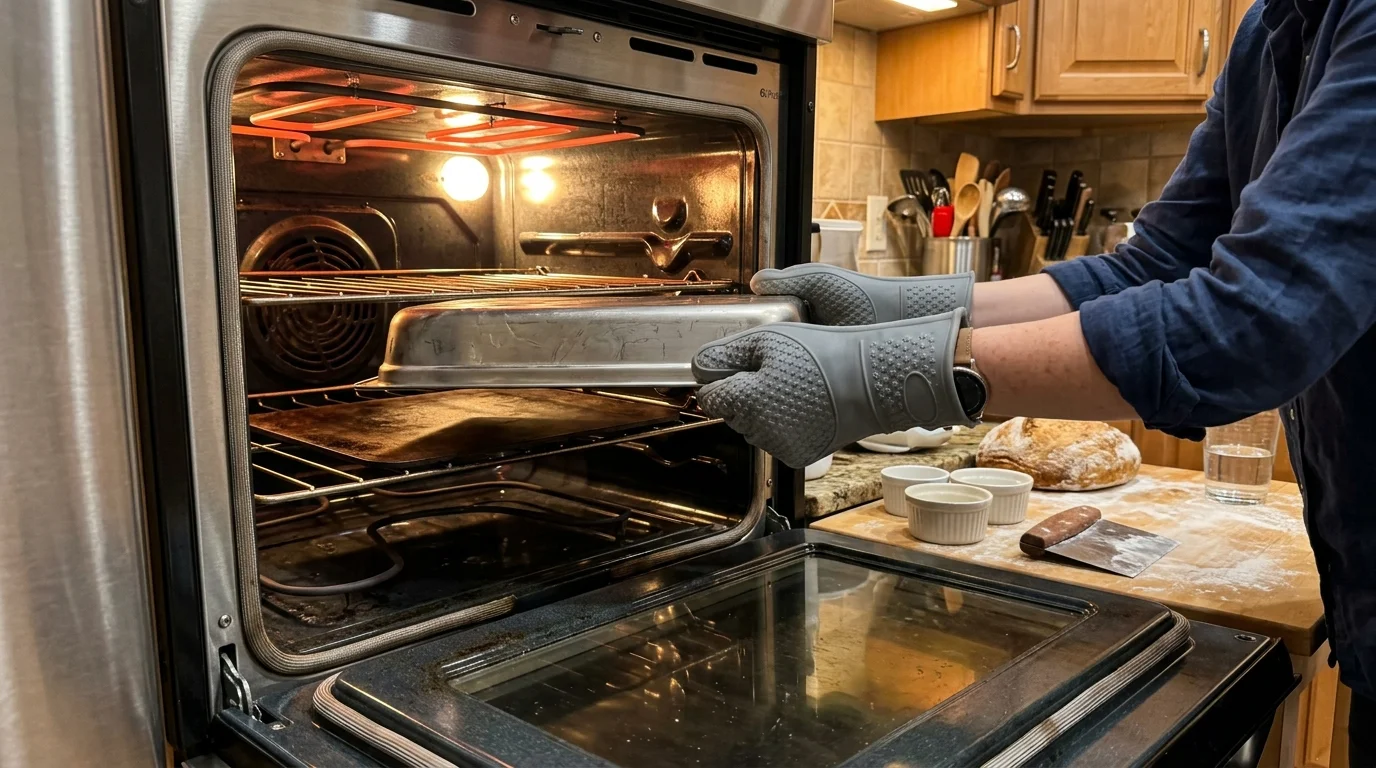
Vertical Oven Rack Clearance and Handling Ergonomics
Residential 30-inch ovens typically provide an interior cavity measuring only 14 to 16 inches in total vertical height. Interior rack rungs sit spaced 1.5 to 2 inches apart along the side walls.
Managing oven volume and rack clearance is just as critical here as it is when arranging half-sheet versus dual quarter-sheet pans to balance airflow.
Placing a thick baking steel on the center rack reduces usable vertical height immediately. Operating a heavy cast iron lid inside this confined, blistering cavity introduces genuine ergonomic hazards.
An inverted 6-inch hotel pan requires at least 7 to 8 inches of open clearance above your baking steel. This gives you sufficient room to lift the cover straight upward without colliding with upper broiler elements.
Lifting a 1.8-pound stainless pan vertically requires negligible forearm effort and ensures stable control. You can smoothly clear the baking surface using standard silicone oven mitts or dry kitchen towels.
Conversely, lifting the 11.3-pound lid of a Challenger cloche inside a 500-degree oven strains wrists and shoulders. The awkward load makes rapid handling dangerous, increasing your risk of touching hot rack supports.
Commercial steam pans feature wide perimeter rims that function as continuous, built-in handles. These flared edges remain easy to grasp with bulky gloves, unlike cramped cast handles positioned near oven walls.
According to appliance safety research from Consumer Reports, handling heavy, awkward cookware at high baking temperatures directly increases domestic burn incidents. Trimming equipment weight substantially enhances kitchen safety.
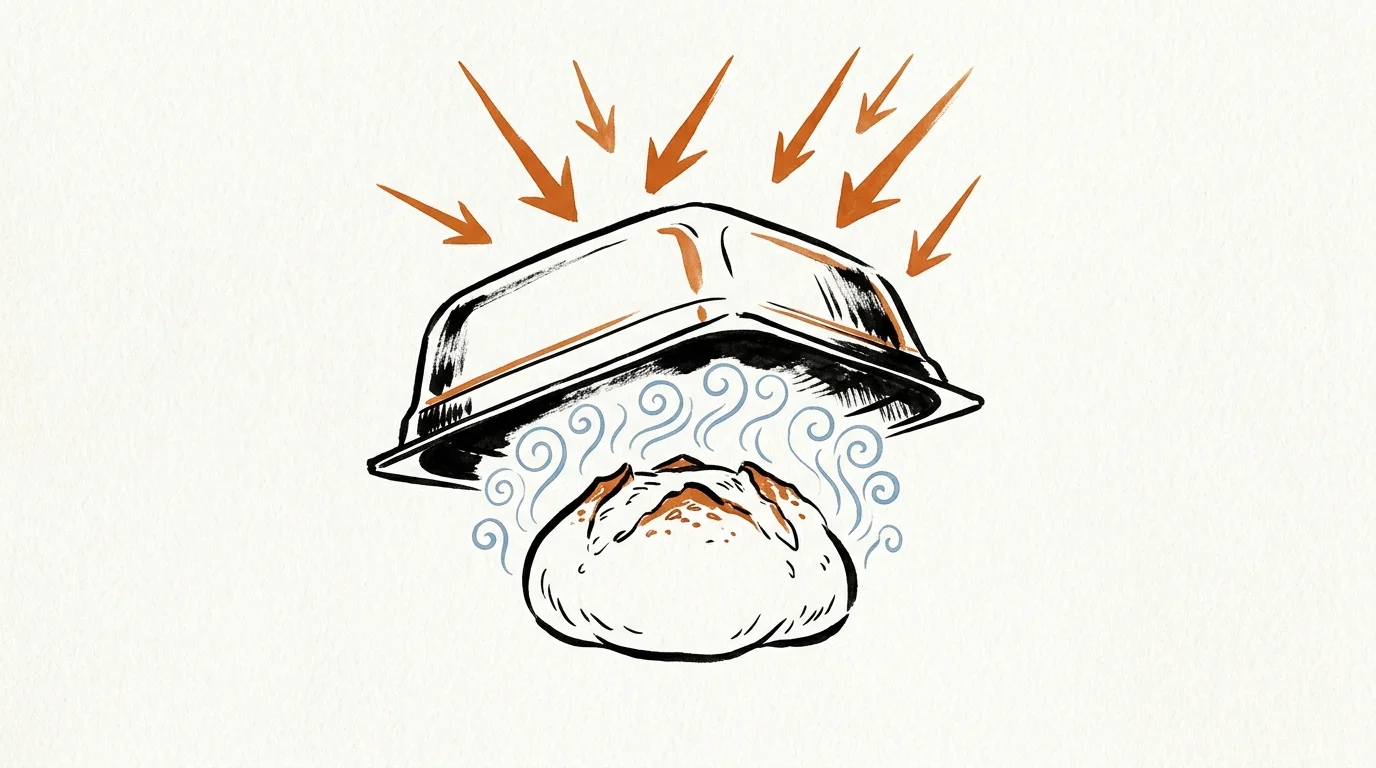
Debunking the Cast Iron Radiance Myth
A persistent baking myth claims heavy iron lids emit essential downward radiant heat required to produce tall oven spring. Thermal physics demonstrates that loaf expansion depends on conductive heat from below, not radiation from above.
Bakers transitioning away from heavy, budget enameled Dutch ovens often worry that eliminating iron’s radiant bulk will harm loaf volume, but thermal conduction tells a different story.
When chilled dough lands on a preheated baking steel, thermal energy conducts straight into the base of the loaf. This conductive rush flashes dough water into steam and expands trapped carbon dioxide before starches set.
A thick cast iron lid radiates intense heat downward, which can actually cause crust starches to set prematurely. Heavy iron domes often singe the top of tall loaves before the crumb structure expands fully.
Stainless steel features low thermal emissivity, reflecting ambient oven heat softly while locking moisture around the dough. This creates a gentle humid enclosure that permits unconstrained dough expansion.
Independent testing by America’s Test Kitchen confirms that carbon steel baking plates conduct thermal energy significantly faster than ceramic baking stones. Combining a high-mass steel base with a lightweight cover delivers optimal heat dynamics.
The baking steel provides massive conductive energy from beneath, while the inverted pan operates purely as a moisture enclosure. This split-material approach outperforms all-iron setups in both speed and crust texture.
“Conduction drives your oven spring from the bottom plate upward. The enclosure above needs to retain moisture, not broil the delicate dough skin before it expands.” — Commercial Bakery Consultant
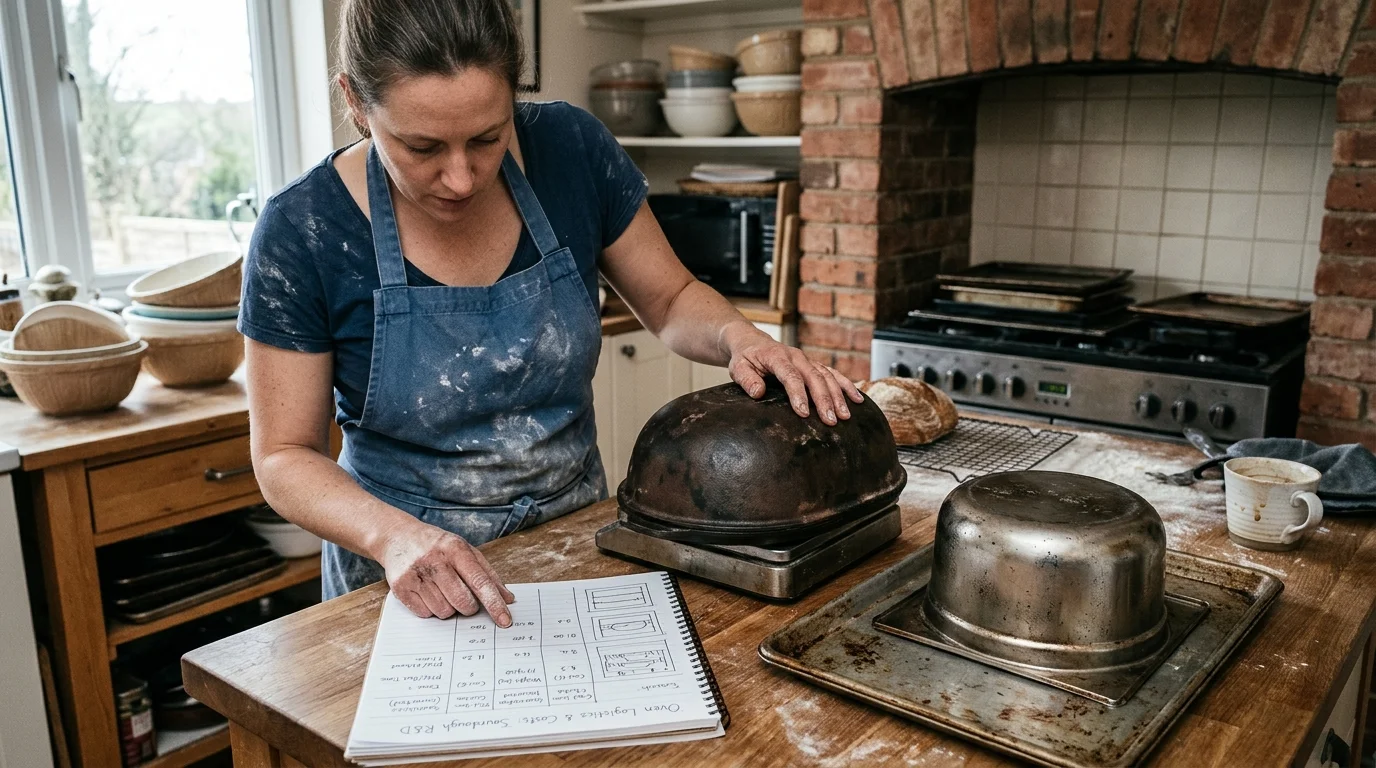
Worked Scenario: Equipment Cost, Weight Load, and Energy Consumption
Consider a concrete scenario modeled on baking two 850-gram sourdough batards sequentially on a Sunday morning. This comparison tracks equipment costs, physical lifting demands, and energy requirements across identical bakes.
In Setup A, you bake with a $299.00 Challenger Bread Pan weighing 21.6 pounds, which includes an 11.3-pound removable domed lid. You preheat the entire cast iron assembly at 500 degrees Fahrenheit for 60 minutes.
In Setup B, you combine an $18.50 Vollrath 6-inch deep stainless hotel pan with a $65.00 A36 baking steel measuring 16 by 14 inches. Your total gear investment is $83.50, saving you $215.50 upfront.
Setup B requires only 45 minutes of preheating to bring the 1/4-inch steel plate to an equilibrium temperature of 485 degrees Fahrenheit. The stainless hotel pan remains cold on the countertop until the dough enters the oven.
During Bake 1, the Setup A baker loads dough into the base and positions the 11.3-pound lid. After 20 minutes, the baker removes the 11.3-pound lid from the oven to vent moisture.
During Bake 2, the Setup A baker repeats this procedure, moving that 11.3-pound lid twice more. Across the session, the baker lifts 45.2 cumulative pounds of hot cast iron through cramped oven doors.
In Setup B, you place the cold 1.8-pound hotel pan over the batard resting on the steel plate. After 20 minutes, you remove the pan by lifting just 1.8 pounds, repeated once for the second loaf.
Setup B reduces your total lifted hot weight from 45.2 pounds down to only 3.6 pounds across both bakes. Furthermore, skipping the preheat on a 21.6-pound iron lid saves 15 minutes of oven run time.
Step-by-Step Guide: Setting Up a Hotel Pan Steam Trap on Baking Steel
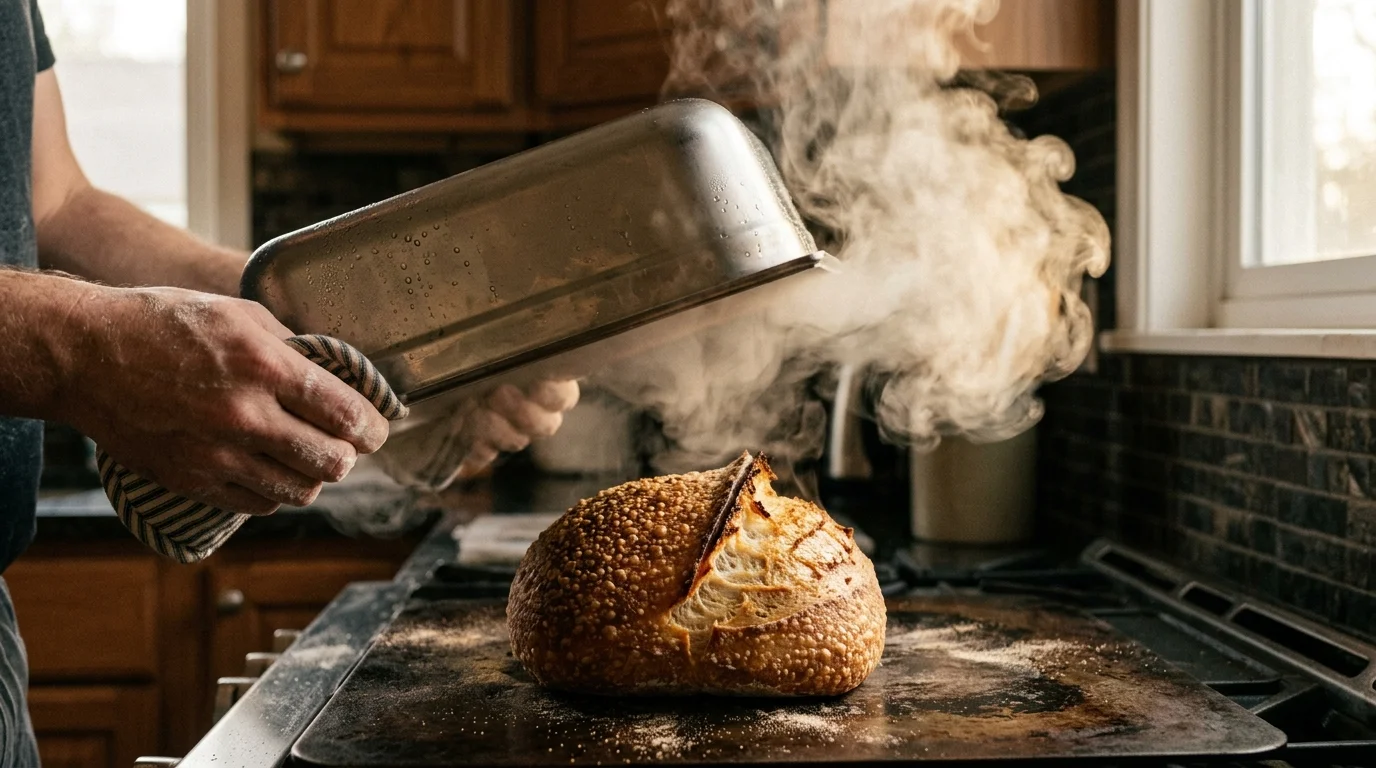
Transforming an inverted hotel pan into a functional bread cloche requires correct oven staging. Follow these steps to maximize steam retention and guarantee smooth loaf handling.
- Rack Positioning: Place an oven rack on the second lowest rung from the bottom cavity floor. This setup leaves 8 to 9 inches of overhead clearance beneath the top heating elements.
- Preheat the Base: Center your baking steel on the rack and preheat your oven to 475 degrees Fahrenheit for 45 minutes. Leave your stainless hotel pan unheated at room temperature.
- Score the Batard: Turn your proofed dough onto parchment paper, sweep off loose flour, and score a clean lengthwise seam. Slide the loaf directly onto the hot baking steel using a flat peel.
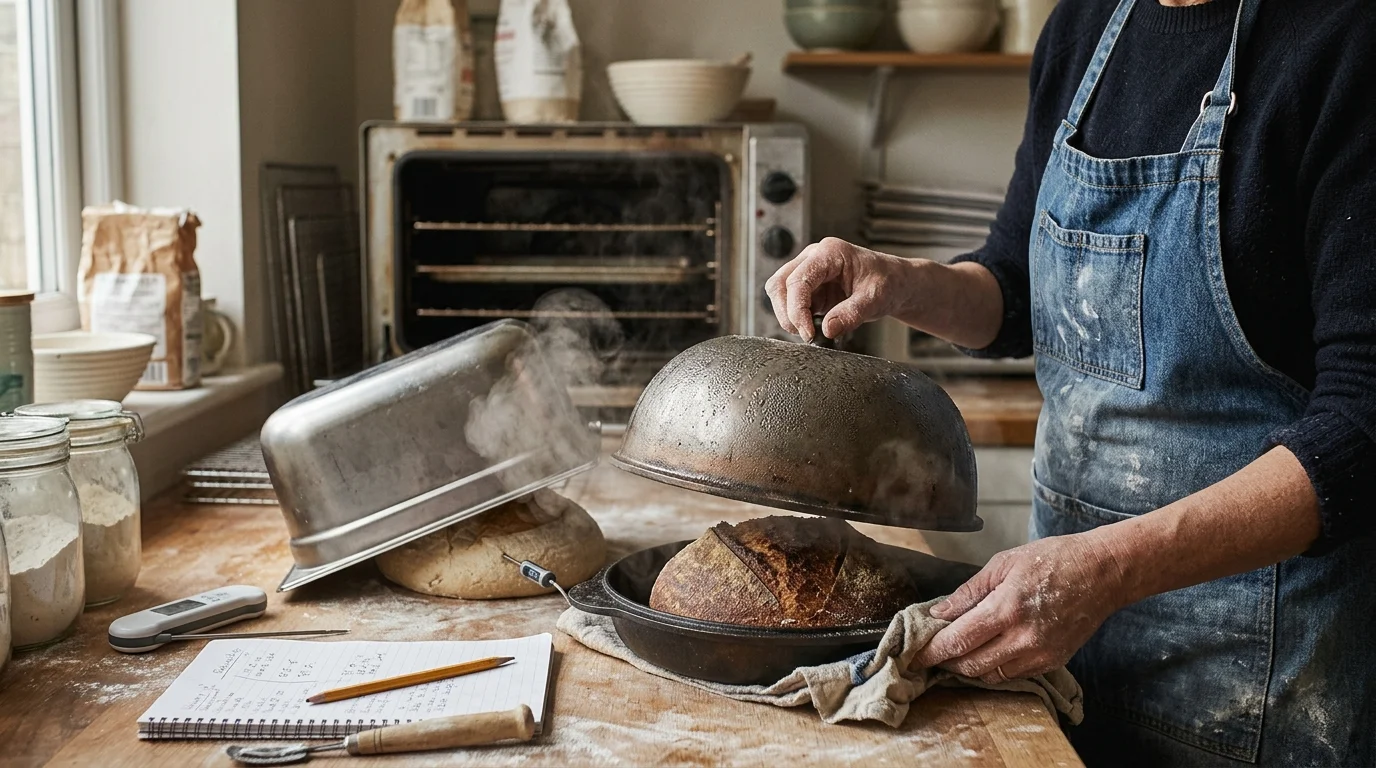
- Invert the Enclosure: Invert the room-temperature 6-inch hotel pan over the dough immediately. Make sure the flat outer rim rests flush against the steel surface to establish a vapor seal.
- Optional Steam Boost: Squirt two tablespoons of hot water onto the steel surface right before lowering the pan. The water flashes into saturated steam under the stainless cover instantly.
- Covered Phase: Bake covered for 20 minutes at 450 degrees Fahrenheit. The sealed chamber traps released dough moisture, sustaining over 90 percent relative humidity during the spring phase.
- Uncover Safely: Put on heat-resistant gloves, grab the side rims of the pan, and lift it straight upward. Remove the pan from the oven cavity and rest it on a trivet.
- Venting Phase: Reduce oven temperature to 425 degrees Fahrenheit and bake uncovered for 18 to 22 minutes. Open convective air dries the crust and develops a deep, caramelized blistered finish.
Durability, Care, and Commercial Kitchen Practicalities
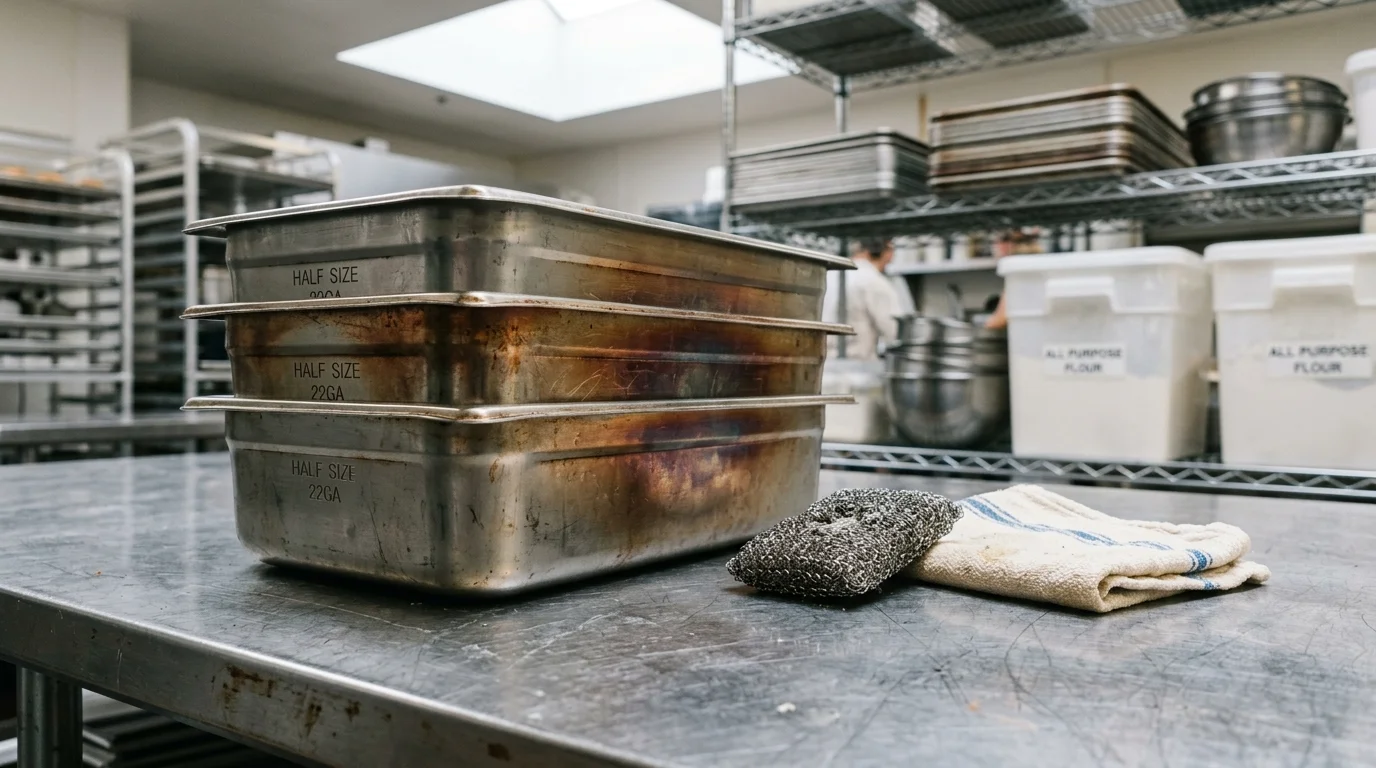
Commercial stainless steel hotel pans withstand heavy daily punishment in professional kitchens. They endure thermal shocks, cleaning chemicals, and moisture that would destroy traditional cast iron bakeware.
Unlike cast iron cloches that rust quickly when exposed to steam, stainless steel requires no seasoning maintenance. You can scour burned flour with abrasive scrub pads or wash the pan in a residential dishwasher.
Storage is equally straightforward in compact home kitchens. A 1.8-pound hotel pan stacks inside standard roasting pans or hangs from a hook without overloading cabinet shelving.
Commercial pans are not induction compatible, which describes cookware engineered with magnetic bases to work on induction cooktops. However, because you use this pan strictly as an oven cover, magnetic responsiveness is unnecessary.
In cookware testing, reviewers at Wirecutter routinely find that commercial restaurant supplies outlast consumer bakeware at lower prices. A food-grade stainless hotel pan easily outlives enameled or non-stick alternatives.
Dropping a cast iron cloche on a tiled floor can crack the iron casting or smash the floor tile. Dropping a 22-gauge stainless pan produces only a harmless dent that you can easily tap back into shape.
Frequently Asked Questions
Do I need to preheat the inverted hotel pan along with the baking steel?
No, you do not need to preheat the hotel pan. Leaving the pan unheated keeps handling safe and has zero negative effect on loaf spring or crust formation.
Will a 4-inch deep hotel pan work, or do I need the 6-inch depth?
A 4-inch pan works for flat boules, but high-rising batards will touch the ceiling. The 6-inch depth provides essential vertical headroom for dramatic ears and expansion.
How do I stop steam from escaping around the edges of the hotel pan?
Ensure your baking steel is flat and clean before loading dough. The heavy rim of a quality 22-gauge pan seals securely against smooth steel under its own weight.
Can I use an aluminum hotel pan instead of stainless steel?
You can use aluminum, but commercial stainless steel offers better rigidity and dent resistance. Stainless steel also resists corrosion from acidic sourdough starter wash much better than aluminum.
Does a hotel pan produce as many crust blisters as a cast iron cloche?
Yes, blister formation depends on saturated steam condensation rather than vessel weight. An inverted hotel pan retains sufficient moisture to match any cast iron cloche’s blister pattern.
Disclaimer: Product prices and availability change frequently. Prices shown were accurate at time of writing but may have changed. We may earn a small commission from purchases made through links on this site, at no extra cost to you. Always verify current pricing on the retailer’s website before purchasing.