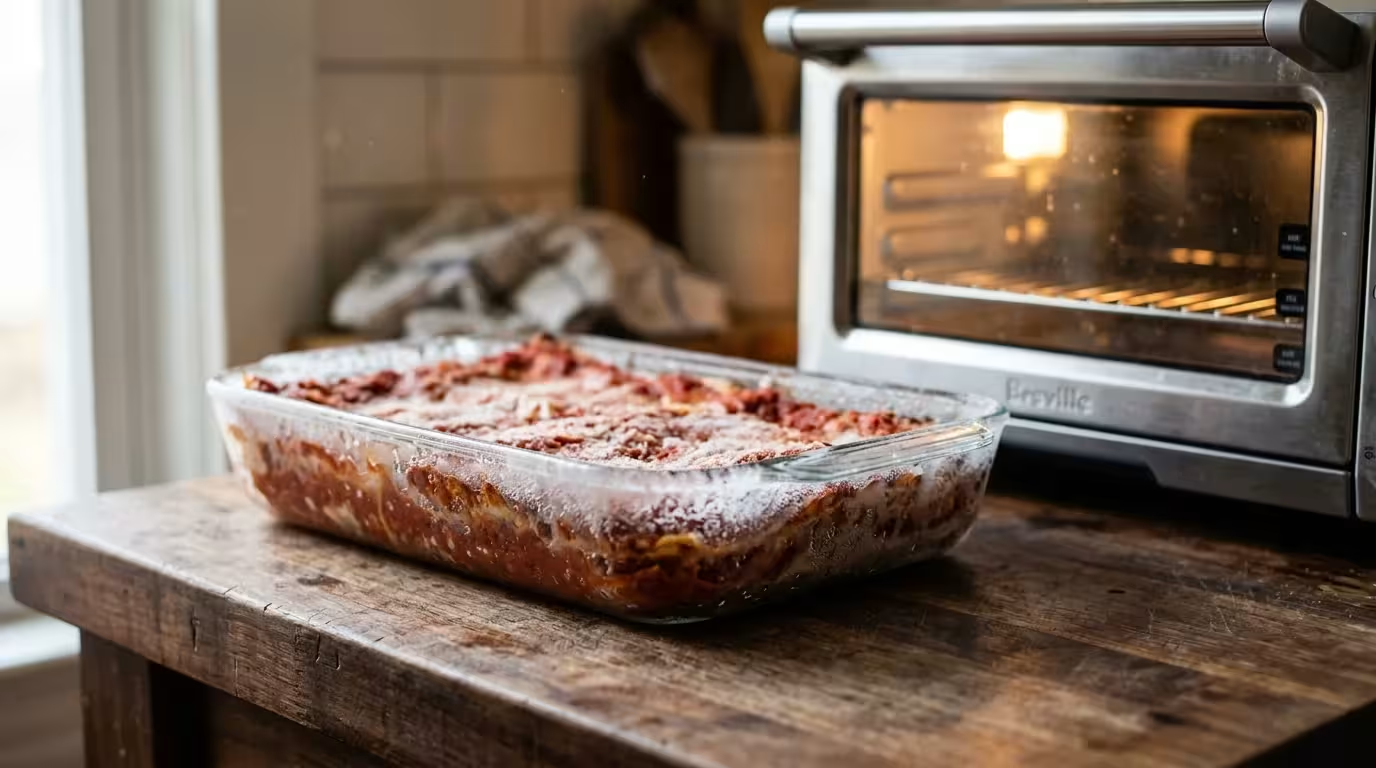
If you batch-freeze individual lasagna portions in glass dishes to bake in your countertop toaster oven, you risk catastrophic shattering. Most cookware guides compare surface browning, but baking frozen glass requires calculating exact thermal shock limits before applying heat.
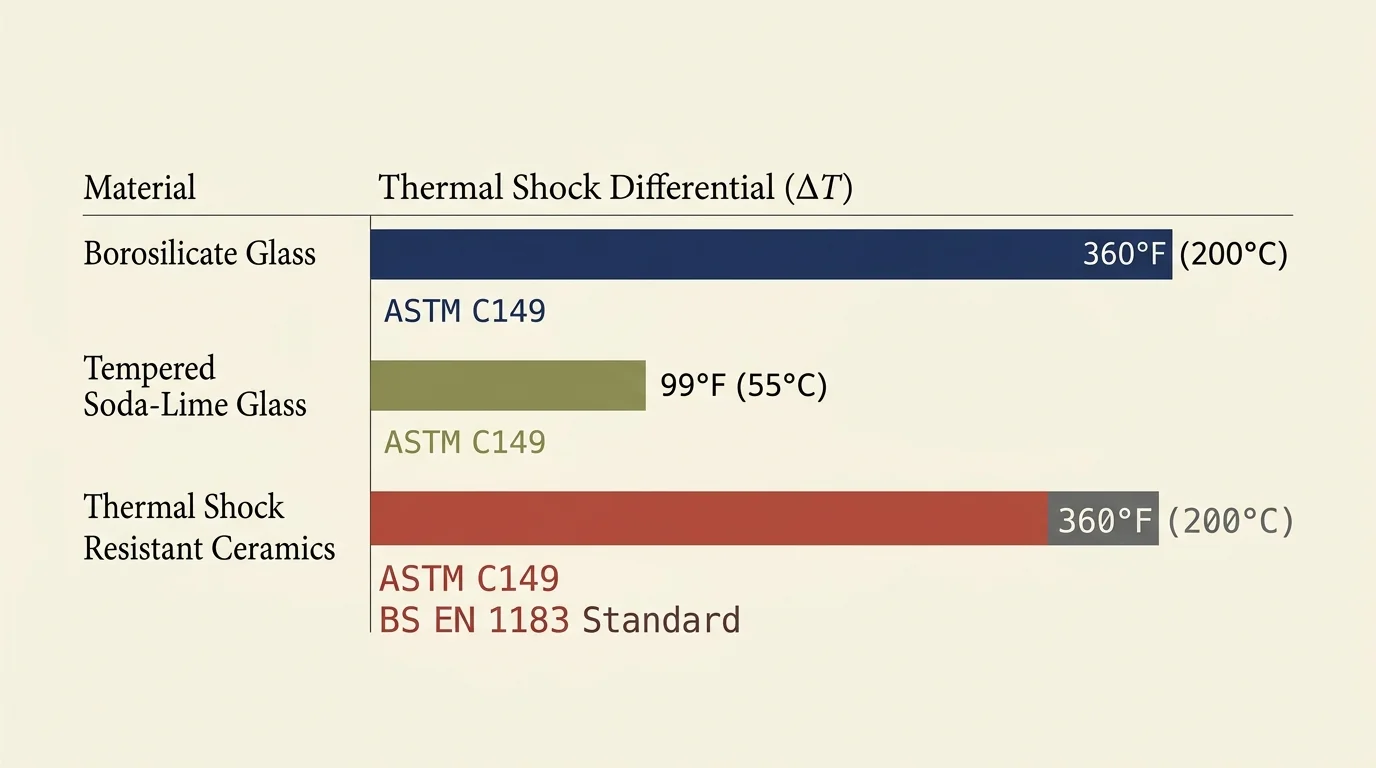
Tempered soda-lime bakeware fails when sudden temperature shifts exceed 99°F, while borosilicate glass withstands differentials up to 360°F. Placing any frozen glass dish under direct toaster oven heating elements violates basic material safety thresholds.
Understanding the exact physics of thermal expansion lets you preserve your weekly meal prep without dangerous cleanup or ruined dinners.
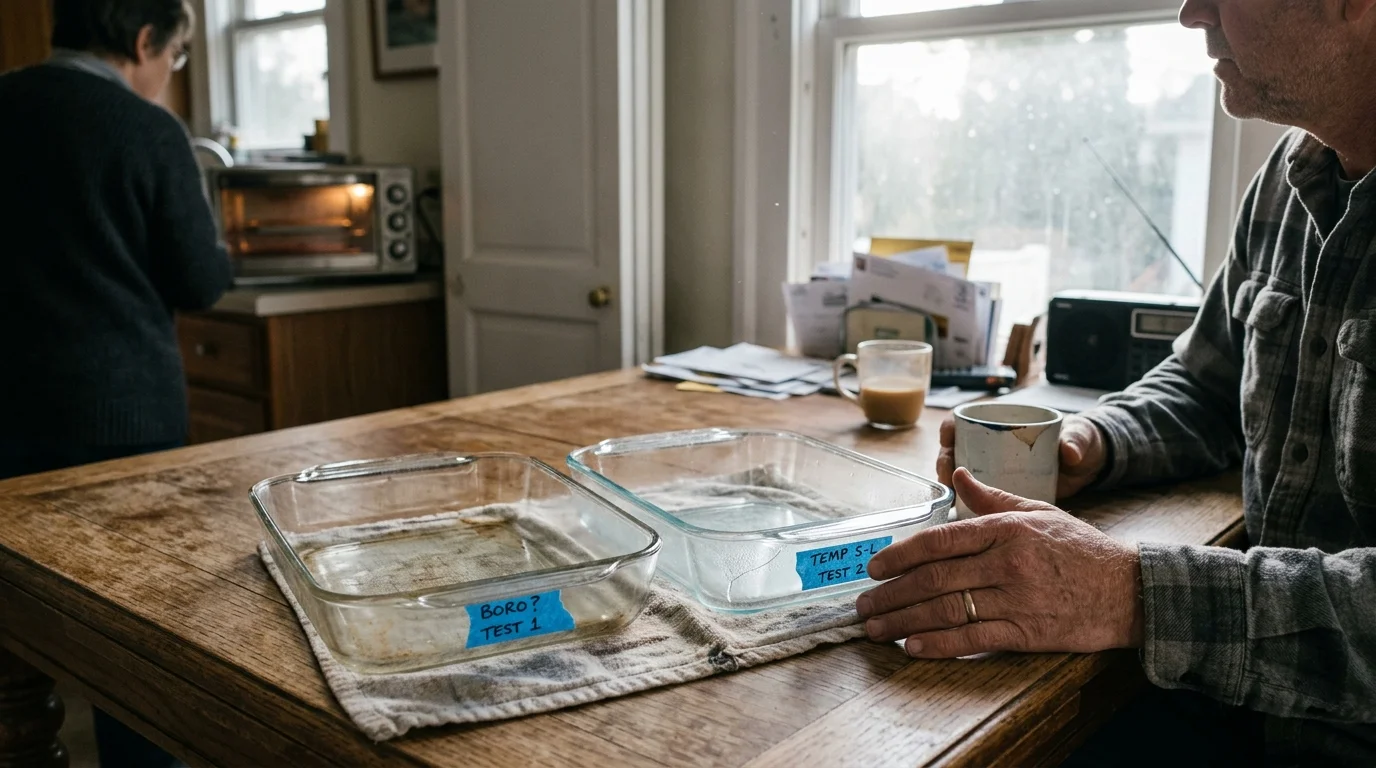
The Physics of Thermal Shock and Delta-T Tolerances
Thermal shock occurs when rapid temperature fluctuations create unequal expansion rates across different zones of a single piece of glass. Because glass is an amorphous solid with low thermal conductivity, heat transfers sluggishly through its structure.
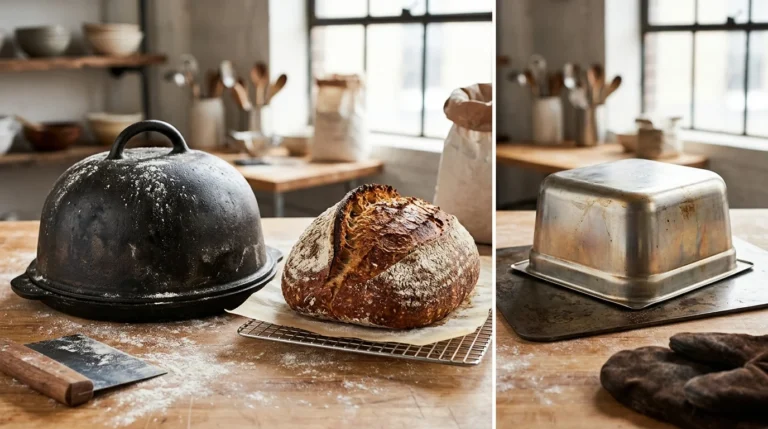
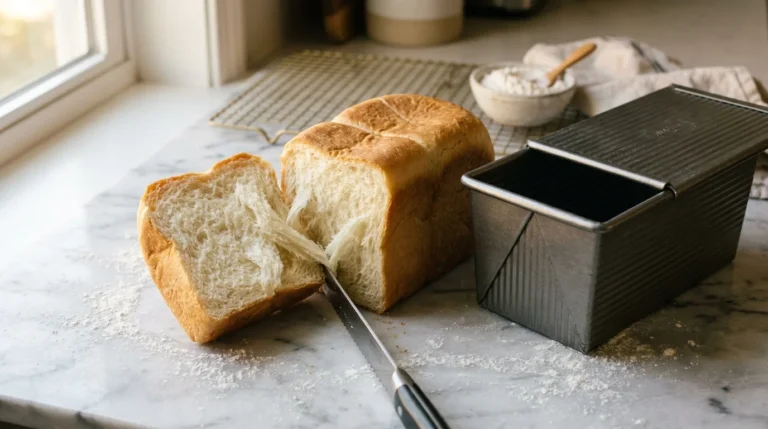
Thermal conductivity also governs how different loaf pans for quick breads absorb heat and develop crusts during high-heat baking.
These material stress principles also apply when handling hot liquids or ice baths during prep, making it vital to choose the right mixing bowl materials and sizes for thermal safety.
Thermal conductivity differences also heavily influence other baking vessels, such as when comparing aluminized steel vs. stoneware loaf pans under high oven heat.
When high heat contacts cold glass, the exterior expands rapidly while the cold core resists movement. This disparity generates intense mechanical tension across the material matrix.
The severity of this structural tension depends directly on the Coefficient of Thermal Expansion (CTE). CTE measures the fractional change in material size per degree of temperature change.
Borosilicate glass features a low linear CTE of approximately 3.3 × 10⁻⁶/K. In comparison, tempered soda-lime silicate glass exhibits a high CTE between 8.5 × 10⁻⁶/K and 9.0 × 10⁻⁶/K.
Because soda-lime glass expands nearly three times more than borosilicate for every degree gained, it generates roughly triple the internal mechanical stress under identical thermal gradients.
Engineers calculate thermal shock vulnerability using the temperature differential formula, known as Delta-T (ΔT). Delta-T equals the surface temperature minus the interior core temperature.
International safety standards define testing procedures for these materials. ASTM C149 evaluates the thermal shock resistance of glass containers through rapid immersion from hot water baths to cold reservoirs.
In Europe, the BS EN 1183 standard establishes rigorous thermal shock endurance testing protocols for domestic kitchen articles. Both standards prove that brittle materials shatter when transient stress exceeds ultimate tensile strength.
Research published in the Bulletin of the American Ceramic Society shows that tempered soda-lime bakeware can experience thermal stress failure with sudden differentials as low as 55°C (99°F).
Kitchen-grade borosilicate glassware safely withstands sudden temperature differentials between 150°C and 200°C (270°F to 360°F) without experiencing micro-fractures or structural failure.
“A material with a high coefficient of thermal expansion creates severe internal mechanical stress during rapid heating. If that tensile stress exceeds the matrix bond strength, failure is instantaneous.” — Ceramic Materials Specialist
When you transfer a frozen vessel into high heat, you force the material to manage these opposing mechanical forces simultaneously.
Material Composition: Borosilicate vs. Soda-Lime Bakeware
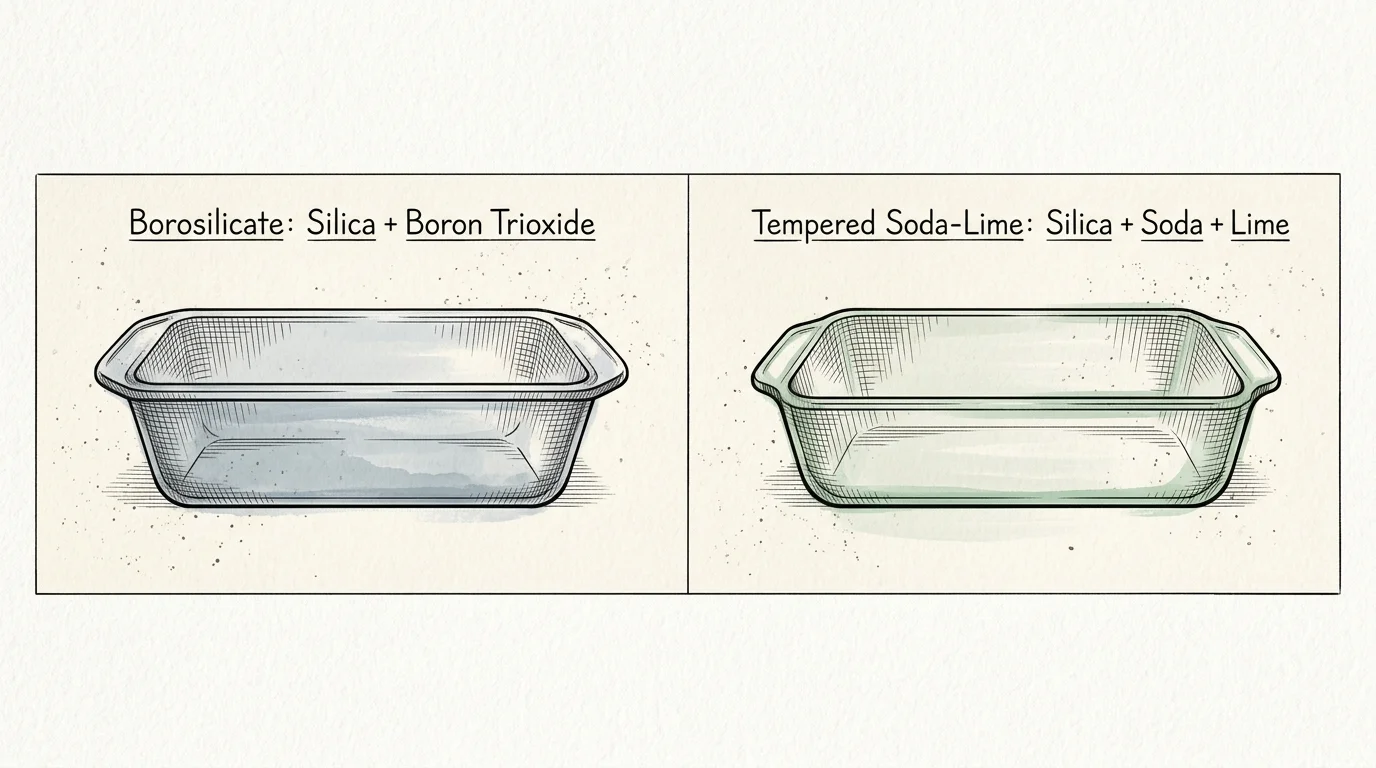
The chemical recipe of your bakeware determines how it reacts to heat and impact. Borosilicate glass incorporates approximately 5% to 13% boron trioxide into its silica network.
While tempered glass provides exceptional surface hardness, that unyielding rigidity is precisely why glass cutting boards destroy knife edges and should be avoided on prep stations.
To see how these glass formulations compare against ceramic, stoneware, and cast iron, consult our comprehensive guide on casserole dish sizes and materials.
Similar material dynamics come into play when comparing pie plates made of glass, ceramic, and metal, where thermal conductivity directly alters your crust.
Boron trioxide alters the molecular lattice, creating extremely stable covalent bonds that minimize dimensional shift during heating. This molecular architecture gives borosilicate its high resistance to rapid thermal changes.
Tempered soda-lime glass relies instead on silica mixed with soda ash (sodium carbonate) and limestone (calcium carbonate). Manufacturers melt these ingredients at lower temperatures to reduce manufacturing costs.
To give weak soda-lime glass structural strength, manufacturers subject the formed dishes to thermal tempering. Tempering rapidly cools the outer surfaces with forced air blasts while the interior remains molten.
This industrial process creates strong compressive stress on the glass surface balanced by tensile stress inside the core. The surface compression makes tempered soda-lime glass highly resistant to mechanical drops on kitchen floors.
A critical shift occurred in American kitchens in 1998. Corning Inc. licensed its consumer products division to World Kitchen (now Corelle Brands), shifting domestic Pyrex production from borosilicate to tempered soda-lime glass.
The manufacturer prioritized impact durability over thermal shock tolerance because kitchen drops caused more consumer returns than thermal breaks. However, European Pyrex production followed an entirely different path.
Manufactured under license by International Cookware in Châteauroux, France, European Pyrex retained its traditional borosilicate composition. This geographical divergence creates dangerous confusion for modern home cooks.
You can identify the composition of your bakeware through careful visual inspection. Tempered soda-lime glass exhibits a distinct greenish hue along its edges due to residual iron content.
Borosilicate glass displays a clean, neutral clarity with slight blue-gray undertones. Branding typography also provides clues; all-caps “PYREX” labels often indicate European borosilicate, whereas lowercase “pyrex” designates American tempered soda-lime vessels.
While tempered soda-lime resists countertop impacts, its internal tensile core remains a ticking energy reservoir under extreme thermal shifts.
The Toaster Oven Hazard: Infrared Radiation and Thermal Gradients
Countertop toaster ovens introduce severe thermodynamic hazards that do not exist inside standard conventional wall ovens. A standard wall oven offers an expansive cavity between 4.5 and 5.5 cubic feet.
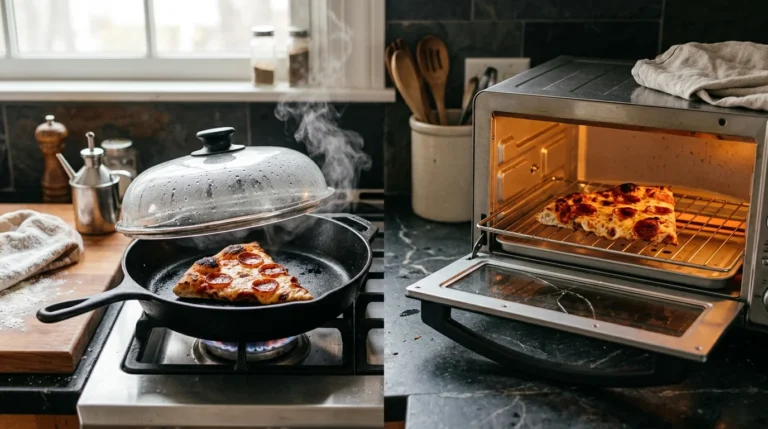
For a gentler way to warm food without exposing brittle dishes or delicate crusts to harsh quartz elements, consider covered skillet steam reheating vs. toaster oven broiling.
Large ovens rely primarily on indirect convection currents to heat food evenly. Conversely, compact countertop toaster ovens possess small interiors measuring only 0.5 to 1.2 cubic feet.
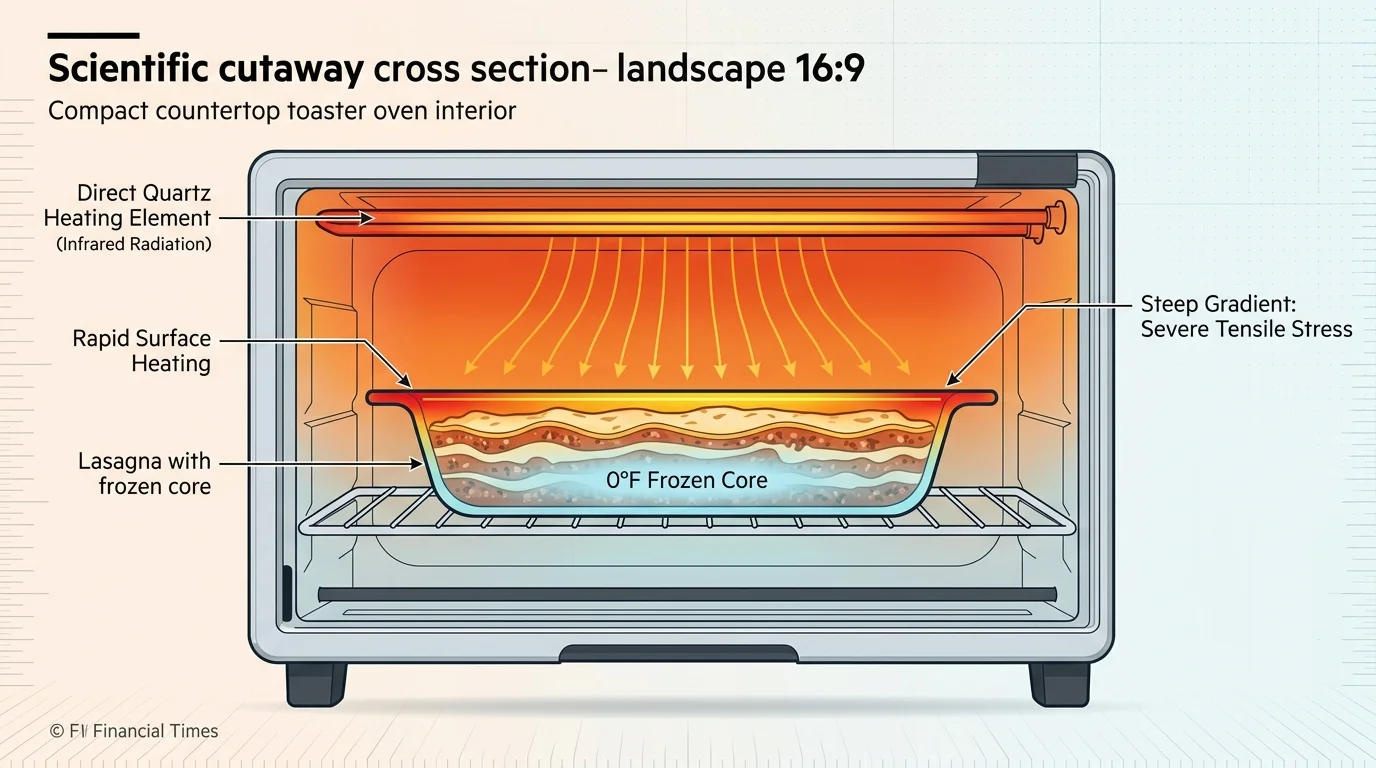
In a compact cavity, the heating elements sit dangerously close to your cookware. Quartz and calrod heating elements often sit just two to four inches away from the upper rim of your baking dish.
These elements do not merely warm the surrounding air; they emit concentrated, direct infrared radiation. The radiant flux density striking the dish surface causes rapid localized energy absorption.
According to appliance testing by Consumer Reports, toaster ovens routinely generate extreme hot spots directly beneath their heating coils.
When you insert a frozen dish, direct radiant heat rapidly warms the top glass rim. Meanwhile, the bottom of the dish remains locked at sub-zero temperatures by the frozen food mass.
This creates a catastrophic thermal gradient across a distance of less than three vertical inches. Even high-grade borosilicate cannot endure such uneven radiant heat exposure without warping its internal matrix.
Leading manufacturers maintain absolute, unambiguous safety restrictions regarding this practice. Corelle Brands and Anchor Hocking explicitly prohibit putting their glass bakeware inside toaster ovens or countertop broilers.
The intense radiant cycling of quartz elements repeatedly pulses thermal energy into the brittle dish walls. This concentrated cycling causes micro-fissures to expand until the dish bursts.
If you use glass bakeware inside a toaster oven, you operate entirely outside manufacturer engineering tolerances and warranty specifications.
Worked Example: The Freezer Lasagna Thermal Calculation
To understand why thermal breakage occurs, examine a realistic scenario involving a working professional batch-prepping individual meals. You freeze a single-serving lasagna portion in a standard 6×4-inch rectangular glass dish.
When reheating frozen portions in compact toaster ovens, using metal quarter-sheet pans eliminates the risk of thermal shock while maximizing oven airflow.
When graduating from single-portion glass dishes to full-size family casseroles, using ergonomic 9×13 baking dishes with wide handles provides a secure grip when maneuvering hot, heavy bakeware.
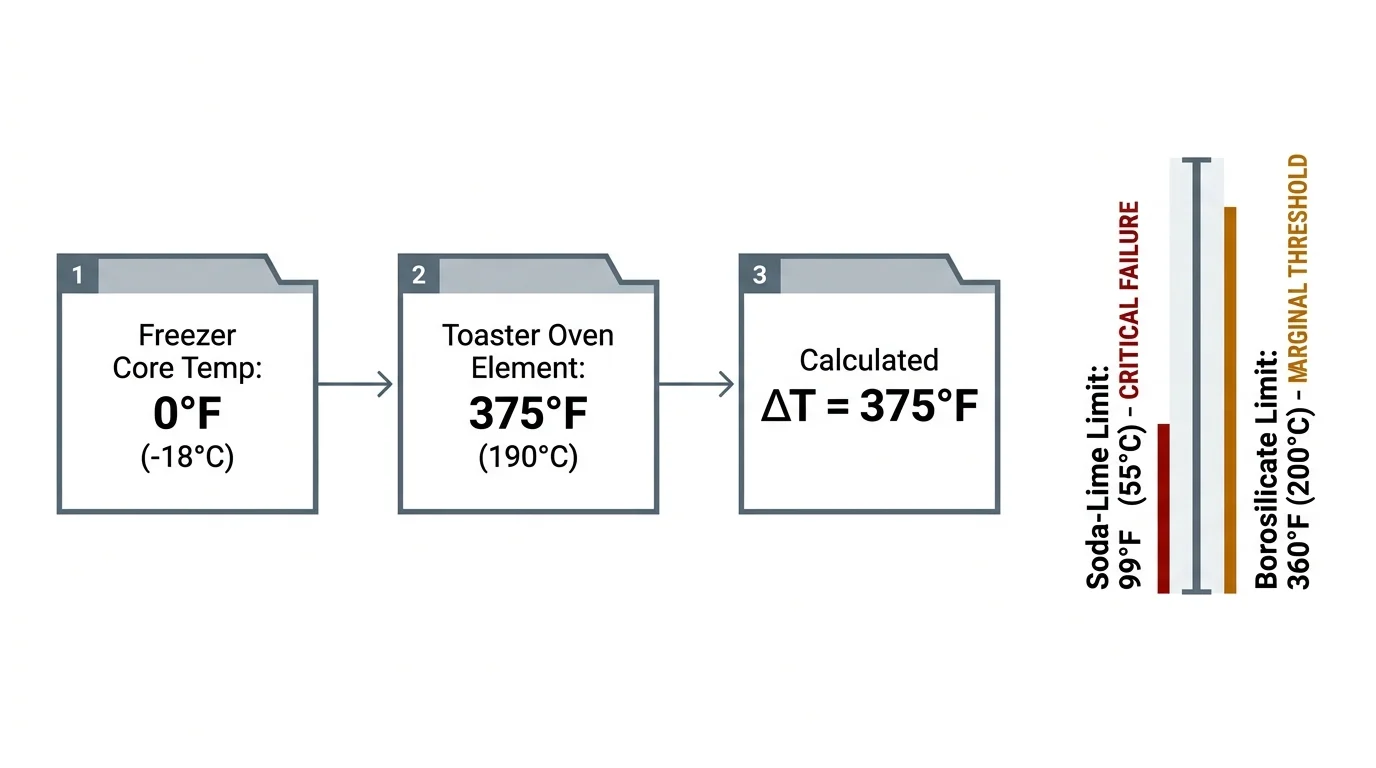
Your domestic freezer runs at 0°F (-18°C), chilling both the food and the glass matrix to sub-zero temperatures. You place this dish into a countertop toaster oven preheated to 375°F (191°C).
Calculate the baseline nominal thermal differential using the formula ΔT = Toven – Tfreezer. This transition produces an immediate nominal ΔT of 375°F (208.3°C).
Compare this operating condition against the empirical limits established by ceramic engineers. As verified in materials science literature, tempered soda-lime bakeware experiences catastrophic failure at a ΔT of only 99°F (55°C).
Your frozen meal transition subjects the soda-lime vessel to a differential 276°F higher than its established failure point. This represents an operating demand 279% beyond the material’s structural capacity.
Borosilicate glass features a certified safe ΔT limit of 360°F (200°C). Even this robust material faces an immediate nominal gap of 375°F, exceeding its maximum safe thermal envelope by 15°F.
The danger multiplies when you factor in direct radiant heating elements. Countertop toaster oven quartz heating elements glow at surface temperatures ranging from 900°F to 1,200°F (482°C to 649°C).
Infrared radiation drives the upper exposed rim of your glass dish to 280°F within four minutes of heating. Concurrently, the bottom center of the dish remains frozen solid at 12°F.
This exposure produces a localized structural differential (ΔTlocal) of 268°F (149°C) across three inches of glass. Soda-lime glass cannot sustain this localized gradient without fracturing.
When the internal tensile stress exceeds the surface compression layer, the dish shatters explosively. It propels high-velocity shards across the appliance cavity, destroying your dinner and ruining the toaster oven.
Thermal Performance and Material Specifications
Selecting the right bakeware requires evaluating hard thermal and mechanical metrics. Different materials deliver varied levels of heat distribution, structural strength, and thermal shock resistance.
To match the right vessel to your cooking technique, reviewing casserole dish sizes and materials clarifies how alternative ceramics and metals manage heat distribution.
In cookware terminology, “heat distribution” describes how evenly a material spreads thermal energy across its surface. Brittle materials like glass offer poor distribution, while metals conduct energy quickly.
Similarly, “oven-safe” indicates that cookware can safely endure oven ambient temperatures without chemical degradation or structural warping. However, oven safety ratings never guarantee immunity to rapid thermal shock.
Review the empirical engineering specifications for standard bakeware materials in the comparative analysis below.
| Material Category | Linear CTE (×10-6/K) | Safe Thermal Shock (ΔT) | Max Operating Temp | Toaster Oven Safe | Primary Failure Mode |
|---|---|---|---|---|---|
| Kitchen Borosilicate (OXO, EU Pyrex) | 3.3 | 270°F–360°F (150°C–200°C) | 500°F (260°C) | No (Prohibited) | Clean lateral shear fracture |
| Tempered Soda-Lime (US Pyrex, Anchor) | 8.5–9.0 | 99°F (55°C) | 425°F (218°C) | No (Prohibited) | High-energy explosive dicing |
| High-Fired Glazed Stoneware (Ceramic) | 5.5–6.5 | 250°F (121°C) | 500°F (260°C) | Conditional | Radial cracking along base |
| Heavy-Gauge Aluminized Steel (USA Pan) | 12.0 | 600°F+ (315°C+) | 450°F (232°C) | Yes (Recommended) | Surface coating breakdown |
The data confirms that tempered soda-lime bakeware possesses the lowest thermal shock tolerance among all kitchen materials. Its maximum operational temperature of 425°F (218°C) also limits its utility for high-heat roasting.
When soda-lime fails under thermal stress, its internal tension causes explosive dicing. The dish disintegrates into thousands of jagged, pebble-sized fragments that disperse across your countertop.
Borosilicate glass fails through linear cleavage when pushed past its limits. It typically splits into several large, clean pieces without explosive dispersal, simplifying cleanup and minimizing injury risks.
High-fired ceramic stoneware offers moderate thermal resilience but remains vulnerable to localized radiant hot spots. Metal bakeware provides absolute immunity to thermal shock fractures.
Metal uses plastic deformation rather than brittle fracture to accommodate thermal expansion. This structural difference makes metal the superior choice for high-stress thermal transitions.
Safe Workflow for Batch Freezing and Reheating Meals
Working professionals need reliable, time-efficient systems for batch-freezing portions without risking shattered glass. You can eliminate thermal shock completely by modifying your preparation and transfer workflow.
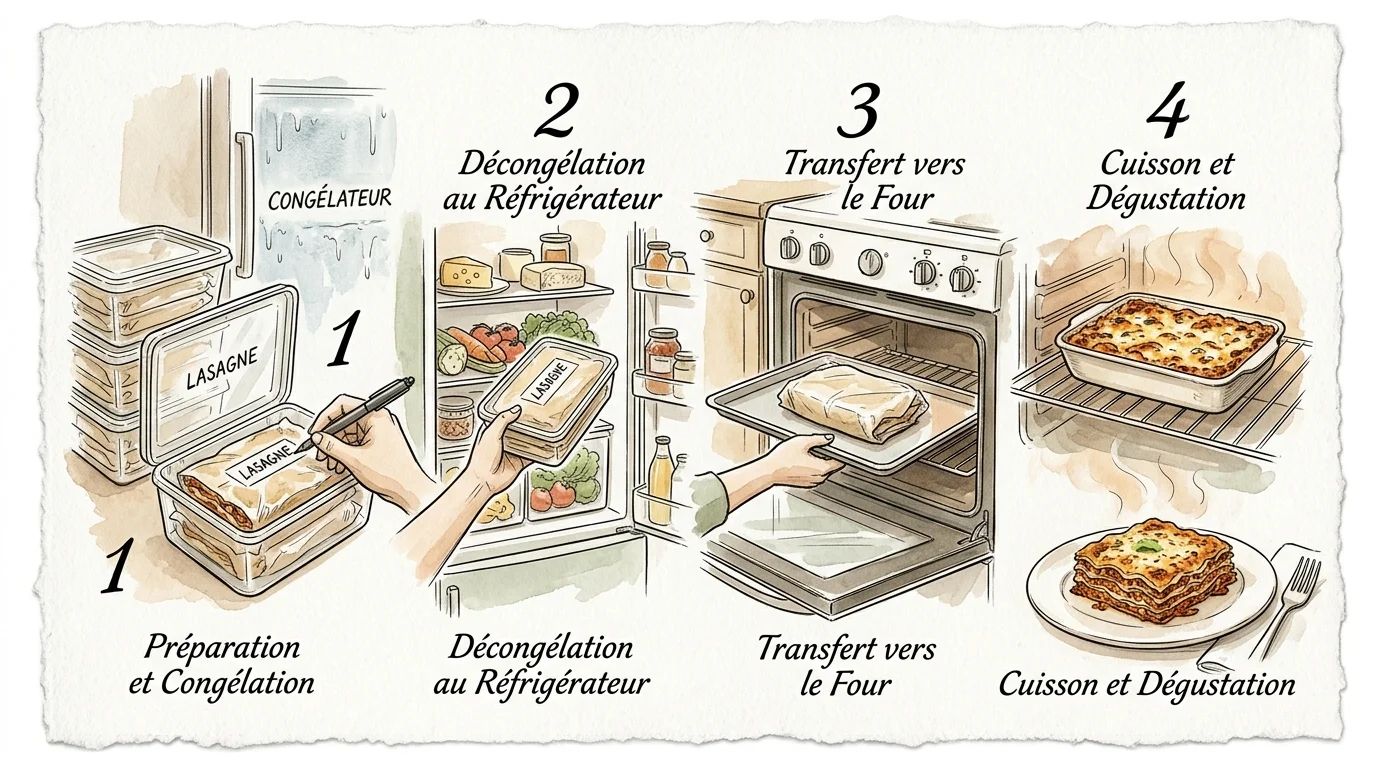
Never bake frozen food directly in glass containers inside a countertop toaster oven. Instead, use the simple “Freeze-and-Pop” technique to separate frozen storage from the baking phase.
Line your individual glass baking dishes with unbleached parchment paper before assembling your lasagna layers. Ensure sufficient paper extends over the edges to serve as lifting handles.
Cover the dish securely and place it in your deep freezer until the food freezes solid. Once frozen, grasp the parchment handles and lift the solid block of lasagna out of the glass dish.
Wrap the frozen food block in aluminum foil or seal it inside a freezer-grade storage bag. Return the wrapped food block to your freezer and return your clean glass dish to the kitchen cupboard.
When you want to bake a portion, unwrap the frozen food block and place it directly into a metal baking pan. Heavy-gauge metal absorbs toaster oven radiant heat without structural vulnerability.
Here, “gauge” refers to the thickness of the metal. Lower gauge numbers mean thicker metal, which resists buckling under high heat and spreads thermal energy smoothly.
If you prefer using glass bakeware, limit its use to conventional wall ovens using a controlled cold-start technique. Equipment guides from Serious Eats emphasize gradual heating cycles when managing delicate materials.
Place your thawed or refrigerated glass dish into a completely cold conventional oven. Turn the oven on to 350°F (177°C) only after closing the oven door.
As the massive oven cavity warms gradually, the glass and the food absorb ambient energy at an identical pace. This gradual ramp prevents severe localized thermal gradients from forming across the dish walls.
Never apply this cold-start technique inside a toaster oven. Countertop units fire their quartz heating elements at maximum output during preheating, creating fatal hot spots within seconds.
Selecting the Right Bakeware: Material Recommendations and Alternatives
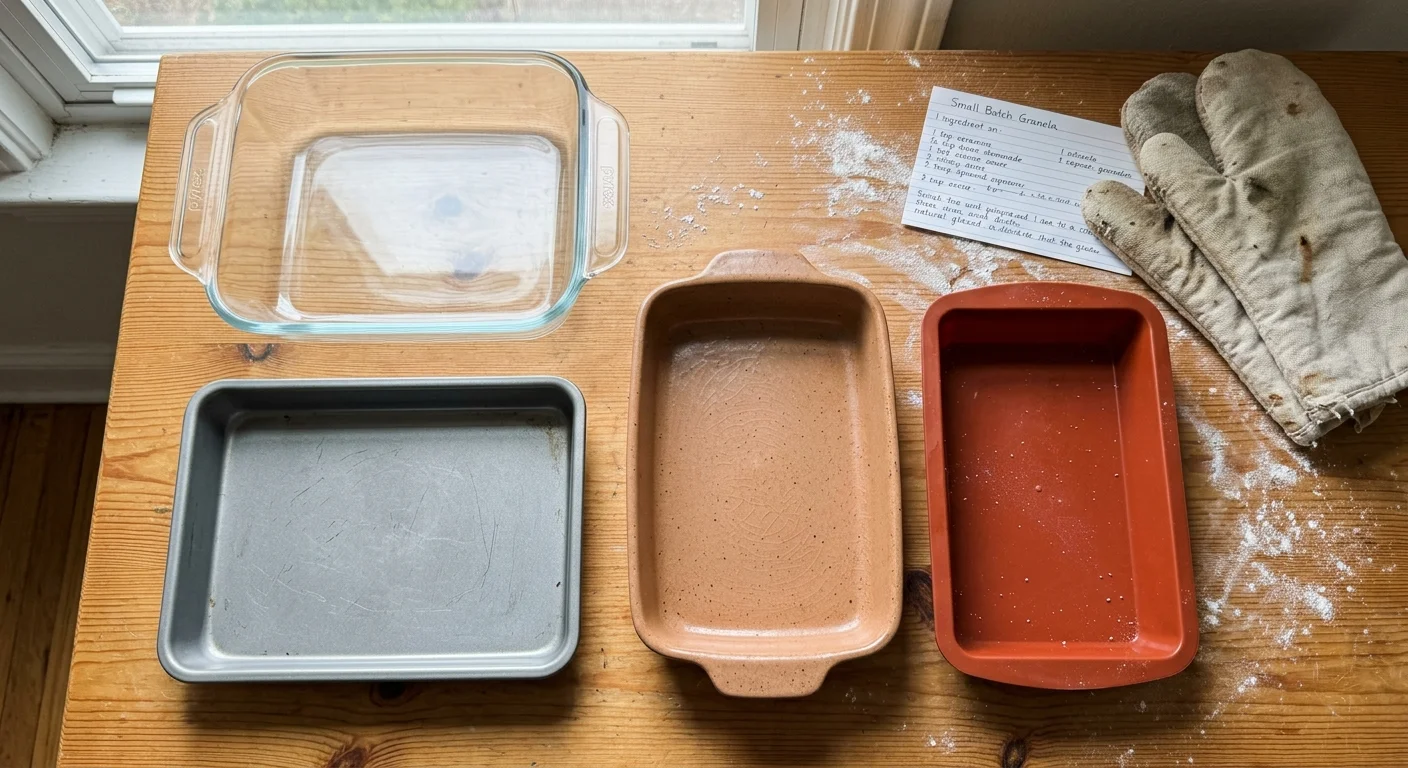
Building a durable, safe kitchen requires matching the right bakeware materials to your specific heating appliances. If you bake in standard conventional ovens, select high-grade borosilicate vessels.
The OXO Good Grips Glass Bakeware line represents the gold standard for contemporary borosilicate in the United States. Testing by Wirecutter highlights OXO glass bakeware for its superior thermal shock resilience.
OXO constructs its bakeware from thermal-shock-resistant borosilicate glass rated up to 450°F (232°C). Their 8-inch square dish and 1.6-quart loaf pan transition smoothly from refrigerator chill to conventional oven heat.
If you prefer European Pyrex, verify the manufacturer origin before buying. Authentic French-made Pyrex displays clear French labeling, states its Châteauroux manufacturing origin, and features crisp borosilicate transparency.
For everyday food storage and room-temperature baking, domestic tempered soda-lime glass remains a practical, cost-effective choice. Brands like Anchor Hocking and American Pyrex deliver exceptional resistance against mechanical chipping.
These domestic dishes withstand spoon strikes, dishwasher cycles, and counter bumps better than untreated glass. However, you must limit them to moderate oven temperatures below 425°F (218°C) and avoid rapid temperature swings.
For countertop toaster ovens, abandon glass entirely and switch to heavy-gauge aluminized steel bakeware. The USA Pan 8.5×4.5-inch loaf pan and their compact Quarter Sheet Pan fit standard toaster ovens perfectly.
USA Pan manufactures its cookware in Pennsylvania from commercial-grade, 22-gauge aluminized steel. As documented by America’s Test Kitchen, heavy aluminized steel distributes heat evenly and prevents scorched edges.
The proprietary silicone coating on USA Pan bakeware releases sticky cheeses cleanly without toxic PTFE coatings. Most importantly, aluminized steel will never crack, shatter, or dice when exposed to rapid thermal transitions.
If you prefer non-metallic baking dishes for countertop toaster ovens, invest in high-fired ceramic stoneware. The Emile Henry Modern Classics Individual Baker uses dense Burgundian clay fired at 2,000°F.
This specialized ceramic handles toaster oven broilers, resists thermal shock up to 500°F (260°C), and delivers table-ready visual presentation.
“Matching your cooking vessel to your heating source matters more than brand prestige. Never ask a brittle material to absorb direct radiant heat.” — Commercial Cookware Designer
Selecting application-specific cookware protects your kitchen investment and keeps your batch-cooking routine safe and efficient.
Frequently Asked Questions
Can I put borosilicate glass in a toaster oven if I do not preheat it?
No, you should never place borosilicate glass inside a toaster oven, even from a cold start. Toaster oven heating elements operate at maximum radiant output during warm-up cycles. Their close proximity creates severe, localized hot spots that shatter the glass.
Why did my tempered soda-lime dish explode hours after coming out of the oven?
Tempered soda-lime glass develops microscopic stress fractures when exposed to rapid temperature changes. These internal fractures slowly spread through the compressed outer surface over several hours. The dish can suddenly fail long after cooling to room temperature.
How can I tell if my existing Pyrex dish is borosilicate or soda-lime?
Examine the glass along the rim or corner under natural light. Tempered soda-lime glass shows a distinct green or cyan tint caused by iron content. Borosilicate glass remains clear with a subtle blue-gray neutrality, often accompanied by uppercase “PYREX” branding.
What is the safest way to reheat frozen homemade lasagna in a toaster oven?
The safest approach is transferring the frozen lasagna portion from its storage container into a heavy-gauge aluminized steel pan. Metal bakeware distributes intense infrared heat evenly and cannot shatter from sudden thermal shock.
Disclaimer: Product prices and availability change frequently. Prices shown were accurate at time of writing but may have changed. We may earn a small commission from purchases made through links on this site, at no extra cost to you. Always verify current pricing on the retailer’s website before purchasing.