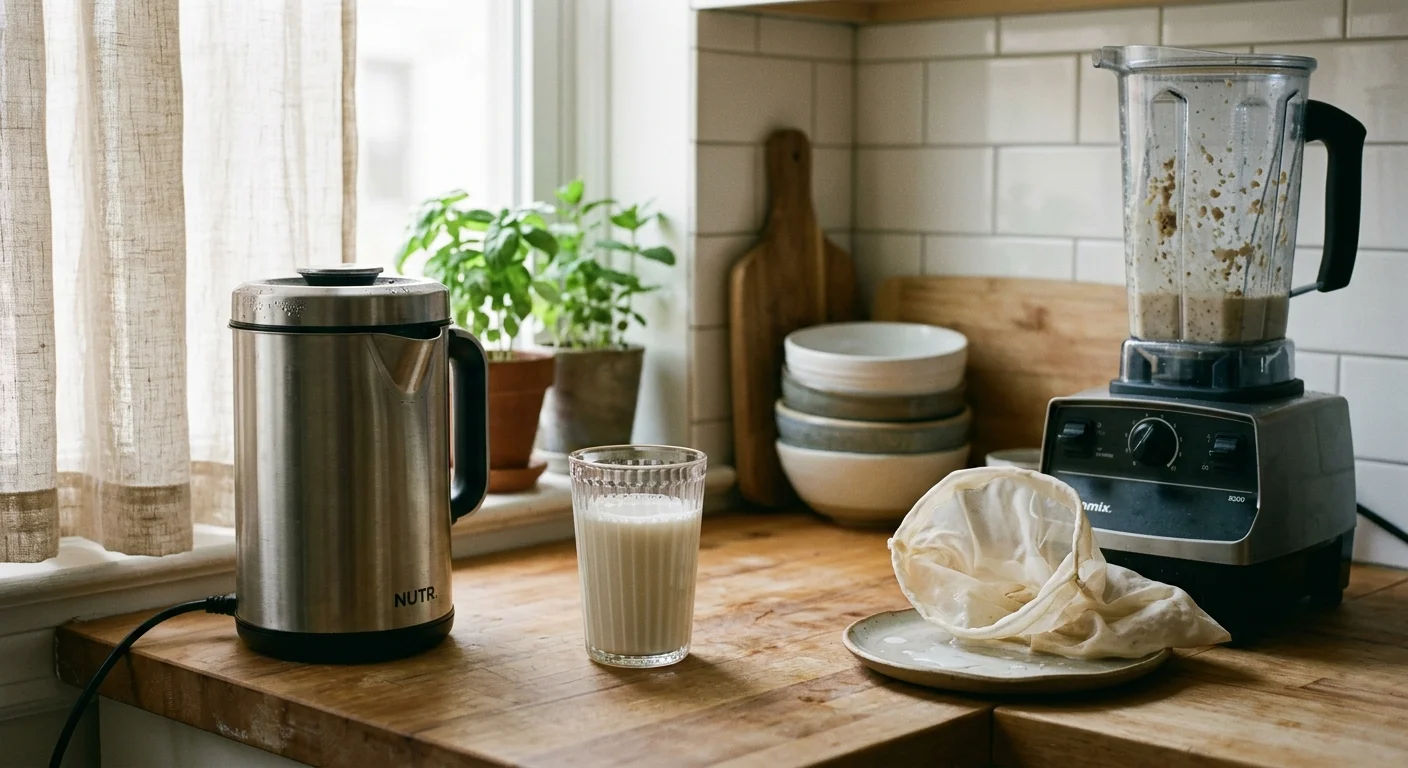
Making an 8-ounce cup of fresh plant milk in a compact studio kitchen shouldn’t bury your sink in dirty dishes. High-speed blenders promise instant dairy alternatives, but standard recipes ignore the tedious manual filtration that ruins quick single-serving morning routines.
While immersion blenders offer quick versatility for basic pureeing, they cannot eliminate the messy manual filtration required when crafting smooth plant milks.
While a 1,400-watt blender cleans its pitcher quickly, scrubbing pulp from a cloth strainer bag adds five minutes of messy work. Dedicated automatic soy milk machines and nut milk makers cut active labor to zero through automated filtration and self-cleaning.
This comparison proves dedicated automated milk makers beat high-wattage blenders on true cleanup speed and small-batch yield under 16 ounces.
The Single-Serving Dilemma: Pitcher Geometry and Minimum Batch Volumes
Full-sized blenders rely on heavy vortex action to pulverize nuts and seeds. Wattage measures how much power an appliance uses; higher wattage usually means faster blending or heating.
Unlike high-RPM electric spice mills engineered to pulverize tablespoons of dry seeds in compact cups, wide blender jars demand deep liquid reservoirs to generate a pulling vortex.
Understanding how blenders differ from food processors helps explain why tall, high-shear jars struggle with small amounts of dry ingredients.
A standard 1,400-watt motor can turn hard almonds into flour within seconds. However, this power requires a specific physical liquid volume to function properly.
Most full-sized blender jars feature a wide base designed for family-sized portions. Quart capacity measures how much the appliance holds, where four quarts equals roughly four liters.
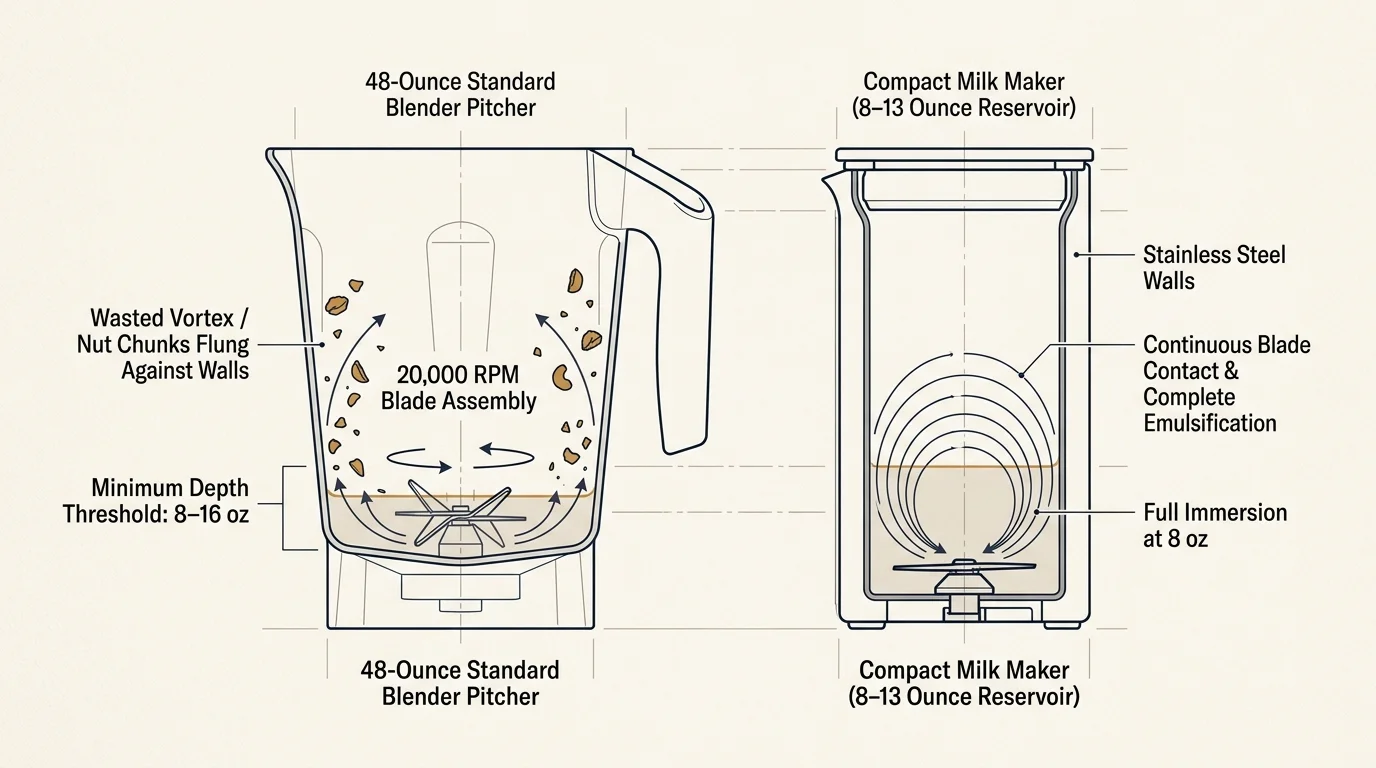
A standard 48-ounce blender container has a 1.5-quart capacity. This container requires at least 8 to 16 ounces of total volume just to submerge the spinning blades.
When you pour 8 ounces of liquid into a broad pitcher, the water level barely clears the blade assembly. As Wirecutter’s kitchen testing shows, wide blending containers struggle to circulate shallow volumes beneath the vortex threshold.
The blades spin at 20,000 RPM and fling the nuts against the walls instead of pulling them down. You end up with watery liquid filled with large, unblended nut chunks.
To get a smooth blend, you are forced to double your batch size to 16 or 24 ounces. That ruins your plan for a fresh, single-serving morning beverage.
A single serving nut milk maker solves this problem using a narrow, straight-walled grinding chamber. Machines like the Nutr utilize an 8 to 13-ounce stainless steel reservoir.
The blades sit flush against the bottom floor of the chamber. This compact layout ensures continuous contact with even three tablespoons of nuts and a single cup of water.
Every nut kernel passes through the cutting path dozens of times per second. You achieve complete emulsification on small batches without adding extra liquid to create artificial volume.
The Straining Bag Overhead: Active Cleanup Times Compared
Blender manufacturers often advertise simple cleanup routines that take only thirty seconds. You add warm water, add a drop of dish soap, and run the motor on high.
The manual labor of clearing dense nut pulp mirrors the cleanup overhead seen in rotary food mills, where fine screens stubbornly trap fibrous residue.
This automated cleaning cycle cleans the glass or plastic pitcher effectively. However, it completely ignores the messiest step in making plant milk: the manual filtration cloth.
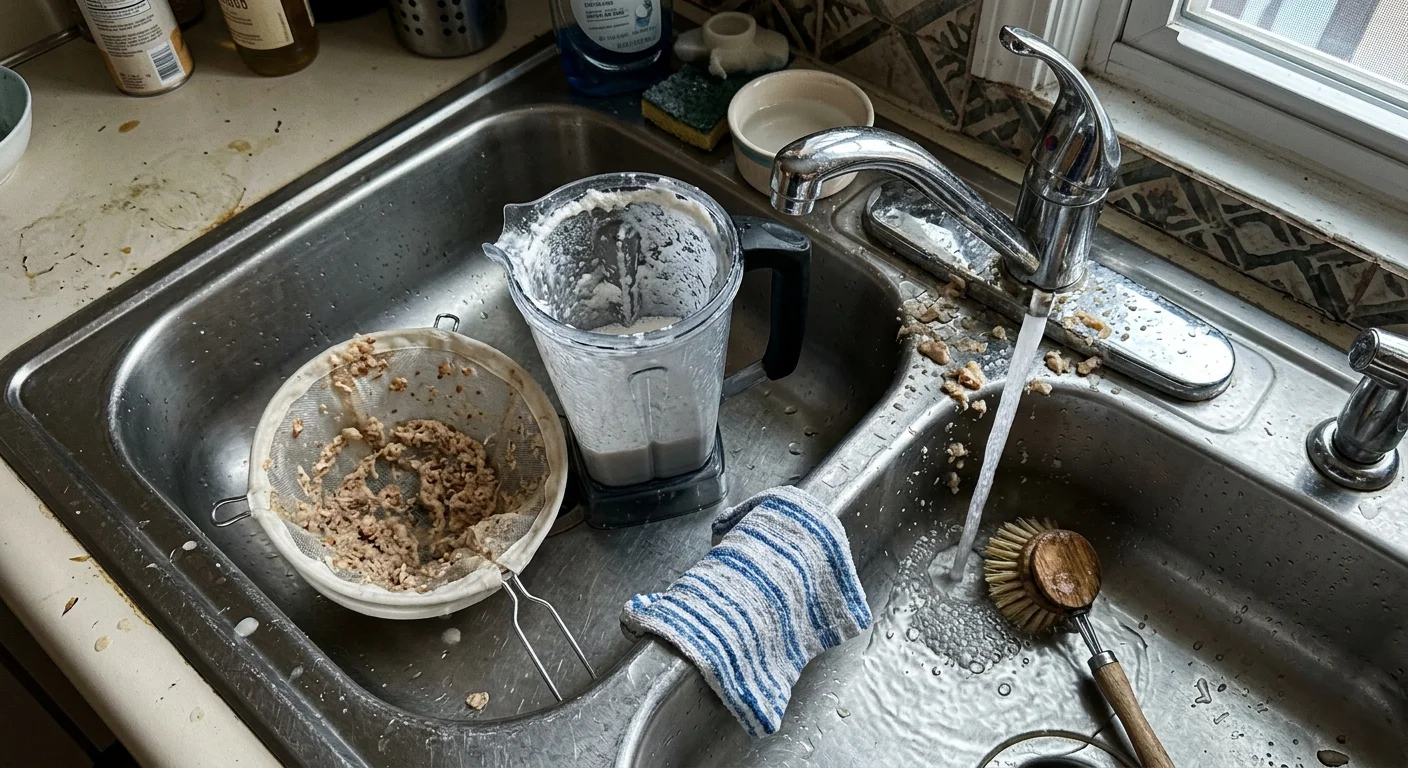
High-wattage blenders do not separate insoluble plant fiber from the extracted liquid. You must pour the blended slurry into a nylon mesh nut milk bag positioned over a bowl.
You then have to spend two to three minutes manually squeezing the bag with both hands. Milky pulp inevitably oozes through the seams, running down your wrists and splattering the counter.
“Manual straining bags transform a sixty-second blender recipe into a multi-step sink chore that solo cooks quickly abandon.”
Cleaning the mesh bag is even more tedious than squeezing it. Fine nut sediment embeds itself into the weave of the nylon fabric.
You must turn the bag inside out, scrape sticky pulp into your trash, and blast the mesh under running water. Washing, rinsing, and wringing out the bag takes three to four minutes of active sink time.
You must then hang the damp bag somewhere in your compact studio apartment to air-dry. In humid months, damp bags can harbor mildew odors if not dried quickly.
An automatic soy milk machine eliminates the cloth bag entirely. Units like the ChefWave Milkmade pump water through a sealed grinding chamber equipped with an internal micro-screen.
The machine dispenses finished, strained milk directly into a glass pitcher while routing waste pulp into a separate collection box. Once brewing ends, the machine triggers an automatic self-cleaning cycle.
The unit flushes internal piping with high-temperature steam and boiling water for three consecutive cycles. The wastewater dumps automatically into a discard reservoir, leaving you with zero manual scrubbing.
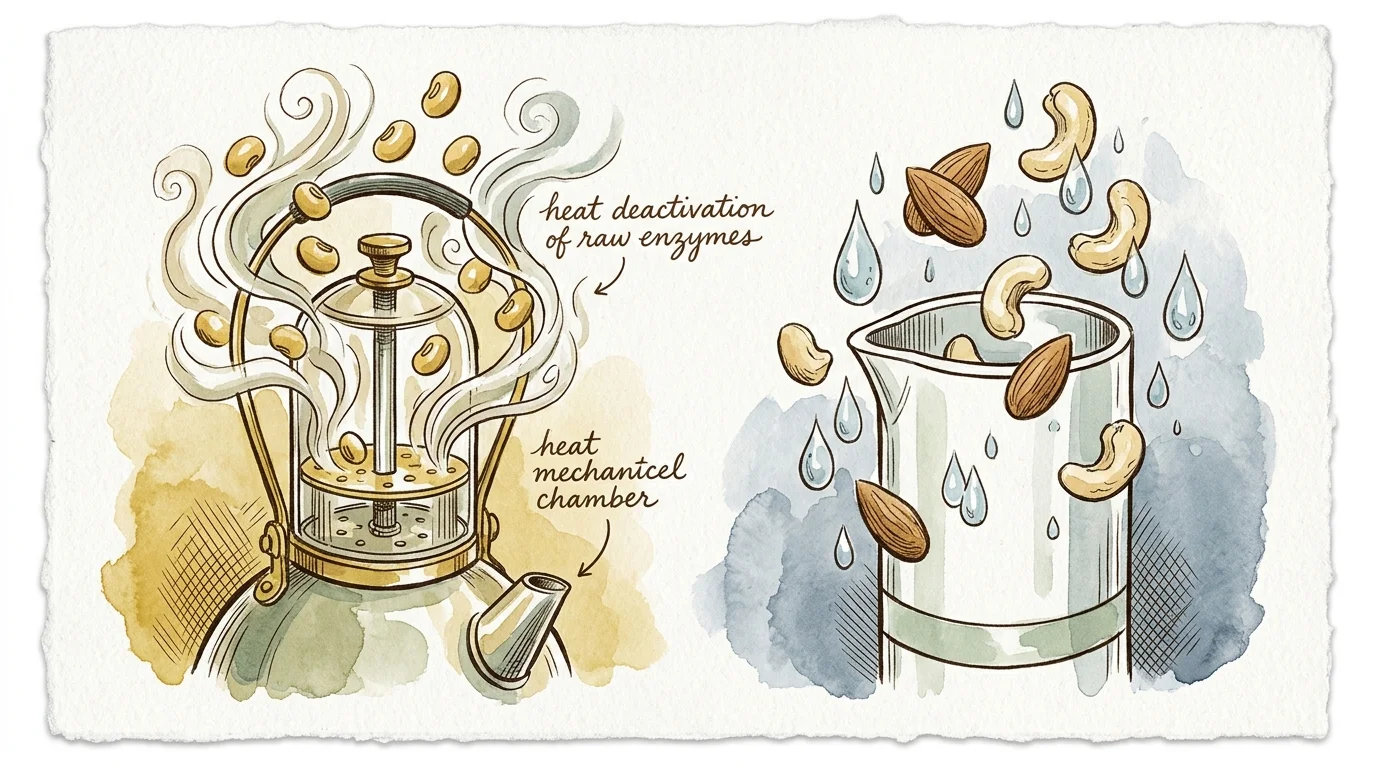
Thermal Processing: Soy Safety Versus Raw Tree Nuts
Making almond or cashew milk is primarily a mechanical task, but soy milk requires precise thermal chemistry. Raw soybeans contain naturally occurring trypsin inhibitors and lectins.
Understanding the limits of friction heat is just as vital here as it is when choosing between food mills and high-shear blenders for strict temperature and texture targets.
These anti-nutritional compounds disrupt human digestive enzymes and can cause acute stomach cramps and vomiting. To make soy milk safe, you must break down these heat-labile proteins completely.
Scientific food safety standards require bringing soy milk to 212°F (100°C) and holding that temperature for fifteen to twenty minutes. This sustained boil deactivates more than 90 percent of trypsin inhibitor activity.
High-wattage blenders create heat solely through mechanical friction from the spinning blades. Even running a 1,400-watt blender on maximum speed for six minutes only raises liquid temperatures to roughly 165°F to 180°F.
That friction heat is insufficient to neutralize trypsin inhibitors safely. Running a high-wattage motor for fifteen continuous minutes will trigger internal thermal protection sensors and shut off the motor.
If you use a blender for soy milk, you must pour the strained liquid into a saucepan and boil it on your stove. This extra cooking step creates a second wave of dirty cookware.
Soy milk foams aggressively when boiled, requiring constant stirring to prevent burnt residue and messy stove boilovers. That adds twenty minutes of active monitoring in your kitchen.
Preset programs are automatic settings for common tasks like heating or blending that control motor speed and run duration. Dedicated automatic soy milk machines feature built-in 1,000-watt heating plates and automated preset programs.
The machine cooks the raw beans at a steady rolling boil while intermittently pulsing its grinding blades. You get fully cooked, safe soy milk without dirtying a pot or standing over a hot stove.
Liquid Yield and Extraction Efficiency for Small Batches
Extraction efficiency dictates how much usable milk you produce from your expensive raw ingredients. Organic nuts and heirloom soybeans carry high grocery costs that add up over months.
Similar ingredient loss challenges occur when testing small-capacity immersion blender attachments versus mini choppers, where blade clearance directly dictates how much product is retained.
When you use a blender vs nut milk maker, liquid retention in discarded pulp significantly alters your final yield. Cloth straining bags act like sponges that trap valuable liquid.
According to Serious Eats’ equipment reviews, fine particle suspension determines the body and richness of homemade nut milks. Squeezing by hand always leaves dense, damp meal behind.
In an 8-ounce test batch using one ounce of raw almonds, a high-wattage blender yields approximately 6.5 ounces of strained milk. The remaining 1.5 ounces of enriched liquid stays trapped inside the soggy pulp.
That results in an eighty-one percent liquid yield efficiency. Almost twenty percent of your beverage is thrown into the compost bin.
Filterless single-serving machines take a radically different approach to extraction. The Nutr machine uses high-speed micro-milling blades rotating at high velocity in a compact chamber.
This pulverizes nut skins and fibrous cell walls into microscopic particles under forty microns in size. Because the particles are so fine, they remain suspended in the liquid rather than settling out.
You pour the entire mixture directly into your glass without any straining step. This method delivers a ninety-eight percent liquid yield from your initial ingredients.
The resulting beverage has a richer mouthfeel and contains all the original prebiotic fiber of the nuts. For smooth coffee creamers, this full-suspension yield prevents watery separation.
Auto-separating machines like the ChefWave sit comfortably between these two designs. They use internal centrifugal separation to squeeze solids against a micro-sieve, hitting an eighty-eight percent yield without manual effort.
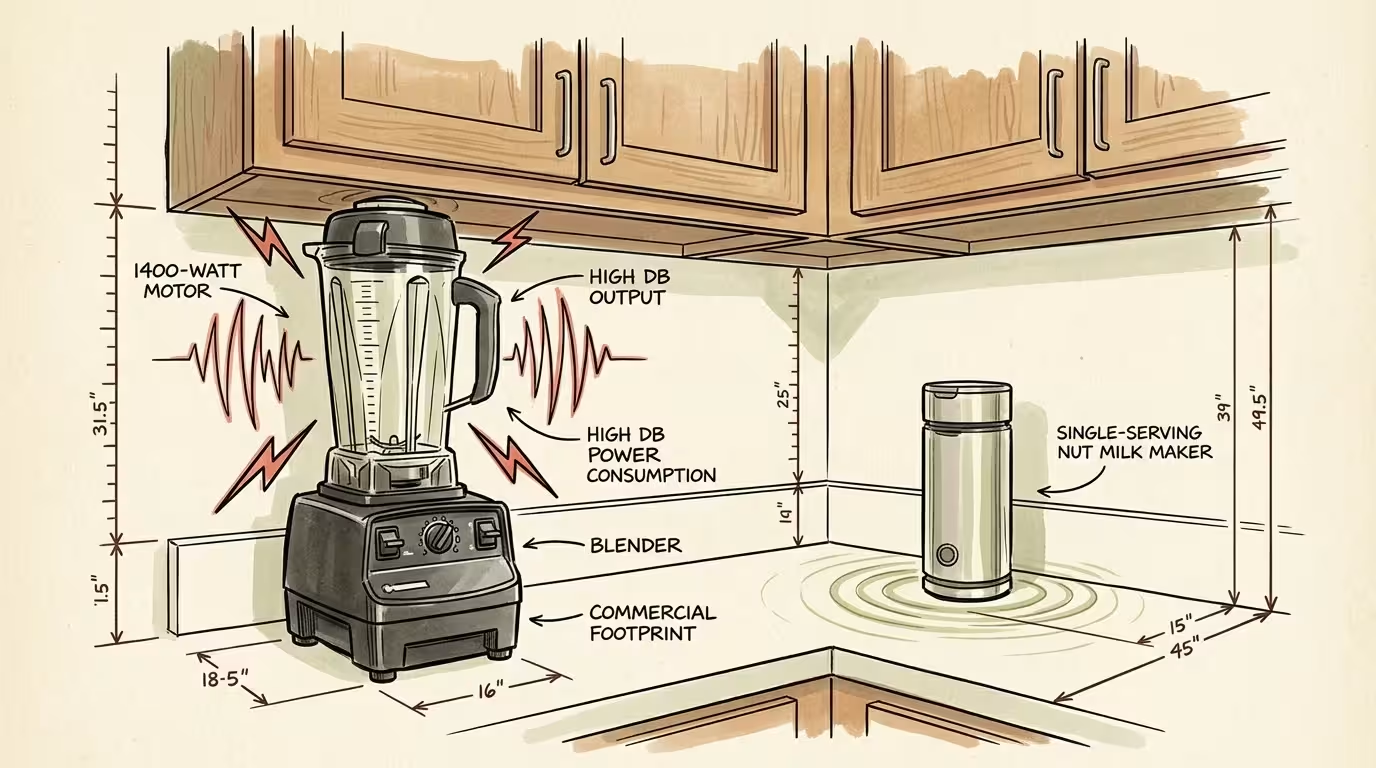
Studio Kitchen Footprints, Noise Levels, and Power Draw
Countertop space is limited in a compact urban studio apartment. Appliance dimensions dictate whether a machine stays on the counter or gets shoved into a closet.
Strategically outfitting your space with dedicated compact kitchen appliances for small spaces prevents daily beverage tools from claiming critical food prep counter room.
Cooks dealing with severe space constraints often experiment with portable blenders for personal drinks, though they lack the heating elements required for legumes.
A classic high-wattage blender like the Vitamix Explorian E310 occupies eleven by eight inches of counter space. At seventeen inches tall, it barely clears the underside of standard overhead cabinets.
The blender weighs over ten pounds, making daily retrieval from deep cabinets an annoying physical chore. It also draws 1,400 watts of electrical power during operation.
Worse, a commercial-style blender produces sound levels between 88 and 93 decibels on high speed. In a small studio apartment, that volume penetrates thin walls and disturbs sleeping neighbors early in the morning.
A compact single serving nut milk maker like the Nutr measures just 4.3 inches wide and 8.2 inches tall. It takes up less counter space than an electric water kettle.
Weighing only three pounds, you can lift it with one hand and store it inside any shallow studio cabinet. Its motor draws roughly 350 watts during grinding cycles.
Because the blending chamber is encased within thick, double-walled insulation, motor noise drops to 68 decibels. You can run the machine in your kitchenette without waking anyone in the same room.
Larger self-cleaning units like the ChefWave Milkmade require more counter space, measuring 13.6 by 6.5 inches. They stand twelve inches tall and weigh roughly eleven pounds.
These automated units combine a 1,000-watt boiling element with an internal motor. The entire closed cycle runs at moderate sound levels, avoiding the high-pitched shriek of open blender jars.
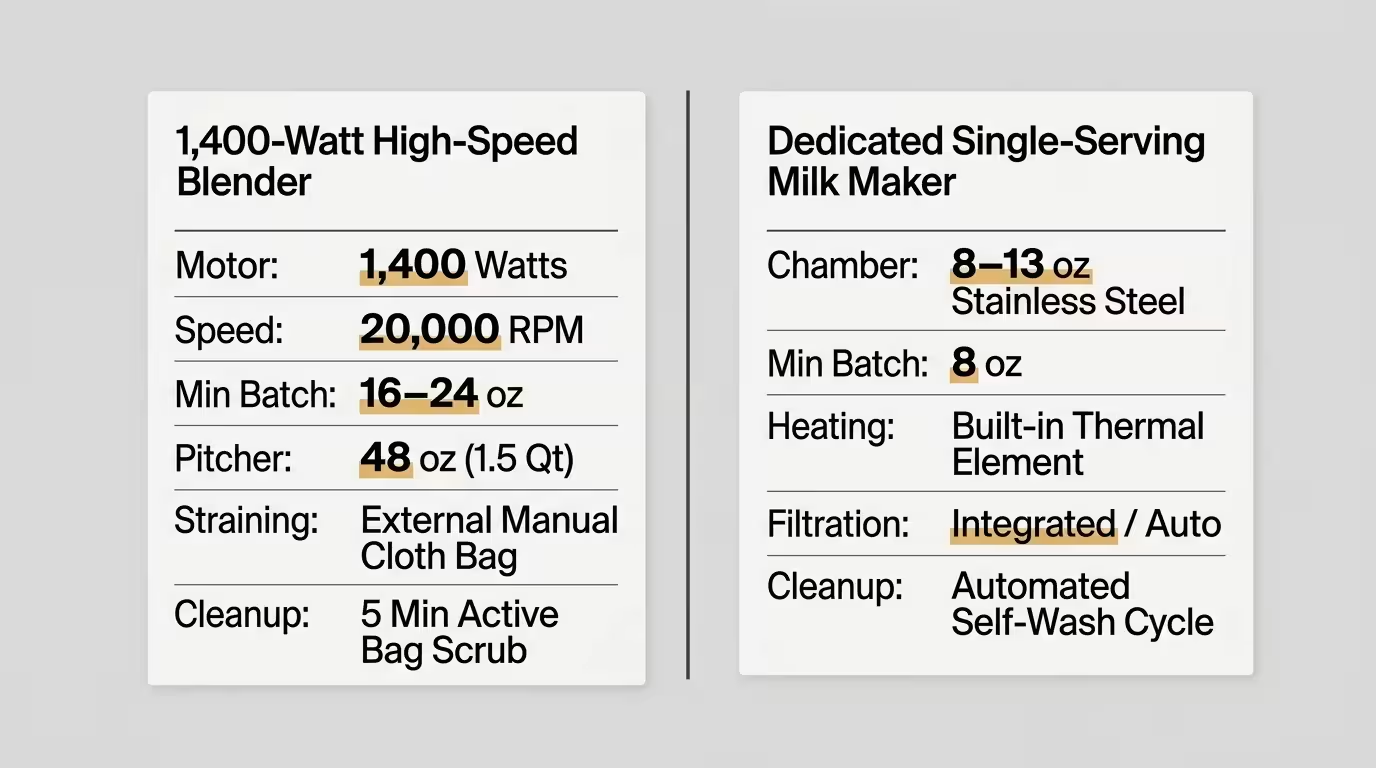
Head-to-Head Appliance Specifications
Evaluating technical specifications side by side clarifies which machine meets your daily volume needs and space limitations. The table below compares the most popular options across key metrics.
| Appliance Model | Appliance Category | Motor & Heating Wattage | Min Batch Size | Dimensions (W x D x H) | Active Hands-On Cleanup | Straining Required |
|---|---|---|---|---|---|---|
| Vitamix Explorian E310 | High-Wattage Blender | 1,400W (Motor only) | 12 oz (355 mL) | 11.0″ x 8.0″ x 17.0″ | 5 to 7 Minutes | Yes (Nut Milk Bag) |
| Nutr Machine | Single-Serving Maker | 350W Motor / 1,000W Heat | 8 oz (240 mL) | 4.3″ x 4.3″ x 8.2″ | 90 Seconds | Optional (Ultra-Fine) |
| ChefWave Milkmade | Auto-Cleaning Maker | 200W Motor / 1,000W Heat | 10 oz (300 mL) | 13.6″ x 6.5″ x 12.8″ | 60 Seconds | No (Auto-Separated) |
| Joyoung DJ10U-K61 | Auto-Cleaning Soy Maker | 210W Motor / 1,000W Heat | 10 oz (300 mL) | 15.2″ x 7.8″ x 14.5″ | 60 Seconds | No (Auto-Separated) |
The numbers highlight a clear operational trade-off for single users. While blenders deliver unmatched motor power, their large minimum batch thresholds undermine compact, single-glass preparations.
Automated plant milk machines compromise on raw horsepower to optimize chamber heating, micro-grinding geometry, and hands-free maintenance.
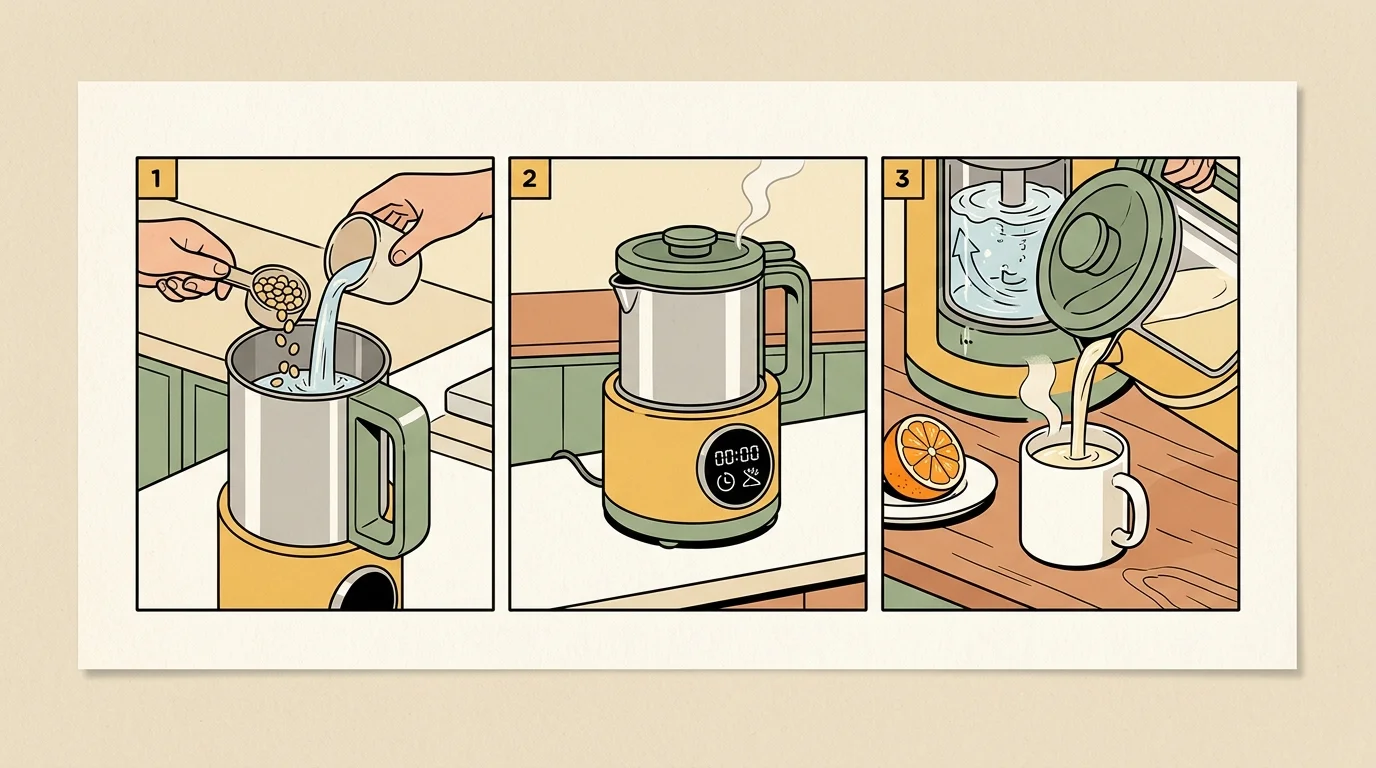
Worked Example: Daily 10-Ounce Soy Milk Morning Routine
Consider a solo vegan named Alex living in a 450-square-foot studio apartment in Chicago. Alex drinks a fresh 10-ounce warm soy milk latte every weekday morning at 7:00 AM.
Let’s compare the exact workflow, time investment, and equipment usage across two different appliance setups. Alex uses thirty grams of organic dry soybeans and 300 milliliters of filtered water.
In Workflow A, Alex uses a Vitamix Explorian E310 high-wattage blender paired with a fine nylon nut milk bag. Because raw soy is toxic unboiled, Alex must complete several manual cooking steps.
First, Alex loads the soaked beans and water into the blender pitcher and runs it on high for ninety seconds. Next, Alex pours the slurry into a nylon bag held over a mixing bowl.
Alex spends three full minutes squeezing the fibrous bag until the okara pulp feels dry. Then Alex pours the raw soy milk into a stainless steel saucepan on the stovetop.
Alex brings the milk to a boil and simmers it for eighteen minutes, stirring continuously to prevent scorch marks. Finally, Alex pours the cooked milk into a mug to make coffee.
Now the cleanup begins in a tiny studio sink. Alex rinses the blender pitcher, adds soap, and runs a cleaning cycle for sixty seconds.
Then Alex spends four minutes turning the nut milk bag inside out, picking okara fibers from the mesh, and washing it with soap. Finally, Alex scrubs the scorched soy film off the saucepan and wooden spoon for three minutes.
Total time elapsed: 28 minutes. Total active, hands-on labor: 11 minutes. Dirty items created: blender pitcher, blender lid, nut milk bag, mixing bowl, saucepan, and stirring spoon.
Now consider Workflow B using the ChefWave Milkmade automatic soy milk machine. Alex adds dry soybeans into the hopper, fills the water tank to 10 ounces, and selects the Soy Milk preset.
The machine heats to 212°F, grinds the beans, simmers the milk safely, and dispenses hot soy milk into a glass carafe after 16 minutes. Alex does not touch the machine during this entire cooking phase.
The machine immediately starts its automated self-cleaning cycle, pulsing steam and boiling water through its lines for four minutes. The rinse water dumps into a hidden wastewater basin.
Alex’s active cleanup requires rinsing the glass carafe for thirty seconds and dumping the wastewater pan into the sink for thirty seconds. Total time elapsed: 20 minutes. Total active, hands-on labor: 1 minute.
Workflow B saves Alex ten full minutes of active kitchen labor every single morning. Over a full working year, that equals forty hours of scrubbing bags and pots saved.
Targeted Recommendations for Small Kitchen Spaces
Selecting the right appliance depends on whether you value true counter compactness, hands-off automation, or multi-use flexibility. Each machine fits a specific cooking habit and lifestyle.
The Nutr Machine is the best choice for renters living in micro-studios who make almond, oat, or cashew milks. At under five inches wide, it occupies minimal counter space and stows away easily.
Its fine-grind blades eliminate the need for straining bags if you enjoy rich, fiber-dense milks. It heats liquid up to boiling, but its small chamber capacity limits batches to 13 ounces maximum.
“Automated milk makers sacrifice the raw ice-crushing power of blenders to solve the daily chore of straining and scrubbing.”
The ChefWave Milkmade is our top recommendation for daily soy and oat milk drinkers who hate dishwashing. Its automated self-cleaning cycle and pressurized steam purging work remarkably well.
As confirmed by Good Housekeeping’s appliance lab, self-cleaning steam cycles significantly reduce dairy and plant residue buildup on interior components. The machine handles dry, unsoaked beans effortlessly without user intervention.
If you already own a 1,400-watt blender like the Vitamix E310, keep it if you prioritize making green smoothies, nut butters, and frozen desserts. However, do not buy a commercial blender solely for single-serving plant milks.
The minimum liquid volume requirements and messy cloth straining bags make single servings deeply frustrating. For solo plant-based cooking, automated single-serving machines provide far better everyday convenience.
Frequently Asked Questions
Can you drink soy milk straight from a high-wattage blender without cooking it?
No, you should never drink raw blended soy milk without boiling it first. Raw soybeans contain toxic trypsin inhibitors and lectins that disrupt human digestion and cause acute stomach pain and nausea.
You must boil blended soy milk at 212°F for at least fifteen minutes to deactivate these proteins safely. High-speed blenders cannot sustain this rolling boil through blade friction alone.
Do self-cleaning nut milk makers leave gritty pulp in single-serving drinks?
Filterless machines like the Nutr pulverize nuts down to microscopic sizes, leaving a smooth but noticeably thicker texture. The pulp remains suspended in the liquid rather than settling out as grit.
If you prefer thin, store-bought consistency, you can pour the milk through a small metal strainer in five seconds. Auto-separating machines like the ChefWave filter out all pulp internally.
Is a nut milk bag necessary when using a Vitamix for almond milk?
Yes, a nut milk bag is necessary if you want silky, store-style milk from a blender. Even at 20,000 RPM, blenders leave coarse almond meal in the liquid that tastes gritty in coffee.
Cashews and hemp seeds are the only exceptions that blend completely smooth without requiring manual filtration.
How much water does an automatic self-cleaning soy milk machine waste during cleaning?
Most automatic machines use between eight and twelve ounces of clean water per self-cleaning cycle. The machine turns a portion of this water into steam to dissolve oily residue along the walls.
This automated rinse uses significantly less water than running your kitchen faucet for four minutes to scrub a mesh straining bag.
Disclaimer: Product prices, features, and availability change frequently. Prices shown were accurate at time of writing but may have changed. We may earn a small commission from purchases made through links on this site, at no extra cost to you. Always verify current pricing and specifications on the retailer’s website before purchasing.