
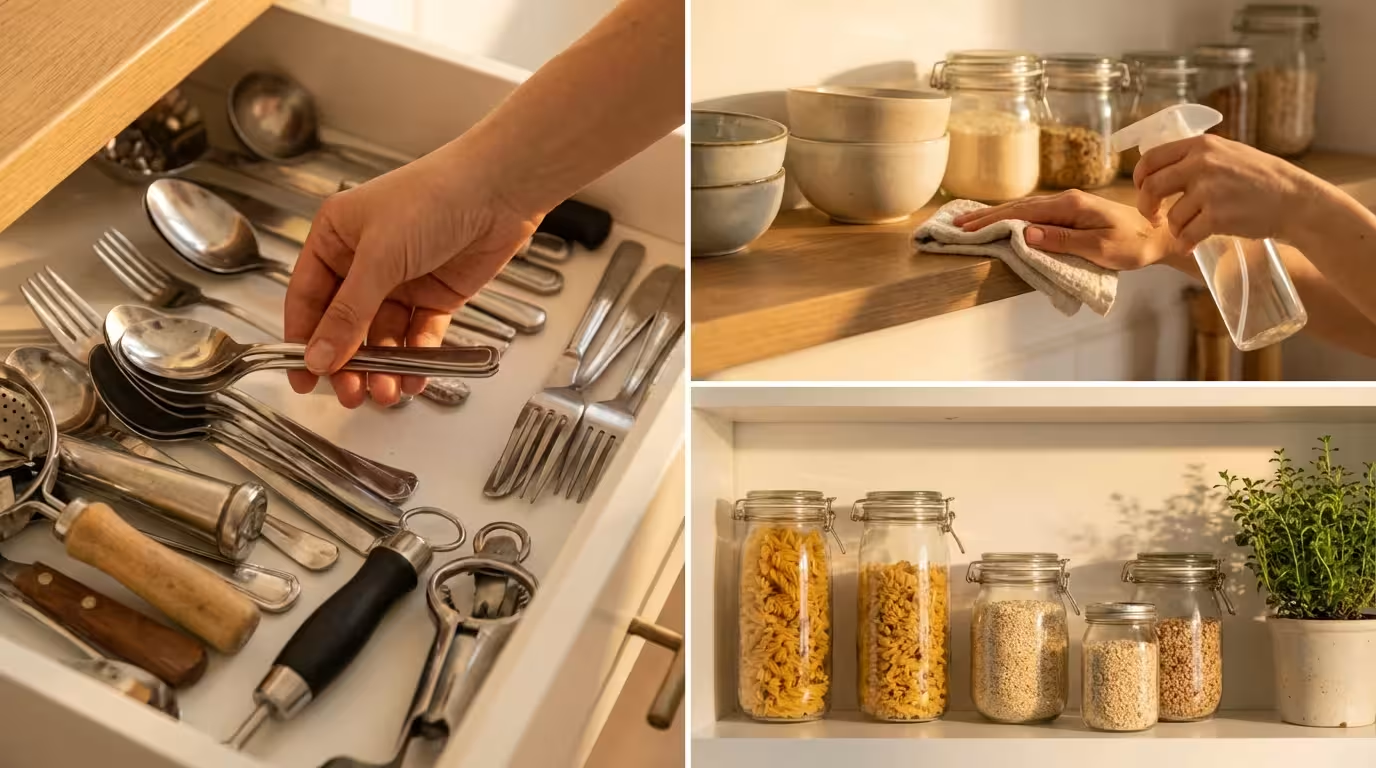
You open a drawer to grab a spatula, but the ladle gets stuck on the top lip of the cabinet. You shove it back down, wiggle it, and finally yank the drawer open, only to realize the spatula is actually in the dishwasher. Sound familiar? This isn’t just a minor annoyance; it is friction that slows down your cooking and adds unnecessary stress to your daily routine.
A functional kitchen does not require a massive renovation or a doubled square footage. It requires a strategic approach to “stuff.” Whether you are working with a sprawling suburban layout or a tight galley kitchen in the city, the principles of kitchen organization remain the same: reduce the inventory, zone the workflow, and utilize every inch of available space efficiently.
This guide walks you through a complete kitchen overhaul. We move beyond simple tidying and dive into structural organization—creating systems that stay messy-proof long after you finish reading.
Preparation: The Purge Before the Place
You cannot organize clutter. Buying matching bins before you declutter is like buying a suitcase before you know where you are traveling. The first step is arguably the hardest, but it is the most critical for long-term success. You must ruthlessly edit your kitchen inventory.
If you are looking to save money while refreshing your space, consider these DIY kitchen organization projects on a budget to maximize your results without a major investment.
The “Touch It Once” Method
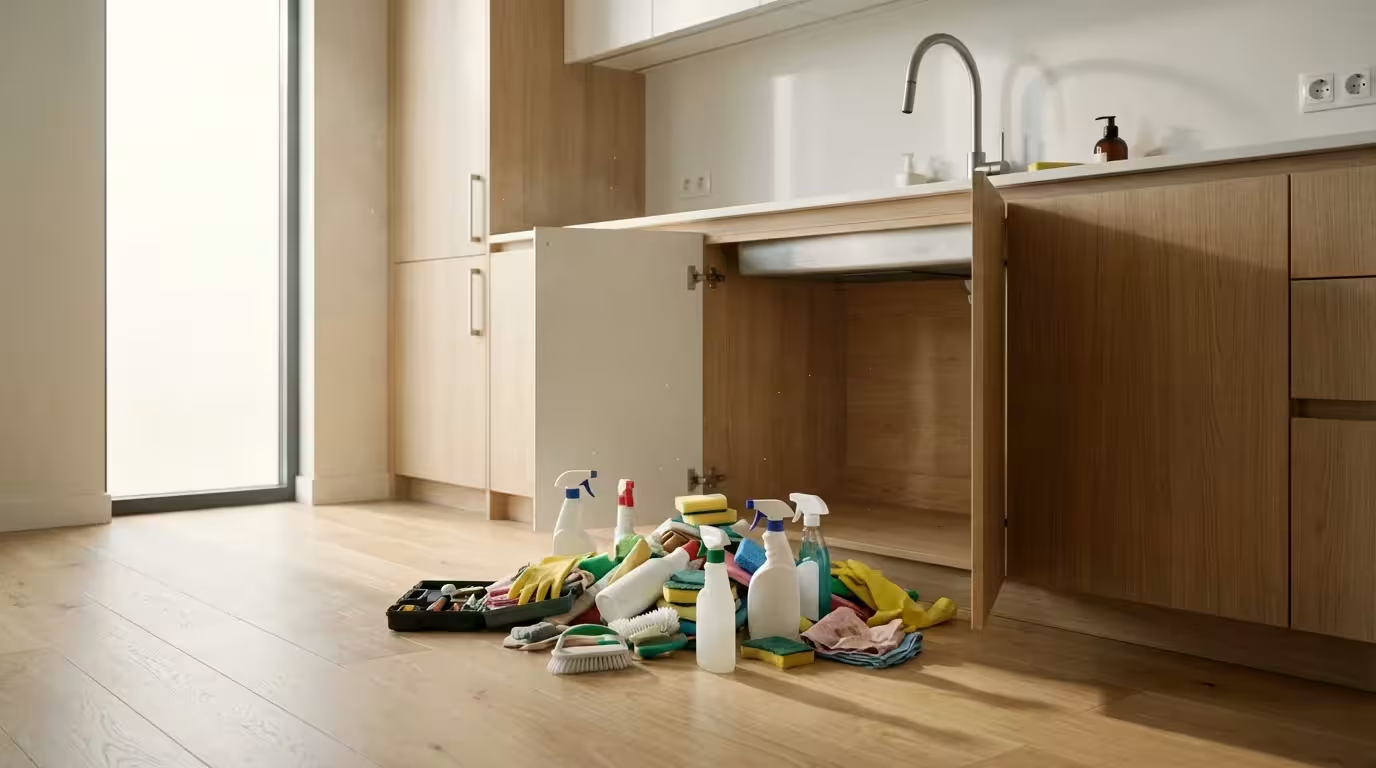
To begin, select one area—start with the “junk drawer” or the under-sink cabinet to build momentum. Empty the entire contents onto a table or the floor. You need to see the empty space to understand its potential. As you pick up each item, make an immediate decision:
- Keep: Items you use weekly or essential tools you use seasonally (like a roasting pan).
- Donate: Duplicates (you do not need four can openers), gadgets you haven’t touched in a year, or mismatching dishware.
- Trash/Recycle: Broken appliances, Tupperware without lids, and expired food.
Be honest with yourself about aspirational items. That pasta maker you bought three years ago but never opened is taking up prime real estate. If you haven’t used it, let it go. According to Real Simple, the psychological weight of keeping unused items often exceeds the “value” of the item itself. Clearing physical space clears mental space.
Strategic Zoning: The Golden Triangle and Beyond
Once you have pared down your belongings, do not just shove them back where they came from. Kitchen efficiency relies on “zoning.” The classic “Golden Triangle” connects your stove, sink, and refrigerator. Your storage should radiate out from these points based on frequency of use.
Don’t forget to address the center of the room, as optimizing your kitchen island storage and organization is key to maintaining a smooth workflow.
Zone 1: The Prep Zone (Near Sink/Counter)
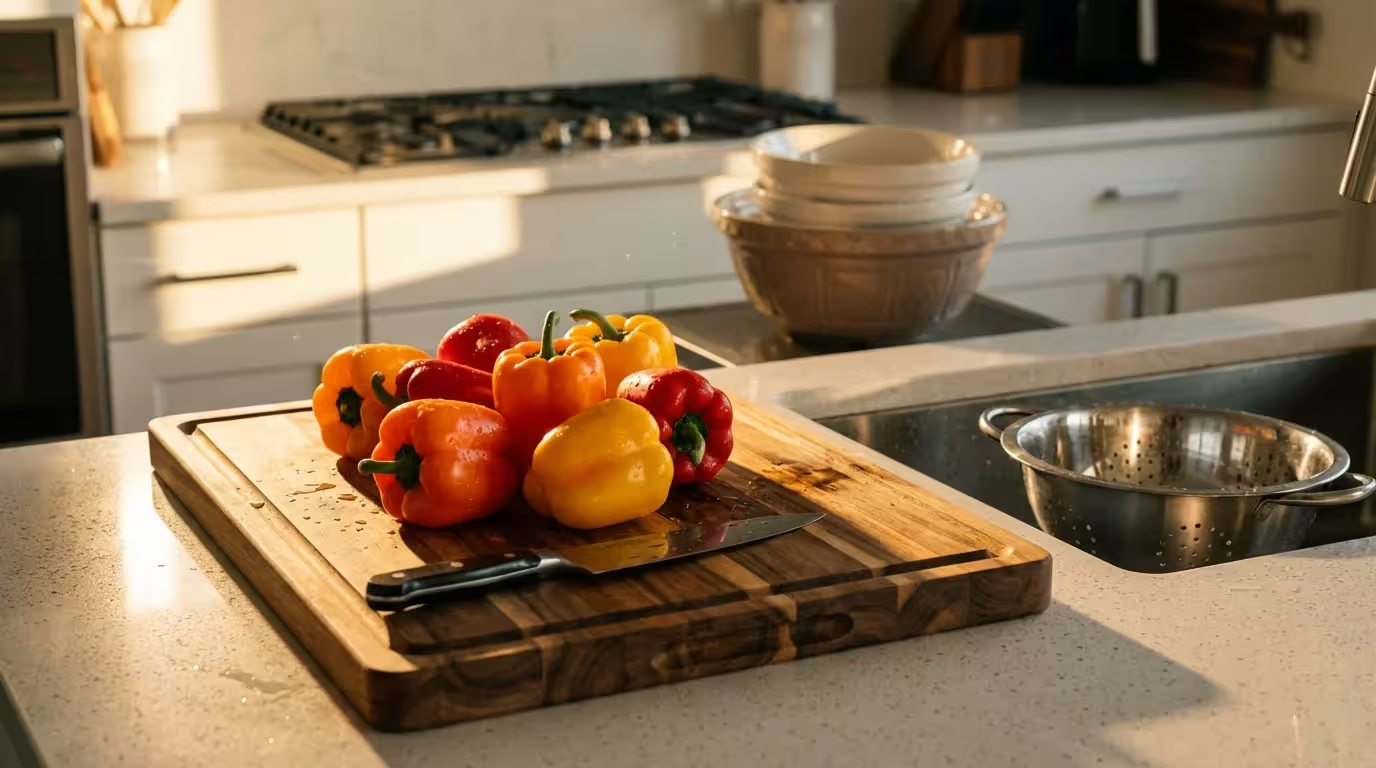
This is where you chop, mix, and wash. Keep knives, cutting boards, colanders, and mixing bowls here. The trash bin and compost pail should be within arm’s reach.
Zone 2: The Cooking Zone (Near Stove)
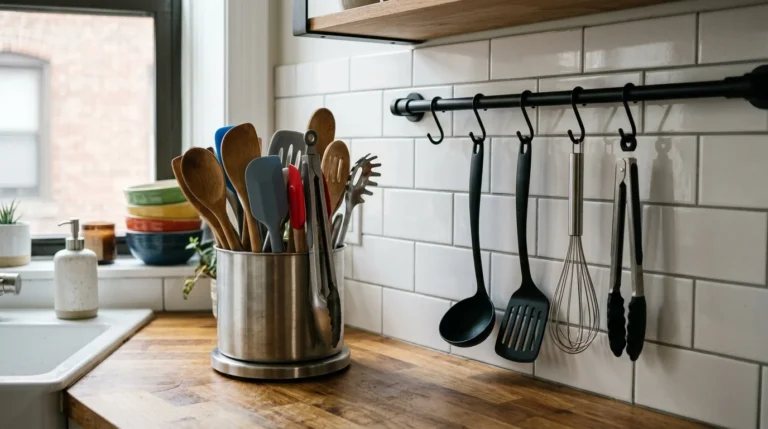
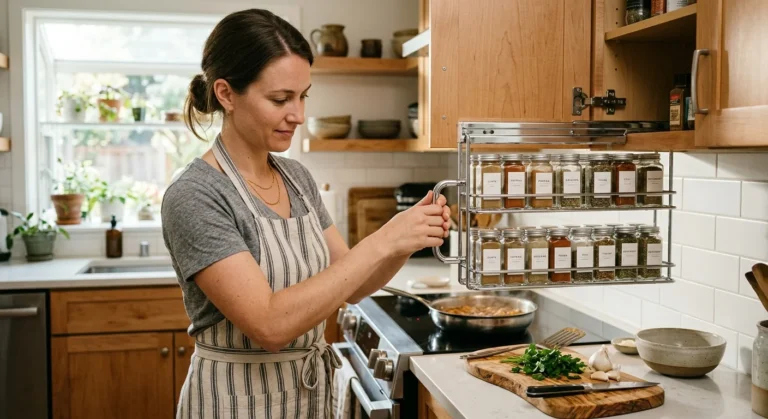
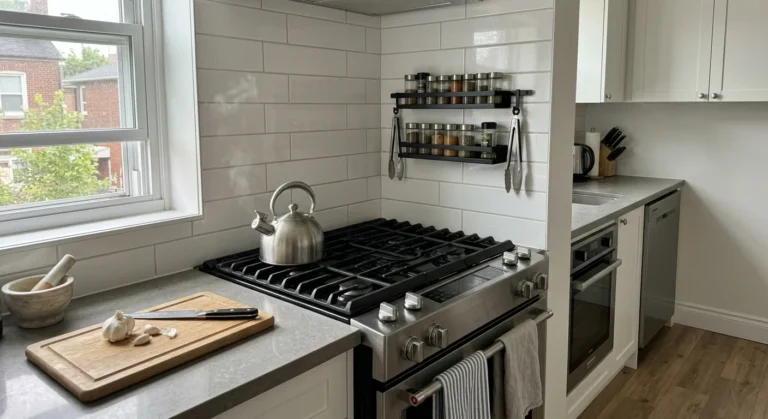
Pots, pans, baking sheets, and cooking utensils (spatulas, wooden spoons) belong here. Spices and oils should also be accessible without taking more than a step. Do not store your spices across the room in a pantry if you use them while sautéing.
Zone 3: The Serving Zone (Near Dishwasher/Table)
Plates, bowls, glasses, and silverware should be stored near the dishwasher to make unloading easy, or near the dining area to facilitate setting the table.
Cabinet Mastery: Pots, Pans, and Tupperware
Cabinets are often deep, dark caverns where items go to disappear. This is particularly true for lower cabinets. To fix this, we need to bring the back of the cabinet to the front.
Lower Cabinets: The Pull-Out Revolution
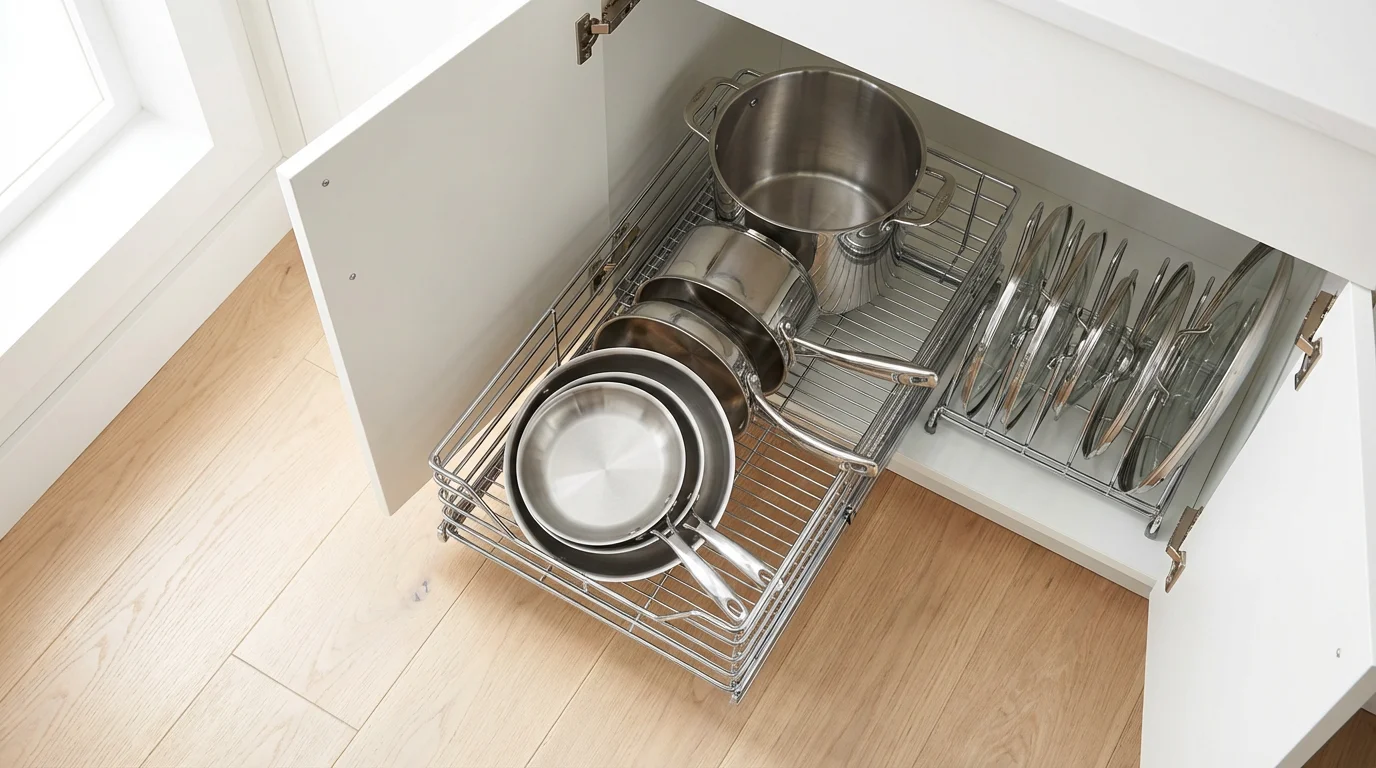
If you have standard cabinets with shelves, you likely struggle to reach items in the back. The solution is the pull-out organizer. These are sliding drawers you install directly onto the existing shelf. They transform a static shelf into a drawer, allowing you to see everything at a glance.
For heavy items like cast iron skillets or stand mixers, ensure you purchase heavy-duty glides rated for at least 50-75 pounds. Measure the *clear opening* of your cabinet (inside the hinges), not just the door width, to ensure the organizer fits.
The Corner Cabinet Challenge
Corner cabinets are notorious for “dead space”—areas that are difficult to access and often go unused.
- Lazy Susan: This is a rotating tray that sits on a shelf. It spins 360 degrees, bringing items from the back to the front. These are ideal for spices, oils, or baking ingredients in upper corners.
- Blind Corner Pull-Outs: For lower blind corners, specialized wire racks swing out and slide forward. While more expensive, they recover cubic feet of storage that would otherwise be lost.
The Food Container Nightmare
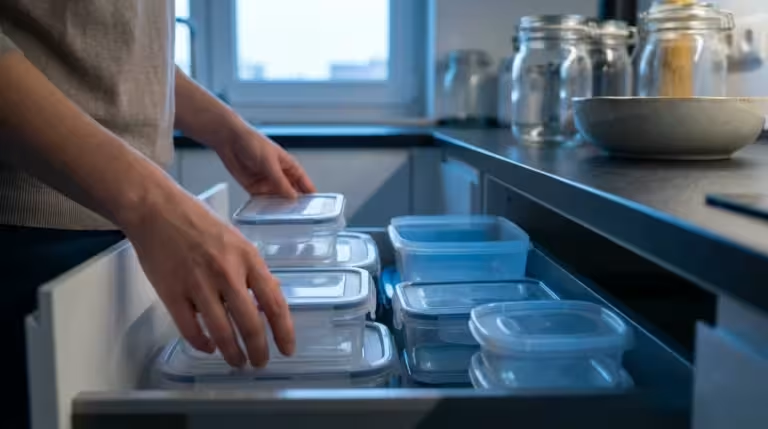
Plastic food containers are the entropy of the kitchen. To tame them:
- Separate Lids and Bases: Stack bases (nested inside each other) by shape—round with round, square with square.
- Contain the Lids: Use a dedicated bin or a large drawer divider to stand lids vertically. This acts like a file folder system for your lids, making it easy to flip through and find the right size.
- Stick to One System: As suggested by the experts at Wirecutter, investing in a single brand of glass or high-quality plastic containers ensures uniform stacking and interchangeable lids, drastically reducing clutter.
Conquering the Drawer Dilemma
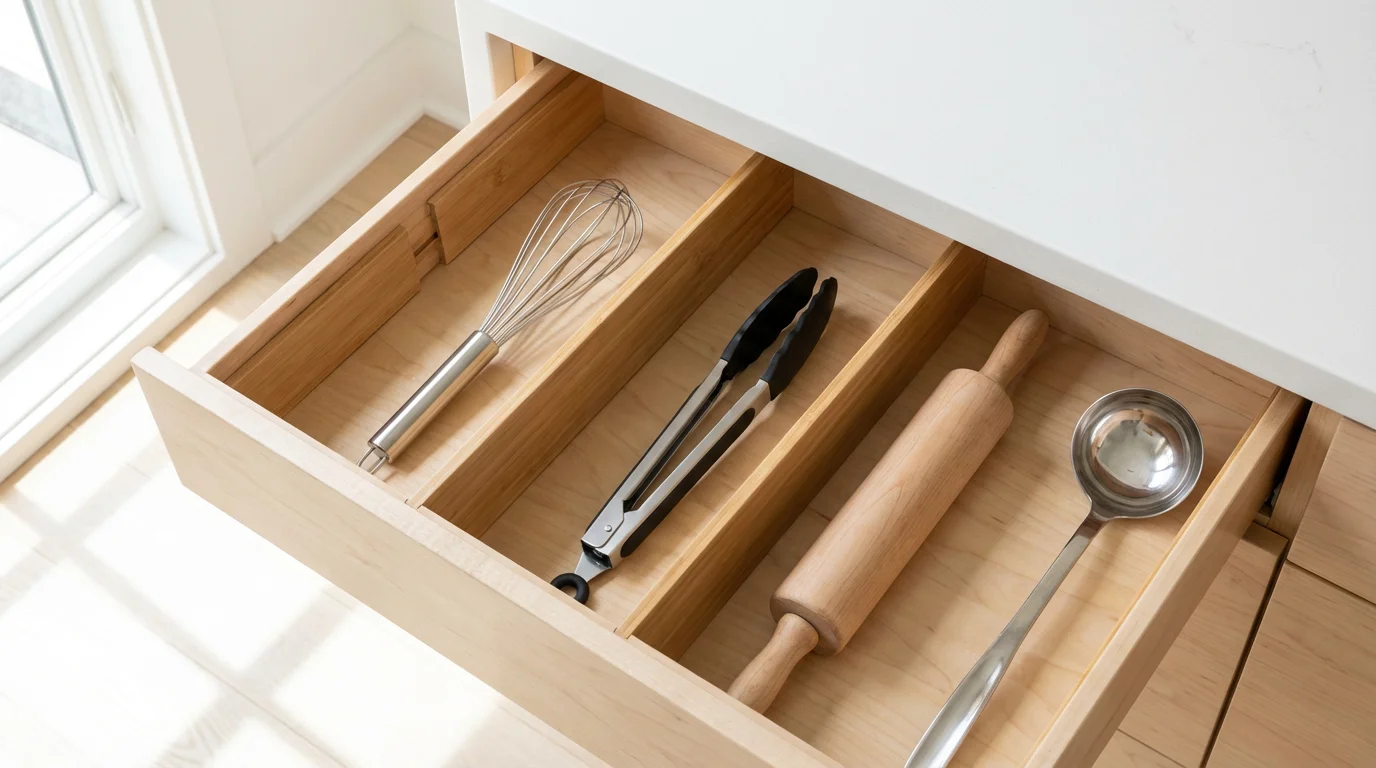
Drawers are prone to becoming junk heaps because they are easy to close and ignore. The key to drawer organization is subdivision.
Silverware vs. Cooking Utensils
For standard silverware, a bamboo or acrylic tray with fixed compartments usually suffices. However, cooking utensil drawers (whisks, ladles, tongs) are often too chaotic for standard trays.
The Solution: Diagonal drawer dividers. By placing dividers diagonally, you create longer compartments that accommodate 12-inch tongs or rolling pins that wouldn’t fit in a horizontal slot. Alternatively, expandable spring-loaded dividers allow you to create custom-sized channels based on your specific tool collection.
The “Junk” Drawer Rebrand
Every kitchen needs a utility drawer. The problem arises when it becomes a trash drawer. Rename it the “Utility Drawer” and give it structure. Use small modular bins to separate batteries, tape, pens, and rubber bands. If an item doesn’t have a defined category (like a random screw), it doesn’t belong there.
The Pantry Protocol: FIFO and Visibility
Whether you have a walk-in closet or a single tall cabinet, the pantry is where food goes to expire. Organization here saves you money by preventing food waste.
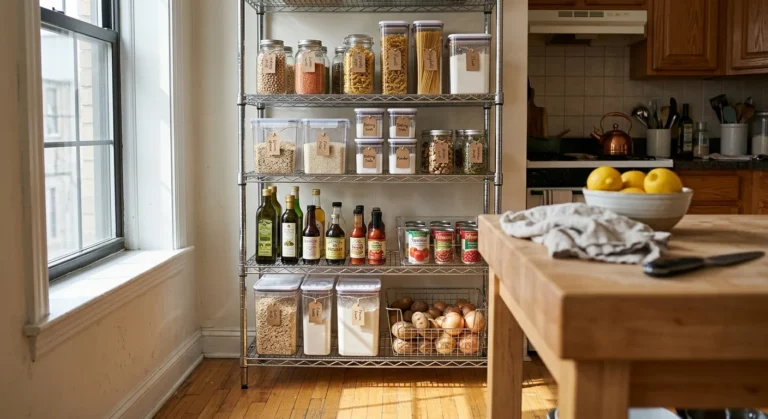
A high-functioning pantry also relies on clear identification, so using labels and label makers for kitchen organization helps keep your inventory manageable.
Exploring different pantry organization ideas can help you find a visibility system that suits your cooking habits.
The FIFO Method
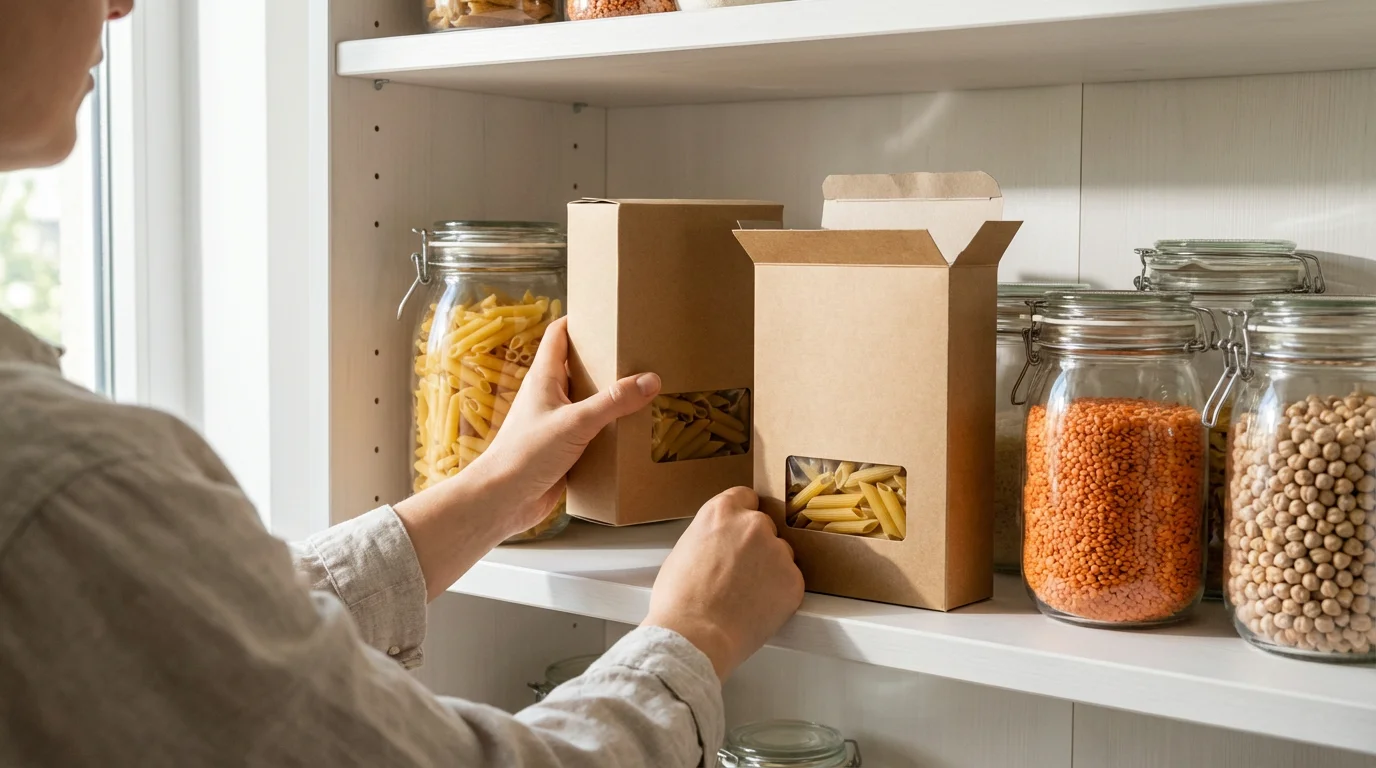
Restaurants use the FIFO (First In, First Out) method. When you buy a new box of pasta, place it behind the open or older box. This ensures you consume the oldest items first.
Decanting: Is It Worth It?
Decanting refers to taking food out of original packaging and putting it into matching jars.
Pros: Airtight seals keep food fresher; rectangular containers stack more efficiently than bags; you can easily see when you are running low.
Cons: It takes time and effort to maintain; you lose cooking instructions (unless you tape them to the jar).
Verdict: Decant dry staples you use in bulk (flour, sugar, rice, pasta). Keep snacks and rapidly consumed items in their original boxes or dump them into open bins.
Zone Planning with Shelf Risers
Many pantry shelves are 12 to 16 inches apart, yet a row of canned goods is only 4 inches high. This leaves 8 inches of wasted vertical space.
Shelf Risers: A shelf riser is a freestanding mini-shelf that sits on your existing shelf. It allows you to stack cans or boxes on two levels without them toppling over. This instantly doubles your storage capacity for small items.
“The goal isn’t a Pinterest-perfect pantry. It’s being able to find what you need in 10 seconds or less. If a system takes too long to maintain, you won’t use it.”
Reclaiming Countertop Real Estate
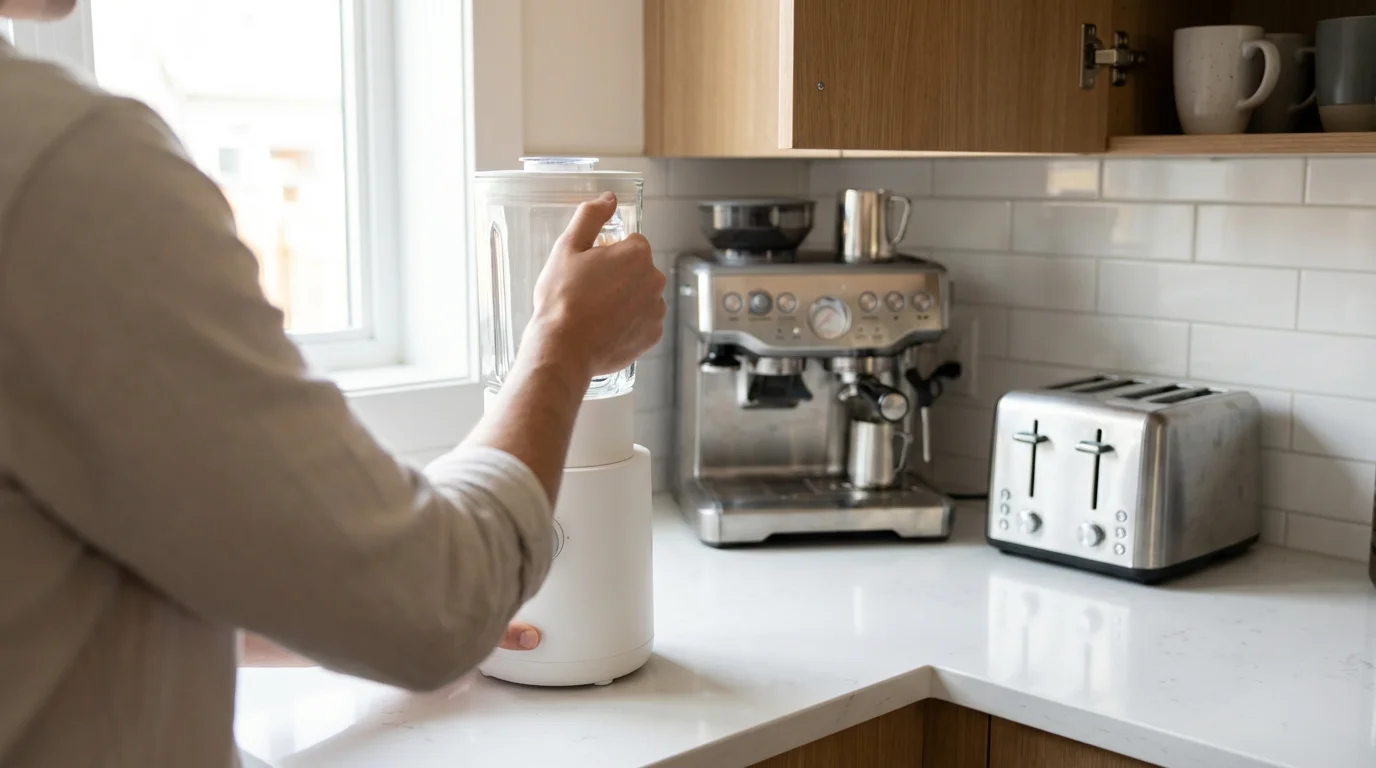
Visual clutter on countertops makes a kitchen feel smaller and dirtier. The “daily use” rule is paramount here: only appliances used every single day (e.g., coffee maker, toaster) deserve a permanent spot on the counter. The blender you use for smoothies once a week belongs in a cabinet.
Appliance Garages
If you hate moving appliances but want a clean look, consider an appliance garage. In modern cabinetry, this is a dedicated cupboard with a lift-up or tambour door that sits at counter level. You can slide your mixer and toaster out when needed and hide them away instantly.
Grouping Trays
If you must keep oil, salt, and pepper on the counter, corral them on a small tray or a wooden board. This turns “clutter” into “decor.” It also makes cleaning easier—you lift one tray to wipe the counter rather than moving six individual bottles.
Refrigerator and Freezer Management
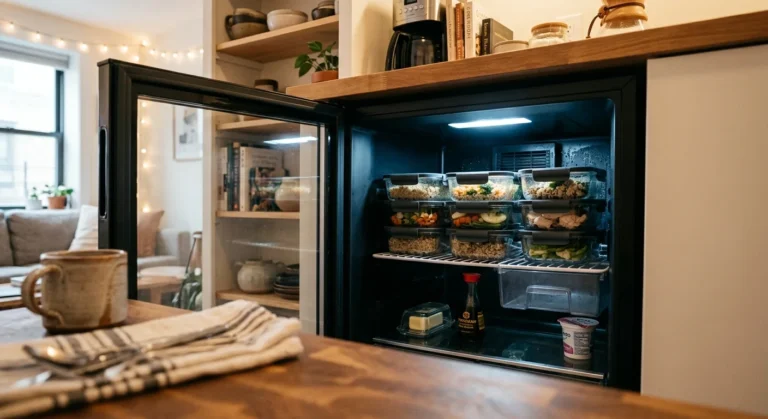
The refrigerator is a high-traffic zone that requires hygiene-focused organization.
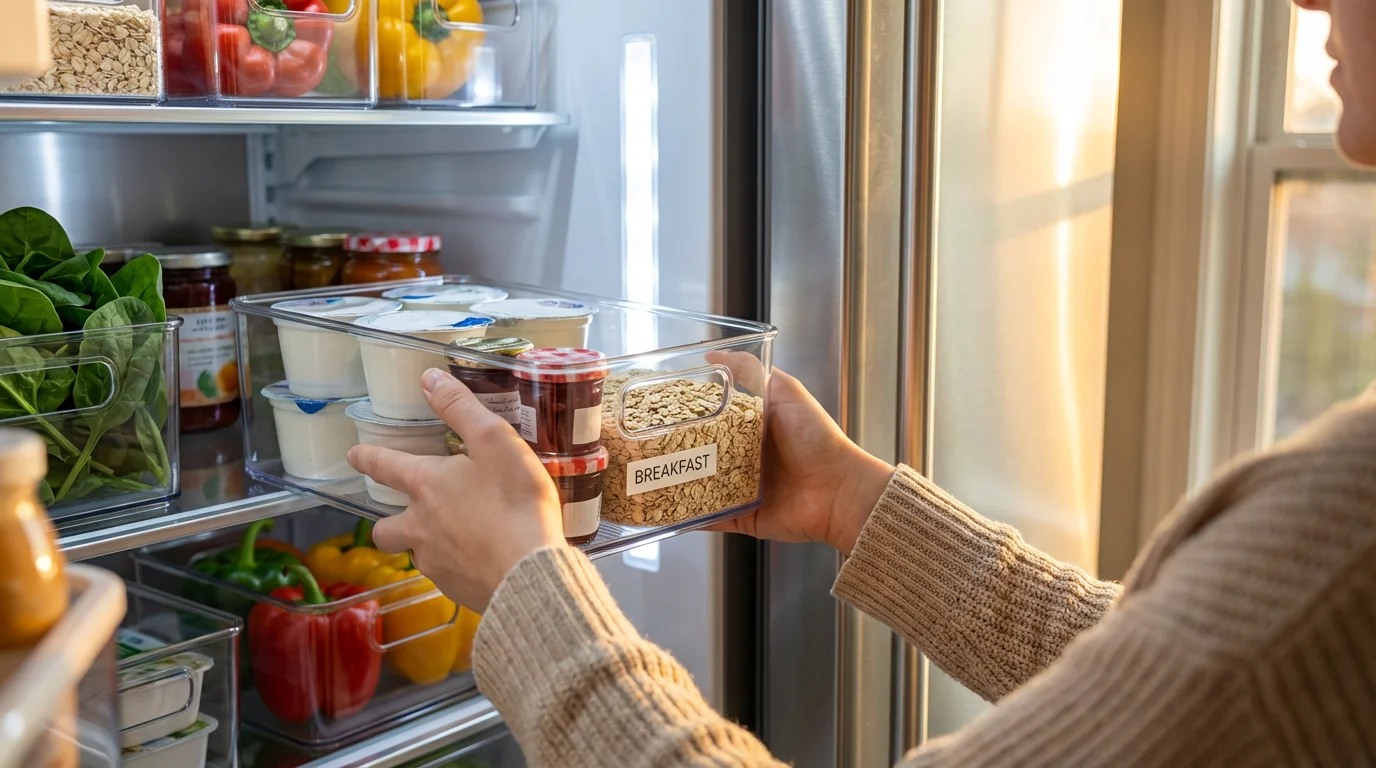
Clear Bins for Categorization
Acrylic bins are excellent for grouping similar items. Create a “Breakfast” bin with yogurts and cream cheese, or a “Condiment” bin for sauces. This allows you to pull out the whole bin to find what you need, rather than digging behind jars.
Note: Square or rectangular bins maximize space. Avoid round bins in the fridge.
Managing the Freezer
The freezer is often a graveyard for leftovers.
- Freeze Flat: Freeze soups, stews, and sauces in freezer bags laid flat. Once frozen, they turn into rigid “tiles” that can be filed vertically in a bin, saving massive amounts of space compared to round tubs.
- Label Everything: Use masking tape and a sharpie to write the date and contents. Unidentified frozen objects rarely get eaten.
Space-Saving Solutions for Small Kitchens
If you lack cabinet space, you must look to the walls and doors. Vertical storage is the secret weapon of the small kitchen.
Door-Mounted Racks
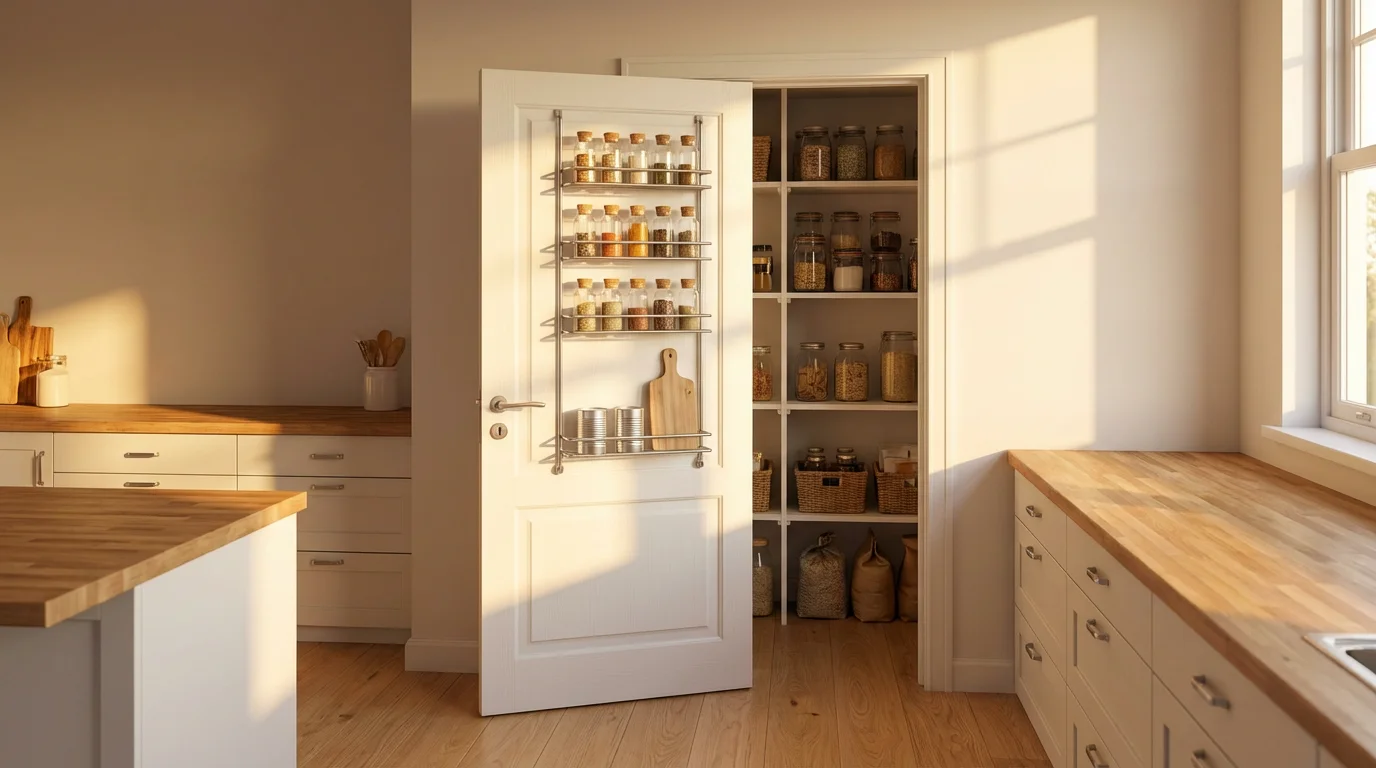
The inside of a cabinet door is prime storage. Door-mounted racks can hold cutting boards, foil/wrap boxes, or cleaning supplies. In a pantry, an over-the-door rack can hold nearly all your canned goods and spices, freeing up the main shelves for bulkier items.
Under-Shelf Baskets
These wire baskets slide onto an existing shelf and hang below it. They utilize the dead air space between shelves. They are perfect for storing lighter items like sandwich bags, napkins, or bread.
Comparison of Storage Materials
Choosing the right material for your organizers matters for durability and cleaning.
| Material | Best Use Case | Pros | Cons |
|---|---|---|---|
| Clear Acrylic | Fridge, Pantry, Drawers | Visibility is high; easy to wipe clean; looks modern. | Can crack if dropped; not dishwasher safe (usually). |
| Wire/Metal | Pantry, Under-Sink, Heavy Items | Extremely durable; allows airflow (good for produce). | Small items can fall through mesh; can rust if cheap. |
| Bamboo/Wood | Drawer Dividers, Countertop | Aesthetically pleasing; sustainable; gentle on silverware. | Harder to deep clean; susceptible to water damage. |
| Plastic (Opaque) | Utility Drawers, Under-Sink | Cheap; hides messy contents. | Low visibility (easy to lose items); can look cluttered. |
Maintenance: Keeping the Clutter Away
The best organizational system in the world will fail without maintenance habits.
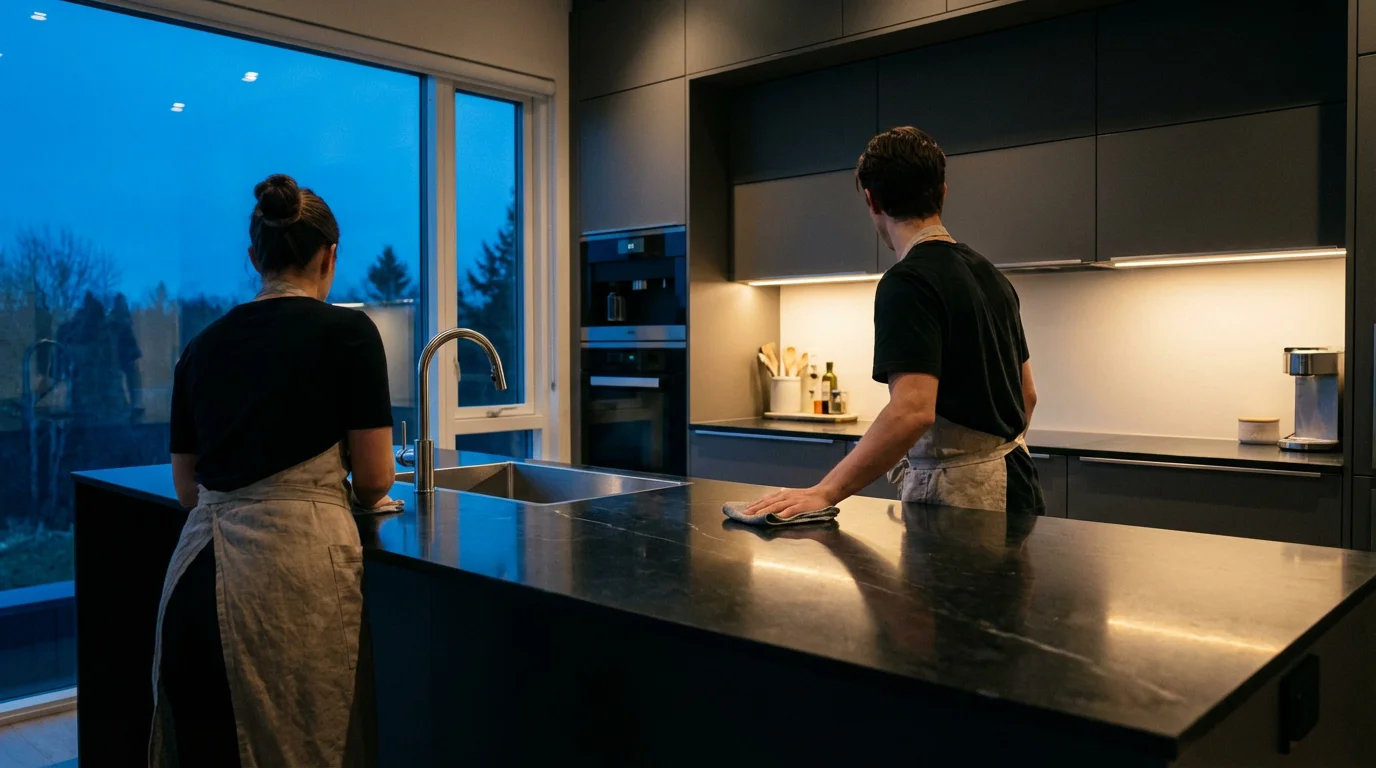
1. The 10-Minute Reset: Every night, spend 10 minutes putting things back in their assigned zones. Run the dishwasher so the sink is clear for the morning.
2. One In, One Out: If you buy a new coffee mug, an old one must be donated. Do not let the inventory creep back up.
3. Seasonal Audits: Twice a year, do a quick scan of the pantry for expired goods and the drawers for broken tools.
Frequently Asked Questions
How do I organize a deep corner cabinet without a Lazy Susan?
If a Lazy Susan isn’t an option, use large, handled bins. Place rarely used items (like holiday baking gear) in the very back “dead” corner. Place the bins in front. When you need the back items, you simply pull out the front bin to access the rear. Never place loose jars in the back of a deep cabinet; they will be lost forever.
Is decanting spices really necessary?
It is not strictly necessary for freshness, but it is highly recommended for space efficiency. Store-bought spice bottles come in various shapes and sizes that don’t fit well together. Transferring them to matching square glass jars allows you to fit 20-30% more spices in the same drawer or rack. The Spruce notes that uniform jars also make it easier to alphabetize your collection.
How do I maximize space in a rental kitchen where I can’t drill holes?
Focus on “freestanding” and “tension” solutions. Use tension rods inside cabinets to create dividers for baking sheets. Use command hooks on the inside of doors for measuring spoons. Use stackable shelf risers that require no installation. Avoid anything that needs to be screwed into the door or wall.
What is the best way to store heavy appliances like stand mixers?
Heavy appliances should always be stored between waist and shoulder height if possible to prevent back strain. If you have counter space, a corner is a good spot. If it must go in a cabinet, a lower cabinet with a heavy-duty pull-out drawer is the safest option. Avoid storing heavy items on high shelves where lifting them down can be dangerous.
Disclaimer: Product prices and availability change frequently. Prices shown were accurate at time of writing but may have changed. We may earn a small commission from purchases made through links on this site, at no extra cost to you. Always measure your space before purchasing organizers to ensure proper fit.
2 Comments