You want crystal-clear cocktail spheres for your dinner parties without forfeiting three hundred dollars for an electric ice appliance. Standard two-piece novelty trays promise bar-quality ice, but they produce cloudy, cracked globes every single run.
The secret is thermodynamic control rather than boiling or filtering tap water. Insulated directional freezing molds push dissolved air and mineral deposits downward, leaving a flawless sphere at the top.
Boiling water in novelty trays never prevents cloudiness; only an insulated directional mould reliably harvests four crystal-clear 2.5-inch spheres every 24 to 30 hours using ordinary tap water.
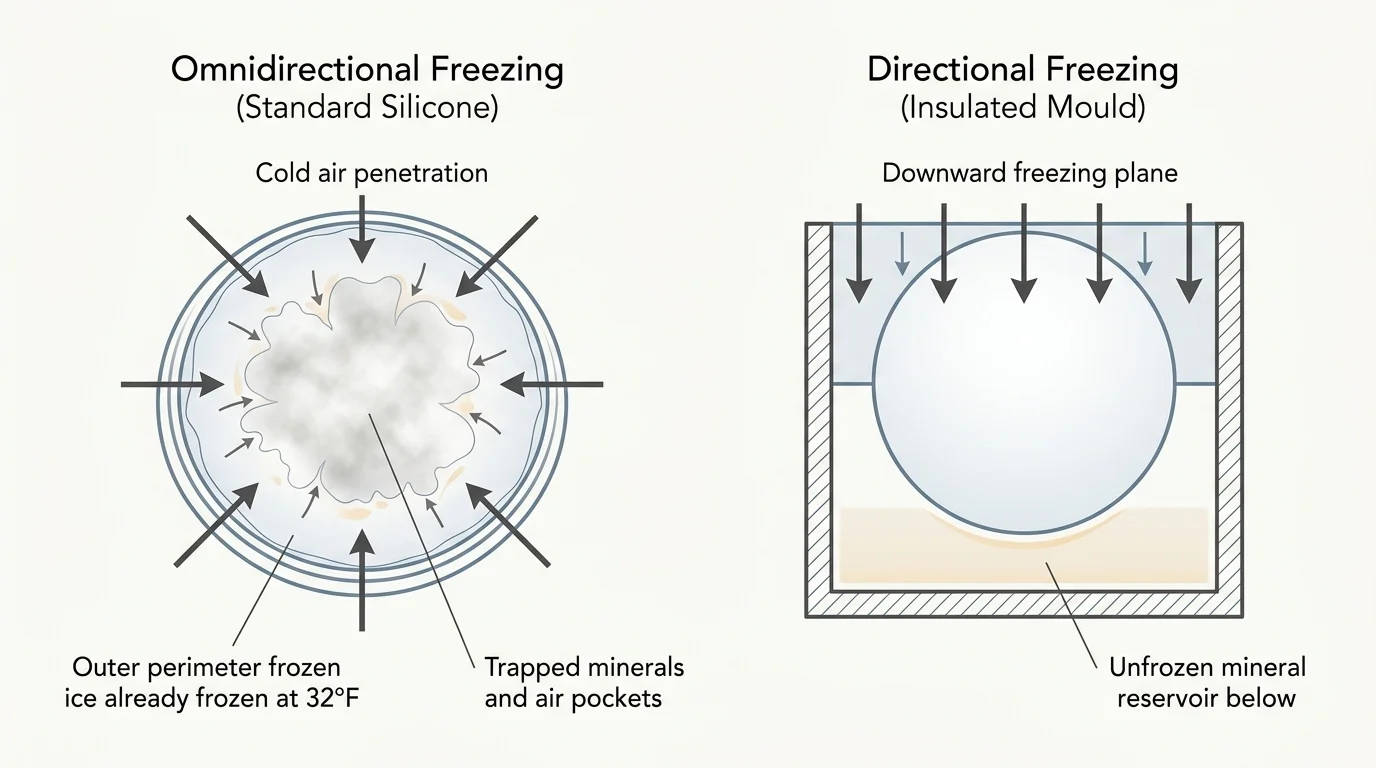
The Physics of Ice Clarity: Omnidirectional vs. Directional Freezing
Clear ice is not a luxury cosmetic preference; it directly governs drink dilution and aroma preservation. Cloudy ice contains thousands of microscopic air pockets and mineral concentrations that accelerate melting.
Managing thermal transfer is equally critical in pastry preparation, where bakers employ chillable water-filled rolling pins to regulate temperature during sensitive dough handling.
If your kitchen relies on hard groundwater, using mineral absorber balls or mesh catchers can help reduce heavy sediment before freezing.
When you place an uninsulated mould made of silicone—a flexible, heat-resistant material used in many kitchen tools—into a freezer, cooling occurs omnidirectionally. Cold air penetrates the sphere equally from the top, bottom, and sides.
Pure water molecules freeze at 32 degrees Fahrenheit, whereas dissolved minerals like calcium and magnesium freeze at lower temperatures. The advancing outer shell of ice forces these impurities inward toward the center.
By the time the core freezes, trapped air and minerals have nowhere to go. They crystallize into an opaque, white core that shatters rapidly when exposed to room-temperature spirits.
Directional freezing replicates the natural thermodynamic behavior of a winter lake. Cold air contacts only the top surface, causing ice to freeze downward in a single plane.
According to cocktail chemistry analyses published by Serious Eats, directional freezing forces impurities away from the freezing front into an unfrozen reservoir below.
The descending ice front leaves behind a crystal-clear matrix above it. As long as you halt the freeze before the reservoir solidifies, your sphere remains free of defects.
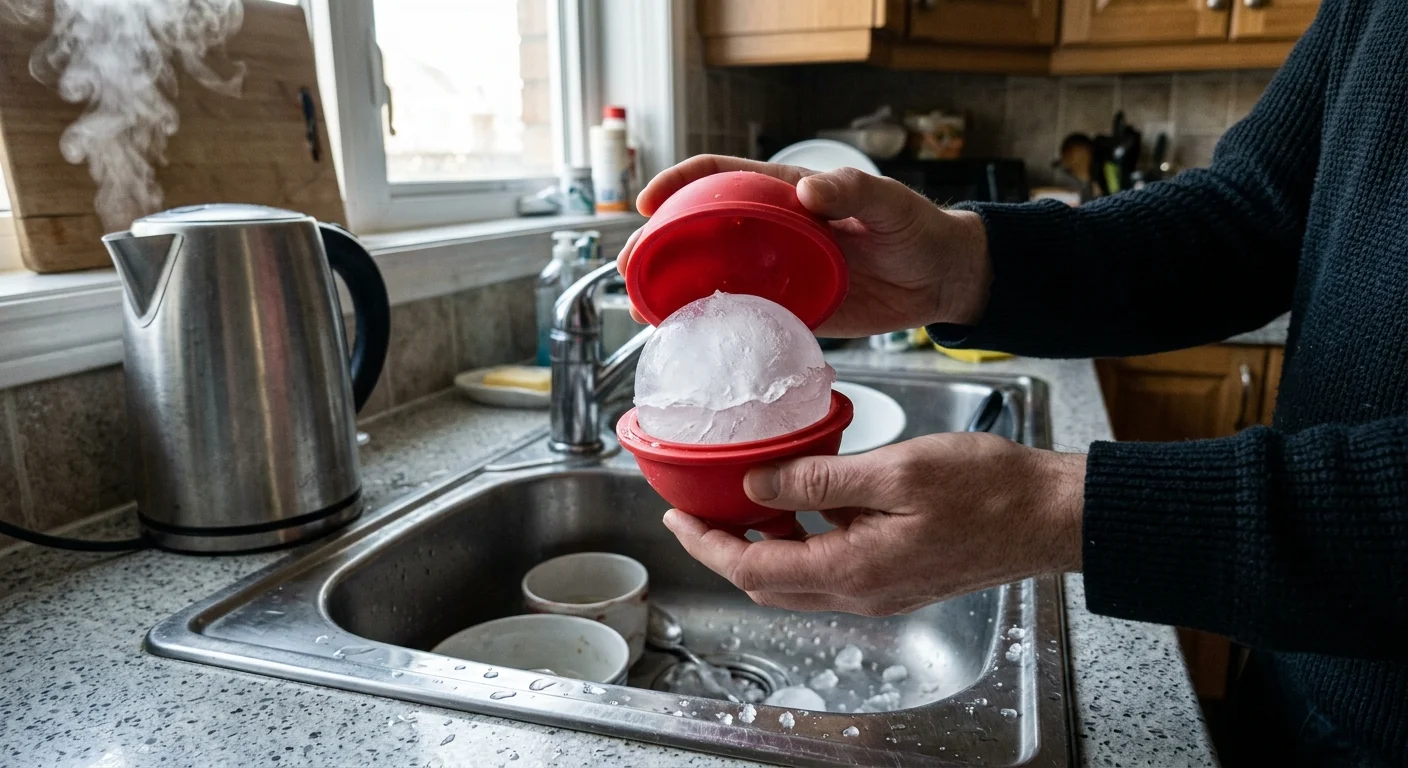
Novelty Silicone Sphere Molds: Why Boiled Water Always Fails
Inexpensive novelty sphere trays flood online marketplaces, often selling for under fifteen dollars. These two-piece moulds typically feature a rigid plastic frame and flexible silicone hemispheres fitted with small fill holes.
If you must trim excess equatorial ice bands with a paring knife, avoid working on rigid surfaces like glass cutting boards that ruin knife edges through severe impact deflection.
Pouring scalding liquid into pinhole-sized tray vents is also awkward and dangerous without using heat-resistant funnels for boiling liquids to control the stream.
Repeatedly boiling batches of water also accelerates scale buildup, making regular kettle descaling with citric acid or vinegar necessary to keep heating elements clear.
Manufacturers often tell you to boil distilled water twice before filling these trays. They claim that boiling removes all trapped air and guarantees pristine cocktail ice at home.
This claim fails basic physics. Boiling degasses water temporarily, but liquid absorbs ambient oxygen rapidly as it cools back to room temperature.
More importantly, boiling does not remove dissolved mineral solids like calcium carbonate. In fact, prolonged boiling evaporates water and increases mineral concentration per fluid ounce.
Because standard silicone trays lack insulation, the cold freezer air freezes the sphere from the outside inward regardless of water source. The boiled water still produces a cloudy center every time.
Novelty trays also suffer from severe structural seam leakage. Water expands by roughly nine percent as it transitions into ice, exerting substantial hydrostatic pressure inside sealed cavities.
This expansion forces the silicone halves apart during freezing. The result is an irregular sphere wrapped in a thick, jagged equatorial belt of excess ice.
Trimming these frozen seams requires extra prep work with paring knives. An irregular shape also makes your sphere melt unevenly in a lowball glass.
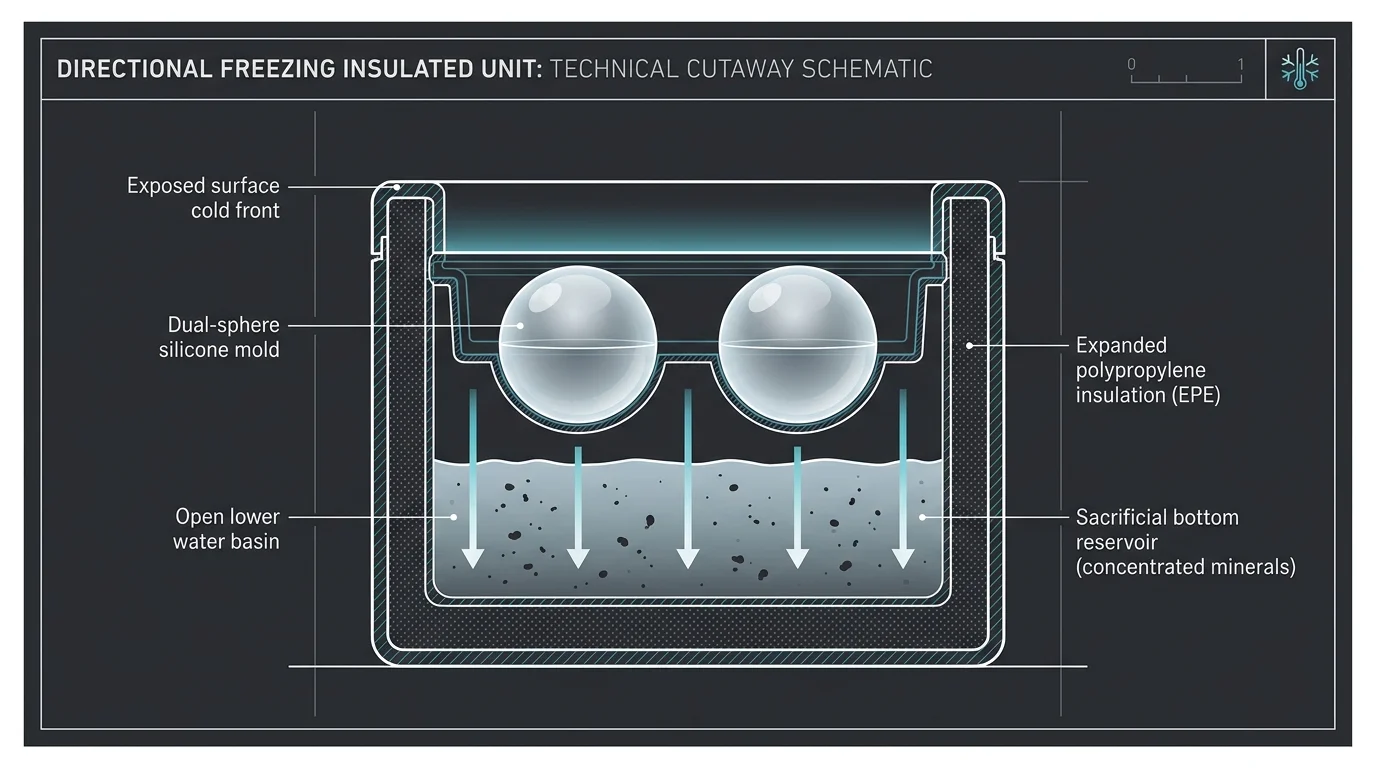
Directional Freezing Insulated Moulds: Engineering Top-Down Solidification
Directional freezing moulds solve the clarity problem by introducing targeted insulation. These systems combine an insulated thermal sleeve, a collection water reservoir, and a perforated silicone sphere assembly.
Just as butchering stiff ingredients calls for dedicated cutlery like specialized boning knives for semi-frozen proteins, hand-carving solid ice blocks poses unnecessary blade damage and slipping hazards.
Just as cooks use insulated containers with neoprene sleeves to regulate thermal loss during long sous-vide baths, directional molds rely on perimeter insulation to force temperature gradients in a single direction.
The exterior housing uses dense expanded polypropylene foam or double-walled vacuum insulation. This barrier blocks freezer air from penetrating the bottom and lateral sides of the system.
Cold air can only enter through the uninsulated open top. Freezing starts at the crown of the sphere and moves steadily downward toward the base.
Each sphere cavity features open drainage holes at its lowest point. As pure ice crystals form above, they displace dissolved gasses and minerals downward through these perforations.
The displaced impurities settle inside the lower reservoir, which remains liquid longer than the upper chambers. When you remove the mould, the cloudy waste ice stays isolated in the bottom basin.
“True ice clarity requires controlling where trapped impurities migrate during the phase change. Thermal insulation turns chaotic freeze fronts into an orderly, predictable process.”
Many home bartenders hesitate to buy an insulated mold because it is a unitasker—a gadget that only does one specific task. However, this single task cannot be duplicated by multipurpose kitchen tools.
If you want clear ice without dedicated equipment, you must use a heavy hard-sided cooler inside your freezer. That DIY approach consumes massive vertical freezer space and requires dangerous serrated-knife carving.
A specialized insulated mould automates directional displacement cleanly. You lift the silicone form out of the casing and pop out finished spheres ready for immediate cocktail service.

Side-by-Side Comparison: Insulated Directional Units vs. Standard Trays
Evaluating clear ice systems requires looking at freeze duration, space requirements, and total clarity. Directional freezing demands more time and freezer volume than conventional molds due to thermal mass.
Instead of discarding retired novelty molds that fail at cocktail ice, you can repurpose them for clever herb freezing hacks using olive oil.
The table below compares four distinct ice-making setups across essential operational metrics. All clarity ratings reflect performance using standard municipal tap water without pre-boiling.
| Ice Mold Model | Capacity | Freeze Time (Hours) | Footprint (L x W x H) | Average Clarity | Retail Price |
|---|---|---|---|---|---|
| True Cubes 4-Sphere Clear System | 4 Spheres (2.5 in) | 24 to 28 hrs | 7.0 x 7.0 x 6.0 in | 98% Transparent | $45.00 |
| Tovolo Insulated Clear Sphere Mold | 1 Sphere (2.5 in) | 18 to 22 hrs | 4.5 x 4.5 x 5.5 in | 95% Transparent | $22.00 |
| Wintersmiths Phantom Ice Maker | 6 Spheres (2.3 in) | 30 to 36 hrs | 11.5 x 6.5 x 8.0 in | 99% Transparent | $140.00 |
| Standard Novelty 4-Sphere Tray | 4 Spheres (2.5 in) | 6 to 8 hrs | 5.0 x 5.0 x 2.5 in | 20% (Cloudy Core) | $12.00 |
Standard novelty silicone trays freeze rapidly because cold air reaches the entire surface at once. However, that rapid cycle locks in air pockets and ruins clarity.
Insulated models require at least triple the freezing time. The insulating walls slow heat transfer deliberately, allowing water molecules to align into a clean lattice.
Equipment roundups from America’s Test Kitchen highlight that controlled top-down freezing remains the only domestic method that replicates commercial Clinebell clarity. Fast freezing always sacrifices optical transparency.
Standard trays also deform under cold conditions. Directional systems use thick silicone walls within rigid outer sleeves to keep spheres round and uniform.

Step-by-Step Dinner Party Production Schedule: 4 Clear Spheres
Producing four clear ice spheres for a Saturday evening gathering requires precise timing. You cannot fill an insulated mould on Saturday morning and expect finished spheres by cocktail hour.
Always seal finished ice spheres in airtight freezer bags to avoid picking up lingering odors, particularly if you are using sheet pans and wire cooling racks for exposed meat brining in the same appliance.
When timing your party prep, coordinating frozen dessert courses with the right ice cream scoop alongside your ice freezing schedule prevents last-minute kitchen bottlenecks.
Follow this exact timeline using a standard four-cavity directional unit, such as the True Cubes system, to prepare your service without stress.
The system requires approximately 1,720 milliliters of water total. The four 2.5-inch spheres consume roughly 520 milliliters, while the lower reservoir holds the remaining 1,200 milliliters.
Set your home freezer to 0 degrees Fahrenheit (-18 degrees Celsius). Running the freezer colder than 0 degrees accelerates freezing too much and traps clouds in the bottom hemisphere.
- Thursday, 4:00 PM: Fill the reservoir with lukewarm tap water to minimize micro-bubbles. Assemble the silicone insert and seat it slowly to prevent trapped air pockets.
- Thursday, 4:15 PM: Place the mould level on your freezer shelf. Ensure at least three inches of vertical clearance above the top surface for air circulation.
- Friday, 6:15 PM (26 Hours Later): Remove the unit from the freezer. Allow it to sit on the counter for ten minutes so the outer casing releases easily.
- Friday, 6:30 PM: Pull the silicone insert upward out of the insulated base. Break away the cloudy reservoir ice below the drain holes.
- Friday, 6:35 PM: Open the silicone spheres and place the clear ice into a sealed freezer bag lined with parchment paper. Refill the unit for batch two.
- Saturday, 7:00 PM: Harvest batch two using the same procedure. You now have eight crystal-clear spheres ready for service.
Before pouring liquor over clear ice, you must temper the sphere at room temperature for two minutes. Placing cold ice directly into warm alcohol causes thermal shock and fractures the sphere.
When tempered properly, clear ice stays silent and intact as bourbon or rye pours over its surface. It chills your spirits while reducing dilution by up to forty percent compared to cloudy ice.
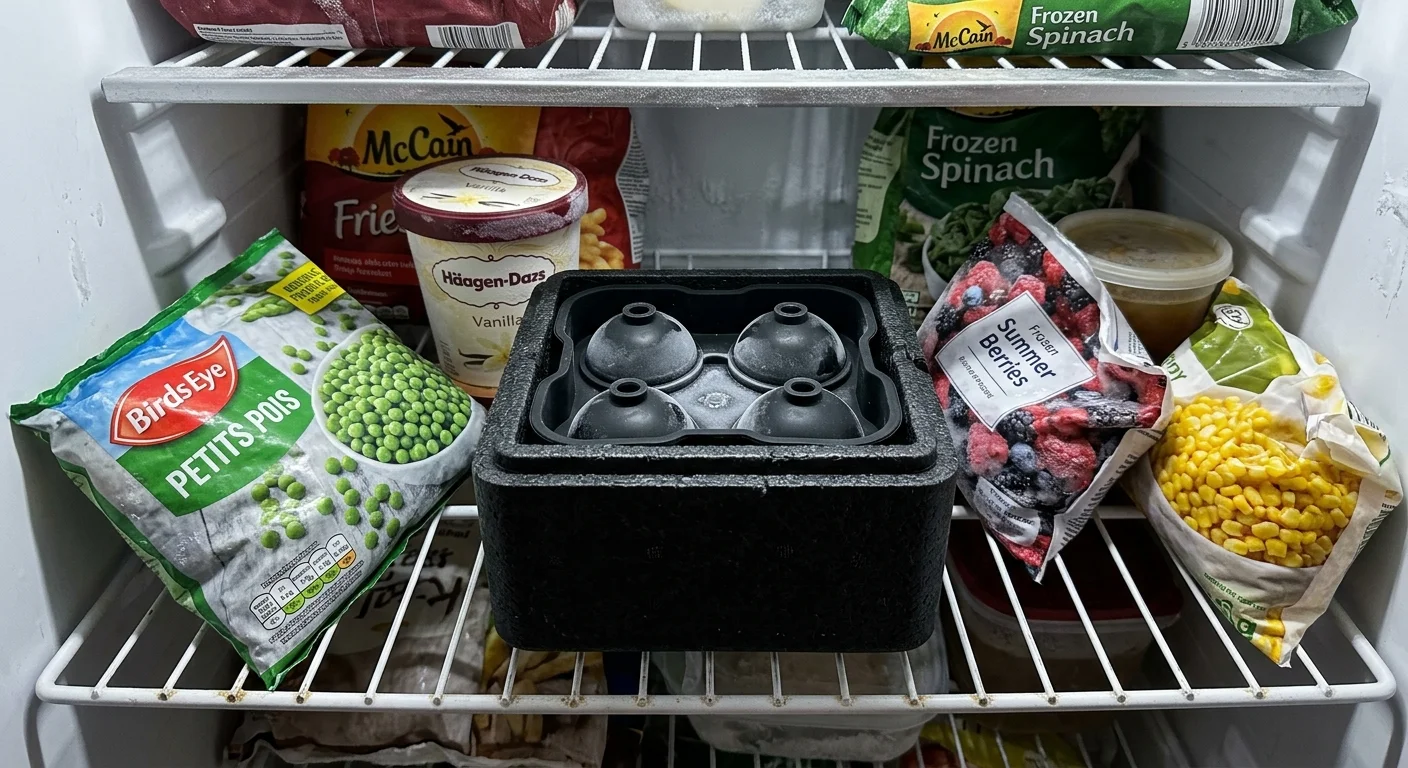
Freezer Footprint, Material Durability, and Maintenance Realities
Insulated moulds demand substantial freezer real estate. A four-sphere unit occupies approximately 294 cubic inches of freezer space, compared to just 62 cubic inches for a flat novelty tray.
You must measure shelf clearance before ordering. Directional moulds require between six and eight inches of vertical height, which can block standard pull-out freezer drawers.
Material construction directly influences the longevity of these tools. Premium models feature heavy-duty BPA-free materials, meaning they are made without a chemical that some people prefer to avoid.
The interior freezing moulds rely on thick silicone designed to endure repeated stretching and freezing without tearing along the seams. Flimsy novelty molds crack along hinge joints after just twenty cycles.
Higher-end commercial-grade units incorporate stainless steel—a durable metal that resists rust and staining—into the casing for enhanced thermal stability. These hybrid metal-and-foam shells protect the silicone core from freezer odors.
Maintenance is straightforward but requires care. The silicone inner moulds are generally dishwasher safe, meaning they can be cleaned in a dishwasher without damage.
However, the insulated foam base should never go into a dishwasher. High heat warps expanded polypropylene and destroys its insulation properties.
Hand-wash the outer foam sleeve with mild dish soap and warm water, then let it dry completely. Trapped moisture inside the foam casing can harbor mildew over time.
Look for moulds featuring a textured non-slip grip, which is a handle designed to not slide in your hand, even when wet. Handling a frozen, slippery ice unit with wet hands invites accidental drops onto hard tile floors.
Ergonomic components—designed to be comfortable to hold and use—make separating the upper silicone tray from the lower reservoir far less frustrating. Avoid systems that lack thumb tabs or leverage handles.
According to appliance durability tests from Wirecutter, rigid plastic tabs on cheaper ice molds snap easily under cold temperatures. Flexible silicone tabs with reinforced ribbing offer the best long-term durability.
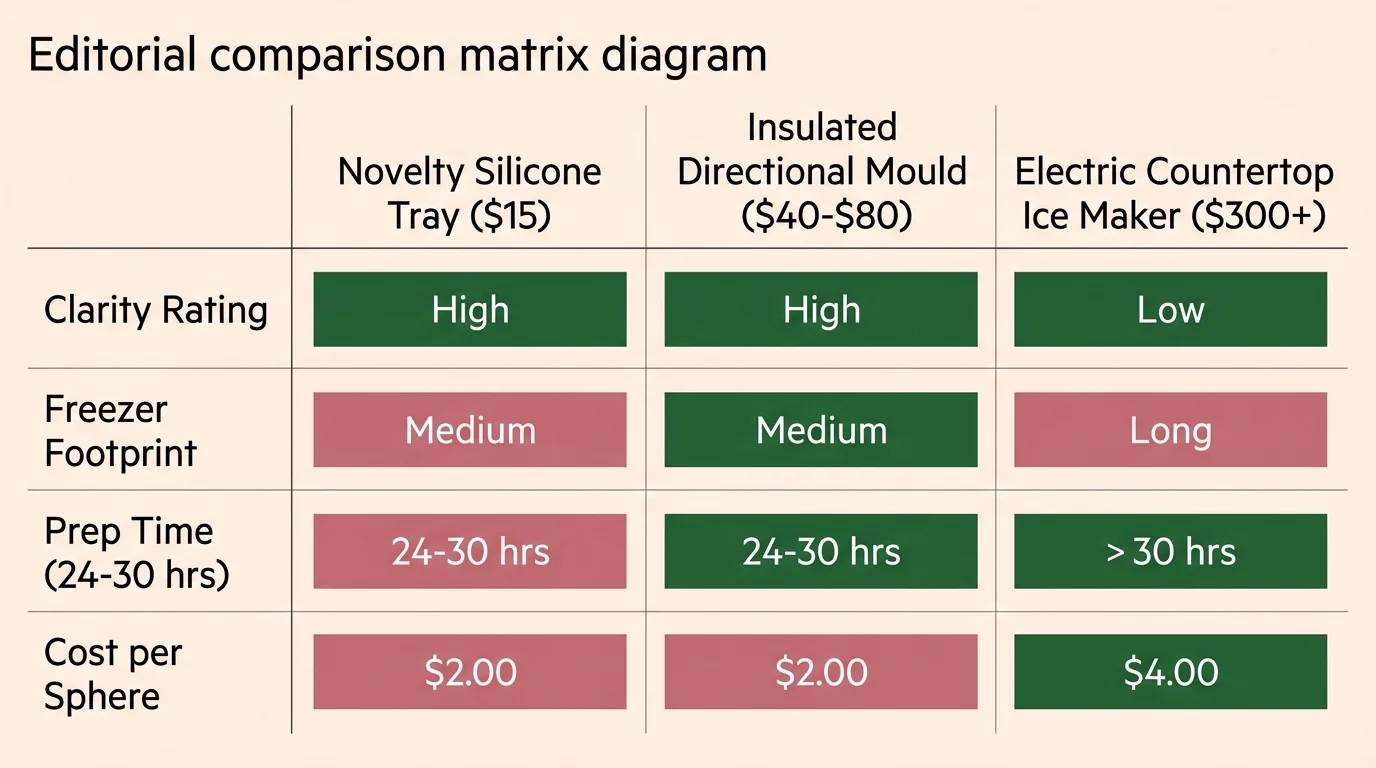
Buying Guide: Which Clear Ice System Fits Your Setup?
Choosing between directional freezing systems and simple silicone trays comes down to your serving goals and freezer capacity. Standard trays have clear limitations, but directional units require schedule planning.
Use these practical criteria to determine which approach fits your home bar setup.
Buy an Insulated Directional Freezing Mould If:
- You regularly host dinner parties and serve neat spirits or classic stirred cocktails like Old Fashioneds and Manhattans.
- You have at least eight inches of vertical clearance on an open, level shelf in your kitchen freezer.
- You want genuine bar-quality clarity without spending hundreds on a standalone electric ice maker.
- You are willing to manage a 24-hour freezing schedule ahead of planned hosting events.
Skip the Insulated Mould and Keep Novelty Trays If:
- Your freezer space is limited to a small, packed French-door drawer with low shelf clearance.
- You primarily serve blended frozen cocktails, punch bowls, or tall highballs where ice clarity is hidden by mixers.
- You need eight or more ice spheres on two hours of notice.
- You are unwilling to hand-wash and air-dry multi-part gadgets after every hosting session.
Frequently Asked Questions
Why does my directional freezing mold still produce a slightly cloudy base?
Cloudiness occurs when the mold remains in the freezer too long. If the lower reservoir freezes completely, trapped minerals back up into the bottom of the sphere cavity.
Pull the mould from your freezer two hours earlier on your next run. Halting the freeze while the bottom reservoir remains partially liquid keeps the spheres crystal clear.
Can I use warm water in an insulated clear ice mold?
Yes, warm tap water can actually improve clarity. Warm water carries slightly fewer micro-bubbles and slows early crystal formation, promoting an orderly top-down freeze.
Never use boiling water, as extreme thermal shock can warp the silicone cavities and damage the surrounding insulated sleeve.
How long can I store clear ice spheres before they turn cloudy?
Clear ice spheres will not turn cloudy from the inside, but freezer frost will coat their exterior over time. Sublimation also causes spheres to shrink and lose their smooth shape after two weeks.
Store harvested spheres in a heavy-duty, airtight freezer bag with the air squeezed out. For maximum clarity and shape, use your stored spheres within seven days.
Do clear ice spheres melt noticeably slower than cloudy ice spheres?
Yes, clear spheres melt up to forty percent slower than cloudy spheres of the exact same size. Cloudy ice contains structural fissures and air pockets that increase surface area exposure to liquid.
The dense, uniform crystal structure of clear ice insulates the sphere against rapid melting, chilling your drink thoroughly without excessive watery dilution.
Disclaimer: Product prices and availability change frequently. Prices shown were accurate at time of writing but may have changed. We may earn a small commission from purchases made through links on this site, at no extra cost to you. Always verify current pricing on the retailer’s website before purchasing.