
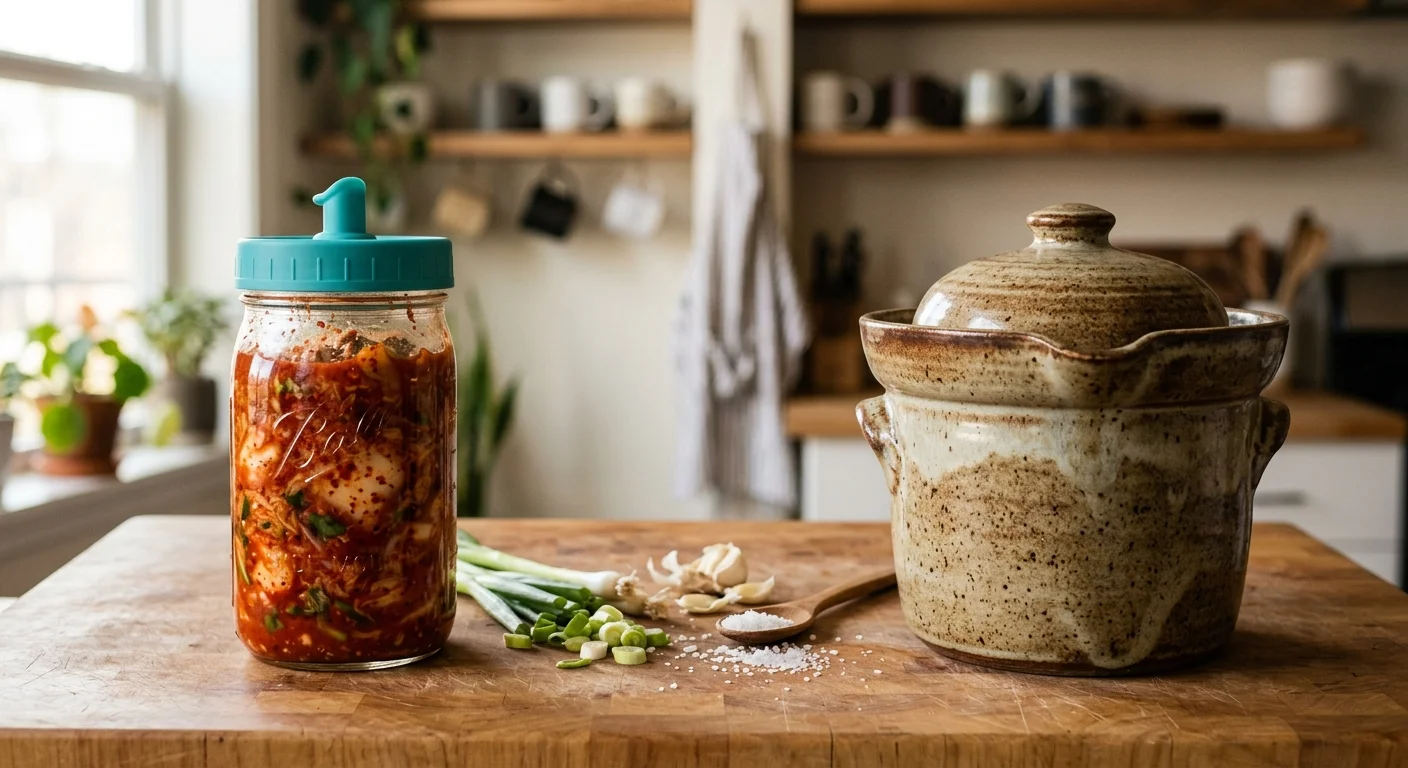
Fermenting kimchi in a small apartment kitchen often fills your living space with pungent sulfur compounds. You can achieve an odor free kimchi fermentation without banishing your jars to a distant closet.
Managing odors and space constraints is a constant priority in small living spaces, whether you are culturing vegetables or selecting mini woks for apartment stoves.
Most fermentation guides suggest heavy stoneware crocks, but silicone one-way airlock lids actually provide superior vapor and odor containment inside compact apartment spaces.
While water troughs eventually evaporate and burp concentrated bursts of allium gas into the room, silicone valve lids seal tightly to wide-mouth Mason jars, blocking volatile odors between pressure releases.
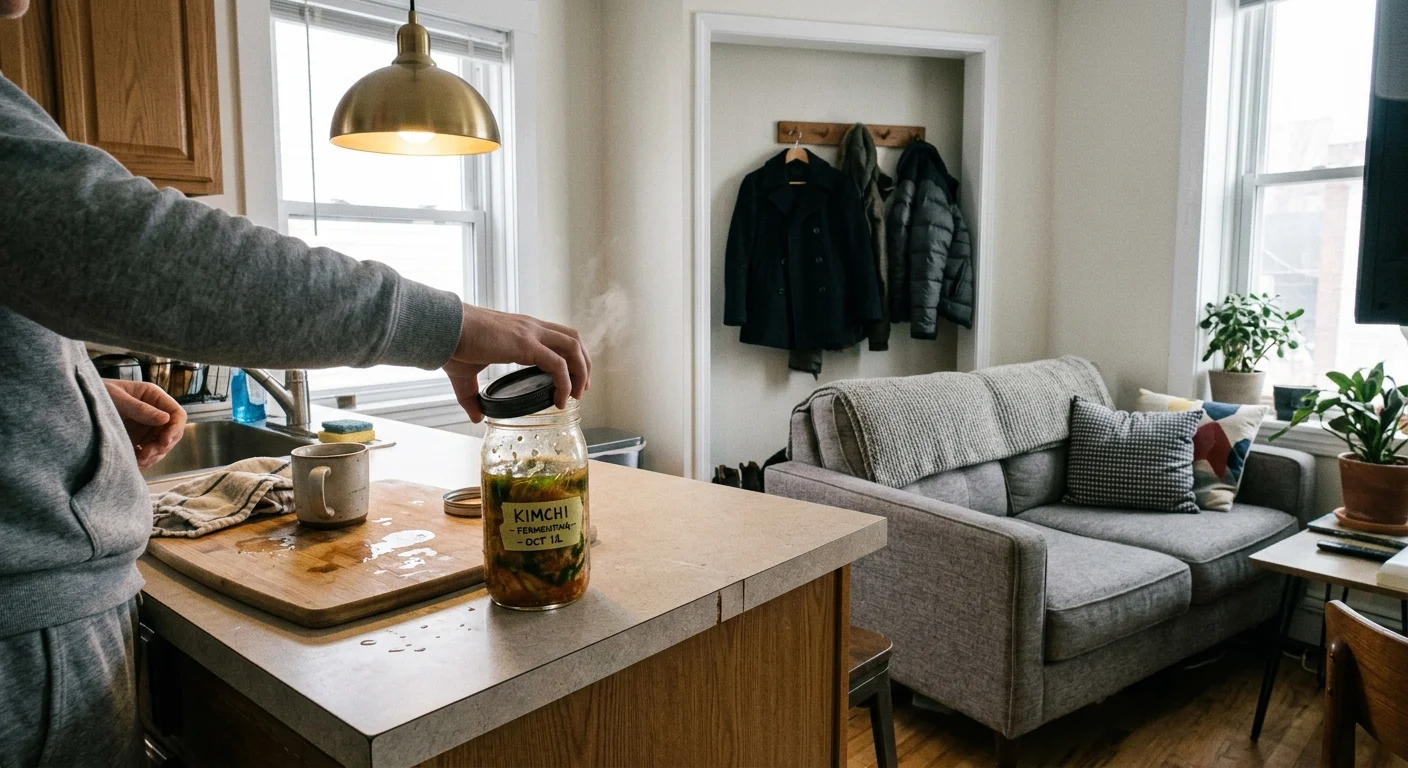
The Apartment Kimchi Dilemma: Sulfur and Small Spaces
Kimchi requires lactic acid bacteria to convert sugars into lactic acid, carbon dioxide, and complex savory notes. That biological transformation creates exceptional flavor; however, it also liberates volatile organic sulfur compounds.
Even after fermentation completes, storing mature kimchi requires reliable, leakproof glass containers with tight-sealing latches to prevent strong sulfur aromas from overtaking your refrigerator.
Prepping large volumes of alliums like scallions can be equally overwhelming, which is why some cooks rely on levered grid choppers or protective goggles to minimize tear-inducing fumes before fermentation even begins.
Ingredients like crushed garlic, scallions, and radishes produce diallyl disulfide and methanethiol. In an 800-square-foot apartment, these volatile gases migrate into upholstered furniture, clothing, and kitchen cabinetry within hours.
Standard screw-top lids force you to manually burp your jars to relieve internal pressure. Every time you twist open a pressurized lid, you release a concentrated cloud of sulfur into your living room.
To prevent ferment smell, your fermentation system must vent carbon dioxide continuously while barring exterior oxygen from entering. Oxygen ingress encourages Kahm yeast and mold growth, which quickly ruins your batch.
Both water-seal ceramic crocks and one-way airlock lids promise automatic venting. Yet their mechanical execution differs drastically, creating divergent results for apartment dwellers with zero odor tolerance.
Silicone Airlock Lids: Engineering and Odor Containment
Modern waterless fermentation lids rely on food-grade silicone, which is a flexible, heat-resistant material used in many kitchen tools. These lids convert ordinary wide-mouth Mason jars into self-regulating anaerobic chambers.
Much like using reliable bag clips to keep pantry goods fresh, simple physical seals often outperform fussy multi-piece apparatuses.
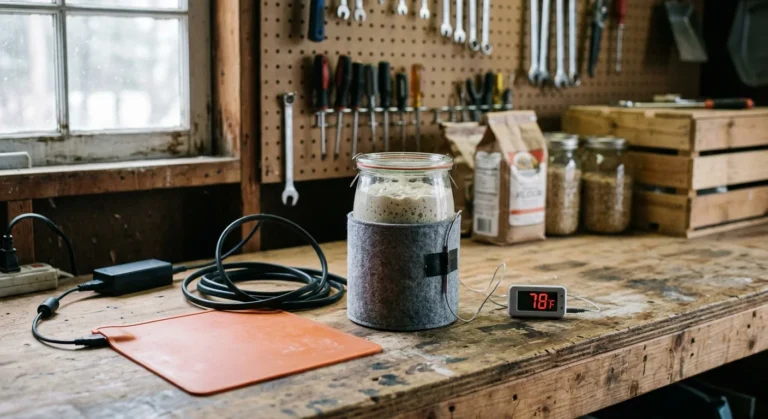
Much like managing ambient temperature with sourdough fermentation boxes, dialling in the physical environment of your vessel makes all the difference in culturing foods cleanly.
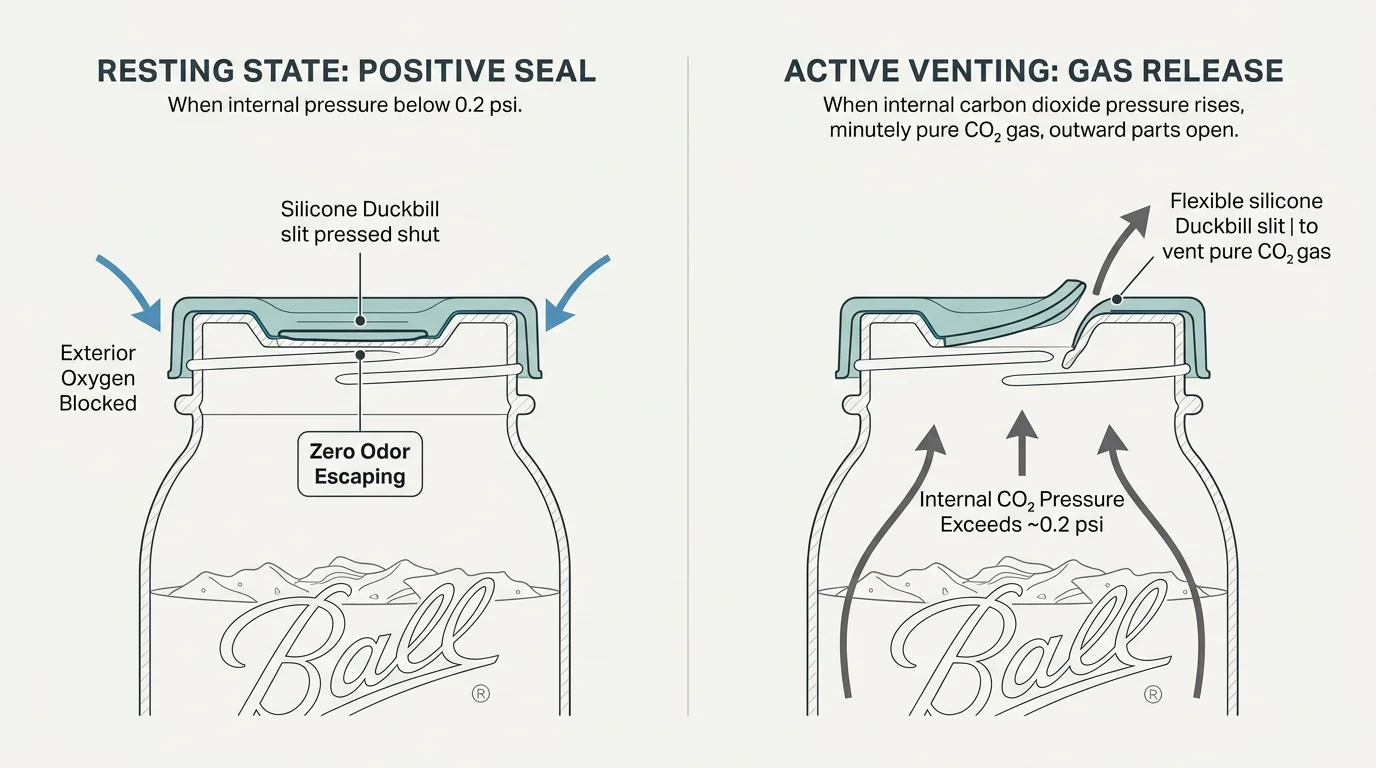
The core technology uses a one-way duckbill valve molded directly into the lid top. Models like the Masontops Pickle Pipe feature a slit that remains tightly shut until internal pressure builds.
Manufacturers produce these valves using BPA-free materials, meaning they are made without a chemical (BPA) that some people prefer to avoid. This construction ensures no chemical plasticizers leach into your acidic brine.
In our mason jar airlock lid review testing across several small-batch recipes, these valves maintained positive internal pressure effortlessly. Carbon dioxide pushes the valve open only when internal pressure exceeds approximately 0.2 pounds per square inch.
Because the valve opens merely a fraction of a millimeter to expel gas, it immediately snaps shut. It vents pure carbon dioxide without allowing ambient air or volatile food aromas to billow outward.
“One-way silicone valves maintain positive internal vessel pressure, expelling gas while keeping ambient oxygen and volatile aromas locked down.”
According to equipment evaluations from America’s Test Kitchen, maintaining an airtight seal remains essential for preventing spoilage organisms from overtaking wild ferments.
Unlike old-fashioned three-piece plastic airlocks, silicone lids eliminate liquid reservoirs completely. You never need to monitor water levels, nor will you risk stagnant airlock water bubbling backwards into your cabbage.

Water-Seal Ceramic Crocks: Traditional Design vs. Modern Reality
Traditional fermenting crocks utilize a glazed stoneware body featuring a deep circular trough molded around the top rim. The ceramic lid rests directly inside this rim channel.
Rapid water evaporation can easily compromise open barriers, an issue home cooks also confront when managing evaporation in extended sous-vide cooking.
Just as ambient moisture impacts kitchen staples in terracotta or gasket-sealed salt cellars, room air dramatically influences how quickly water barriers in ceramic crocks dry out.
You fill this gutter with water to create an airtight liquid barrier. As bacteria produce carbon dioxide, internal pressure lifts the heavy lid slightly, allowing gas to bubble up through the water barrier.
Shoppers hunting for the best crock for small apartment fermenting often gravitate toward 2-liter or 5-liter models from brands like Kenley or Ohio Stoneware. These stoneware vessels look striking on a kitchen counter.
However, the water gutter introduces distinct operational challenges in compact homes. Each escaping gas bubble forces cabbage and allium vapors directly through the water barrier into your ambient kitchen air.
Furthermore, indoor heating and air conditioning accelerate gutter evaporation. If the water level drops below the lid rim, the airtight barrier breaks entirely, releasing unfiltered odors into your home.
Stoneware crocks also present physical handling challenges. An empty 2-liter crock weighs roughly 8 to 10 pounds; when loaded with salted cabbage, weights, and water, that total easily reaches 14 pounds.
Moving a slippery, glazed vessel without a non-slip grip, which is a handle designed to not slide in your hand, even when wet, invites costly kitchen accidents. Cleaning these heavy pots in a shallow apartment sink proves equally cumbersome.
Head-to-Head Specifications and Performance Comparison
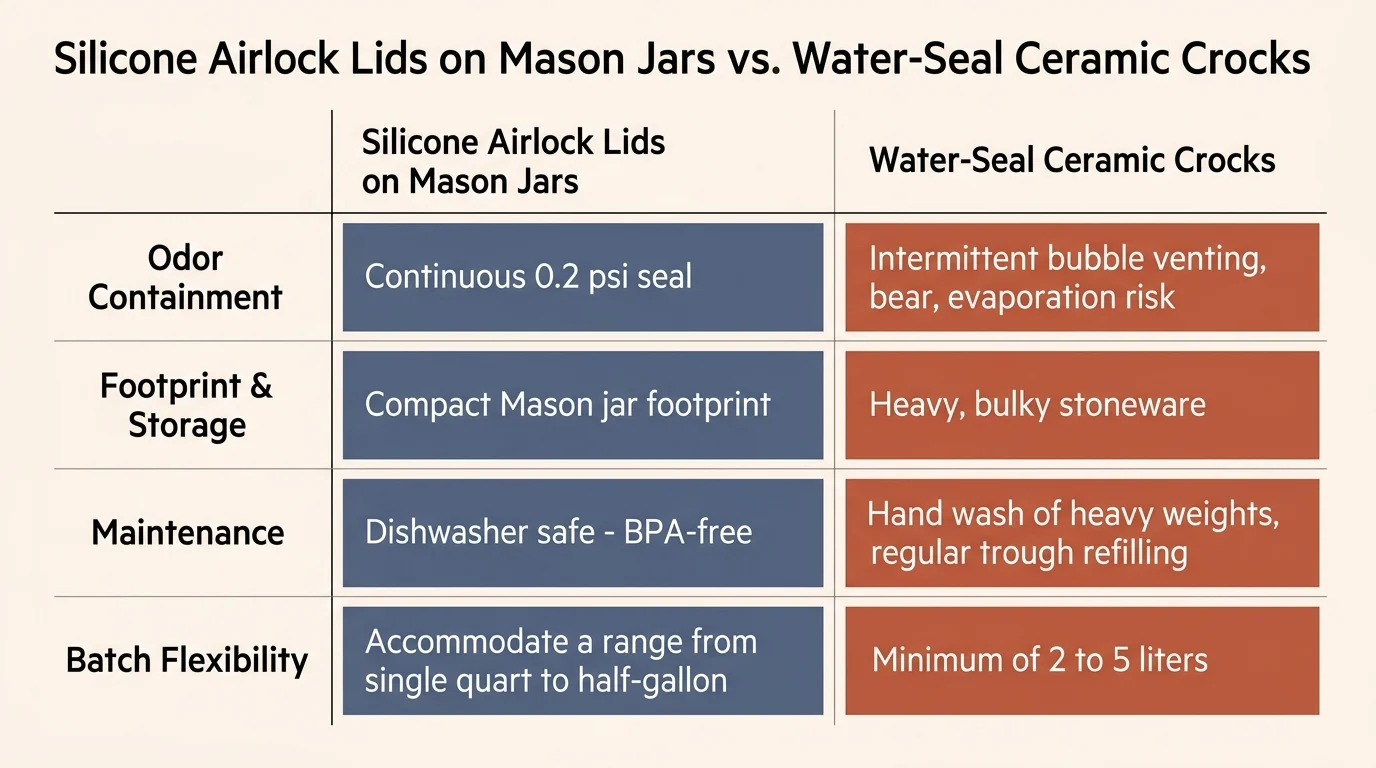
Evaluating fermentation gear requires analyzing physical footprint, sealing mechanisms, and odor control performance. The following comparison table outlines the real-world metrics for leading fermentation solutions.
Prioritizing compact, vertical vessel dimensions is just as crucial here as it is when arranging stackable food storage systems in mini-fridges.
| Model | Sealing Mechanism | Footprint (W × H) | Empty Weight | Retail Price Range | Odor Containment |
|---|---|---|---|---|---|
| Masontops Pickle Pipe | Silicone Duckbill Valve | 3.4 in × 0.8 in | 0.8 oz (lid only) | $14.00 – $22.00 (4-pack) | High (Micro-venting) |
| Jillmo Fermentation Kit | 3-Piece Plastic Airlock | 3.5 in × 4.5 in | 3.2 oz (lid + lock) | $16.00 – $24.00 (4-pack) | Moderate (Liquid barrier) |
| Kenley 2-Liter Ceramic Crock | Ceramic Water-Seal Rim | 8.0 in × 10.2 in | 9.2 lbs | $45.00 – $60.00 | Low (Bubble venting) |
| Ohio Stoneware 1-Gallon Crock | Water Gutter Channel | 9.5 in × 11.5 in | 13.5 lbs | $65.00 – $85.00 | Low (Gutter evaporation) |
As kitchen product analysts at Serious Eats frequently demonstrate, space efficiency and practical maintenance determine whether a kitchen gadget earns permanent counter space.
Silicone valves take up virtually no vertical clearance above standard glass jars. In contrast, three-piece plastic airlocks add four inches of height, preventing jars from fitting onto standard refrigerator or cabinet shelves.
Ceramic crocks dominate kitchen workspace. A single 2-liter stoneware crock occupies the counter area of three 32-ounce wide-mouth glass jars while delivering identical food capacity.
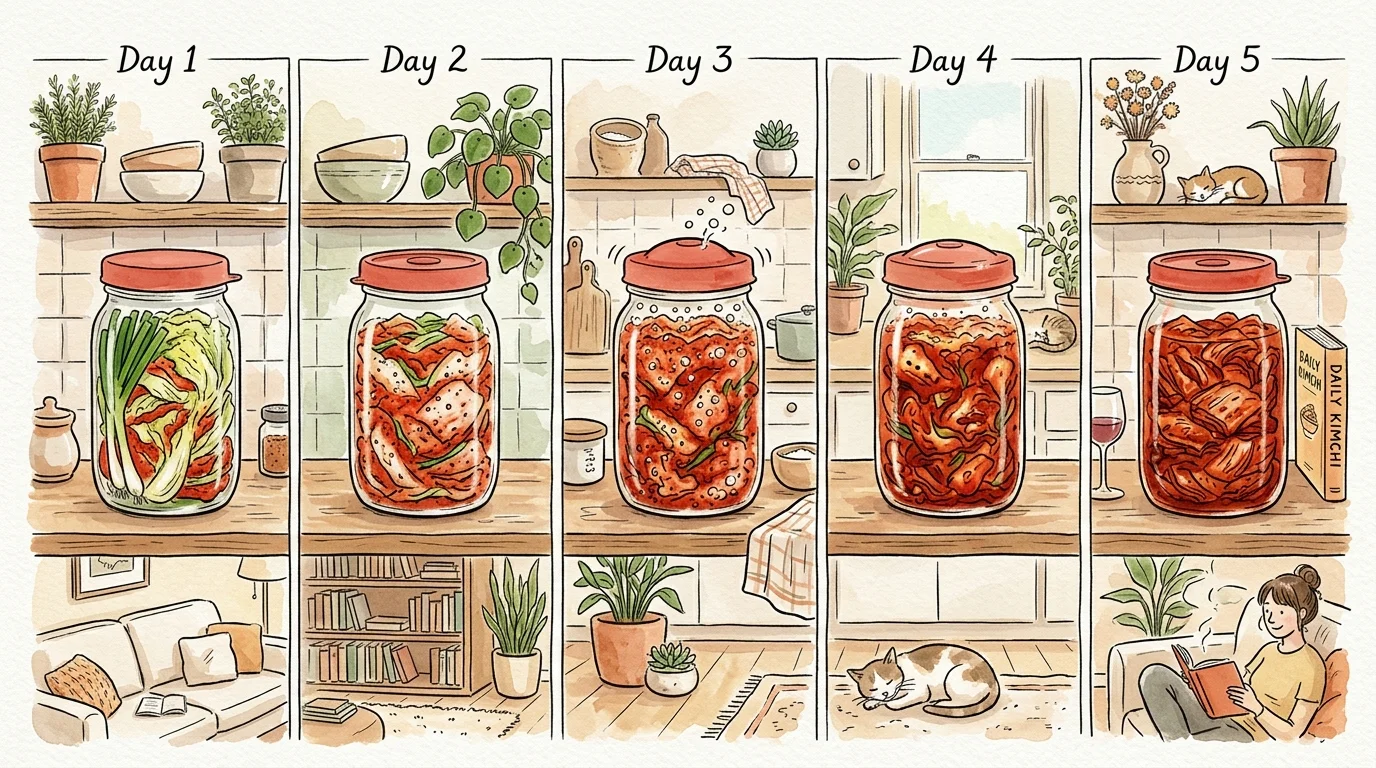
Worked Example: A Five-Day Apartment Ferment Scenario
To measure the odor mitigation differences, consider a standard batch of traditional napa cabbage kimchi prepared in a 650-square-foot studio apartment. The room maintains a steady 70°F with 42 percent ambient relative humidity.
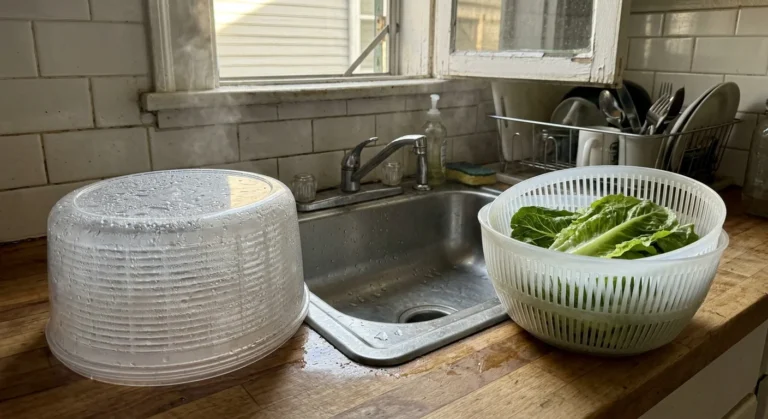
Rinsing and thoroughly removing surface water with an open-drain salad spinner helps keep salted cabbage crisp while preventing extra moisture from diluting your brine.
For apartments that dip below optimal culturing temperatures in the winter, pairing your jars with silicone heating mats provides steady, controllable warmth.
The ingredient bill includes 2.5 pounds of napa cabbage, 35 grams of kosher salt, 45 grams of Korean red pepper flakes, 4 scallions, and 24 grams of crushed fresh garlic. This recipe produces 1.8 liters of packed vegetable matter.
In Scenario A, you pack the kimchi into two 32-ounce wide-mouth Ball glass jars ($3.99 for two). You top them with Masontops Pickle Pipe silicone lids ($14.95 for a 4-pack) secured by stainless steel bands ($12.00 for four).
Here, stainless steel refers to a durable metal that resists rust and staining from acidic salt brine. The entire two-jar footprint measures 7.0 inches wide, 3.5 inches deep, and 7.0 inches tall.
Over the 120-hour ferment, the lactic bacteria produce roughly 1.8 liters of carbon dioxide gas. The silicone duckbill valve opens intermittently, releasing microscopic gas volumes only when pressure spikes.
Because the valve remains shut 98 percent of the fermentation cycle, sulfur gas dispersion stays restricted. Ambient odor remains completely undetectable beyond a 24-inch radius from the cabinet shelf.
In Scenario B, you pack the identical ingredients into a Kenley 2-Liter Water-Seal Crock ($49.99). The crock measures 8.0 inches wide by 10.2 inches tall and weighs 13.4 pounds once loaded.
You pour 180 milliliters of tap water into the ceramic rim trough to establish the vapor barrier. At 70°F and 42 percent humidity, the trough loses 36 milliliters of water daily due to natural evaporation.
Every carbon dioxide surge forces large bubbles through the gutter water. This mechanical action atomizes volatile garlic sulfur molecules directly into the ambient room air, establishing a 16-foot odor perimeter by hour 48.
By day five, the trough loses 180 milliliters of water. If you skip refilling the gutter on day four, the water line drops below the lid rim, unsealing the crock entirely.
“A water-seal trough acts as a continuous diffuser for sulfur vapors, whereas a silicone valve isolates volatile gases until internal pressure forces an exit.”
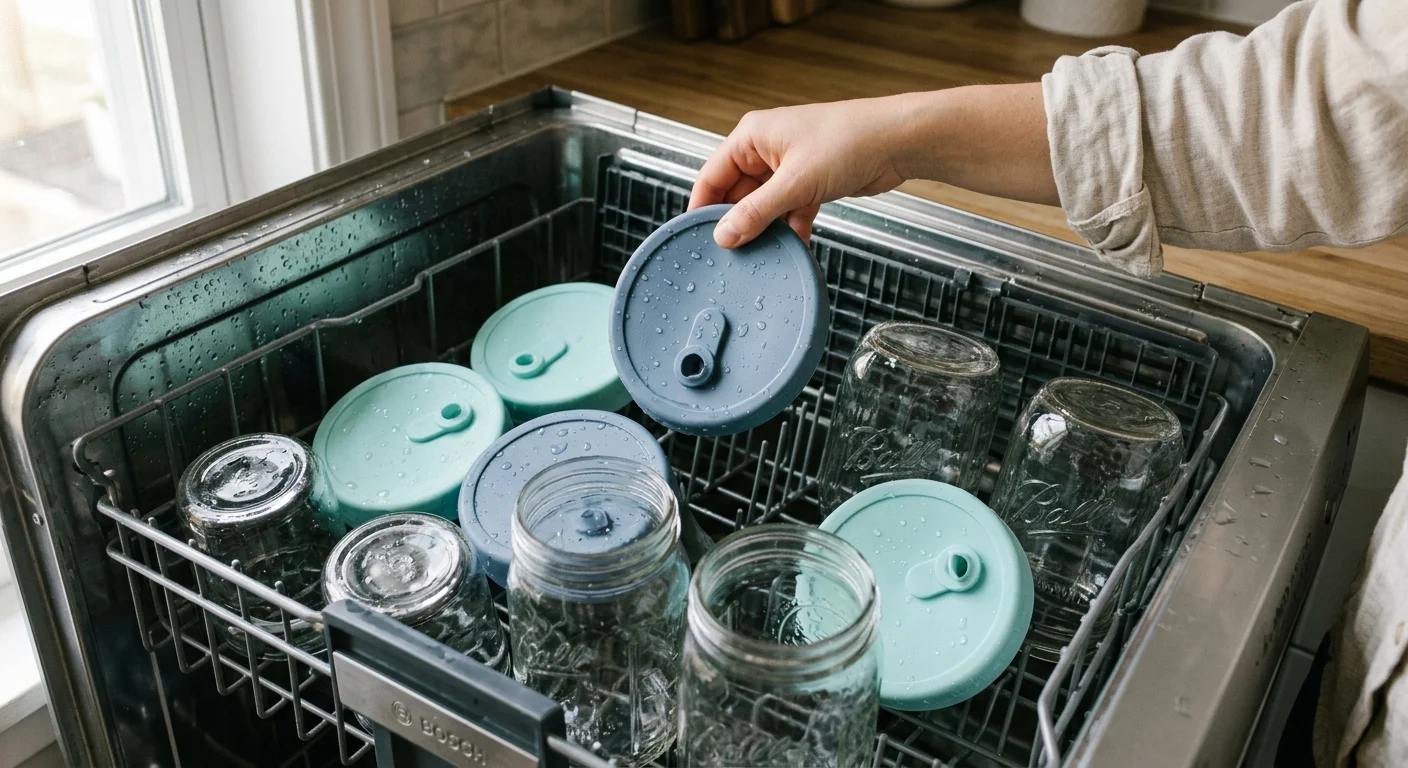
Cleaning, Durability, and Dishwasher Maintenance
Sanitation directly impacts fermentation success. Any gadget that traps brine residues or bacteria will ruin future vegetable batches with unintended mold growth.
Once the initial active ferment finishes, transferring kimchi into stackable food storage systems keeps compact refrigerator shelves organized and smelling fresh.
Most silicone valve lids are completely dishwasher safe, meaning they can be cleaned in a dishwasher without damage. High-temperature wash and dry cycles eliminate lingering allium oils from food-grade silicone surfaces effortlessly.
Glass Mason jars withstand repeated boiling water sanitization cycles. If you crack a glass jar, replacement costs remain under two dollars at any local grocery store.
Ceramic crocks present far more difficult cleaning requirements. Their heavy weight and bulky dimensions make them impossible to fit inside residential dishwashers.
You must wash stoneware crocks by hand in a standard sink basin. Rough handling often chips the glazed rim or cracks the interior bottom, exposing porous clay underneath.
Porous, unglazed ceramic absorbs vegetable pigments, brine salt, and sulfur oils permanently. Once wild mold spores penetrate crazed ceramic glazes, completely sanitizing the vessel becomes an uphill battle.
Independent gadget evaluations from Wirecutter consistently emphasize that easy-to-clean tools encourage regular use, whereas heavy, fragile vessels end up abandoned in storage.

The Verdict: Which Tool Should You Buy?
Choosing between these two tools comes down to your living space, batch volume, and tolerance for room-filling food odors. Each product caters to entirely different household realities.
The ceramic crock represents an archetypal unitasker, meaning a gadget that only does one specific task. Unless you ferment huge cabbages monthly, that 10-pound stoneware crock will monopolize valuable storage space.
Conversely, Mason jar airlock lids leverage standard canning jars you already own. When you finish your ferment, the jars store your kimchi directly in the refrigerator without requiring secondary containers.
Buy Silicone Airlock Lids If:
- You live in an apartment, condo, or home without a isolated root cellar or pantry.
- You ferment small batches between 16 ounces and 64 ounces at a time.
- You want zero ongoing maintenance, such as monitoring water levels in a gutter trough.
- You need compact vessels that transition directly from kitchen counter to refrigerator shelves.
Buy a Water-Seal Ceramic Crock If:
- You harvest large garden plots and routinely ferment 5 to 10 pounds of vegetables per batch.
- You have dedicated pantry or basement space where pungent sulfur aromas will not bother anyone.
- You prefer traditional Old World aesthetics on your countertops over modern glass canning jars.
- You do not mind hand-washing 10-pound ceramic vessels in your kitchen sink.
Frequently Asked Questions
Do silicone airlock lids eliminate 100 percent of kimchi odors?
Silicone airlock lids eliminate approximately 90 to 95 percent of ambient odor during active fermentation. They trap volatile gases inside the jar, venting only micro-bursts of carbon dioxide when internal pressure rises.
Why does my water-seal ceramic crock smell like sulfur?
Water-seal crocks vent gas by pushing bubbles up through the rim trough. This bubbling action atomizes volatile sulfur compounds from garlic and scallions into the air, while evaporating trough water can break the seal entirely.
Can I wash silicone fermentation lids in the dishwasher?
Yes, silicone fermentation lids are dishwasher safe. Placing them on the top rack of your dishwasher thoroughly removes volatile allium oils and sanitizes the one-way valve for your next fermentation project.
Are glass weights necessary when using silicone airlock lids?
Glass fermentation weights remain necessary when using silicone airlock lids. Keeping vegetable matter fully submerged beneath the brine prevents surface mold from developing, even inside an oxygen-depleted jar environment.
Disclaimer: Product prices and availability change frequently. Prices shown were accurate at time of writing but may have changed. We may earn a small commission from purchases made through links on this site, at no extra cost to you. Always verify current pricing on the retailer’s website before purchasing.


1 Comment